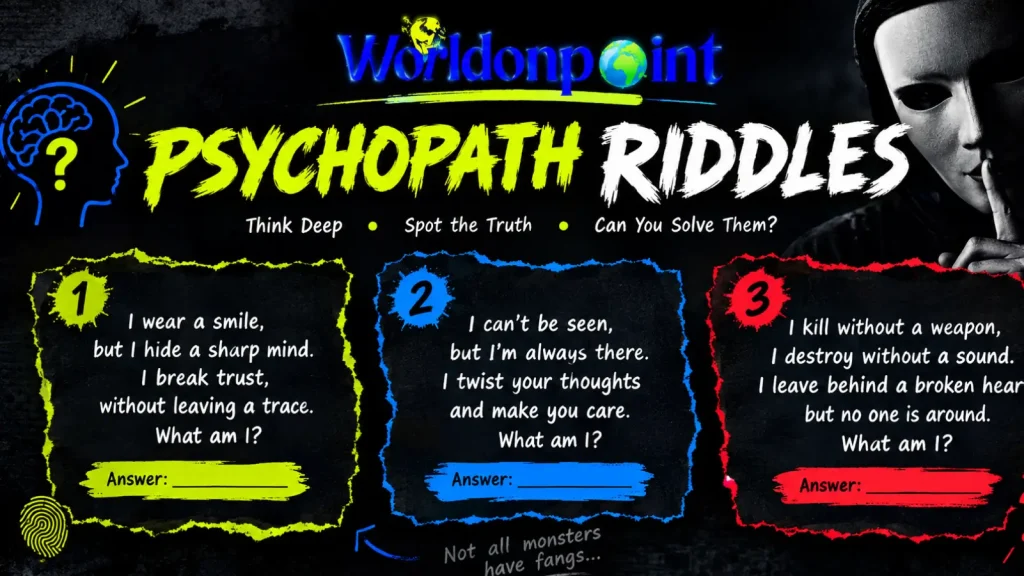
Psychopath riddles can turn a serious topic into a collection of mystery-style brain teasers. Instead of treating psychopathy as a simple synonym for violence, these riddles focus on ideas often discussed around the topic, such as empathy, manipulation, deception, emotions, charm, conscience, behavior, observation, and psychological clues.
This collection contains 200+ original psychopath riddles. Some are easy, while others require you to connect several clues before reaching the answer. They are designed for readers who enjoy psychological puzzles, mystery games, tricky questions, and unusual brain teasers.
Remember that a riddle is a puzzle, not a psychological test. A person cannot be identified as having psychopathy simply because they show one particular behavior or personality trait.
🧠 Riddle of the Day
I can be copied without being felt.
I appear on a face when happiness is expected.
Sometimes I hide what a person really thinks.
What am I?
Answer: A fake smile
Why: A fake smile can imitate genuine happiness without necessarily reflecting the person’s actual feelings.
💡 Interesting to Know
Psychopathy Is More Than One Trait
Psychopathy is commonly discussed as a pattern involving several interpersonal, emotional, and behavioral traits rather than one single behavior.
A Lack of Empathy Is Not the Whole Story
Reduced empathy can be discussed as one feature associated with psychopathic traits, but it does not by itself establish psychopathy.
Charm Can Be Misleading
Someone who appears charming or confident is not automatically dangerous or psychopathic. Personality traits must be considered in context.
Not Every Psychopath Is Violent
Popular entertainment often connects psychopathy with murder and extreme violence. Real-world discussions of psychopathy are more complicated than that stereotype.
Psychopathy and Antisocial Personality Disorder Are Not Identical Terms
The terms are sometimes used interchangeably in casual conversation, but they describe different concepts in psychological and forensic literature.
Behavior Has Context
A single lie, selfish decision, emotional reaction, or lack of sympathy cannot reliably identify someone’s personality structure.
Table of Contents
ToggleEasy Psychopath Riddles
Psychopath Riddle #1
I can hide behind a friendly face.
I may sound warm while revealing nothing real.
What am I?
Answer: False charm
Why: False charm describes friendliness that does not necessarily reflect genuine warmth.
Psychopath Riddle #2
I am felt by one person but may be missing in another.
I help you understand another person’s pain.
What am I?
Answer: Empathy
Why: Empathy involves understanding or sharing another person’s emotional experience.
Psychopath Riddle #3
I tell you what happened,
but sometimes I change the truth.
What am I?
Answer: A lie
Why: A lie presents false information as though it were true.
Psychopath Riddle #4
I sit inside your decisions.
I whisper that some actions are right or wrong.
What am I?
Answer: Conscience
Why: Conscience refers to an inner sense of right and wrong.
Psychopath Riddle #5
I can make someone look innocent
even when the story is carefully prepared.
What am I?
Answer: Deception
Why: Deception involves deliberately creating a false impression.
Psychopath Riddle #6
I can be pleasant, confident, and convincing.
But what matters is whether I am genuine.
What am I?
Answer: Charm
Why: Charm can make someone attractive or persuasive, but charm alone does not reveal their character.
Psychopath Riddle #7
I am an emotion you may notice in another person’s sadness.
I can make you want to help.
What am I?
Answer: Compassion
Why: Compassion involves concern about another person’s suffering.
Psychopath Riddle #8
I have no hands,
yet I can control a conversation.
I use words instead of ropes.
What am I?
Answer: Manipulation
Why: Manipulation uses influence or pressure to affect another person’s thoughts or actions.
Psychopath Riddle #9
I can be loud without making a sound.
I appear through posture, expression, and movement.
What am I?
Answer: Body language
Why: Body language communicates information without spoken words.
Psychopath Riddle #10
I am invisible but can guide behavior.
I tell you that hurting someone is wrong.
What am I?
Answer: Morality
Why: Morality concerns principles about right and wrong behavior.
Psychopath Riddle #11
I may look like confidence,
but sometimes I am only an act.
What am I?
Answer: Pretended confidence
Why: Someone can deliberately display confidence without actually feeling it.
Psychopath Riddle #12
I remember your words
and use them later in a conversation.
What am I?
Answer: Social observation
Why: Paying close attention to others can provide information that is later used in conversation.
Psychopath Riddle #13
I arrive after someone realizes they caused harm.
I can make a person wish they had acted differently.
What am I?
Answer: Remorse
Why: Remorse is deep regret about something harmful or wrong a person has done.
Psychopath Riddle #14
I can be genuine or manufactured.
People often see me before they know someone’s true intentions.
What am I?
Answer: A first impression
Why: A first impression is the initial judgment formed from someone’s appearance or behavior.
Psychopath Riddle #15
I am a promise that may be broken before anyone discovers it.
What am I?
Answer: A false promise
Why: A false promise is a commitment made without genuine intention to keep it.
Psychopath Riddle #16
I make a person think about consequences
before taking an action.
What am I?
Answer: Self-control
Why: Self-control helps someone regulate impulses and consider consequences.
Psychopath Riddle #17
I can hide fear behind a calm expression.
What am I?
Answer: Emotional masking
Why: Emotional masking means concealing an emotion through controlled outward behavior.
Psychopath Riddle #18
I can be copied from another person’s behavior.
A person may use me to appear familiar or friendly.
What am I?
Answer: Mimicry
Why: Mimicry involves copying another person’s actions, expressions, or mannerisms.
Psychopath Riddle #19
I can make a stranger trust you quickly.
But trust should grow from evidence, not appearance alone.
What am I?
Answer: Persuasion
Why: Persuasion uses communication to influence another person’s beliefs or decisions.
Psychopath Riddle #20
I am the part of a story that reveals what someone really wanted.
What am I?
Answer: Motive
Why: A motive is a reason or purpose behind an action.
Psychopath Riddle #21
I can make two people see the same event differently.
What am I?
Answer: Perception
Why: Perception is how someone interprets information from their surroundings.
Psychopath Riddle #22
I can be hidden in ordinary words.
Look closely and you may discover the contradiction.
What am I?
Answer: A deception clue
Why: A contradiction can reveal that a statement or story may not be truthful.
Psychopath Riddle #23
I happen when someone copies feelings they do not actually experience.
What am I?
Answer: Emotional imitation
Why: Emotional imitation involves displaying an emotion because it is socially expected rather than genuinely felt.
Psychopath Riddle #24
I help investigators ask, “Why did this happen?”
What am I?
Answer: Motive
Why: Investigators often examine motive when trying to understand someone’s actions.
Psychopath Riddle #25
I can make a person appear caring without proving that they are.
What am I?
Answer: An appearance
Why: Outward behavior can create an impression without revealing everything happening internally.
Read More:100 +Cowboy Riddles for Brave Souls!
Fun Psychopath Riddles
Psychopath Riddle #26
I wear no costume,
yet I can disguise a person’s real intentions.
What am I?
Answer: Deception
Why: Deception can hide intentions without requiring any physical disguise.
Psychopath Riddle #27
I am not a feeling, but I can imitate one.
I can appear in a voice or expression.
What am I?
Answer: Emotional display
Why: An emotional display is the outward expression of an emotion, whether genuine or performed.
Psychopath Riddle #28
I ask questions while revealing almost nothing about myself.
What am I?
Answer: Strategic questioning
Why: Strategic questioning gathers information while deliberately limiting self-disclosure.
Psychopath Riddle #29
I can turn a conversation toward the person who asked the question.
What am I?
Answer: Deflection
Why: Deflection shifts attention away from the original subject.
Psychopath Riddle #30
I am a story with missing pieces.
The gaps may matter more than the words.
What am I?
Answer: An incomplete account
Why: Missing information can sometimes be important when evaluating a story.
Psychopath Riddle #31
I can sound sincere while saying something untrue.
What am I?
Answer: A convincing lie
Why: A lie can be delivered confidently and convincingly even though its content is false.
Psychopath Riddle #32
I grow when people believe what they are told.
I disappear when trust is broken.
What am I?
Answer: Credibility
Why: Credibility depends on whether others consider someone trustworthy and believable.
Psychopath Riddle #33
I can be borrowed from someone else.
A person copies my style to appear similar.
What am I?
Answer: Persona
Why: A persona is the outward identity or character someone presents to others.
Psychopath Riddle #34
I am the mask between private thoughts and public behavior.
What am I?
Answer: Social persona
Why: A social persona is the version of oneself presented in social situations.
Psychopath Riddle #35
I can make an ordinary story sound extraordinary.
What am I?
Answer: Exaggeration
Why: Exaggeration makes something seem larger, better, worse, or more dramatic than it really is.
Psychopath Riddle #36
I can be used to make another person doubt their own memory.
What am I?
Answer: Gaslighting
Why: Gaslighting refers to a pattern of psychological manipulation intended to make someone question their perception or memory.
Psychopath Riddle #37
I am the silence after a shocking statement.
What am I?
Answer: Reaction
Why: Silence can itself communicate surprise, discomfort, confusion, or another reaction.
Psychopath Riddle #38
I reveal feelings without using words.
A raised eyebrow can be enough.
What am I?
Answer: Expression
Why: Facial expressions can communicate emotions and reactions without speech.
Psychopath Riddle #39
I can be real, rehearsed, or completely fake.
People often judge me within seconds.
What am I?
Answer: Behavior
Why: People form impressions from behavior, although quick judgments can be inaccurate.
Psychopath Riddle #40
I can hide behind politeness.
You may hear kind words while missing the real intention.
What am I?
Answer: Hidden intent
Why: A person’s stated words and underlying intention do not always match.
Psychopath Riddle #41
I am the reason someone chooses one action instead of another.
What am I?
Answer: Motivation
Why: Motivation is what drives a person toward a particular action.
Psychopath Riddle #42
I can be copied from a movie character
and worn like a social costume.
What am I?
Answer: A persona
Why: Someone can adopt a particular persona or character-like presentation.
Psychopath Riddle #43
I can make a small lie grow into a large story.
What am I?
Answer: Deception
Why: One false statement can lead to additional false explanations.
Psychopath Riddle #44
I have no lock,
yet I can keep information hidden.
What am I?
Answer: Secrecy
Why: Secrecy means deliberately keeping information from others.
Psychopath Riddle #45
I can protect someone’s privacy
or hide something important.
What am I?
Answer: Silence
Why: Silence can serve a legitimate purpose, but it can also conceal information.
Psychopath Riddle #46
I can practice until it looks natural.
What am I?
Answer: Acting
Why: Acting involves deliberately portraying emotions, behavior, or characters.
Psychopath Riddle #47
I am a question with an answer the speaker already knows.
Why ask me?
Answer: A strategic question
Why: A strategic question can be used to obtain information, test someone, or guide a conversation.
Psychopath Riddle #48
I can be friendly without being honest.
What am I?
Answer: Superficial charm
Why: Superficial charm can create a pleasant impression without proving genuine concern or honesty.
Psychopath Riddle #49
I can disappear when the audience leaves.
What am I?
Answer: A performance
Why: Some outward behaviors may be maintained for an audience and changed in private.
Psychopath Riddle #50
I am the clue hidden inside a contradiction.
What am I?
Answer: An inconsistency
Why: An inconsistency occurs when details do not agree with one another.
Clever Psychopath Riddles
Psychopath Riddle #51
I have two faces but no body.
One is shown to the world; the other remains hidden.
What am I?
Answer: A social mask
Why: A social mask represents the difference between outward presentation and private behavior.
Psychopath Riddle #52
I can enter a room before you speak.
People notice me through posture and expression.
What am I?
Answer: Presence
Why: Presence is the impression someone creates through their appearance and behavior.
Psychopath Riddle #53
I never tell you the whole story.
You must notice what I leave out.
What am I?
Answer: Omission
Why: An omission is something deliberately or accidentally left out.
Psychopath Riddle #54
I can make truth look suspicious
and lies look ordinary.
What am I?
Answer: Misdirection
Why: Misdirection shifts attention away from the information that matters.
Psychopath Riddle #55
I am a bridge between what someone wants
and what they say.
What am I?
Answer: Persuasion
Why: Persuasion connects a desired outcome with communication intended to influence another person.
Psychopath Riddle #56
I can be measured by actions more reliably than promises.
What am I?
Answer: Reliability
Why: Consistent actions provide stronger evidence of reliability than promises alone.
Psychopath Riddle #57
I can sound like an apology
without containing regret.
What am I?
Answer: A forced apology
Why: A person can say apologetic words without genuinely feeling remorse.
Psychopath Riddle #58
I can make someone feel guilty
without directly accusing them.
What am I?
Answer: Guilt manipulation
Why: Guilt can be deliberately used as a way to influence another person’s behavior.
Psychopath Riddle #59
I am invisible until someone breaks a promise.
Then everyone notices me.
What am I?
Answer: Trust
Why: Trust often becomes especially noticeable when it is damaged or violated.
Psychopath Riddle #60
I can be built slowly
and destroyed with one dishonest act.
What am I?
Answer: Trust
Why: Trust develops through repeated reliable behavior and can be damaged by serious dishonesty.
Psychopath Riddle #61
I am not a lie,
but I can make a lie easier to believe.
What am I?
Answer: Confidence
Why: Confidence can make a statement sound convincing even when its content is false.
Psychopath Riddle #62
I copy your mood without necessarily sharing it.
What am I?
Answer: Emotional mirroring
Why: Emotional mirroring involves reflecting another person’s emotional expression.
Psychopath Riddle #63
I can make two different people hear two different messages in one sentence.
What am I?
Answer: Ambiguity
Why: Ambiguous wording can support multiple interpretations.
Psychopath Riddle #64
I am a clue that appears innocent
until you compare it with another clue.
What am I?
Answer: A contradiction
Why: Contradictions often become visible only when separate pieces of information are compared.
Psychopath Riddle #65
I can change the meaning of a conversation
without changing its words.
What am I?
Answer: Tone
Why: Tone can alter how spoken words are interpreted.
Psychopath Riddle #66
I can make a person seem fearless
when they are simply hiding fear.
What am I?
Answer: Emotional control
Why: Controlled outward behavior can conceal an internal emotional response.
Psychopath Riddle #67
I am the difference between saying “sorry”
and actually regretting what happened.
What am I?
Answer: Sincerity
Why: Sincerity concerns whether an expression genuinely reflects what someone means or feels.
Psychopath Riddle #68
I can be planned before the conversation starts.
What am I?
Answer: Strategy
Why: A person can plan how they intend to approach a conversation or situation.
Psychopath Riddle #69
I am a hidden reason behind an obvious action.
What am I?
Answer: Motive
Why: A motive explains why someone chooses to perform an action.
Psychopath Riddle #70
I can be strong in words
but weak in evidence.
What am I?
Answer: Persuasion
Why: Persuasive language can influence people even when supporting evidence is limited.
Psychopath Riddle #71
I appear when someone tells different versions of the same event.
What am I?
Answer: Inconsistency
Why: Different accounts of the same event can reveal inconsistencies.
Psychopath Riddle #72
I can be hidden in a pause.
What am I?
Answer: Hesitation
Why: A pause can indicate hesitation, although pauses have many possible explanations.
Psychopath Riddle #73
I am not a detective,
but I look for clues in behavior.
What am I?
Answer: An observer
Why: An observer watches behavior and looks for meaningful details.
Psychopath Riddle #74
I can tell you someone is uncomfortable
without them saying a word.
What am I?
Answer: Body language
Why: Posture, gestures, and facial expressions can sometimes indicate discomfort.
Psychopath Riddle #75
I can make a false story feel familiar.
What am I?
Answer: Repetition
Why: Repeating a claim can make it seem familiar, though familiarity does not make it true.
Also Read : Riddle of the Night: A Thrilling Challenge for Brave Minds!
Tricky Psychopath Riddles
Psychopath Riddle #76
I am strongest when nobody notices me.
I guide a conversation from the shadows.
What am I?
Answer: Influence
Why: Influence can operate quietly without being openly recognized.
Psychopath Riddle #77
I can reveal a person’s priorities
without asking what they value.
What am I?
Answer: Behavior
Why: Choices and repeated actions can provide clues about priorities.
Psychopath Riddle #78
I can be genuine, false, or somewhere between.
You see me in almost every conversation.
What am I?
Answer: Emotion
Why: Emotions may be genuinely experienced, strategically displayed, or difficult to interpret from the outside.
Psychopath Riddle #79
I have no voice,
but I can accuse someone.
What am I?
Answer: Evidence
Why: Evidence can support a conclusion without speaking itself.
Psychopath Riddle #80
I am a story’s missing sentence.
Sometimes I change everything.
What am I?
Answer: Missing information
Why: Missing information can significantly change how an event is understood.
Psychopath Riddle #81
I can make a person appear generous
while secretly expecting something in return.
What am I?
Answer: Conditional generosity
Why: A generous act may be offered with an unstated expectation of receiving something back.
Psychopath Riddle #82
I can be used to control attention.
Look here, while the important detail stays there.
What am I?
Answer: Misdirection
Why: Misdirection deliberately directs attention away from another detail.
Psychopath Riddle #83
I am a question that sounds harmless
but reveals what someone already suspects.
What am I?
Answer: A probing question
Why: Probing questions are designed to obtain information or explore an issue more deeply.
Psychopath Riddle #84
I can be written on paper
but live inside someone’s intentions.
What am I?
Answer: A plan
Why: A plan records intended actions and the goals behind them.
Psychopath Riddle #85
I can make a person seem mysterious
simply because they reveal very little.
What am I?
Answer: Secrecy
Why: Limited disclosure can create an impression of mystery.
Psychopath Riddle #86
I am easy to mistake for confidence.
Sometimes I am simply certainty without evidence.
What am I?
Answer: Overconfidence
Why: Overconfidence involves greater certainty than the available evidence justifies.
Psychopath Riddle #87
I can be a weapon without being physical.
Words are my ammunition.
What am I?
Answer: Verbal manipulation
Why: Words can be used to pressure, deceive, or influence others.
Psychopath Riddle #88
I can make someone question an event they clearly remember.
What am I?
Answer: Gaslighting
Why: Gaslighting describes manipulative behavior that can cause someone to doubt their own perception or memory.
Psychopath Riddle #89
I appear when someone knows what another person wants
and uses that knowledge to influence them.
What am I?
Answer: Manipulation
Why: Knowing someone’s preferences can be used strategically to influence their choices.
Psychopath Riddle #90
I can be practiced in front of a mirror
before being shown to another person.
What am I?
Answer: An expression
Why: People can consciously rehearse facial expressions or other forms of outward presentation.
Psychopath Riddle #91
I can hide behind a compliment.
The words sound positive, but the purpose may be different.
What am I?
Answer: Flattery
Why: Flattery can be sincere, but it can also be used strategically to influence someone.
Psychopath Riddle #92
I am the gap between appearance and reality.
What am I?
Answer: Deception
Why: Deception creates a misleading difference between what appears true and what is actually true.
Psychopath Riddle #93
I can make an accusation sound like a question.
What am I?
Answer: Leading question
Why: A leading question contains wording that pushes toward a particular answer or interpretation.
Psychopath Riddle #94
I can make someone feel responsible
for something they did not cause.
What am I?
Answer: Blame shifting
Why: Blame shifting redirects responsibility toward another person.
Psychopath Riddle #95
I can make a person look calm
while their thoughts remain unknown.
What am I?
Answer: Composure
Why: Composure is outward calmness and does not automatically reveal someone’s private thoughts.
Psychopath Riddle #96
I can make a true statement misleading
without changing a single word.
What am I?
Answer: Context
Why: Removing context can make an otherwise true statement create a misleading impression.
Psychopath Riddle #97
I can hide inside selective honesty.
What am I?
Answer: Omission
Why: A person can tell technically true details while leaving out information that changes the overall picture.
Psychopath Riddle #98
I can be offered freely
but accepted with a hidden price.
What am I?
Answer: A favor
Why: A favor may be presented as freely given but can sometimes carry an expectation of reciprocity.
Psychopath Riddle #99
I am the ability to wait
instead of immediately acting on an urge.
What am I?
Answer: Impulse control
Why: Impulse control involves regulating immediate urges and choosing how to respond.
Psychopath Riddle #100
I can turn a conversation into a chessboard.
Every word becomes a move.
What am I?
Answer: Strategy
Why: Strategic communication treats each response as part of a planned interaction.
Hard Psychopath Riddles
Psychopath Riddle #101
I cannot be seen directly,
yet investigators may search for me after an action.
I answer the question “Why?”
What am I?
Answer: Motive
Why: Motive is the underlying reason for an action.
Psychopath Riddle #102
I may look like kindness,
but my true meaning depends on what happens afterward.
What am I?
Answer: A gesture
Why: A gesture can communicate kindness, obligation, politeness, or another intention depending on context.
Psychopath Riddle #103
I can be built from repeated small actions.
One event rarely tells my whole story.
What am I?
Answer: A behavioral pattern
Why: Patterns become clearer when behavior is observed repeatedly rather than from one isolated event.
Psychopath Riddle #104
I can be hidden behind a thousand friendly words.
But one action can reveal the difference.
What am I?
Answer: Character
Why: Character is often discussed through consistent behavior rather than words alone.
Psychopath Riddle #105
I am the distance between what someone says
and what they actually do.
What am I?
Answer: Inconsistency
Why: Inconsistency occurs when statements and behavior do not match.
Psychopath Riddle #106
I can imitate concern
without revealing whether concern is truly felt.
What am I?
Answer: Empathetic expression
Why: A person can display words or expressions associated with concern without an observer knowing the person’s internal experience.
Psychopath Riddle #107
I can be hidden in a perfectly ordinary sentence.
One word changes its entire meaning.
What am I?
Answer: Tone
Why: Tone and context can change how a sentence is understood.
Psychopath Riddle #108
I am not the crime.
I am the reason someone might give for committing it.
What am I?
Answer: Motive
Why: Motive explains the reason behind an action and is distinct from the action itself.
Psychopath Riddle #109
I can make a person appear trustworthy
before they have earned trust.
What am I?
Answer: First impression
Why: People often form quick impressions before having enough information to establish genuine trust.
Psychopath Riddle #110
I am a bridge built from repeated promises.
One broken promise can damage me.
What am I?
Answer: Trust
Why: Trust develops through consistent reliability and can be damaged by broken commitments.
Psychopath Riddle #111
I can be used to make another person choose
without openly telling them what to choose.
What am I?
Answer: Influence
Why: Influence affects decisions without necessarily giving a direct command.
Psychopath Riddle #112
I can make a person feel as if an idea was theirs
when someone else planted it.
What am I?
Answer: Suggestion
Why: Suggestions can introduce ideas that another person may later adopt.
Psychopath Riddle #113
I am strongest when both sides believe
they understand each other.
What am I?
Answer: Communication
Why: Effective communication depends on shared understanding.
Psychopath Riddle #114
I can reveal more through omission
than through a long explanation.
What am I?
Answer: A missing detail
Why: The absence of an expected detail can sometimes raise useful questions.
Psychopath Riddle #115
I can be honest and still misleading.
How?
Answer: Selective truth
Why: Individual statements may be true while important context is deliberately omitted.
Psychopath Riddle #116
I can turn praise into a tool.
What am I?
Answer: Flattery
Why: Praise can sometimes be used strategically to gain cooperation or influence.
Psychopath Riddle #117
I can make a person seem relaxed
because their face shows little emotion.
What am I?
Answer: Emotional restraint
Why: Emotional restraint limits outward expression but does not reveal the complete internal emotional state.
Psychopath Riddle #118
I am the clue that tells you to look twice.
What am I?
Answer: An anomaly
Why: An anomaly is something unusual or inconsistent with what is expected.
Psychopath Riddle #119
I can make a false story survive
because every new lie supports the previous one.
What am I?
Answer: A deception chain
Why: Deceptive stories can become increasingly elaborate as new claims are added to support earlier claims.
Psychopath Riddle #120
I am a wall built from unanswered questions.
What am I?
Answer: Secrecy
Why: Keeping information hidden can prevent others from understanding the complete situation.
Psychopath Riddle #121
I can reveal a hidden priority
when someone must choose between two things.
What am I?
Answer: A choice
Why: Choices can provide evidence about what someone values or prioritizes.
Psychopath Riddle #122
I can be rehearsed, polished, and performed.
People may mistake me for spontaneity.
What am I?
Answer: A social performance
Why: Social behavior can sometimes be consciously prepared and presented.
Psychopath Riddle #123
I am not proof of anything by myself.
I become meaningful when combined with other clues.
What am I?
Answer: A behavioral clue
Why: Individual observations should be interpreted in context rather than treated as definitive proof.
Psychopath Riddle #124
I can make someone look sincere
because their story never changes.
But consistency alone cannot prove truth.
What am I?
Answer: Consistency
Why: A consistent story may appear credible, but consistency by itself does not establish that the story is true.
Psychopath Riddle #125
I can hide an intention behind a harmless question.
What am I?
Answer: Indirect questioning
Why: Indirect questions can gather information without clearly revealing the questioner’s purpose.
Funny Psychopath Riddles
Psychopath Riddle #126
I enter a conversation wearing a smile.
Nobody checks my pockets for hidden intentions.
What am I?
Answer: Charm
Why: Charm can create a pleasant first impression while revealing little about deeper intentions.
Psychopath Riddle #127
I say “Trust me” before giving you a reason.
What am I?
Answer: An unsupported promise
Why: Asking for trust without evidence is not the same as earning it.
Psychopath Riddle #128
I am the world’s cheapest disguise.
You only need a different expression.
What am I?
Answer: A fake smile
Why: A changed facial expression can disguise someone’s actual mood.
Psychopath Riddle #129
I never wear a cape,
but I can still play the hero.
What am I?
Answer: A persona
Why: A persona can be created to present someone as heroic, confident, kind, or another desired identity.
Psychopath Riddle #130
I have no remote control,
yet I can change another person’s behavior.
What am I?
Answer: Influence
Why: Influence can affect another person’s decisions or actions.
Psychopath Riddle #131
I am a compliment with a hidden shopping list.
What am I?
Answer: Manipulative flattery
Why: The compliment becomes manipulative when it is mainly used to obtain something.
Psychopath Riddle #132
I can be as polished as a mirror
and still show you nothing real.
What am I?
Answer: A false image
Why: A polished outward image does not necessarily reveal someone’s private character.
Psychopath Riddle #133
I have no batteries,
yet I can keep a conversation running for hours.
What am I?
Answer: Charm
Why: Charm can help someone maintain engaging social interactions.
Psychopath Riddle #134
I can be rehearsed in the bathroom mirror.
Then I become someone’s “natural” expression.
What am I?
Answer: An act
Why: An act can be practiced until it appears natural to observers.
Psychopath Riddle #135
I am a sentence that sounds innocent
until someone asks, “Why did you say that?”
What am I?
Answer: An ambiguous statement
Why: Ambiguous statements can have meanings that become clearer when their purpose is questioned.
Psychopath Riddle #136
I can be friendly at breakfast
and suspicious by lunchtime.
What changed?
Answer: Context
Why: New information can change how earlier behavior is interpreted.
Psychopath Riddle #137
I never tell a lie,
but I can help one survive.
What am I?
Answer: Omission
Why: Leaving out important facts can allow a misleading story to continue without adding another direct falsehood.
Psychopath Riddle #138
I am the magician’s favorite psychological trick.
Look somewhere else.
What am I?
Answer: Misdirection
Why: Misdirection works by directing attention away from another detail.
Psychopath Riddle #139
I can make a boring story exciting
by adding things that never happened.
What am I?
Answer: Embellishment
Why: Embellishment adds details that make a story more dramatic or interesting.
Psychopath Riddle #140
I am the cousin of confidence
who sometimes forgets to bring evidence.
Who am I?
Answer: Overconfidence
Why: Overconfidence involves excessive certainty relative to the available evidence.
Psychopath Riddle #141
I can make a person feel special
and ask for a favor five minutes later.
What am I?
Answer: Flattery
Why: Flattery can sometimes be used to build goodwill before making a request.
Psychopath Riddle #142
I have no hands,
but I can push people around.
What am I?
Answer: Pressure
Why: Social or psychological pressure can influence someone’s behavior without physical force.
Psychopath Riddle #143
I can hide inside the words “It’s your choice.”
What am I?
Answer: Influence
Why: A person may claim another has a free choice while subtly shaping the available options or pressure.
Psychopath Riddle #144
I can sound like an explanation
while answering absolutely nothing.
What am I?
Answer: Evasion
Why: Evasive answers avoid directly addressing the question.
Psychopath Riddle #145
I am a puzzle with a missing piece called “context.”
What am I?
Answer: Misunderstanding
Why: Without context, information can easily be interpreted incorrectly.
Psychopath Riddle #146
I can make a person look innocent
by making everyone else look guilty.
What am I?
Answer: Blame shifting
Why: Blame shifting attempts to redirect responsibility to others.
Psychopath Riddle #147
I can be tiny in size
but huge in meaning.
What am I?
Answer: A clue
Why: A small detail can sometimes change how a larger situation is understood.
Psychopath Riddle #148
I am the sentence that begins with “Technically…”
What am I?
Answer: A qualification
Why: A qualification narrows or modifies a statement and can sometimes avoid answering its broader implication.
Psychopath Riddle #149
I can turn a simple disagreement
into a battle over who remembers correctly.
What am I?
Answer: Conflicting memories
Why: People can remember the same event differently, creating disagreement about what happened.
Psychopath Riddle #150
I am invisible, but everyone notices when I disappear.
What am I?
Answer: Trust
Why: Trust is often taken for granted until it is damaged or lost.
Brain-Teasing Psychopath Riddles
Psychopath Riddle #151
I am a pattern, not a single event.
Find me by watching what happens repeatedly.
What am I?
Answer: Behavior pattern
Why: Patterns require multiple observations rather than relying on one isolated action.
Psychopath Riddle #152
I can be true in one sentence
and misleading in the whole story.
What am I?
Answer: Selective truth
Why: A statement may be literally true while leaving out information needed to understand the complete situation.
Psychopath Riddle #153
I can reveal someone’s priorities
when resources become limited.
What am I?
Answer: Decision-making
Why: Choices made under constraints can reveal which options a person prioritizes.
Psychopath Riddle #154
I can sound caring
without answering the person’s actual concern.
What am I?
Answer: Empty reassurance
Why: Reassurance can sound comforting while failing to address the underlying issue.
Psychopath Riddle #155
I can be a bridge or a barrier.
Words decide which one I become.
What am I?
Answer: Communication
Why: Clear communication can connect people, while poor communication can create barriers.
Psychopath Riddle #156
I can hide behind a question
and reveal the questioner’s real concern.
What am I?
Answer: Subtext
Why: Subtext is the underlying meaning or concern beneath explicit words.
Psychopath Riddle #157
I am the hidden message beneath the spoken message.
What am I?
Answer: Subtext
Why: Subtext refers to meaning that is implied rather than directly stated.
Psychopath Riddle #158
I can make a person change their behavior
without ever giving an order.
What am I?
Answer: Social pressure
Why: People can alter their behavior because of expectations or pressure from others.
Psychopath Riddle #159
I am the difference between hearing words
and understanding their purpose.
What am I?
Answer: Interpretation
Why: Interpretation involves assigning meaning to what someone communicates.
Psychopath Riddle #160
I can make two identical sentences mean different things.
What am I?
Answer: Context
Why: Context changes how words and statements are understood.
Psychopath Riddle #161
I can hide a request inside praise.
What am I?
Answer: Manipulative flattery
Why: Praise can sometimes be used as a vehicle for an indirect request.
Psychopath Riddle #162
I am what remains after every excuse is removed.
What am I?
Answer: Responsibility
Why: Responsibility concerns who is accountable for an action or outcome.
Psychopath Riddle #163
I can make someone look generous
because they want everyone watching.
What am I?
Answer: Public generosity
Why: Generosity displayed publicly may be genuine or may partly serve an image-building purpose.
Psychopath Riddle #164
I can make a person appear humble
while secretly seeking praise.
What am I?
Answer: False modesty
Why: False modesty is an outward display of humility that may conceal a desire for recognition.
Psychopath Riddle #165
I can turn criticism into an attack on the critic.
What am I?
Answer: Deflection
Why: Deflection avoids the original criticism by redirecting attention elsewhere.
Psychopath Riddle #166
I can answer a question
without actually answering it.
What am I?
Answer: Evasion
Why: Evasion provides a response that avoids the central question.
Psychopath Riddle #167
I am the ability to notice small changes in behavior.
What am I?
Answer: Observation
Why: Observation involves carefully noticing details in a situation.
Psychopath Riddle #168
I can make an ordinary person look mysterious
because nobody knows what they are thinking.
What am I?
Answer: Uncertainty
Why: Limited information about someone’s thoughts creates uncertainty.
Psychopath Riddle #169
I can be used to test whether someone remembers a story.
What am I?
Answer: A follow-up question
Why: Follow-up questions can reveal whether details remain consistent.
Psychopath Riddle #170
I can expose a contradiction
without accusing anyone.
What am I?
Answer: Comparison
Why: Comparing two statements can reveal differences without directly making an accusation.
Psychopath Riddle #171
I can make people agree
because everyone else appears to agree.
What am I?
Answer: Social influence
Why: People can be influenced by the apparent behavior or opinions of a group.
Psychopath Riddle #172
I am the fear of being judged
that changes how someone behaves.
What am I?
Answer: Social anxiety
Why: Social anxiety involves significant fear or concern about social judgment or situations.
Psychopath Riddle #173
I can make someone hide a mistake
even when admitting it would be easier.
What am I?
Answer: Shame
Why: Shame can motivate people to conceal behavior they feel negatively about.
Psychopath Riddle #174
I can appear after wrongdoing
and push someone toward making amends.
What am I?
Answer: Remorse
Why: Remorse involves regret and can motivate corrective action.
Psychopath Riddle #175
I am the mental brake that stops an immediate reaction.
What am I?
Answer: Inhibition
Why: Inhibition helps prevent an immediate response or impulse from automatically becoming action.
Interesting Psychopath Riddles
Psychopath Riddle #176
I am not an emotion,
but I can shape how emotions are displayed.
What am I?
Answer: Social expectation
Why: Social expectations can influence which emotions people show and how they show them.
Psychopath Riddle #177
I can make someone seem interested
by encouraging them to copy your movements.
What am I?
Answer: Mirroring
Why: Mirroring involves reflecting another person’s gestures, posture, or behavior.
Psychopath Riddle #178
I can be learned by watching people.
What am I?
Answer: Social behavior
Why: People can learn many social behaviors through observation and experience.
Psychopath Riddle #179
I can hide behind a polite laugh.
What am I?
Answer: Discomfort
Why: People sometimes laugh politely even when they are uncomfortable.
Psychopath Riddle #180
I can reveal tension
when someone’s words say everything is fine.
What am I?
Answer: Body language
Why: Nonverbal behavior can sometimes communicate tension that differs from spoken words.
Psychopath Riddle #181
I can be honest but incomplete.
What am I?
Answer: Partial truth
Why: A partial truth contains accurate information while leaving out other relevant details.
Psychopath Riddle #182
I can change a person’s opinion
without presenting a command.
What am I?
Answer: Persuasion
Why: Persuasion seeks to change attitudes or decisions through communication.
Psychopath Riddle #183
I can be used to make another person feel indebted.
What am I?
Answer: A favor
Why: Some favors create a sense of obligation, particularly when the giver expects repayment.
Psychopath Riddle #184
I am an invisible line
between private information and public information.
What am I?
Answer: A boundary
Why: Personal boundaries help determine what information or behavior is appropriate to share.
Psychopath Riddle #185
I can be crossed without moving a single step.
What am I?
Answer: A personal boundary
Why: Boundaries are psychological or social limits rather than physical lines.
Psychopath Riddle #186
I can be broken without making a sound.
What am I?
Answer: Trust
Why: Trust can be damaged through behavior without any physical noise.
Psychopath Riddle #187
I can be repaired slowly
but never instantly.
What am I?
Answer: Trust
Why: Rebuilding trust generally requires repeated reliable behavior over time.
Psychopath Riddle #188
I can make someone feel watched
even when nobody is watching.
What am I?
Answer: Self-consciousness
Why: Self-consciousness involves heightened awareness of how one may appear to others.
Psychopath Riddle #189
I can make someone change their behavior
because they expect an audience.
What am I?
Answer: Social awareness
Why: Awareness of being observed can influence behavior.
Psychopath Riddle #190
I am the ability to understand another person’s point of view.
What am I?
Answer: Perspective-taking
Why: Perspective-taking involves considering another person’s viewpoint.
Psychopath Riddle #191
I can exist even when two people disagree.
What am I?
Answer: Understanding
Why: Understanding another person’s position does not require agreeing with it.
Psychopath Riddle #192
I can explain an action
without excusing it.
What am I?
Answer: Context
Why: Context can help explain why something happened without necessarily approving the behavior.
Psychopath Riddle #193
I can make an action seem different
when you learn what happened beforehand.
What am I?
Answer: Context
Why: Earlier circumstances can change the interpretation of later behavior.
Psychopath Riddle #194
I can be hidden in a person’s choice of words.
What am I?
Answer: Word choice
Why: The words someone selects can provide clues about emphasis, attitude, or intended meaning.
Psychopath Riddle #195
I can reveal what someone avoids talking about.
What am I?
Answer: Avoidance
Why: Repeatedly avoiding a subject can itself become observable behavior.
Psychopath Riddle #196
I can turn a conversation away
from an uncomfortable subject.
What am I?
Answer: Redirection
Why: Redirection shifts attention to another subject.
Psychopath Riddle #197
I can be genuine in one moment
and strategic in another.
What am I?
Answer: Kindness
Why: Kind behavior can arise from genuine concern or sometimes be used strategically.
Psychopath Riddle #198
I am the clue that tells you
someone’s story deserves another question.
What am I?
Answer: An inconsistency
Why: An inconsistency can signal that additional clarification is needed.
Psychopath Riddle #199
I can make a person look guilty
without proving guilt.
What am I?
Answer: Suspicion
Why: Suspicion is a feeling or belief that something may be wrong, not proof by itself.
Psychopath Riddle #200
I can disappear when evidence arrives.
What am I?
Answer: Suspicion
Why: Strong evidence can either confirm or eliminate a suspicion.
Challenging Psychopath Riddles
Psychopath Riddle #201
I have no fingerprints,
but I can still leave a pattern.
Look at repeated choices to find me.
What am I?
Answer: Behavior
Why: Repeated choices create behavioral patterns even though behavior leaves no physical fingerprint.
Psychopath Riddle #202
I can hide in kindness,
live inside a promise,
and reveal myself through expectations.
What am I?
Answer: Manipulation
Why: Manipulation can be concealed within apparently kind actions or promises when they are used to influence another person.
Psychopath Riddle #203
I am not the mask.
I am the reason someone chooses to wear it.
What am I?
Answer: Intention
Why: Intention refers to what someone aims or plans to accomplish.
Psychopath Riddle #204
I can make two people hear
the same words but remember different meanings.
What am I?
Answer: Interpretation
Why: Different interpretations can lead people to understand the same statement differently.
Psychopath Riddle #205
I can be deliberately created
to make strangers trust someone quickly.
What am I?
Answer: A false reputation
Why: A reputation can be deliberately constructed through misleading information or staged behavior.
Psychopath Riddle #206
I can be earned through actions
but requested through words.
What am I?
Answer: Trust
Why: People may ask others to trust them, but trust is generally developed through experience.
Psychopath Riddle #207
I can be hidden in a gift
that expects something later.
What am I?
Answer: An obligation
Why: A gift can sometimes create a sense of obligation if the giver expects something in return.
Psychopath Riddle #208
I can be used without being spoken.
A person’s silence may send me.
What am I?
Answer: A message
Why: Silence can communicate information depending on the situation and context.
Psychopath Riddle #209
I am not what someone says.
I am what their words suggest underneath.
What am I?
Answer: Subtext
Why: Subtext is implied meaning beneath the literal words.
Psychopath Riddle #210
I can be hidden in laughter,
especially when the room feels uncomfortable.
What am I?
Answer: Nervousness
Why: Laughter can sometimes occur as a response to nervousness or discomfort.
Psychopath Riddle #211
I can make a person appear calm
because they reveal very little.
What am I?
Answer: Emotional restraint
Why: Limited outward expression can make someone’s emotional state difficult to read.
Psychopath Riddle #212
I can look like confidence
when it is actually a refusal to admit uncertainty.
What am I?
Answer: Overconfidence
Why: Overconfidence can involve excessive certainty and resistance to recognizing limitations.
Psychopath Riddle #213
I can make a false statement stronger
by surrounding it with true details.
What am I?
Answer: Deceptive framing
Why: True details can be arranged around a false claim to make the overall story seem more credible.
Psychopath Riddle #214
I am the detective’s favorite question.
It begins with one small word: “Why?”
What am I?
Answer: Motive
Why: Asking why an action occurred can lead investigators toward possible motives.
Psychopath Riddle #215
I can reveal a person’s priorities
without hearing their explanation.
What am I?
Answer: Actions
Why: Actions can provide observable evidence about choices and priorities.
Psychopath Riddle #216
I can be promised today
and forgotten tomorrow.
What am I?
Answer: A commitment
Why: A commitment is a promise or obligation that may or may not be honored.
Psychopath Riddle #217
I can make a person look caring
because they know exactly what to say.
What am I?
Answer: Emotional intelligence
Why: Knowing how to respond socially can help someone communicate effectively, although it does not by itself prove genuine emotional concern.
Psychopath Riddle #218
I can be used to understand someone
without agreeing with them.
What am I?
Answer: Perspective-taking
Why: Understanding another viewpoint does not require agreement.
Psychopath Riddle #219
I can be stronger than words
when the two disagree.
What am I?
Answer: Behavior
Why: Actions can provide information that differs from spoken claims.
Psychopath Riddle #220
I can turn a friendly conversation
into a test without announcing the test.
What am I?
Answer: Observation
Why: Someone may quietly observe another person’s reactions while interacting with them.
Psychopath Riddle #221
I am the space between a person’s private thoughts
and public expression.
What am I?
Answer: Emotional masking
Why: Emotional masking involves controlling or concealing outward emotional expression.
Psychopath Riddle #222
I can make an apology sound perfect
while leaving the real issue untouched.
What am I?
Answer: A non-apology
Why: A non-apology can use apologetic language without clearly accepting responsibility for the specific behavior.
Psychopath Riddle #223
I can be hidden behind the words
“I was only joking.”
What am I?
Answer: Deflection
Why: Calling something a joke can sometimes redirect attention away from its impact or original intent.
Psychopath Riddle #224
I can make someone responsible
for another person’s reaction.
What am I?
Answer: Blame shifting
Why: Blame shifting redirects responsibility away from the original actor.
Psychopath Riddle #225
I can tell you what happened
but not why it happened.
What am I?
Answer: A fact
Why: A fact can establish what occurred without necessarily explaining the motive behind it.
Frequently Asked Questions
What are psychopath riddles?
Psychopath riddles are mystery-style puzzles built around psychological concepts commonly associated with discussions of psychopathy. They can involve clues about deception, empathy, manipulation, behavior, motives, and emotional expression.
Are these psychopath riddles suitable for kids?
Many of these riddles are suitable for older children and teenagers because they focus on general ideas such as honesty, emotions, observation, and decision-making. Some concepts, such as gaslighting and manipulation, may be better discussed with adult guidance.
What makes a good psychopath riddle?
A good riddle provides enough clues to support a specific answer while still leaving room for thought. The answer should follow logically from the clues rather than depending on confusing wording.
Are these psychopath riddles original?
The collection above was written specifically for this article rather than copied from another riddle collection. Individual concepts such as empathy, deception, and manipulation are common ideas, but the riddle wording is original.
Can these riddles be used in a classroom?
Yes. Teachers can use suitable riddles as discussion starters for topics such as critical thinking, communication, emotions, observation, and ethical decision-making.
Can these riddles be used as a riddle-of-the-day activity?
Yes. Choose one riddle each day and let readers solve it before revealing the answer. The explanation can then become a short discussion about the clue and its connection.
What is the hardest psychopath riddle?
Difficulty depends on the reader. A riddle that seems obvious to one person may require more thought from another, especially when it depends on context, wordplay, or multiple clues.
Can psychopath riddles diagnose psychopathy?
No. Riddles cannot diagnose a psychological condition or determine whether a real person has psychopathy. A diagnosis or professional assessment requires appropriate evaluation by qualified professionals.
Key Takeaways
- Psychopath riddles can combine mystery with psychological concepts.
- Empathy, deception, manipulation, and conscience can create interesting puzzle themes.
- One behavior should not be treated as proof of a personality condition.
- Context is important when interpreting human behavior.
- Riddles encourage observation and logical thinking.
- Different difficulty levels make the collection useful for individual and group activities.
- The puzzles can be adapted for family games, classrooms, and daily brain-teaser activities.
Final Thoughts
These 250 psychopath riddles turn psychological ideas into a collection of clues, questions, and small mysteries. Some answers are easy to spot, while others require you to compare clues and think about the meaning behind the words.
The most interesting part of a psychological riddle is often not the answer itself. It is the reasoning used to reach that answer. A single clue may point in one direction, while a second clue changes the picture completely.
Challenge yourself by covering each answer and solving the riddles first. You can also share selected puzzles with friends, classmates, or family members and compare how each person interprets the clues.
Most importantly, remember that riddles are for entertainment and learning. They can encourage curiosity, observation, and logical thinking, but they should never be used to label or diagnose a real person.
150+ Nothing Riddles Where the Answer Is Nothing!
100+Sphinx Riddles Challenge: Only the Wise Will Survive These Tests!