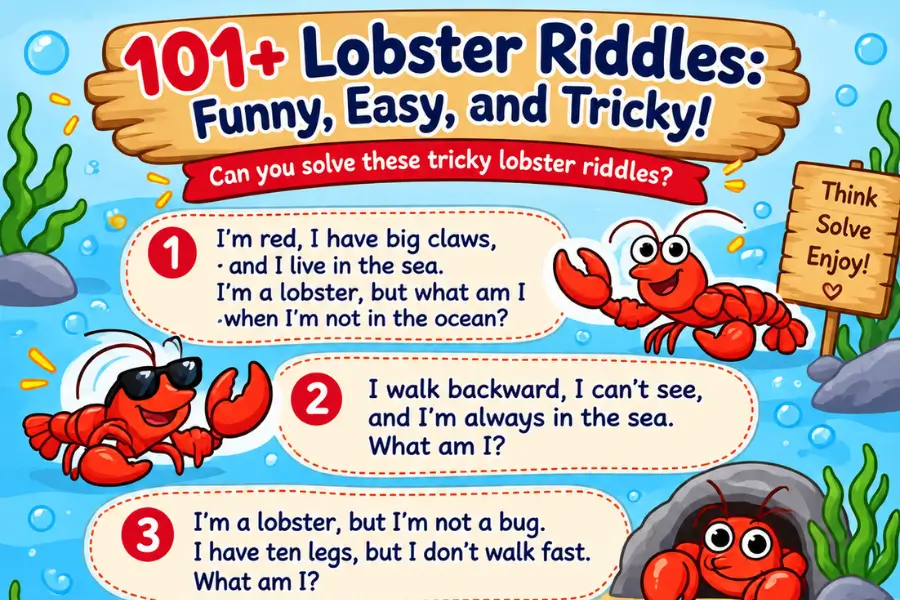
Lobster riddles are fun brain teasers inspired by lobsters, ocean life, hard shells, powerful claws, and underwater adventures. They challenge readers to think creatively, solve clues, and discover surprising answers. Whether you need easy lobster riddles for kids, funny puzzles for a classroom, or tricky brain teasers for adults, this collection offers something for everyone.
These lobster riddles with answers are perfect for family game nights, school activities, birthday parties, and daily brain challenges. Some are simple enough for young children, while others use clever wordplay and logic to test older readers. You will also discover fascinating lobster facts and ideas for creating your own ocean-themed puzzles. Read each riddle, pause before checking the answer, and see how many you can solve without help.
What Are Lobster Riddles?
Lobster riddles are questions or puzzles that use clues about lobsters, their body parts, ocean habitats, and related sea creatures. Some focus on real animal features, while others use jokes, wordplay, and imaginative situations.
For example, a riddle might describe an animal with a hard shell and two large claws. Another might ask which sea creature would make the funniest comedian. The first tests observation, while the second encourages creative thinking.
These puzzles can help children practice reading comprehension, vocabulary, reasoning, and problem-solving. They also give adults a lighthearted way to enjoy ocean-themed brain teasers.
Riddle of the Day
I carry my own armor, walk along the ocean floor, and leave my old coat behind when I grow. What am I?
Interesting to Know
- Lobsters have hard outer skeletons.
- Their claws can have different jobs.
- In American lobsters, one claw is adapted for crushing, while the other is adapted for cutting or tearing food.
- Antennae help lobsters explore.
- Lobsters use their antennae to sense their surroundings.
Easy Lobster Riddles for Kids
Lobster Riddle #1
Riddle: I live in the sea, wear a hard coat, and have two big claws. What am I?
Answer: A lobster.
Explanation: Lobsters have hard outer shells and two front claws.
Lobster Riddle #2
Riddle: I am hard on the outside, but I am part of a living animal. What am I?
Answer: A lobster’s shell.
Explanation: The shell protects a lobster’s soft body.
Lobster Riddle #3
Riddle: I help a lobster grab food and protect itself. What am I?
Answer: A claw.
Explanation: Lobsters use their claws to handle food and defend themselves.
Lobster Riddle #4
Riddle: I am a salty home filled with fish, crabs, and lobsters. What am I?
Answer: The ocean.
Explanation: Many lobster species live in marine environments.
Lobster Riddle #5
Riddle: I stick out from a lobster’s head and help it explore its surroundings. What am I?
Answer: An antenna.
Explanation: Lobsters use their antennae to sense their environment.
Lobster Riddle #6
Riddle: I have many legs and walk along the ocean floor. Who am I?
Answer: A lobster.
Explanation: Lobsters have several pairs of legs for moving around.
Lobster Riddle #7
Riddle: I protect a lobster’s body, but I cannot keep growing with it forever. What am I?
Answer: Its shell.
Explanation: A lobster must shed its old shell to grow.
Lobster Riddle #8
Riddle: I am a sea creature with two noticeable claws, but I am not a crab. Who am I?
Answer: A lobster.
Explanation: Lobsters and crabs are different kinds of crustaceans.
Lobster Riddle #9
Riddle: I am a small sea plant that can sway with ocean currents. What am I?
Answer: Seaweed.
Explanation: Seaweed grows in marine environments and provides habitat for many sea creatures.
Lobster Riddle #10
Riddle: A lobster loses its old outer covering as it grows. What is this process called?
Answer: Molting.
Explanation: Molting allows a lobster to shed its old shell and develop a larger one.
Lobster Riddle #11
Riddle: I am a lobster’s hard body covering. What protects it from the outside?
Answer: Its exoskeleton.
Explanation: An exoskeleton is a hard supporting and protective covering on the outside of an animal.
Lobster Riddle #12
Riddle: I help a lobster move forward, backward, or sideways along the seabed. What am I?
Answer: A walking leg.
Explanation: Lobsters use their walking legs to move around their habitat.
Lobster Riddle #13
Riddle: I am a lobster’s home environment, where rocks and crevices can offer shelter. What am I?
Answer: A marine habitat.
Explanation: Many lobsters use rocky areas and other underwater spaces for shelter.
Lobster Riddle #14
Riddle: I am a crustacean with a hard shell, jointed legs, and a pair of large front claws. Who am I?
Answer: A lobster.
Explanation: These are recognizable features of many lobster species.
Lobster Riddle #15
Riddle: I am not a fish, but I live underwater and have a hard outer skeleton. Who am I?
Answer: A lobster.
Explanation: Lobsters are crustaceans, not fish.
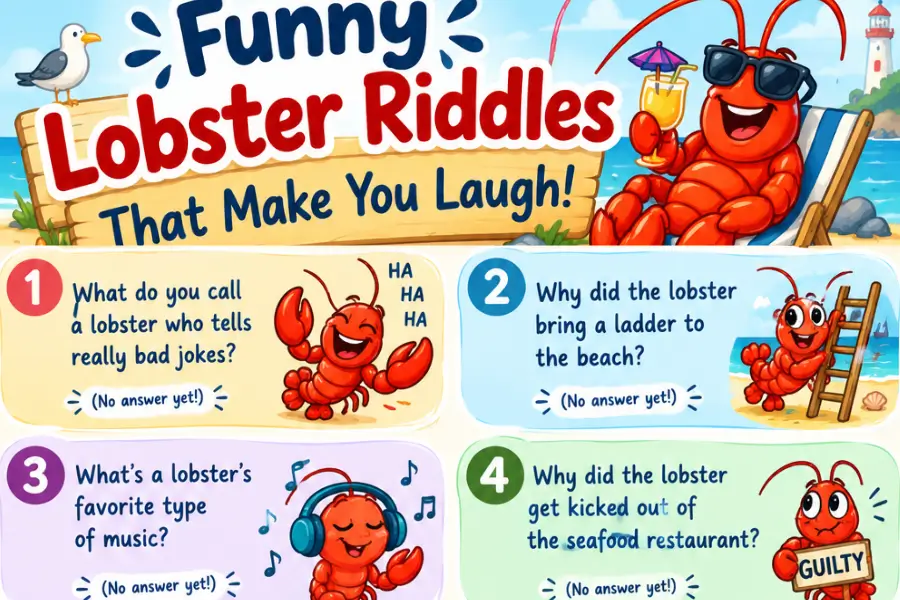
Funny Lobster Riddles That Make You Laugh
Ready for some ocean-inspired humor? These funny lobster riddles mix silly situations, playful clues, and lobster-themed jokes.
Lobster Riddle #16
Riddle: Why did the lobster bring a suitcase to the ocean?
Answer: It was ready for a shell-cation!
Explanation: The joke combines a lobster’s shell with the word vacation.
Lobster Riddle #17
Riddle: What does a lobster wear when it wants to look fancy?
Answer: A shell-ebration outfit!
Explanation: This playful answer mixes the word shell with celebration.
Lobster Riddle #18
Riddle: Why did the lobster refuse to share its lunch?
Answer: It was feeling a little crabby.
Explanation: The joke uses the familiar word crabby to describe a grumpy mood.
Lobster Riddle #19
Riddle: What does a lobster say when it wins a race?
Answer: Claw-some!
Explanation: Claw-some is a playful twist on the word awesome.
Lobster Riddle #20
Riddle: Why did the lobster become a musician?
Answer: It wanted to play some shell-ebrated hits!
Explanation: This silly pun connects a lobster’s shell with musical hits.
Lobster Riddle #21
Riddle: What is a lobster’s favorite kind of story?
Answer: A tail of adventure!
Explanation: The word tail sounds like tale, which means a story.
Lobster Riddle #22
Riddle: Why did the lobster take a notebook to school?
Answer: It wanted to take claw-ful notes!
Explanation: This joke plays on the lobster’s claws and the phrase careful notes.
Lobster Riddle #23
Riddle: What did the lobster say when someone told a terrible joke?
Answer: That joke was shell-ful!
Explanation: The made-up word is a silly shell-themed way to criticize a joke.
Lobster Riddle #24
Riddle: Why did the lobster open a restaurant?
Answer: It wanted to become the head chef of the sea.
Explanation: Lobsters do not cook in real life, but this imaginary restaurant owner can.
Lobster Riddle #25
Riddle: What do you call a lobster that loves telling stories?
Answer: A tale-spinner!
Explanation: The answer plays on a lobster’s tail and the phrase tale-spinner.
Lobster Riddle #26
Riddle: Why did the lobster bring an umbrella underwater?
Answer: It expected a little sea drizzle!
Explanation: The joke imagines underwater weather as if the ocean were a rainy street.
Lobster Riddle #27
Riddle: What is a lobster’s favorite school subject?
Answer: Shell-gebra!
Explanation: Shell-gebra is a playful combination of shell and algebra.
Lobster Riddle #28
Riddle: Why did the lobster become a detective?
Answer: It was great at cracking shell cases!
Explanation: The joke turns the phrase cracking cases into a lobster-themed pun.
Lobster Riddle #29
Riddle: What does a lobster say before a big performance?
Answer: Let me get my claws together!
Explanation: This is a playful twist on getting yourself together before performing.
Lobster Riddle #30
Riddle: Why did the lobster sit beside the ocean’s loudest fish?
Answer: It wanted to hear the latest sea-lebrity gossip!
Explanation: Sea-lebrity is a made-up ocean version of celebrity.
Tricky Lobster Riddles to Test Your Brain
These tricky lobster riddles require careful reading. Some answers depend on noticing what the clues actually say rather than making assumptions.
Lobster Riddle #31
Riddle: A lobster has two claws. One is larger than the other. Does that mean it has two different kinds of animals attached to it?
Answer: No, both claws belong to the same lobster.
Explanation: Different claw sizes do not mean they belong to different animals.
Lobster Riddle #32
Riddle: A lobster walks five steps forward and five steps backward. How many steps does it take altogether?
Answer: Ten steps.
Explanation: Five forward plus five backward equals ten steps.
Lobster Riddle #33
Riddle: Three lobsters are hiding beneath rocks. One swims away. How many remain beneath the rocks?
Answer: Two, assuming the other two stay there.
Explanation: The answer depends on the clue that only one lobster leaves.
Also Read : 180+ Koala Riddles: Funny, Easy, and Tricky Puzzles
Lobster Riddle #34
Riddle: A lobster has a shell, claws, and legs. Which of these is not a separate animal?
Answer: All three are body parts of the lobster.
Explanation: The shell, claws, and legs belong to one animal.
Lobster Riddle #35
Riddle: Two lobsters are beside a rock. One moves behind it. How many lobsters are there altogether?
Answer: Two.
Explanation: Hiding behind a rock does not make a lobster disappear.
Lobster Riddle #36
Riddle: A lobster sheds its shell but remains alive. What has it lost?
Answer: Its old outer shell.
Explanation: Molting means shedding the old exoskeleton, not losing the entire body.
Lobster Riddle #37
Riddle: A lobster is underwater, but it is not a fish. Is that possible?
Answer: Yes.
Explanation: Lobsters are crustaceans that live in water, not fish.
Lobster Riddle #38
Riddle: Four lobsters are in a tank. Each lobster sees three other lobsters. How many lobsters are in the tank?
Answer: Four.
Explanation: Each lobster can see the other three.
Lobster Riddle #39
Riddle: A lobster walks around a rock and returns to the same spot. How far has it moved from its starting point?
Answer: Zero distance from its starting point.
Explanation: It traveled along a path but ended where it began.
Lobster Riddle #40
Riddle: Which is heavier: one kilogram of lobster shells or one kilogram of seaweed?
Answer: Neither. They weigh the same.
Explanation: Both weigh one kilogram, even if they occupy different amounts of space.
Lobster Riddle #41
Riddle: A lobster has six visible legs in a drawing. Does that prove the real animal has only six legs?
Answer: No.
Explanation: A drawing may show only some legs. Many lobsters have ten walking legs, including their claw-bearing front legs.
Lobster Riddle #42
Riddle: You see a lobster’s shell on the seabed. Can you be certain a living lobster is still inside it?
Answer: No.
Explanation: Lobsters shed their shells, so an empty shell may remain behind.
Lobster Riddle #43
Riddle: A lobster moves into a cave, but the cave does not move. Which one changes location?
Answer: The lobster.
Explanation: The lobster moves while the cave remains in place.
Lobster Riddle #44
Riddle: A lobster faces east. It turns around and then turns around again. Which direction does it face?
Answer: East.
Explanation: Two complete turns bring it back to its original direction.
Lobster Riddle #45
Riddle: You find a lobster-shaped toy with two claws. Is it necessarily a living animal?
Answer: No, it could be a toy.
Explanation: An object can look like a lobster without being alive.
How to Use Lobster Riddles in Classrooms and at Home
Lobster riddles are easy to turn into activities that combine entertainment with learning. Here are seven practical ways to use them.
1. Start a classroom warm-up. Choose three easy lobster riddles and write them on the board. Give students two minutes to solve each one before discussing the clues.
2. Organize a team competition. Divide students into small groups. Award one point for each correct answer and an extra point when a team explains its reasoning clearly.
3. Create printable riddle worksheets. Place the riddles in one column and leave blank spaces for answers. For younger children, add pictures of lobsters, shells, claws, and other ocean animals.
4. Connect riddles with science. Use questions about molting, antennae, and exoskeletons to introduce crustaceans. After the game, ask students to identify which clues describe real animal features.
5. Practice vocabulary and reading. Ask children to circle important words in each clue. Discuss words such as crustacean, habitat, pincer, and molting before attempting harder riddles.
6. Add riddles to family game night. Let each family member choose a riddle and read it aloud. Everyone else gets one guess before the reader reveals the answer.
7. Try a timed challenge. Give older children five minutes to solve five tricky lobster riddles. Encourage them to explain their thinking rather than guess quickly.
For the best results, mix easy, funny, and difficult puzzles. This helps everyone participate, even when their reading and reasoning skills differ.
Lobster Logic Riddles for Clever Thinkers
These lobster logic riddles encourage readers to compare clues, count carefully, and solve small problems. They work well for classroom challenges and family puzzle games.
Lobster Riddle #46
Riddle: Three lobsters are named Red, Blue, and Green. Red is not first, and Blue is not last. If Green is first, which lobster is last?
Answer: Red.
Explanation: Green must be first. Blue cannot be last, so Red must be last.
Lobster Riddle #47
Riddle: A lobster travels four meters toward a rock, then two meters farther. How far has it traveled in total?
Answer: Six meters.
Explanation: Add the two distances: four plus two equals six meters.
Lobster Riddle #48
Riddle: Two lobsters find three empty shells. If they each take one shell, how many shells remain?
Answer: One shell.
Explanation: Two shells are taken from the original three.
Lobster Riddle #49
Riddle: A lobster visits three caves in order: A, B, and C. It visits B before C. Which cave must it visit before B?
Answer: Cave A.
Explanation: The stated order places A before B and C.
Lobster Riddle #50
Riddle: Four lobsters are in a row. One is at each end, and two are between them. How many lobsters are in the row?
Answer: Four.
Explanation: The two end positions and two middle positions make four places.
Read This : 151+ Zebra Riddles: Funny and Tricky Puzzles for All Ages
Lobster Riddle #51
Riddle: A lobster has two claws. Another lobster has two claws. How many claws do they have altogether?
Answer: Four claws.
Explanation: Two claws plus two claws equals four.
Lobster Riddle #52
Riddle: Five lobsters are exploring a reef. Two return to their hiding place. How many are still exploring?
Answer: Three.
Explanation: Five minus two leaves three lobsters.
Lobster Riddle #53
Riddle: A lobster is older than a newly hatched fish but younger than an adult turtle. Which animal is the oldest?
Answer: The adult turtle, according to the clues.
Explanation: The comparison places the turtle above the lobster in age.
Lobster Riddle #54
Riddle: One lobster hides under a rock, another hides inside a crevice, and a third remains in the open. How many are hiding?
Answer: Two.
Explanation: The lobster in the open is not hiding.
Lobster Riddle #55
Riddle: A lobster travels north for three steps, then south for three steps. Where is it compared with its starting point?
Answer: At its starting point.
Explanation: Equal distances in opposite directions cancel each other out.
Lobster Riddle #56
Riddle: Six lobster-shaped counters are divided equally among three children. How many counters does each child receive?
Answer: Two counters.
Explanation: Six divided by three equals two.
Lobster Riddle #57
Riddle: A lobster sees a crab and a fish. The crab is not behind the lobster, and the fish is in front. Which animal is in front?
Answer: The fish.
Explanation: The clue directly identifies the fish’s position.
Lobster Riddle #58
Riddle: There are two red shells and four white shells. How many shells are there if you collect every shell?
Answer: Six shells.
Explanation: Two plus four equals six.
Lobster Riddle #59
Riddle: A lobster takes one minute to crawl across a short rock. How long will two lobsters take if they crawl side by side and move at the same speed?
Answer: One minute.
Explanation: If both can move side by side without slowing down, they finish together.
Lobster Riddle #60
Riddle: Three lobsters enter a cave one after another. Which lobster enters first?
Answer: The first lobster.
Explanation: The wording gives their order of entry.
Lobster Wordplay and Pun Riddles
These lobster wordplay riddles use familiar expressions, funny twists, and ocean-themed language. Some have playful answers rather than strict scientific ones.
Lobster Riddle #61
Riddle: What do you call a lobster that always wins arguments?
Answer: A claw-ver debater!
Explanation: The answer combines claw with clever.
Lobster Riddle #62
Riddle: What do lobsters call their favorite music group?
Answer: The Shell Stones!
Explanation: This playful answer is inspired by the name of a famous rock band.
Lobster Riddle #63
Riddle: What do you call a lobster that tells the truth every time?
Answer: A shell-honest lobster!
Explanation: The joke combines shell with the word honest.
Lobster Riddle #64
Riddle: Why was the lobster so good at solving mysteries?
Answer: It always got a grip on the clues.
Explanation: The answer refers to gripping something with claws and understanding a problem.
Lobster Riddle #65
Riddle: What do you call a lobster that loves taking photographs?
Answer: A snapper!
Explanation: Snapper is a playful nickname, although it is also the name of real fish species.
Lobster Riddle #66
Riddle: What does a lobster say when it meets its best friend?
Answer: Claw there, buddy!
Explanation: The phrase is a silly variation of “Hello there.”
Lobster Riddle #67
Riddle: What do you call a lobster that is always on time?
Answer: Punctual-pincer!
Explanation: This made-up name combines punctuality with the lobster’s pincers.
Lobster Riddle #68
Riddle: What kind of story does a lobster tell before bedtime?
Answer: A shell-time story!
Explanation: The answer plays on the phrase bedtime story.
Lobster Riddle #69
Riddle: What do you call a lobster that loves painting?
Answer: An art-claw!
Explanation: This playful word combines art with claw.
Lobster Riddle #70
Riddle: Why did the lobster join the school debate team?
Answer: It wanted to make a strong point with its pincers!
Explanation: The joke connects making a point with the lobster’s pointed claws.
Lobster Riddle #71
Riddle: What do you call a lobster who loves reading the news?
Answer: A current-events crustacean!
Explanation: The answer plays on ocean currents and current events.
Lobster Riddle #72
Riddle: Why did the lobster start a gardening club underwater?
Answer: It wanted to grow its own sea-crets!
Explanation: Sea-crets is a playful spelling of secrets.
Lobster Riddle #73
Riddle: What do you call a lobster who never gives up?
Answer: A claw-some fighter!
Explanation: The answer uses a lobster pun to describe persistence.
Lobster Riddle #74
Riddle: What does a lobster say when it needs a break?
Answer: I need some shell-ter!
Explanation: Shell-ter is a pun on shelter.
Lobster Riddle #75
Riddle: What do you call a lobster who loves solving puzzles?
Answer: A brainy crustacean!
Explanation: Crustacean is the animal group that includes lobsters.
Short Lobster Riddles for Quick Fun
Need a quick brain teaser? These short lobster riddles are easy to read aloud, add to worksheets, or share with friends.
Lobster Riddle #76
Riddle: Who wears a shell underwater?
Answer: A lobster.
Lobster Riddle #77
Riddle: What helps a lobster grab food?
Answer: Its claws.
Lobster Riddle #78
Riddle: What does a lobster shed to grow?
Answer: Its old shell.
Lobster Riddle #79
Riddle: Where do marine lobsters live?
Answer: In the sea.
Lobster Riddle #80
Riddle: What helps a lobster explore nearby objects?
Answer: Its antennae.
Lobster Riddle #81
Riddle: What animal group includes lobsters?
Answer: Crustaceans.
Lobster Riddle #82
Riddle: What covers a lobster’s body?
Answer: An exoskeleton.
Lobster Riddle #83
Riddle: What process lets a lobster shed its outer covering?
Answer: Molting.
Lobster Riddle #84
Riddle: What do lobsters use to walk?
Answer: Their legs.
Lobster Riddle #85
Riddle: What might a lobster hide beneath?
Answer: A rock.
Lobster Riddles for Classroom Activities
Teachers can use these lobster riddles to introduce marine animals, encourage teamwork, and help students practice reading comprehension.
Lobster Riddle #86
Riddle: I am a hard covering that protects a lobster’s body. What am I?
Answer: An exoskeleton.
Explanation: An exoskeleton is a supporting and protective structure on the outside of an animal.
Lobster Riddle #87
Riddle: I am a lobster’s home, filled with seawater and many other living things. What am I?
Answer: The ocean.
Explanation: The ocean provides a habitat for many lobster species.
Lobster Riddle #88
Riddle: I am a tiny animal that may live among sea plants and rocks. What am I?
Answer: A small marine animal.
Explanation: Many small marine animals use sea plants and rocks as shelter.
Lobster Riddle #89
Riddle: I am a body part that helps a lobster sense things around its head. What am I?
Answer: An antenna.
Explanation: Lobsters use their antennae to explore their surroundings.
Lobster Riddle #90
Riddle: I am the process that allows a growing lobster to leave its old shell behind. What am I?
Answer: Molting.
Explanation: Molting is a normal part of a lobster’s growth.
Lobster Riddle #91
Riddle: I am a marine animal with ten walking legs, including two large claw-bearing front legs. Who am I?
Answer: A lobster.
Explanation: Many familiar lobster species have ten legs, with the front pair modified into claws.
Lobster Riddle #92
Riddle: I am a lobster’s habitat, where it may find food and places to hide. What am I?
Answer: The seabed.
Explanation: Many lobsters spend time near the ocean floor.
Lobster Riddle #93
Riddle: I help scientists group animals based on shared features. What is the broad group that includes lobsters and crabs?
Answer: Crustaceans.
Explanation: Crustaceans are a group of animals that includes lobsters, crabs, and shrimp.
Lobster Riddle #94
Riddle: I am a sensory structure that helps a lobster detect chemicals in the water. What am I?
Answer: Its chemosensory system.
Explanation: Lobsters can detect chemical cues in water, which helps them locate food and respond to their environment.
Lobster Riddle #95
Riddle: I am a hard covering that a lobster leaves behind when it molts. What am I?
Answer: Its old exoskeleton.
Explanation: The old exoskeleton can remain after the lobster has shed it.
Hard Lobster Riddles for Adults
These harder lobster riddles use deduction, careful wording, and simple mathematical reasoning. Try solving each one before reading the answer.
Lobster Riddle #96
Riddle: A lobster moves three meters east, four meters north, and then three meters west. How far north of its starting point is it?
Answer: Four meters.
Explanation: The eastward and westward movements cancel each other out. The remaining displacement is four meters north.
Lobster Riddle #97
Riddle: A lobster has an old shell and a new shell is forming beneath it. Which shell will protect its larger body after molting?
Answer: The new exoskeleton.
Explanation: After molting, the new outer covering gradually hardens and provides protection.
Lobster Riddle #98
Riddle: Four lobsters are labeled A, B, C, and D. A is before B, C is after B, and D is after C. Which lobster comes last?
Answer: D.
Explanation: The order is A, B, C, D.
Lobster Riddle #99
Riddle: A lobster’s path is twice as long as a five-meter path. It then travels another three meters. How far does it travel altogether?
Answer: Thirteen meters.
Explanation: Twice five is ten, and ten plus three equals thirteen meters.
Lobster Riddle #100
Riddle: A lobster can be alive without its old shell, and an old shell can remain without the lobster. What does this tell you about the shell?
Answer: The shell is a body covering that can be shed.
Explanation: Lobsters molt as they grow, leaving their old exoskeleton behind.
How to Create Your Own Lobster Riddles
You do not need to be a professional writer to create an entertaining lobster riddle. Start with a recognizable feature and turn it into a question.
- Choose a feature: Pick a lobster’s claws, shell, antennae, legs, or underwater habitat.
- Think of its function: Consider how the feature helps the lobster move, eat, sense its surroundings, or stay protected.
- Write a clue: Describe the feature without immediately naming it.
- Add a twist: Use a comparison, a funny situation, or a small logic challenge.
- Check the answer: Make sure the clues lead to a reasonable answer without requiring hidden information.
For example, start with the fact that a lobster sheds its old exoskeleton as it grows. Turn that fact into a question:
Your Riddle: I leave my old armor behind, but I am still the same animal. What am I doing?
Answer: Molting.
Explanation: A lobster molts when it sheds its old outer skeleton as part of its growth.
Try writing three riddles of your own. Share them with friends and see whether they can solve them without extra clues.
Frequently Asked Questions
What are lobster riddles?
Lobster riddles are brain teasers inspired by lobsters, their claws, shells, behavior, and ocean habitats. They can include simple questions, logic puzzles, and funny wordplay.
What is a good lobster riddle for kids?
A simple example is: “I live in the ocean, wear a hard shell, and have two large claws. What am I?” The answer is a lobster.
Are lobster riddles suitable for classroom activities?
Yes. Teachers can use them for reading practice, vocabulary development, science lessons, group competitions, and short problem-solving exercises.
How do you make a lobster riddle funny?
Use lobster-related words such as claw, shell, and tail in unexpected ways. For example, “What does a lobster say when something is awesome?” Answer: “Claw-some!”
What are some tricky ocean riddles?
Tricky ocean riddles often involve counting, directions, hidden assumptions, and marine animal features. The best ones have clear clues and answers that follow logically.
Can lobster riddles help children develop problem-solving skills?
They can provide practice in logical thinking, reading comprehension, and recognizing patterns. The benefits depend on the child’s engagement and the type of puzzle.
Where can I use lobster riddles?
You can use them in classrooms, family game nights, birthday parties, ocean-themed events, printable worksheets, social media posts, and daily puzzle challenges.
How can I create my own lobster riddles?
Choose a lobster feature, identify an interesting fact about it, and turn that fact into a clue. Add a funny twist or a logic challenge, then check that the answer fits.
Final Thoughts
These 100 lobster riddles with answers offer a mix of easy questions, funny puns, tricky challenges, and educational brain teasers. Children can learn about lobster features while practicing reading and reasoning, and adults can enjoy the wordplay and logic puzzles.
Use these lobster riddles for classroom activities, family game nights, printable worksheets, or your daily brain teaser. You can also challenge friends to write their own riddles and compare the answers.
The best riddle is not always the hardest one. It is the one that makes you pause, think carefully, and smile when you discover the answer.