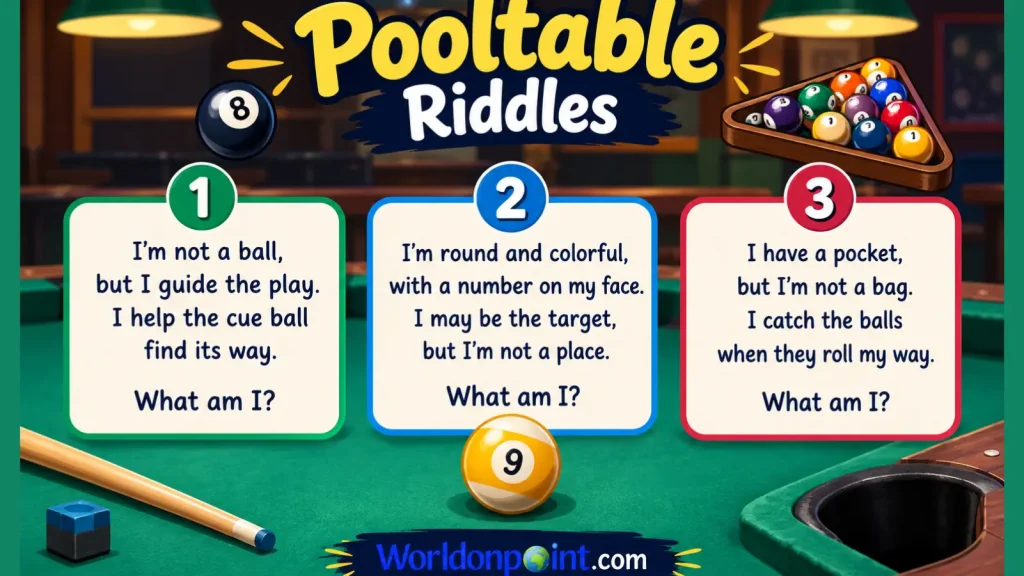
A pool table looks simple: a green rectangle, six holes, and sixteen balls. Yet the moment someone lines up a shot, the room fills with geometry, physics, patience, and a little friendly trash talk. That mix of everyday objects and hidden cleverness is exactly why pool table riddles are so much fun to solve.
This collection brings you 250 original pool table riddles with answers. Some are easy warm-ups about chalk, cues, and pockets. Others are tricky brain teasers built on wordplay, counting, and the science of how balls move. You will meet riddles about parts of the table, famous shots, game rules, the language of the pool hall, and even a few well-known players.
Every riddle comes with a short explanation, so you can see how the clues connect to the answer. Try them at a family game night, in a classroom, on a road trip, or right next to a real table with a cue in your hand. Whether you love the game or have never picked up a stick, there is a puzzle here for you.
🧠 Riddle of the Day
I appear eighteen times around the edge of a green field,
yet I am no jewel. Players count me in their heads to plan a bounce.
I sit on the wooden frame, never on the cloth.
What am I?
Answer: The diamonds
The clues describe small markers placed on the rails of a pool table. A standard table has eighteen of them, and players use them like a ruler to plan bank shots and kick shots. They look like jewels, but they are only dots that help with aiming.
💡 Interesting to Know
How Pool Got Its Name
The word “pool” is commonly traced to poolrooms, places where people bet on horse races. Billiard tables were kept in those rooms to entertain the crowd, and the name slowly stuck to the game.
It Started on the Grass
Early cue games were played outdoors on grass, a bit like lawn games. Over time the game moved indoors and onto tables, and green cloth is often said to be a reminder of those grassy roots.
Why Slate?
Many quality tables use slate under the cloth. Slate stays flat and stable, while wood can warp when the air gets damp or dry. A flat bed is a big reason the balls roll true.
Chalk Is Not for the Ball
Chalk goes on the tip of the cue. It adds friction so the tip grips the ball instead of slipping off. It does nothing to the ball itself.
Two Shapes of Rack
Eight-ball is racked in a triangle, while nine-ball is racked in a diamond. The shape matters because it changes how the balls break apart.
Matching Colors
Solids and stripes share their colors. The one ball and the nine ball are both yellow, the two and the ten are both blue, and so on up the line.
Cloth Comes in Many Colors
Green is the classic choice, but pool cloth also comes in blue, red, burgundy, and many other shades. The color changes the look of the room but not the rules of the game.
Table of Contents
ToggleEasy Pool Table Riddles
Start here. These easy pool table riddles are perfect warm-ups for kids and beginners.
1. I have six mouths but never eat a thing.
A green field covers my top, and sixteen round guests roll across it.
People gather around me holding sticks instead of forks.
Answer: A pool table
Why: Six pockets act as the “mouths,” the green cloth is the field, and sixteen balls are the guests moved by cue sticks.
2. I am long, slim, and tapered, but I am no wand.
I send one white ball on a journey.
I do my best work after a rub of chalk.
Answer: A cue stick
Why: A cue stick strikes the white ball, and players chalk its tip before shooting.
3. Of all the balls on the table, I am the only one with no number and no color.
Everyone hits me, yet I am never supposed to disappear into a pocket.
Answer: The cue ball
Why: It is the plain white ball that players strike, and sinking it is normally a foul.
4. I am black and I wear the number eight.
Sink me too early and the game is over for you.
Answer: The eight ball
Why: In the standard game, pocketing the black ball before your group is cleared usually means a loss.
5. I hold fifteen balls in a tight shape.
I have three sides but never need a corner shot.
When the game begins, I disappear from the table.
Answer: A triangle rack
Why: The rack forms the balls into a triangle and is lifted away before the break.
6. I am a small blue cube.
You rub me on the end of a stick, not on a blackboard.
My dust ends up on your fingers.
Answer: Pool chalk
Why: Players rub chalk cubes on the cue tip, and the fine dust rubs off on their hands.
7. I am a hole with a net or a leather basket underneath.
A full-size table has six of me.
Answer: A pocket
Why: Pockets are the six openings, four at the corners and two at the sides, where balls are sunk.
8. I am green, smooth, and thin, but I am not grass.
Balls glide across me, and a spilled drink is my worst enemy.
Answer: Felt (or cloth)
Why: The playing surface is covered in a tight cloth, usually green, that balls roll across.
9. I run around the edge of the table.
Balls bounce off me, and I give a missed shot a second chance.
I am not a wall, but I act like one.
Answer: A rail
Why: The rails are the raised edges with rubber inside, and balls rebound off them.
10. I am the first shot of the game, and the balls scatter in every direction.
The loudest sound in the room comes from me.
Answer: The break
Why: The break is the opening shot that sends the racked balls flying apart.
11. I am small, round, and made of leather.
I sit on the end of a long stick, and I am the only part that touches the ball.
Answer: A cue tip
Why: The leather tip is the contact point between the cue and the cue ball.
12. I look like a white belt wrapped around a colored ball.
The numbers nine through fifteen wear me.
Answer: Stripes (a striped ball)
Why: Balls numbered nine to fifteen have a white band with a colored stripe.
13. I am one solid color with a number between one and seven.
Half of the players in a game are trying to sink my group.
Answer: A solid ball
Why: Solids are the balls numbered one through seven, and one player is assigned that group.
14. Players groan when I happen.
The white ball drops into a pocket, and the turn passes to the opponent.
Answer: A scratch
Why: Sinking the cue ball is called a scratch and gives the other player an advantage.
15. There are four of me, and I sit where two rails meet.
Every time a shot is close to the edge, I am the target.
Answer: A corner pocket
Why: A table has four corner pockets, one at each corner where the rails meet.
16. I am a room built around tables, chalk dust, and clacking balls.
People visit me after work to play, watch, and argue over who is next.
Answer: A pool hall
Why: A pool hall is a venue full of pool tables.
17. I am small, round, and silver, and I lie on the rail.
On a bar table, I mean “I’m next.”
Answer: A quarter
Why: Players place a coin on the rail of a coin-operated table to claim the next game.
18. I hang on the wall and hold several sticks at once.
The straightest one is always taken first.
Answer: A cue rack
Why: A cue rack stores the house cues on the wall.
19. I am zipped or clipped shut and I carry a stick in two pieces.
Serious players never leave home without me.
Answer: A cue case
Why: A cue case protects a two-piece cue while traveling.
20. Sunk balls roll into me and wait there.
I sit at the end or under the table, out of sight.
Answer: A ball return
Why: The ball return collects pocketed balls so they can be gathered for the next rack.
21. I hang low above the table.
I cast a bright rectangle of light and keep shadows off the shot.
Answer: An overhead lamp
Why: Pool tables are lit by a hanging lamp positioned over the playing surface.
22. When the game is over, I go over the table like a blanket.
I keep out dust, pets, and popcorn.
Answer: A table cover
Why: A cover protects the cloth when the table is not in use.
23. I keep track of who is winning without ever touching a ball.
My beads slide along a wire, or my numbers change.
Answer: A scoreboard
Why: It records points using sliding markers or numbers.
24. My bristles are soft, and I move in one direction across the table.
I sweep away chalk dust without hurting the cloth.
Answer: A table brush
Why: A brush is used to clean chalk dust from the felt.
25. I am the color of the cloth on most tables.
I am also the color of a lawn, a lime, and a frog.
Answer: Green
Why: Traditional pool cloth is green, a color linked to the grass where cue games began.
Also Read: 150+ Circus Riddles for Clever Minds
Fun Pool Table Riddles
These fun pool table riddles are all about shots, spins, and the language of the game.
26. I make the crowd say, “How did you do that?”
I may use jumps, curves, or a whole line of balls.
I look impossible until someone makes me.
Answer: A trick shot
Why: Trick shots are showy, difficult shots that amaze an audience.
27. The ball touches an edge before it goes anywhere near a pocket.
My path looks like the letter V.
Answer: A bank shot
Why: A bank shot sends the ball off a rail first, so its route forms a V shape.
28. Two balls touch lightly, like a gentle peck, and the path suddenly changes.
Answer: A kiss shot
Why: A kiss shot uses a light touch between balls to redirect one of them toward the pocket.
29. The cue ball hits one ball, that ball hits another, and the second one drops.
It takes teamwork, but only one ball gets the credit.
Answer: A combination shot
Why: A combination shot uses one object ball to knock another into a pocket.
30. I make the cue ball curve around a blocker like a banana.
The cue stands almost upright when I am performed.
Answer: A masse shot
Why: The masse uses extreme spin and a steep cue angle to bend the cue ball’s path.
31. I lift the cue ball off the cloth so it hops over a blocker.
The cue points downward, and the ball takes to the air.
Answer: A jump shot
Why: A jump shot is used when another ball blocks the direct path.
32. I make the white ball roll backward after it strikes the target.
My secret is a hit below center.
Answer: Backspin
Why: Hitting below the cue ball’s center creates backspin that pulls it back after contact.
33. I stretch nearly the full length of the table.
Nerves rise when I am the shot to make.
Answer: A long shot
Why: It is a shot with a great distance between the cue ball and the target.
34. I am the shot where you do not try to score.
Instead, I hide the white ball and make the next shot hard for the opponent.
Answer: A safety
Why: A safety shot is a defensive move that leaves the opponent with a difficult position.
35. I look like a rake, but I never gather leaves.
Players use me when the white ball is too far to reach comfortably.
Answer: A mechanical bridge
Why: The rake-shaped mechanical bridge steadies the cue for far-away shots.
36. After a foul, I am the reward for the other player.
I let them place the white ball anywhere they like.
Answer: Ball in hand
Why: Ball in hand gives the fouled player free placement of the cue ball.
37. Before you shoot, you announce where a ball is headed.
Say the wrong pocket, and the shot might not count.
Answer: Calling the shot
Why: Many rules require calling the ball and pocket before a shot.
38. I am a rule broken during a shot.
My reward goes to your opponent.
Answer: A foul
Why: A foul gives the opponent an advantage, often ball in hand.
39. The tip slips off the ball with a small squeak.
A bit of chalk might have prevented me.
Answer: A miscue
Why: A miscue happens when the tip fails to grip the cue ball properly.
40. I make the white ball keep rolling forward after it strikes the target.
I am the opposite of backspin.
Answer: Topspin
Why: Hitting above center adds forward spin that keeps the cue ball moving.
41. The white ball hits a target head-on and freezes on the spot.
The target moves on, while I stay still.
Answer: A stop shot
Why: The cue ball transfers its motion and stops where the target ball was.
42. I am a whole game in one turn.
First, I scatter the balls. Then I clear them all without a miss.
Answer: Break and run
Why: A player breaks and then pockets every ball in a single turn.
43. I am a thin piece of material slipped under a leg.
Without me, a rolling ball would drift downhill.
Answer: A shim
Why: Shims level the table so balls do not roll toward one side.
44. I screw onto the end of the stick.
Long stretches are no longer a problem when I am in use.
Answer: A cue extension
Why: The extension makes the cue longer for hard-to-reach shots.
45. I am the smooth back-and-forth motion of the arm.
Good players have me down to a steady rhythm.
Answer: The stroke
Why: The stroke is the forward and backward arm movement that delivers the cue to the ball.
46. I happen before every shot, and I last only a moment.
I need eyes, imagination, and a good guess.
Answer: Aim
Why: Aiming is the line-up process where players choose where to hit the ball.
47. I am measured in degrees between where the ball is and where it needs to go.
A geometry teacher would recognize me.
Answer: An angle
Why: Angles determine the direction and difficulty of a shot.
48. I mean planning where the white ball should end up, so the next shot is easy.
Chess players do the same thing with their pieces.
Answer: Position play
Why: Players plan the cue ball’s final position to set up their next shot.
49. I am how hard you hit the ball.
Too much and the ball flies off the table. Too little and it dies on the way.
Answer: Speed
Why: Speed, or pace, controls how far and how fast the ball travels.
50. After the break, nobody has been assigned solids or stripes.
Everything is possible, and nothing is decided.
Answer: An open table
Why: In eight-ball, the table is “open” until a player legally pockets a ball and is assigned a group.
Must Riddles: 150+ Ice Skating Riddles to Test Your Skating Knowledge
Clever Pool Table Riddles
Time to think about games, rules, and table markings. These clever pool table riddles reward sharp thinking.
51. I use fifteen balls, two groups, and one black.
Clear your group first, then sink the black to win.
Answer: Eight-ball
Why: This is the most popular pool game, where players clear solids or stripes before the eight ball.
52. I use only nine numbered balls.
You must always hit the lowest number first, and the last ball wins the game.
Answer: Nine-ball
Why: Nine-ball uses balls one through nine, hit in order, with the nine ball ending the game.
53. Any ball in any pocket counts as one point.
The first player to reach an agreed total wins.
Answer: Straight pool
Why: Straight pool, also called 14.1 continuous, scores one point per ball with no assigned groups.
54. Each player owns one pocket, chosen in advance.
Get enough balls into yours before your rival does.
Answer: One-pocket
Why: In one-pocket, each player can only score in their own designated pocket.
55. Three players sit around me, each protecting a group of five balls.
Sinking your rival’s balls is the way to win.
Answer: Cutthroat
Why: Cutthroat is a three-player game where the goal is to sink other players’ balls.
56. In my game, every ball must bounce off a rail before it drops.
Straight shots are not allowed.
Answer: Bank pool
Why: Bank pool only counts balls that first touch a rail.
57. I want the balls hit in numerical order: one, then two, then three.
Skip a number and you lose your turn.
Answer: Rotation
Why: Rotation is a pool game where the lowest-numbered ball must be hit first.
58. My table is bigger and my pockets are tighter.
Red ball, colored ball, red ball again.
Answer: Snooker
Why: Snooker is a cousin of pool played on a larger table with red and colored balls.
59. My table has no pockets at all.
The cue ball must hit three rails before it touches the second ball.
Answer: Three-cushion billiards
Why: This carom game is scored by bouncing off cushions rather than sinking balls.
60. I am rare luck: sinking the game-winning ball on the very first shot.
Answer: A golden break
Why: In nine-ball, pocketing the nine ball on the break wins the game outright.
61. My name sounds like a shove, but I am an option in nine-ball.
I let you move the cue ball on one shot without trying to score.
Answer: A push out
Why: A push out lets a player reposition the cue ball, and the opponent can choose who shoots next.
62. I am not a wall clock, but I count down while players think.
Tournaments use me to keep the game moving.
Answer: A shot clock
Why: A shot clock limits the time a player can take before shooting.
63. I even out a match between an expert and a beginner.
The weaker player gets a head start.
Answer: A handicap
Why: Handicaps give the weaker player an advantage to make matches fairer.
64. Two players shoot at the same time toward the far rail and back.
Whoever finishes closest gets to break.
Answer: The lag
Why: The lag decides who breaks by testing cue ball control.
65. I am a tiny dot on the cloth.
The front ball of the rack sits right on top of me.
Answer: The foot spot
Why: The foot spot marks where the apex ball of the rack is placed.
66. I am an imaginary line across the table, one quarter of the way down.
The cue ball starts behind me.
Answer: The head string
Why: The head string marks the area where the cue ball is placed for the break.
67. You cook nothing in me, but you will spend time there at the start.
I am the area behind the head string.
Answer: The kitchen
Why: “The kitchen” is the nickname for the zone where the cue ball is placed at the start.
68. I sit at the front of the rack, right on the spot.
Everyone else lines up behind me.
Answer: The apex ball
Why: The apex ball is the front ball at the tip of the triangle.
Interesting to Know: A nine-ball rack is shaped like a diamond, with the one ball at the front and the nine ball tucked in the middle.
Related Riddle:
69. I hold nine balls in a shape with four corners.
The one is at my front and the nine is in my center.
Answer: A diamond rack
Why: Nine-ball is racked in a diamond formation.
70. I am an imaginary line running down the middle of the table’s length.
The foot spot sits on me.
Answer: The long string
Why: The long string is the invisible line down the center of the table, passing through the head and foot spots.
71. The tip touches the cue ball twice in one stroke.
The referee raises an eyebrow.
Answer: A double hit
Why: Hitting the cue ball twice on one stroke is a foul.
72. I sit tight against the rail and cannot move a hair.
Neither of us can slip through.
Answer: A frozen ball
Why: A frozen ball is touching the rail, which changes how it must be played.
73. I am the angled sides of a pocket.
I can welcome a ball or spit it back out.
Answer: The jaws
Why: The jaws are the angled pocket walls that decide whether a ball drops.
74. The cue ball hits me first, then the target.
I am the answer when a blocker sits in the way.
Answer: A kick shot
Why: In a kick shot, the cue ball bounces off a rail before reaching the target.
75. When two balls touch, friction can twist the target a hair off its expected path.
I am that small extra nudge.
Answer: Throw
Why: Throw is the slight change in the target ball’s direction caused by friction.
Tricky Pool Table Riddles
These tricky pool table riddles use wordplay and double meanings. Read every clue.
76. In summer I am full of water.
In a bar I am full of balls.
Answer: Pool
Why: The word means both a body of water and the cue game.
77. I am a place to grab a drink, a chocolate treat, and a measure of pressure.
Sixteen balls roll on one of my tables.
Answer: Bar
Why: “Bar” fits a pub, a candy bar, and a unit of pressure, and bars often hold pool tables.
78. A baseball player takes me, a bowler hopes for me, and workers walk out for me.
A cue delivers me to the ball.
Answer: A strike
Why: “Strike” is used in sports, labor, and the moment of hitting the cue ball.
79. I carry cars across rivers and rest between your eyes.
Players form me with their hand to steady a cue.
Answer: A bridge
Why: A bridge is a structure, part of a nose, and the hand shape used for aiming.
80. A young woman may be called this, a failure may be labeled this, and a ball that misses the pocket earns this.
Answer: A miss
Why: “Miss” works as a title, a failure, and a missed shot.
81. I am a group of wolves, a stick of gum, and a cluster of balls that will not separate.
Answer: A pack
Why: In pool, a pack is a cluster of balls touching each other.
82. My name is a language, but I am really a spin.
A hit off center gives me to the cue ball.
Answer: English
Why: In pool, “English” means sidespin on the cue ball.
83. You wash dishes in me, ships fear me, and you want to do me to the eight ball at the right time.
Answer: Sink
Why: A sink is a basin, a ship can sink, and players sink balls into pockets.
84. Artists do me with pencils, a tied game ends in me, and a cue ball pulls back because of me.
Answer: Draw
Why: “Draw” means to sketch, to tie, and a shot that makes the cue ball move backward.
85. Social media asks you to do me.
On the table, a ball keeps rolling because of me.
Answer: Follow
Why: “Follow” is both a social media action and a shot that keeps the cue ball rolling forward.
86. A wheel does me, a gym class does me, and a cue ball does me when hit off center.
Answer: Spin
Why: All three involve rotation of some kind.
87. I swim in the sea, but I also wait in bars to win your money.
My teeth are not the only sharp thing about me.
Answer: A shark
Why: A “pool shark” is a skilled player who wins bets against less experienced opponents.
88. I make people think I am worse than I am.
Then I win the bet.
Answer: A hustler
Why: A hustler hides their skill until money is on the line.
89. I live in a tank, but sometimes I sit at a table hoping to survive.
Skilled players call a weak opponent this.
Answer: A fish
Why: In pool slang, a “fish” is an inexperienced player.
90. Dinner sits on me and data fills me.
Sixteen balls roll on one of my kind.
Answer: A table
Why: A table is a piece of furniture, a chart, and the surface a pool game is played on.
91. A barber does me, a director says my name to stop filming, and a ball can be hit at an angle that shares my name.
Answer: Cut
Why: A cut shot sends the target ball at an angle, and “cut” also means hair, film, and more.
92. I am a drink, a photo, and a stroke of the cue.
Answer: A shot
Why: “Shot” fits a glass of liquor, a photograph, and a hit on a pool ball.
93. A chef cooks in me, gamblers fight over me, and in some countries players say it when a ball drops.
Answer: Pot
Why: In British English, “pot” means to sink a ball, and it also means a cooking pot or a prize pool.
94. A golfer aims at me, a sock can have me, and a table has six of me.
Answer: A hole
Why: Pockets are holes, and the word also covers golf and socks.
95. I am an old saying about being at a disadvantage, and I am named after a black ball.
Answer: Behind the eight ball
Why: The phrase means being in a difficult position, and it comes from pool.
96. I am an expression for accepting a loss as experience.
My first word is something rubbed on a cue tip.
Answer: Chalk it up
Why: “Chalk it up to experience” borrows from the chalk used at the table.
97. I am a boast: sink every ball in one visit.
My first word is what a sprinter does, and my last is where dinner sits.
Answer: Run the table
Why: To “run the table” means to pocket all balls without giving the opponent a turn.
98. My name sounds like something on a car, but I am a game with fixed obstacles in the middle of the table.
Answer: Bumper pool
Why: Bumper pool is played on a small table with fixed posts and two pockets.
99. A basketball player grabs me and a ball does me off the rail.
Answer: Rebound
Why: “Rebound” describes both a basketball recovery and a ball bouncing off a rail.
100. I bounce at recess and dance at a party.
There are sixteen of me on a pool table.
Answer: A ball
Why: A ball is a toy, a formal dance, and one of the round objects in pool.
Hard Pool Table Riddles
Ready for a real challenge? These hard pool table riddles dig into materials, parts, and physics.
101. I lie under the cloth, heavy and flat.
Wood can bend with the weather, but I stay put.
Answer: Slate
Why: Many quality tables use a slate bed because it stays flat and stable.
102. I am the size used in most professional tournaments.
My long side stretches nine feet.
Answer: A nine-foot table
Why: Nine feet is the standard length for tournament tables.
Interesting to Know: A standard nine-foot table has a playing surface that is about 50 inches wide and 100 inches long.
Related Riddle:
103. My length is exactly double my width.
Fold my playing surface in half, and you get two squares.
Answer: A ratio of two to one
Why: Pool tables have a 2:1 length-to-width ratio, so the surface splits into two equal squares.
104. A regulation ball is this wide.
It is a little more than two inches.
Answer: About two and a quarter inches
Why: Standard pool balls measure roughly 2¼ inches across.
105. I am woven from sheep and pulled tight.
Tournament tables often prefer me for my smooth roll.
Answer: Wool cloth
Why: High-quality cloth is often made from wool or a wool blend.
106. I hide inside each rail.
Without me, the ball would thud and stop.
Answer: Rubber cushions
Why: The rubber inside the rail is what makes balls bounce.
107. I hold the table up.
A heavy table like mine needs sturdy pieces of me.
Answer: Table legs
Why: Legs support the heavy slate and frame.
108. I sit at the bottom of the legs and can be turned up or down.
Adjusting me makes the table flat.
Answer: Leveling feet
Why: Adjustable feet are used to level the table.
109. I am a small ring near the tip.
I protect the wood from splitting when the stick hits the ball.
Answer: A ferrule
Why: The ferrule reinforces the end of the shaft.
110. Slim and smooth, I am the front part of the cue.
Maple is a favorite material for me.
Answer: The shaft
Why: The shaft is the tapered front section that slides through the bridge hand.
111. I am the thick, heavy end of the cue.
Inlays and decorations often appear on me.
Answer: The butt
Why: The butt is the back part of the cue held by the shooter.
112. Two halves screw together at me.
Without me, the cue would be one long piece.
Answer: The joint
Why: The joint connects the shaft and butt of a two-piece cue.
113. I am linen or leather around the grip.
I keep sweaty hands from slipping.
Answer: The wrap
Why: The wrap is the grip covering on the butt.
114. Modern balls are made of me: hard, smooth, and strong.
No elephants are involved.
Answer: Phenolic resin
Why: Many modern balls use phenolic resin instead of ivory.
115. Once, the best balls were carved from me.
Today’s makers avoid me.
Answer: Ivory
Why: Ivory balls were used in the past, but the material is no longer used for balls.
116. In the 1860s, an inventor searched for a replacement for ivory balls.
He ended up creating me, an early plastic.
Answer: Celluloid
Why: Celluloid was invented in the 1860s while looking for an ivory substitute for billiard balls.
117. Without me, a ball would slide on the cloth like a puck on ice.
I let it grip and roll.
Answer: Friction
Why: Friction between ball and cloth converts sliding into rolling.
118. A moving ball hits another head-on and stops.
The second ball rolls away with what the first one had.
Answer: Momentum
Why: Momentum transfers from the first ball to the second.
119. A ball that bounces off a rail leaves at almost the same angle it arrived.
I am the rule that explains it.
Answer: The law of reflection
Why: Without spin, the angle in roughly equals the angle out.
120. After a cut shot with no spin, the cue ball and target ball leave at about a right angle.
Players call me the tangent line, too.
Answer: The 90-degree rule
Why: The two balls travel about 90 degrees apart after contact.
121. Hit the cue ball off center and it darts slightly away from where the stick points.
My name sounds like a squirt of water.
Answer: Squirt
Why: Squirt is the small deflection of the cue ball when hit off center.
122. With a raised cue and side spin, the cue ball curves like a banana.
Answer: Swerve
Why: The swerve is the curved path a cue ball follows with elevation and sidespin.
123. Brush the cloth one way and it feels smooth.
Brush it the other way and it feels rough.
Answer: The nap
Why: The nap is the direction of the cloth fibers.
124. Weigh a pool ball and you will see a number close to this.
It weighs less than a soda can.
Answer: About six ounces
Why: Pool balls weigh around 5½ to 6 ounces.
125. I am the wooden skirt beneath the rails.
I hide the underside of the table.
Answer: The apron
Why: The apron is the wooden panel beneath the rails.
Funny Pool Table Riddles
Pool nights come with plenty of laughs. These funny pool table riddles celebrate the silly side of the game.
126. A player shouts, “I meant to do that!”
Nobody believes them.
Answer: A fluke
Why: A fluke is a lucky shot that was not planned.
127. I lose the first game on purpose.
Then I raise the bet.
Answer: A sandbagger
Why: A sandbagger hides their skill to get better odds.
128. I look like a warm-up, but I am really nervous thinking.
The cue slides back and forth, and nothing ever gets hit.
Answer: Practice strokes
Why: Practice strokes are the extra moves players make before finally shooting.
129. I lean on the table right as you shoot.
I also say, “You got this.”
Answer: A heckler
Why: A heckler is a friend who distracts you while you shoot.
130. I nudge the table just as the ball rolls.
Nobody admits I did it.
Answer: An elbow
Why: An accidental elbow bump is a classic pool-night problem.
131. While waiting for their turn, some players hold the cue like this and pretend to play a concert.
Answer: Air guitar
Why: A cue makes a decent pretend guitar.
132. I am a ball hanging on the edge of a pocket.
I refuse to fall, and everyone holds their breath.
Answer: A hanger
Why: A hanger is a ball that sits right at the lip of a pocket.
133. I am a seat with no back, a little too tall.
Players sit on me while waiting for their turn.
Answer: A bar stool
Why: Bar stools are commonly placed near pool tables for watchers.
134. I hum in the corner, glow with colors, and cannot be turned down.
Everyone chooses my songs, but nobody agrees.
Answer: A jukebox
Why: Jukeboxes are a staple of pool halls and bars.
135. I buzz above the window in red and blue.
My light says a bar is open.
Answer: A neon sign
Why: Neon signs are part of the pool hall atmosphere.
136. I look like a cue stick, but I am bent.
Nobody wants me, and yet I stay on the rack.
Answer: A warped cue
Why: House cues sometimes warp, and players avoid them.
137. Pizza night has left me all over your hands.
Do not touch the felt.
Answer: Greasy fingers
Why: Greasy fingers could stain the cloth, so players are told to wipe their hands.
138. I am a rule written in chalk or marked by a quarter.
The one who beats me does not sit down.
Answer: Winner stays on
Why: In bars, the winning player stays at the table to face the next challenger.
139. I am words shouted across the table, and none of them are helpful.
Answer: Trash talk
Why: Friendly insults are part of many pool games.
140. After a missed shot, a player might say, “It rolls left.”
They are pointing at the table.
Answer: Blaming the table
Why: Players sometimes excuse a miss by blaming the table.
141. The white ball sits behind another ball, blocking every shot.
A player might mutter the name of a game.
Answer: Snookered
Why: To be snookered means being blocked from a direct shot.
142. I always disappear right before my turn.
Wherever I hide, my dust is left behind.
Answer: Missing chalk
Why: Chalk cubes have a way of vanishing.
143. In a basement with a low one, a cue can bump me when a shot is drawn back.
Answer: A low ceiling
Why: Low ceilings limit how far the cue can swing.
144. I am folded and hidden under a table leg.
Without me, the game would tilt.
Answer: A folded coaster
Why: A coaster is a classic fix for a wobbly table.
145. A child stands on me to reach the table.
Nobody says it, but it works.
Answer: A step stool
Why: Stools let smaller players reach over the table.
146. I am a sign that says “No sitting on the table.”
Players read me and look guilty.
Answer: House rules
Why: House rules set the behavior expected at the table.
147. Two players who missed too many shots use their sticks like swords.
Their friends shout, “Put those down!”
Answer: A cue sword fight
Why: Cue sticks are not meant to be swords.
148. I am a strange chat between a player and a ball.
“Please go in!” is a typical line.
Answer: Talking to the ball
Why: Players often beg the ball to fall.
149. After a shot, a player twists and leans, hoping the ball will follow.
It never does.
Answer: Body English
Why: Body English is the unhelpful twisting players do after hitting the ball.
150. I sweat in summer and leave a ring wherever I am set down.
Keep me off the rail, please.
Answer: A cold drink
Why: A cold glass leaves wet rings, so drinks belong on a side table, not on the rail or cloth.
Brain-Teasing Pool Table Riddles
Grab a pencil. These brain-teasing pool table riddles mix math, logic, and word puzzles.
151. Fifteen numbered balls sit in a rack, and the ones numbered nine and up wear stripes.
How many striped balls are there?
Answer: 7
Why: The stripes are numbered 9, 10, 11, 12, 13, 14, and 15, which makes seven balls.
152. Add the numbers on all fifteen object balls, from one to fifteen.
What total do you get?
Answer: 120
Why: The sum of 1 through 15 is 120.
153. Add the numbers on the solids only, from one to seven.
Answer: 28
Why: 1 + 2 + 3 + 4 + 5 + 6 + 7 equals 28.
154. Now add the numbers on the stripes, from nine to fifteen.
Answer: 84
Why: 9 + 10 + 11 + 12 + 13 + 14 + 15 equals 84. Add 28, 8, and 84 and you return to 120.
155. A rack is laid out in rows of 1, 2, 3, 2, and 1 balls.
How many balls does it hold?
Answer: 9
Why: 1 + 2 + 3 + 2 + 1 equals 9, the diamond rack used for nine-ball.
156. A triangle rack has five rows: 1, 2, 3, 4, and 5.
How many balls fit?
Answer: 15
Why: 1 + 2 + 3 + 4 + 5 equals 15.
157. A table’s playing surface is 50 inches wide and twice as long as it is wide.
How long is it?
Answer: 100 inches
Why: Twice 50 is 100.
158. Five balls sit in a straight line, each 2¼ inches wide, touching each other.
How long is the line?
Answer: 11¼ inches
Why: Five times 2¼ inches equals 11¼ inches.
159. In a small league, five players each play everyone else exactly once.
How many matches are played?
Answer: 10
FIRST CLUE: Five players, and everyone plays everyone once.
SECOND CLUE: Each match involves two players.
LOGICAL CONNECTION: Each player faces four opponents, and multiplying five by four counts every match twice.
CONCLUSION: Divide 20 by two and you get 10 matches.
160. A single-elimination tournament starts with 32 players.
Every match knocks out exactly one player until a champion remains.
How many matches are played?
Answer: 31
Why: To crown one champion, 31 players must be knocked out, and each match knocks out one.
161. In eight-ball, one player has three balls left, the other has five, and the black ball remains.
How many object balls are still on the table?
Answer: 9
Why: 3 + 5 + 1 equals 9.
162. Two neighboring numbered balls add up to the number of balls in a full triangle rack.
Which two?
Answer: 7 and 8
Why: 7 + 8 equals 15.
163. Shuffle the letters of the fabric that covers the table.
You get the opposite of right.
Answer: Left (from felt)
Why: FELT rearranged spells LEFT.
164. Shuffle the letters of the leather on the end of a cue.
You get a hole in the ground.
Answer: Pit (from tip)
Why: TIP rearranged spells PIT.
165. Add one letter to the front of a triangle-shaped holder.
You get the sound of a strong break.
Answer: Crack (from rack)
Why: Adding C to RACK spells CRACK.
166. A pool game ends before anybody shoots.
Nobody fouled and nobody won by skill.
Answer: A forfeit
Why: One player did not show up or gave up, so the game ended without a shot.
167. A ball starts rolling.
Nobody touched it with a cue or a hand, and the table is perfectly level.
Answer: Another ball hit it
Why: A rolling ball can transfer its motion to a resting one on contact.
168. Rack, cue, racket, chalk.
Which one does not belong at the table?
Answer: Racket
Why: A racket belongs to tennis, while the other three are pool gear.
169. Balls bounce off my long edges and my short edges.
Count every edge and you have my answer.
Answer: Four rails
Why: A rectangular table has two long rails and two short rails, four in total.
170. Eight-ball, nine-ball, one-pocket, ten-pin.
Which one is not a pool game?
Answer: Ten-pin
Why: Ten-pin is a bowling game.
171. The cue ball rolls at five feet per second for three seconds.
How far does it travel?
Answer: 15 feet
Why: Five times three equals 15.
172. Bank, kick, break, pitch.
Which one belongs to baseball instead of pool?
Answer: Pitch
Why: The others are pool shots, but a pitch is thrown in baseball.
173. Slate, felt, rail, sponge.
Which one is not part of a table?
Answer: Sponge
Why: The other three are parts of a pool table.
174. Count the letters in the words “pool table,” without the space.
Answer: 9
Why: P-O-O-L-T-A-B-L-E has nine letters.
175. Tip, ferrule, shaft, bat.
One of these has nothing to do with a cue.
Answer: Bat
Why: A bat is used in baseball, not on a cue.
Interesting Pool Table Riddles
People, places, sounds, and materials all belong to the world of pool. These interesting pool table riddles explore all of it.
176. I am the room where people once placed bets on horse races.
Tables in me helped give a cue sport its name.
Answer: A poolroom
Why: The word “pool” is commonly traced back to these betting rooms.
177. Long before tables, cue games began on me.
I am green and outdoors.
Answer: Grass
Why: Early versions of the game were played on lawns.
Interesting to Know: In 1953, straight pool champion Willie Mosconi reportedly ran 526 balls in a row during an exhibition.
Related Riddle:
178. I won fifteen world titles and became a legend of straight pool.
People still say my name when talking about the greatest players.
Answer: Willie Mosconi
Why: Mosconi is remembered as one of the game’s greatest players.
179. A 1961 film starring Paul Newman follows a young player named Fast Eddie.
It made pool look cool.
Answer: The Hustler
Why: The Hustler is a classic movie about pool.
180. I am a Filipino player nicknamed “The Magician.”
I have a talent for shots that seem impossible.
Answer: Efren Reyes
Why: Reyes is a well-known Filipino champion nicknamed “The Magician.”
181. I am a champion nicknamed after a spider.
I have made a name for myself in women’s pool.
Answer: Jeanette Lee
Why: Jeanette Lee is known as “The Black Widow.”
182. I am a sharp knock of hard balls colliding.
You hear me best right after the break.
Answer: A clack
Why: The clacking sound is one of pool’s signature noises.
183. I am a low growl that follows a ball down a track.
I only sound when a pocketed ball returns.
Answer: A rumble
Why: Balls make a rolling rumble in the return track.
184. I fall over a room right before a big shot.
Even the jukebox seems to hold its breath.
Answer: Silence
Why: Crowds go quiet before an important shot.
185. I am a room in a house with a pool table and no windows.
Family game nights happen in me.
Answer: A game room (or basement)
Why: Many home tables live in a basement or game room.
186. I am a tucked-away spot in a pub.
One table, one dartboard, and a lot of stories.
Answer: A pub back room
Why: Back rooms are a classic place to find a pool table.
187. I am a hard, pale wood.
Many cue shafts are made from me.
Answer: Maple
Why: Maple is a common material for cue shafts.
188. I am a dark, heavy wood.
Cue makers sometimes use me for decoration.
Answer: Ebony
Why: Ebony is often used for inlays or points on cues.
189. Wool is often blended with me.
I am a strong synthetic fiber, and I am found in many socks.
Answer: Nylon
Why: Some cloth blends wool and nylon.
190. I am a color you might see in place of the usual green.
Some players prefer me because it looks cool.
Answer: Blue cloth
Why: Pool cloth comes in many colors, including blue.
191. Players sprinkle me on their hands so the cue glides smoothly.
I am soft and white and used by babies and billiards fans alike.
Answer: Talcum powder
Why: Players use powder to keep their bridge hand dry.
192. I cover only three fingers.
I am worn on the hand that holds the cue.
Answer: A billiard glove
Why: A glove helps the cue slide smoothly.
193. A standard cue is about this long.
Measure it in inches: it is just under five feet.
Answer: About 58 inches
Why: Most cues measure around 58 inches.
194. A typical cue weighs around this many ounces.
Answer: About 20
Why: Most cues weigh between 18 and 21 ounces.
195. Number seven wears me as a solid.
Number fifteen wears me with a stripe.
Answer: Maroon
Why: The seven and fifteen are both maroon.
196. I am the yellow ball without a stripe.
I lead the numbers.
Answer: The one ball
Why: The one ball is yellow and solid.
197. Number three is me as a solid.
Number eleven is me as a stripe.
Answer: Red
Why: The three and eleven are both red.
Interesting to Know: A snooker table is larger than a standard pool table and uses smaller pockets.
Related Riddle:
198. On my table, there are fifteen reds, six colors, and one white ball.
How many balls in all?
Answer: 22
Why: 15 + 6 + 1 equals 22.
199. A full-size snooker table is about this long.
It is far longer than a nine-foot pool table.
Answer: About 12 feet
Why: A full-size snooker table measures about 12 feet by 6 feet.
200. I am a small, coin-operated pool table often found in a bar.
Players jokingly call me a box.
Answer: A bar box
Why: Bar boxes are the smaller seven-foot tables commonly used in bars.
Challenging Pool Table Riddles
The challenging pool table riddles are for players who know their aiming, angles, and habits.
201. To aim, I imagine a ball that is not there.
It sits exactly where the cue ball must be when it touches the target.
Answer: The ghost ball
Why: The ghost ball method has players picture an invisible ball at the point of contact to line up the shot.
202. I begin after the tip hits the ball.
Stop me short and the shot suffers.
Answer: The follow-through
Why: A good follow-through keeps the cue moving straight after contact.
203. Hit me and the cue ball moves straight with no spin.
I am the middle of the ball, dead in the center.
Answer: Center ball
Why: A center-ball hit avoids side spin, backspin, and topspin.
204. The cue ball hits the target and slides in place, then stays there or barely moves.
I sit between backspin and topspin.
Answer: A stun shot
Why: A stun shot sends the cue ball into the target while it is still sliding, giving it almost no spin at contact.
205. I am the plan for the entire table.
I decide which balls go in first before any of them moves.
Answer: Pattern play
Why: Pattern play means planning a route through the balls so each shot leads to the next.
206. I barely touch the edge of the target.
A small error means a large miss.
Answer: A thin cut
Why: Thin cuts have very little contact between cue ball and target, so tiny mistakes get magnified.
207. I am the raised angle of the back end of the cue.
Higher me and the cue ball may swerve or jump.
Answer: Cue elevation
Why: Raising the butt of the cue changes how the ball moves and is used in masse and jump shots.
208. My path is a diagonal from rail to pocket.
I aim at the opposite corner of the table.
Answer: A cross-corner bank
Why: A cross-corner bank sends the ball across the table to the opposite corner pocket.
209. I make a ball hit two rails before it reaches its hole.
Answer: A two-rail bank
Why: As its name suggests, a two-rail bank uses two rebounds.
210. I mean aiming toward one edge of the pocket instead of its center.
The angle of the jaws is why I work.
Answer: Cheating the pocket
Why: Players “cheat” toward one side of the pocket to increase the odds of a ball dropping.
211. Two players keep hiding the white ball from each other.
Each waits for the other’s mistake.
Answer: A safety battle
Why: A safety battle is a tense exchange of defensive shots.
212. I am the ball in a run that decides how the rest of the pattern goes.
Position me wrong and the whole table gets harder.
Answer: The key ball
Why: The key ball anchors a pattern, and the shots before it are chosen to set it up.
213. I am the steady beat behind a good stroke.
A jumpy player loses me.
Answer: Rhythm
Why: A smooth, consistent tempo helps with accuracy.
214. I am the distance between the hand and the cue ball.
Too long and shots wobble, too short and you feel cramped.
Answer: Bridge length
Why: The length of the bridge affects stability and control.
215. A firm squeeze wrecks the stroke.
Hold the stick like a small bird.
Answer: A light grip
Why: A relaxed hand keeps the cue moving smoothly.
216. Between the backswing and the forward stroke, some players stop for a beat.
It settles the nerves.
Answer: The pause
Why: A tiny pause helps some players find a steady rhythm before shooting.
217. Chalk, look, breathe, shoot.
I am the same every time.
Answer: A pre-shot routine
Why: A consistent routine builds focus before each shot.
218. The cue ball, target ball, and pocket sit in a perfect line.
I look easy, yet I trip up plenty of players.
Answer: A straight-in shot
Why: A straight-in shot looks simple but often causes overconfidence.
219. I am any ball other than the white one.
Players aim at me to reach a pocket.
Answer: An object ball
Why: Object balls are the numbered balls players try to pocket.
220. I am the exact spot on the target where the cue ball must touch.
Miss me by a hair and the ball misses the pocket.
Answer: The contact point
Why: The contact point decides where the target ball goes.
221. Too much of me and the cue ball flies off the table.
Too little and the rack barely breaks.
Answer: Break speed
Why: Break speed has to be balanced to spread the balls without losing control of the cue ball.
222. The balls touch each other with no gaps.
A loose version of me gives a messy break.
Answer: A tight rack
Why: A tight rack means the balls are compact and touching.
223. Balls die quickly on me, so you must hit harder.
Cleaning and brushing changes how I behave.
Answer: Slow cloth
Why: Cloth speed affects how far the ball rolls.
224. Everything feels automatic when I show up.
Even the hard shots seem easy.
Answer: Dead stroke
Why: “Dead stroke” is pool slang for a perfect groove.
225. I am the story of a player who was far behind but still won.
Answer: A comeback
Why: A comeback happens when a trailing player turns the game around.
Final Pool Table Riddles
Almost done. These last pool table riddles wrap up with people, habits, and the joy of the game.
226. Before and after a match, palms meet.
Many say it shows the real spirit of a player.
Answer: A handshake
Why: A handshake is a common sign of respect before and after a game.
227. The loser asks for me before the winner has finished bragging.
Answer: A rematch
Why: A rematch is a second game between the same players.
228. Nobody is born a champion.
I turn missed shots into made ones.
Answer: Practice
Why: Practice builds skill and consistency.
229. A player who has me waits for the right shot instead of forcing a bad one.
Answer: Patience
Why: Patient players avoid risky shots and choose better opportunities.
230. I narrow the whole room down to a single ball.
Noise and chatter fade.
Answer: Focus
Why: Focus helps players ignore distractions and concentrate on one shot.
231. I am shiny, heavy, and dusty by next year.
I sit on a shelf and remind you of a win.
Answer: A trophy
Why: Trophies are awarded to winners of tournaments.
232. Every Tuesday, teams bring their own cues and cheer for each other.
I am a weekly event.
Answer: League night
Why: League nights are regular team matches.
233. I choose who plays first and lead the team’s cheer.
Answer: A team captain
Why: Team captains organize lineups and encourage players.
234. I do not touch a ball, but I make players better.
Answer: A coach
Why: Coaches teach technique and strategy.
235. I hold the stick awkwardly and cheer at every pocketed ball.
Everyone was me once.
Answer: A beginner
Why: Every player starts as a beginner.
236. I am the last player standing.
I got here by beating everyone else.
Answer: A champion
Why: A champion wins the entire tournament.
237. Photos of past winners hang on me.
Players stare at me while waiting for their turn.
Answer: A wall of fame
Why: Pool halls often hang pictures of winners on a wall.
238. Snacks, laughter, and a cue: the evening ends with a group photo.
Answer: Family game night
Why: A pool table is a natural centerpiece for a family gathering.
239. I look like a tree drawn sideways.
Each line shows who advances.
Answer: A tournament bracket
Why: Brackets show matches and winners in a knockout tournament.
240. I hold a table for an hour so nobody else can play.
Answer: A table reservation
Why: Reservations hold a table for a set time.
241. I stand across the table and point out what went wrong.
I am kind, but honest.
Answer: A practice partner
Why: A practice partner gives feedback and challenges you to improve.
242. I am an hour with an expert who fixes your stance.
Answer: A lesson
Why: Lessons teach proper technique.
243. Everybody swears I am the final game of the night.
Nobody believes them.
Answer: The last rack
Why: “One last rack” is often followed by several more.
244. Lights on, chairs up, and a bartender’s call ends the game.
Answer: Closing time
Why: Closing time ends the night at a pool hall or bar.
245. I am shown when you admit the other player’s shot was great.
Answer: Sportsmanship
Why: Sportsmanship means respecting your opponent, win or lose.
246. I am the sound of hands together after a tough shot.
Answer: Applause
Why: Applause is a reward for impressive play.
247. I am a small item that a player keeps in a pocket for luck.
Answer: A lucky charm
Why: Some players carry a lucky charm when they play.
248. Loser buys the next round of snacks.
That is my only rule.
Answer: A friendly bet
Why: A friendly bet adds a bit of fun without high stakes.
249. Two words said at the end, no matter who won.
Answer: Good game
Why: It is a common phrase of respect at the end of a match.
250. Three words asked at midnight when everybody should go home.
Answer: One more game
Why: Pool is fun enough that nobody wants to stop.
Frequently Asked Questions
What are pool table riddles?
Pool table riddles are puzzles where the clues describe a pool table, its parts, its rules, or the people who play the game. The answer might be a piece of equipment, a shot, a term, or a math problem inspired by the table.
Are these pool table riddles suitable for kids?
Yes. The riddles are family friendly and range from very easy to challenging. Younger readers can start with the first sections, while older kids and adults can tackle the tricky and hard ones.
What makes a good pool table riddle?
A good riddle gives fair clues that lead to one specific answer. It should surprise the reader without being confusing, and the answer should feel logical once revealed.
Are these pool table riddles original?
Yes. Every riddle in this collection was written from scratch for this article rather than adapted from other websites.
How can I use these riddles in a classroom?
Teachers can use them as warm-ups, math breaks, or vocabulary practice. The counting and logic riddles are especially useful for math lessons, while the science riddles connect to friction, angles, and momentum.
Can these riddles be used for a riddle-of-the-day activity?
Absolutely. Pick one riddle each morning, let students guess, and reveal the answer at the end of the day. The explanations make good discussion starters.
What is the hardest pool table riddle in this collection?
That depends on the reader. Some people find the math puzzles tough, while others struggle with wordplay or pool terms. Try a few from each section and see which style challenges you most.
Key Takeaways
- The riddles encourage observation by turning familiar table parts into puzzles.
- Logic and math riddles build problem-solving skills.
- They spark curiosity about how balls, angles, and spin work.
- Learning feels more entertaining when the facts hide inside a puzzle.
- They make a good activity for family game nights and parties.
- Teachers can use them for classroom warm-ups and lessons.
- Difficulty ranges from easy to challenging, so everyone can join in.
Final Thoughts
A pool table holds more surprises than it seems. Behind every shot are angles, spin, timing, and a bit of imagination, and riddles are a fun way to notice all of it. Now that you have worked through these 250 pool table riddles, try challenging a friend, a classmate, or someone at your next game night. Read a clue aloud and watch the guesses roll in.
You might find that the best part is not the answer but the moment someone says, “Oh, I get it now!” That small spark of curiosity is what keeps puzzles and games alive, so keep looking closely, keep thinking, and keep asking questions.
100+Gymnastics Riddles That Turn Learning Into Fun!
100+Fitness Riddles That Make Workouts Smarter and Exciting!