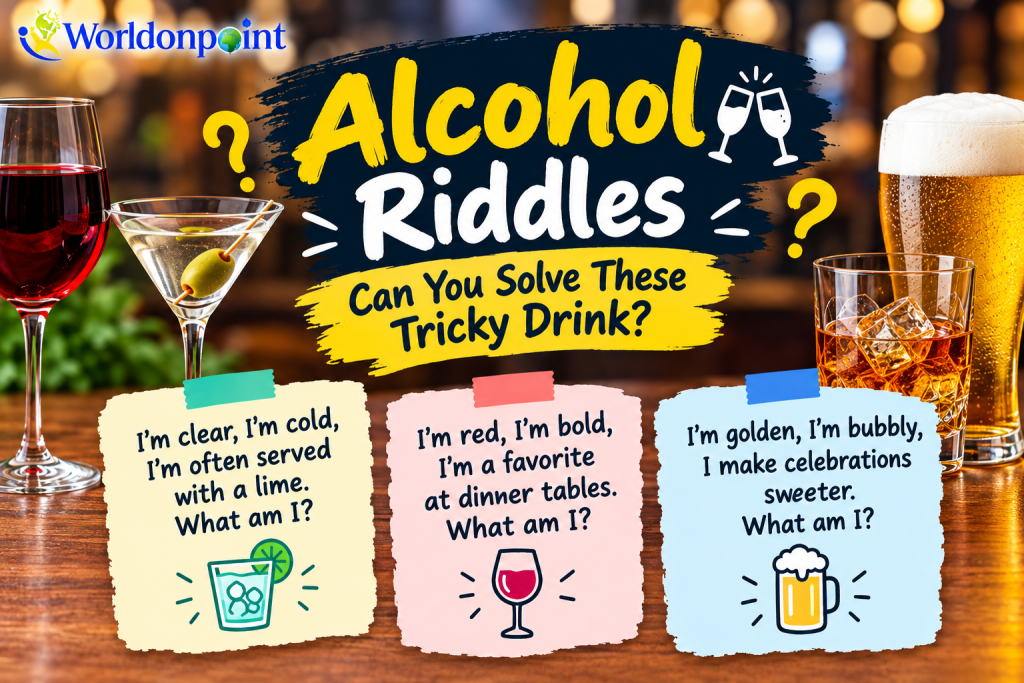
Alcohol Riddles: Can You Solve These Tricky Drink Puzzles?
There’s something special about riddles that mix humor with everyday life, and alcohol riddles do exactly that. They take familiar things, a glass of wine, a bartender’s shaker, a round of beer,and twist them into puzzles that make you pause and think twice. These riddles aren’t about drinking itself; they’re about the clever wordplay and sneaky logic hidden inside a topic almost everyone recognizes.
People enjoy solving them because they’re social. They work well at parties, trivia nights, or casual get-togethers where a bit of friendly competition adds energy to the room. Some riddles rely on puns tied to drink names. Others hide their answer in a small detail you might skip over on the first read.
In this article, you’ll find original alcohol riddles sorted into five categories, a daily riddle feature, solving tips, a difficulty guide, and answers to common questions. Whether you’re hosting a game night or just want a quick mental workout, there’s something here to challenge you.
Interesting to Know
“Spirits” as a word for liquor dates back centuries. Early distillers believed they were extracting the “spirit” or essential nature of a fermented liquid through distillation, which is exactly why Riddle 2’s wordplay works.
Wine “legs” have a scientific name. Winemakers and scientists call this effect the “Marangoni effect,” caused by differences in surface tension between alcohol and water in the glass.
“Happy hour” started as Navy slang. Sailors in the early 1900s used the term for scheduled entertainment breaks long before bars adopted it for discounted drinks.
Layered shots rely on density, not skill alone. Liquids with more sugar or lower alcohol content are naturally denser, which is why bartenders pour the heaviest ingredient first when building a layered drink like the one in Riddle 7.
Beer foam has its own name: “the head.” Its thickness and how long it lasts are actually used by professional tasters to judge a beer’s quality.
“Toasting” may come from an old custom of flavoring wine with actual toasted bread, believed to improve the taste a tradition that faded, but the name stuck.
Riddle of the Day
Call me last, and people cheer. Call me first, and nobody’s here. What am I?
Alcohol riddles are short puzzles built around drinks, drinking culture, or the objects and traditions connected to them glasses, bars, toasts, fermentation, and so on. They usually work in one of two ways. Some rely on wordplay, using drink names or bar terms that sound like other words. Others use logic, asking you to picture a scene involving drinks and figure out what’s really happening.
This type of riddle requires you to think about a familiar setting from an unfamiliar angle. A phrase like “last call” or “on the rocks” can carry more than one meaning, and a good riddle uses that double meaning to lead you somewhere unexpected. Unlike a plain trivia question, an alcohol riddle rarely wants a fact; it wants you to notice a clue you almost missed.
What sets these riddles apart from ordinary riddles is the shared cultural knowledge they lean on. Most people know what a toast is, what a bartender does, or what “happy hour” means, so the riddle can play with that shared understanding instead of explaining background information first.
How to Solve Alcohol Riddles
Alcohol riddles often hide their answer in plain sight. These tips will help you catch what you might otherwise miss.
Read every word slowly. A single word like “shots,” “rounds,” or “spirits” can carry a double meaning that changes the whole riddle.
Watch for drink-related puns. Words connected to alcohol, wine, rum, gin, tap often sound like or double as everyday words.
Picture the scene literally. If the riddle describes a bar or a bottle, imagine it exactly as written before assuming what it means.
Don’t assume it’s about drinking. Many alcohol riddles use drink terms to describe something completely different, like a person, an object, or an event.
Notice contradictions. If a riddle seems to describe something impossible, that contradiction is usually the key clue.
Break down compound phrases. Terms like “happy hour” or “bottoms up” can be split into parts that each hint at the answer.
Say it out loud. Some riddles depend on how a phrase sounds when spoken, not just how it looks when written.
Wine Riddles
Wine riddles tend to lean on aging, tradition, and the small rituals swirling, pouring, tasting that surround the drink.
Riddle 1
I am full when I’m born, but people wait for me to get old. The older I get, the more I am worth. What am I?
Answer: Wine.
Why is this the answer? Wine is bottled full and often improves in flavor and value with age, unlike most things that lose worth over time. This backward relationship between age and value is what the riddle is describing.
What makes it tricky? It plays on the usual idea that aging makes things weaker or less valuable, flipping that expectation on its head.
Riddle 2
I have a family of grapes, but I am not fruit anymore. What am I?
Answer: Wine.
Why is this the answer? Wine comes from grapes, but once fermented, it’s no longer fruit in its original form — it becomes a completely different product.
What makes it tricky? It’s easy to answer “grapes” too quickly without noticing the riddle specifically says the answer is not fruit anymore.
Riddle 3
I rise when I’m poured, but I have no legs. I leave marks on the glass as I go. What am I?
Answer: Wine “legs” (the streaks that form on the inside of a wine glass).
Why is this the answer? When wine is swirled in a glass, streaks called “legs” form and slide down the sides, a visual clue some drinkers use to judge alcohol content or texture.
What makes it tricky? Saying “I have no legs” while the answer is literally called “legs” creates a playful contradiction that takes a second to catch.
Beer Riddles
Beer riddles usually focus on process how it’s made, poured, or served rather than tradition.
Riddle 4
I begin in a field, but I end in a glass. Between the two, I lose my shape completely. What am I?
Answer: Beer, made from grain.
Why is this the answer? Beer starts as grain, such as barley, grown in a field, and goes through fermentation and processing until it becomes a liquid poured into a glass.
What makes it tricky? The riddle avoids naming the drink directly and instead traces its journey, so the answer requires connecting agriculture to a finished product.
Riddle 5
I am round, but I am not a coin. I sit on top, but I am not a hat. I disappear before the drink is done. What am I?
Answer: The foam head on a beer.
Why is this the answer? Foam sits on top of a poured beer in a rounded shape and naturally fades away as the drink is consumed or sits for a while.
What makes it tricky? The comparisons to a coin and a hat are meant to mislead, since neither object fades away on its own.
Cocktail & Mixed Drink Riddles
These riddles focus on preparation shaking, layering, mixing and the tools bartenders use.
Riddle 6
I am shaken, not poured straight. I mix many things into one. Ice cannot stay inside me forever. What am I?
Answer: A cocktail shaker.
Why is this the answer? A cocktail shaker combines multiple ingredients through shaking, and the ice inside it is eventually strained out before serving.
What makes it tricky? The phrase “shaken, not poured straight” nudges toward a famous drink-related phrase, which can distract from the object itself.
Riddle 7
I have layers like a cake, but you cannot cut me. I am judged by how well I stay apart. What am I?
Answer: A layered shot, like a B-52.
Why is this the answer? A layered shot is made by carefully pouring different liquids so they sit in separate layers rather than mixing, and its quality is measured by how distinct those layers remain.
What makes it tricky? Comparing it to a cake sets up a false expectation of cutting or slicing, when the real challenge is keeping the layers from blending.
Bar Culture & Slang Riddles
This group leans on bar terminology phrases regulars and bartenders use without a second thought.
Riddle 8
I have a neck but no head. I hold spirits, but I am not alive. What am I?
Answer: A bottle.
Why is this the answer? A bottle has a narrow “neck” near its top opening, and it commonly holds alcoholic “spirits,” a term for strong liquor like whiskey or rum.
What makes it tricky? The word “spirits” is the misdirection here, since readers may first think of ghosts rather than liquor.
Riddle 9
Call me last, and people cheer. Call me first, and nobody’s here. What am I?
Answer: Last call.
Why is this the answer? “Last call” is the announcement that a bar is closing soon, which often gets a reaction from the crowd. If it were called at the very start, the bar wouldn’t have opened yet, so there’d be no one there.
What makes it tricky? It relies on the specific bar term “last call” and plays with timing rather than physical objects.
Riddle 10
Two people raise me at the same time, but only one sound is heard. What am I?
Answer: A toast (the clinking of glasses).
Why is this the answer? When people toast, they raise their glasses together and clink them, producing one shared sound even though two separate glasses are involved.
What makes it tricky? It sounds like it could describe two versions of the same object making noise separately, when really the answer is about one shared moment.
Riddle 11
I am named for an hour, but I often last longer than sixty minutes. What am I?
Answer: Happy hour.
Why is this the answer? “Happy hour” refers to a promotional time at a bar with discounted drinks, and despite its name, it frequently runs longer than a single hour.
What makes it tricky? The riddle plays with the literal meaning of “hour” versus how the term is actually used in practice.
Riddle 12
I am poured in rounds, yet I have no shape. Everyone takes a turn, but I never run out on my own. What am I?
Answer: A round of drinks.
Why is this the answer? A “round” refers to everyone in a group being served a drink, one person often paying for the whole set, and the term has nothing to do with a physical circular shape.
What makes it tricky? The word “round” strongly suggests a shape, which pulls attention away from its meaning as a turn-based tradition.
Science & Effects Riddles
This last group looks at what’s actually happening chemically, or how alcohol affects behavior and perception.
Riddle 13
The more you take from me, the taller I seem to get. What am I?
Answer: A bottle of beer being emptied glass by glass, from a group’s point of view as their perception shifts.
Why is this the answer? As people drink, their judgment changes, so ordinary things including the bottle or the night itself can start to feel more dramatic or “bigger” than they are.
What makes it tricky? It sounds like a physical riddle about size, but it’s actually describing a psychological effect, not an object shrinking or growing.
Riddle 14
I turn sweet things sour, but people still want more of me. I work slowly, without being seen. What am I?
Answer: Fermentation.
Why is this the answer? Fermentation is the natural process that changes sugars into alcohol, and it happens gradually and invisibly inside a sealed container.
What makes it tricky? Describing something as turning sweet to sour, yet still desirable, seems contradictory until you realize it’s describing a chemical process, not a taste alone.
Riddle 15
I get people talking, but I have no voice. I loosen tongues, though I cannot speak. What am I?
Answer: Alcohol itself.
Why is this the answer? Alcohol is known for making people more talkative and relaxed in social settings, even though it has no voice or ability to speak on its own.
What makes it tricky? The personification makes it sound like a person or storyteller, when the answer is actually a substance with an effect on people.
Logic riddles – These rely on reasoning through a scenario step by step rather than spotting a pun.
Trick riddles – Built to lead your mind toward an obvious wrong answer before revealing the real one.
Word riddles – Focus purely on language, using homophones, double meanings, or hidden words.
Brain teasers – A broader category covering puzzles that challenge memory, math, or spatial thinking.
Lateral thinking riddles – Require you to look at a situation from an unusual angle instead of the obvious one.
Food and drink riddles – A wider category that includes alcohol riddles alongside puzzles about coffee, desserts, and meals.
Frequently Asked Questions
Are alcohol riddles appropriate for all audiences?
Most alcohol riddles are lighthearted wordplay rather than content about drinking itself, making them suitable for adult social settings like parties or trivia nights. As with any drink-themed content, they’re best shared with an adult audience given the subject matter.
Do alcohol riddles require knowledge about drinks to solve?
Not really. Most riddles rely on common terms like “toast,” “round,” or “last call” that most adults have heard, even without deep knowledge of specific drinks or brewing methods.
What makes a good alcohol riddle?
A good one uses a familiar drink-related word or phrase with more than one meaning, then builds the riddle around that overlap so the answer feels surprising but fair once revealed.
Can alcohol riddles be used for party games?
Yes, they work well as icebreakers or trivia rounds. Reading them aloud and letting guests guess adds a playful, competitive element to any gathering.
Why do so many alcohol riddles use wordplay?
Drinking culture has a lot of specific terminology—”spirits,” “rounds,” “shots,” and and “tap”and many of these words have unrelated everyday meanings, which naturally lends itself to puns.
Are these riddles suitable for a bar trivia night?
Absolutely. Their length and structure make them easy to read aloud, and the mix of easy and hard options keeps a mixed group engaged.
How can I make my own alcohol riddle?
Start with a drink-related term that has a double meaning, then build a short description that could apply to both meanings before revealing which one is correct.
Final Thoughts
Alcohol riddles work because they take something familiar a toast, a bottle, or a round of drinks and ask you to see it differently. That small shift in perspective is what makes solving them satisfying. Whether you’re drawn to the wordplay in “last call” or the quiet logic behind fermentation, each riddle rewards close reading and a willingness to question the obvious answer.
These puzzles are more than just party tricks. They train you to notice double meanings and question assumptions, skills that carry over to plenty of other riddle types. Next time you’re hosting a get-together or just want a quick mental challenge, pull out a few alcohol riddles and see who catches the twist first.
Riddle writer and puzzle enthusiast creating fun, clever, and brain-teasing content for all ages. I love turning simple ideas into engaging riddles that challenge minds and spark curiosity.