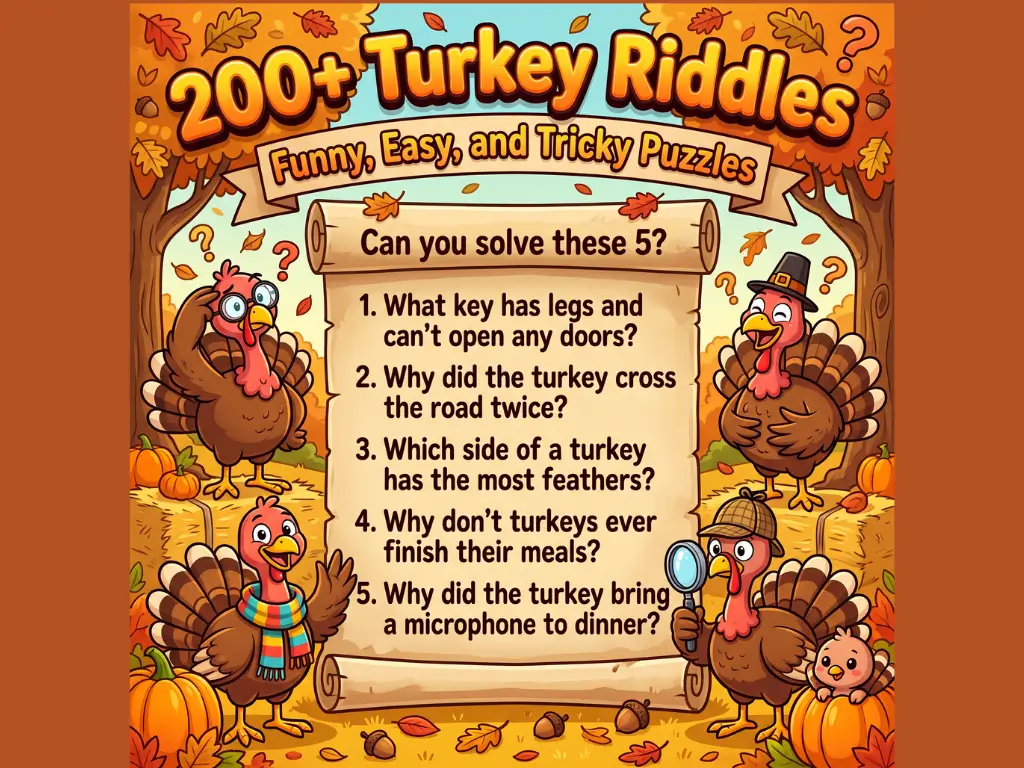
This collection of turkey riddles includes more than 200 original puzzles with answers, from easy questions for kids to tricky logic mysteries for adults. You’ll find funny jokes, short riddles, wordplay, wildlife facts, and team games for classrooms, parties, and Thanksgiving gatherings. Guess first, check the answer, and keep score.
Why Turkey Riddles Are So Much Fun
Turkey riddles work because turkeys are odd, proud, noisy birds with plenty to describe: a fan of feathers, a wobbly wattle, a loud gobble, and a strut that says “look at me.” That gives riddle writers a lot to play with.
Below you’ll find easy riddles for young kids, funny questions for the whole family, and brain teasers that make teens and adults slow down and think. There are also classroom rounds, party games, and Thanksgiving challenges. Cover the answer, say your guess out loud, and then check. The guess is half the fun.
5 Best Turkey Riddles With Answers
1. I have two feet, two wings, and a red wobbly neck. At sunset, I fly up to a tree branch to sleep. What am I?
Answer: A wild turkey.
Explanation: Wild turkeys can fly, and they usually roost in trees at night to stay safe from ground predators.
2. Why did the turkey win the talent show?
Answer: It had the best tail-ent.
Explanation: “Tail-ent” is a pun on “talent.” A turkey’s tail fan is its big show-off feature.
3. I’m a beard, but I never need a razor. I’m a tuft of bristly feathers on a turkey’s chest. What am I?
Answer: A turkey’s beard.
Explanation: A turkey’s beard is made of hair-like feathers. Most males have one, and some hens grow one too.
4. I’m a bit of floppy skin that dangles over a turkey’s beak. Sometimes I get quite long. What am I?
Answer: A snood.
Explanation: The snood is the fleshy appendage over the beak. It can lengthen or shorten, especially when a male turkey is excited.
5. Three turkeys line up for corn: Toby, Pepper, and Hazel. Toby is not first. Pepper stands right behind Hazel. Who is first, second, and third?
Answer: Hazel is first, Pepper is second, and Toby is third.
Explanation: Pepper must be directly behind Hazel, so the only possible orders are Hazel–Pepper–Toby or Toby–Hazel–Pepper. Toby isn’t first, so the first order is the answer.
Turkey Riddle Difficulty Guide
| Difficulty | Suggested age | Best use |
|---|---|---|
| Beginner | Ages 5–7 | First riddles and warm-ups |
| Easy | Ages 6–9 | Family games and classrooms |
| Medium | Ages 8–12 | Quizzes and team challenges |
| Challenging | Ages 12+ | Brain teasers and adult game nights |
These ages are only suggestions. Reading ability and puzzle experience matter more than age, so a confident young reader may enjoy medium riddles, and an adult may still enjoy the beginner ones.
Easy Turkey Riddles for Kids
1. I’m a baby turkey that hatches from an egg. My name rhymes with “bolt”. What am I?
Answer: A poult.
Explanation: Young turkeys are called poults.
2. I’m a loud sound that begins with G. A male turkey makes me to call across the woods. What am I?
Answer: A gobble.
Explanation: Male turkeys gobble to announce themselves to hens and other toms.
3. I’m hard and pointy. A turkey uses me to peck seeds and bugs from the ground. What am I?
Answer: A beak.
4. A turkey has two of me. I’m covered in feathers and I help the bird fly in short bursts. What am I?
Answer: Wings.
5. I’m a female turkey. I lay eggs and make soft yelping sounds. What am I?
Answer: A hen.
6. I’m a grown male turkey. I’m the one who gobbles. What’s my name?
Answer: A tom.
Explanation: Male turkeys are also called gobblers.
7. I’m a cozy spot on the ground, hidden under leaves, where a hen lays her eggs. What am I?
Answer: A nest.
8. I’m sharp and on the ends of a turkey’s toes. I help it scratch the dirt for snacks. What am I?
Answer: Claws.
9. I’m oval and speckled, and I crack open when a baby is ready to come out. What am I?
Answer: A turkey egg.
10. I have a red barn, a muddy path, and a pen where domestic turkeys may live. What am I?
Answer: A farmyard.
11. I’m a small brown nut that drops from oak trees. Wild turkeys love to find me on the forest floor. What am I?
Answer: An acorn.
12. I grow in tall green stalks, I wear a husk, and turkeys love to eat my yellow kernels. What am I?
Answer: Corn.
13. I cover a turkey’s body and come in brown, bronze, or white. I’m not fur. What am I?
Answer: Feathers.
14. A tom turkey spreads me wide, and I look like a big, feathered half-circle. What am I?
Answer: A tail fan.
15. I’m a proud walk. A tom does me with puffed-up feathers and a spread tail. What am I?
Answer: Strutting.
16. A wild turkey does me at night while perched on a branch. I rhyme with “boosting.” What am I?
Answer: Roosting.
17. I’m red, floppy skin that hangs under a turkey’s chin. What am I?
Answer: A wattle.
18. I’m what you call a group of turkeys walking together. What am I?
Answer: A flock.
Explanation: A group of turkeys can also be called a rafter.
19. I’m a bath with no water. A turkey rolls in me to keep its feathers clean. What am I?
Answer: A dust bath.
Explanation: Turkeys really do dust bathe by fluffing loose dirt through their feathers.
20. I’m a young male turkey. My name is also a boy’s name that starts with J. What am I?
Answer: A jake.
21. I’m full of trees and fallen leaves. Wild turkeys wander through me looking for acorns. What am I?
Answer: A forest (or woodland).
22. I have six legs and I hop through the grass. A turkey will snap me up for a snack. What am I?
Answer: A grasshopper.
Explanation: Turkeys eat insects as well as seeds, nuts, and plants.
23. I’m a smaller farm bird that clucks and lays eggs. A turkey is bigger than me. What am I?
Answer: A chicken.
24. I’m a sharp point on the back of a male turkey’s leg. What am I?
Answer: A spur.
Explanation: Spurs are usually longer and sharper on males.
25. A turkey has 2 wings and 2 legs. How many wings and legs are there on 3 turkeys?
Answer: 12.
Explanation: Each turkey has 2 + 2 = 4, and 3 × 4 = 12.
Funny Turkey Riddles
26. Why did the turkey ask to be a judge at the cooking contest instead of a contestant?
Answer: It wanted to taste the pie, not be the main course.
27. What kind of act did the turkey bring to the talent show?
Answer: A fan dance.
Explanation: A turkey’s tail is a fan of feathers.
28. A turkey detective followed muddy footprints all day. What did it discover at the end?
Answer: The footprints were its own.
29. Why did the turkey read the dinner invitation twice before replying?
Answer: It wanted to be sure “special” meant “special guest,” not “special dish.”
30. Why did the turkey get in trouble at school?
Answer: It kept gobbling during quiet reading time.
31. Why was the turkey comedian invited back to every show?
Answer: It really knew how to crack up a flock.
32. What did the cow tell the turkey after its joke fell flat?
Answer: “That one was a little corny.”
33. Why did the turkey ace the spelling bee word “gobble”?
Answer: It had been practicing the double b’s all week.
34. What do you call a turkey that solves mysteries with a magnifying glass?
Answer: Sherlock Gobbles.
Also Read : 151+ Zebra Riddles: Funny and Tricky Puzzles for All Ages
35. Why did the turkey get picked first for the barnyard dance?
Answer: It had the best strutting moves.
36. Why wasn’t the turkey scared of the scarecrow?
Answer: It had a bird’s-eye view and could see the straw sticking out.
37. What’s a turkey’s favorite party game?
Answer: Peck-a-boo.
38. What did the turkey say to the nervous goose before the talent show?
Answer: “Don’t worry, just wing it.”
39. What do you call a turkey that’s great at math?
Answer: A calcu-gobbler.
40. Why did the turkey pack only a tiny suitcase?
Answer: It already had everything it needed: a fan, a coat, and two good feet.
41. What does a bowler hope to roll that has nothing to do with Thanksgiving dinner?
Answer: A turkey.
Explanation: In bowling, three strikes in a row is called a turkey.
42. Why did the turkey wear sunglasses at the harvest festival?
Answer: Its own tail fan was so shiny it was the star of the show.
43. Why did the turkey wear a scarf on a chilly morning?
Answer: It wanted to keep its wattle warm.
44. Why was the turkey so good at hide-and-seek in the woods?
Answer: Its brown feathers blended in with the fallen leaves.
Explanation: This one is real. A turkey’s dull feathers make it hard to see against a forest floor.
45. What did the turkey say when the goose asked how its day went?
Answer: “Feather-ly good, thanks for asking!”
Short Turkey Riddles
46. I have no teeth, but I grind a turkey’s food. What am I?
Answer: A gizzard.
Explanation: The gizzard is a muscular organ that works with small stones the bird swallows.
47. Two people pull me and one makes a wish. What am I?
Answer: A wishbone.
48. I have three toes forward and one back, pressed in the mud. What am I?
Answer: A turkey track.
49. I’m a quick tap with a beak. What am I?
Answer: A peck.
50. A group of turkeys is called me, and I’m also part of a roof. What am I?
Answer: A rafter.
51. A hen makes me to call her flock. I’m not a gobble. What am I?
Answer: A yelp.
52. I’m another name for a male turkey, and I sound like what he does. What am I?
Answer: A gobbler.
53. I’m raised on farms and I’m usually too heavy to fly well. What am I?
Answer: A domestic turkey.
54. I’m a high branch where a wild turkey sleeps at night. What am I?
Answer: A roost.
55. I have six legs and I’m a snack for a turkey. What am I?
Answer: An insect.
56. A hen’s family of poults is called me. What am I?
Answer: A brood.
57. I’m the season of falling leaves and harvest dinners. What am I?
Answer: Autumn (or fall).
58. A fox, a coyote, or a hawk could be me, and turkeys watch out for me. What am I?
Answer: A predator.
59. I’m red, tart, and often spooned beside turkey on a holiday plate. What am I?
Answer: Cranberry sauce.
60. A wild turkey does me in a quick burst to reach a high branch. What am I?
Answer: Fly.
Explanation: Wild turkeys can fly in short bursts, even though they spend most of their time on the ground.
Tricky Turkey Riddles
61. A pen holds 9 turkeys, and every turkey is either a tom or a hen. All but 3 are toms. How many hens are there?
Answer: 3 hens.
Explanation: “All but 3 are toms” means 3 turkeys are not toms. Since every turkey is a tom or a hen, those 3 must be hens.
62. Which weighs more: a pound of turkey feathers or a pound of corn?
Answer: Neither. They weigh the same.
Explanation: A pound is a pound. The feathers just take up much more space.
63. I’m a bird that gobbles, and I’m also a country that stretches across two continents. What am I?
Answer: Turkey.
Explanation: The country of Turkey, also called Türkiye, sits partly in Europe and partly in Asia. The bird shares its English name.
64. A 12-pound turkey stands on one leg. How much does it weigh when it stands on two legs?
Answer: 12 pounds.
Explanation: Standing on one leg or two doesn’t change a turkey’s weight. It only changes how the weight is spread.
65. Pip finds 5 clear turkey tracks in the mud, and every track shows all four toes. How many toe marks are there in total?
Answer: 20.
Explanation: 5 tracks × 4 toes = 20 toe marks.
66. I have a beard but never shave, spurs but never wear boots, and a fan but no breeze. Who am I?
Answer: A tom (a male turkey).
Explanation: Beards and spurs are most common on males, and a tom is the one that spreads his tail fan to show off.
67. I look like a turkey with a fan of feathers, but I never gobble, eat, or fly. Kids make me by tracing a hand. What am I?
Answer: A handprint turkey craft.
Explanation: The thumb is the head, and the four fingers become the tail feathers.
68. Four turkeys are at the feeder. Two leave, then four more arrive. Then half the turkeys at the feeder fly up into a tree. How many are still on the ground?
Answer: 3.
Explanation: 4 – 2 = 2, then 2 + 4 = 6. Half of 6 is 3 flying up, so 3 remain.
69. There are two turkeys in front of a turkey, two turkeys behind a turkey, and one turkey in the middle. What is the smallest number of turkeys that fits?
Answer: 3.
Explanation: In a line of three, the first turkey has two behind it, the last has two in front of it, and the middle one is in the middle. Every turkey is counted more than once.
70. Toby is taller than Hazel. Pepper is shorter than Hazel but taller than Pip. List the four turkeys from tallest to shortest.
Answer: Toby, Hazel, Pepper, Pip.
Explanation: Toby > Hazel, and Hazel > Pepper > Pip. Chain them together and the order is fixed.
71. Hazel says the Thanksgiving month has 30 days. How many months in a year have at least 28 days?
Answer: All 12.
Explanation: Even February has 28 days, so every month has at least 28.
72. A turkey weighs 15 pounds plus half of its own weight. How much does it weigh?
Answer: 30 pounds.
Explanation: If the weight is 30, half is 15, and 15 + 15 = 30. The “extra” 15 pounds must equal the other half of the turkey.
73. Only one of these three statements is true. Toby: “The corn is in the barn.” Pepper: “The corn is not in the barn.” Hazel: “Pepper is not telling the truth.” Where is the corn?
Answer: The corn is not in the barn.
Explanation: Toby and Pepper contradict each other, so exactly one of them is right. If Pepper were wrong, then Toby would be right and Hazel (who says Pepper is wrong) would also be right. That makes two true statements, which breaks the rule. So Pepper is the true one, and the corn is not in the barn.
74. I’m a short, sharp alarm call a wild turkey makes when it senses danger. My name sounds like a golf term. What am I?
Answer: A putt.
Explanation: Wild turkeys use a sharp “putt” as an alarm call, along with other sounds such as yelps, clucks, and gobbles.
75. Take away my first letter and I become a night bird that hoots. I’m another word for a bird like a turkey. What am I?
Answer: Fowl.
Explanation: Remove the F from “fowl” and you get “owl.”
76. I’m a hen’s name with a different first letter. I’m also a number you reach right before eleven. What am I?
Answer: Ten.
Explanation: Change the H in “hen” to a T.
77. After the Thanksgiving dishes are washed, what gets wetter the more it dries?
Answer: A dish towel.
Explanation: Drying dishes soaks the towel.
78. I’m orange inside, spiced with cinnamon, baked in a crust, and often served with whipped cream. I grew on a vine before I became dessert. What am I?
Answer: Pumpkin pie.
79. A tom sits on the peak of a barn roof and lays an egg. Which side of the roof does the egg roll down?
Answer: Neither, because toms don’t lay eggs.
Explanation: Only hens lay eggs. The question assumes something that isn’t possible.
80. Pip has 2 eggs. Pepper has 3 more than Pip. Hazel has twice as many as Pepper. How many eggs does Hazel have?
Answer: 10.
Explanation: Pepper has 2 + 3 = 5, and Hazel has 5 × 2 = 10.
Hard Turkey Brain Teasers
81. Find the next number: 1, 1, 2, 3, 5, 8, ___
Answer: 13.
Explanation: Each number is the sum of the two before it: 5 + 8 = 13.
82. Find the next number in this pattern: 3, 6, 5, 10, 9, 18, ___
Answer: 17.
Explanation: The pattern alternates between doubling and subtracting 1. 3 × 2 = 6, 6 – 1 = 5, 5 × 2 = 10, 10 – 1 = 9, 9 × 2 = 18, and 18 – 1 = 17.
83. A pen has only turkeys and pigs. Together they have 10 heads and 28 legs. How many turkeys are there?
Answer: 6 turkeys (and 4 pigs).
Explanation: Turkeys have 2 legs and pigs have 4. If all 10 animals were turkeys, there would be 20 legs. That leaves 8 extra legs, and each pig adds 2 extra, so there are 4 pigs. 6 × 2 + 4 × 4 = 12 + 16 = 28.
84. A hen starts sitting on her eggs on October 5. They hatch after 28 days. On what date do the poults hatch?
Answer: November 2.
Explanation: October has 31 days. Counting 26 days gets you to October 31, and 2 more days lands on November 2.
85. Toby is twice as old as Pip in weeks. Together they are 18 weeks old. How old is each?
Answer: Pip is 6 weeks old and Toby is 12 weeks old.
Explanation: Pip is one part, Toby is two parts, so 3 parts equal 18. One part is 6.
86. Four turkeys wear four different ribbons: red, blue, green, and yellow. Toby wears neither red nor blue. Hazel wears red. Rusty wears neither green nor blue. Pepper doesn’t wear yellow. Who wears what?
Answer: Hazel wears red, Rusty wears yellow, Toby wears green, and Pepper wears blue.
Explanation: Hazel takes red. Rusty can’t wear red, green, or blue, so Rusty must wear yellow. Toby can’t wear blue, so he gets green. That leaves blue for Pepper, which fits her clue.
87. In a race, Rusty finished before Pip. Hazel finished after Pip. Toby finished before Rusty. What was the finishing order?
Answer: Toby, Rusty, Pip, Hazel.
Explanation: Toby is before Rusty, Rusty is before Pip, and Pip is before Hazel. That is one unbroken chain.
88. A tom’s fan has 4 rows of feathers in this puzzle. The first row has 6 feathers, and each row after it has 3 more than the row before. How many feathers are there in total?
Answer: 42.
Explanation: The rows have 6, 9, 12, and 15 feathers. 6 + 9 + 12 + 15 = 42. (This is a math puzzle, not a real feather count.)
89. Hazel leaves the barn at 7:15 a.m. She walks for 50 minutes, rests for 20 minutes, and then walks 35 more minutes to the creek. What time does she arrive?
Answer: 9:00 a.m.
Explanation: 7:15 + 50 minutes = 8:05. Add 20 minutes to get 8:25. Add 35 more and you arrive at 9:00.
90. Complete the letter pattern: A, C, F, J, ___
Answer: O.
Explanation: Use the alphabet positions: 1, 3, 6, 10. The gaps grow by one each time (+2, +3, +4), so the next gap is +5. Position 15 is O.
91. Three turkeys share 24 acorns. Toby gets twice as many as Pip. Hazel gets 4 more than Pip. How many does each get?
Answer: Pip gets 5, Toby gets 10, and Hazel gets 9.
Explanation: Call Pip’s share p. Then p + 2p + (p + 4) = 24, so 4p = 20 and p = 5.
Must Read: 150+ Deer Riddles: Can You Crack These Wild Brain Teasers?
92. A flock of 12 turkeys in a story eats 2 cups of corn each per day. A bag holds 150 cups. For how many full days does the bag last?
Answer: 6 full days.
Explanation: The flock eats 12 × 2 = 24 cups per day. 150 ÷ 24 = 6.25, so the bag lasts 6 full days with some left over.
93. On Monday, Pip finds 1 acorn. Each day after, Pip finds twice as many as the day before. How many acorns has Pip found in total by Friday?
Answer: 31.
Explanation: Monday to Friday gives 1, 2, 4, 8, 16. The total is 31.
94. A story turkey needs 3 hours and 30 minutes in the oven and then 30 minutes to rest before dinner at 5:30 p.m. What time should it go into the oven?
Answer: 1:30 p.m.
Explanation: Subtract the rest time first: 5:30 – 0:30 = 5:00. Then subtract the cooking time: 5:00 – 3:30 = 1:30. (This is a puzzle only. Always follow safe cooking instructions for a real turkey.)
95. Four turkeys sit on a fence in a row. Hazel is on the far left. Pip is directly next to Hazel. Rusty is not on the far right. Toby is the fourth turkey. Who sits where, from left to right?
Answer: Hazel, Pip, Rusty, Toby.
Explanation: Hazel is first and Pip is second. Rusty can’t be last, so he takes the third seat, which leaves Toby at the far right.
96. In a balance puzzle, 1 turkey weighs the same as 4 pumpkin pies, and 1 pie weighs the same as 2 jars of cranberry sauce. How many jars balance 2 turkeys?
Answer: 16 jars.
Explanation: 1 turkey = 4 pies = 8 jars. So 2 turkeys = 16 jars.
97. Pepper lays 1 egg every other day in this puzzle, starting on Day 1. How many eggs does she have after Day 10?
Answer: 5 eggs.
Explanation: She lays on days 1, 3, 5, 7, and 9.
98. A barn lock has a 3-digit code. The digits add up to 12, the middle digit is 3, and the first digit is twice the last digit. What is the code?
Answer: 633.
Explanation: Let the last digit be c. Then the first is 2c, so 2c + 3 + c = 12. That gives 3c = 9 and c = 3. The code is 6, 3, 3.
99. If A = 1, B = 2, C = 3, and so on, what is the total value of the letters in GOBBLE?
Answer: 43.
Explanation: G = 7, O = 15, B = 2, B = 2, L = 12, E = 5. Adding them: 7 + 15 + 2 + 2 + 12 + 5 = 43.
100. A flock has 40 turkeys. One quarter roost in an oak tree. Half of the remaining turkeys are in the field. The rest are in the barn. How many are in the barn?
Answer: 15.
Explanation: A quarter of 40 is 10, which leaves 30. Half of 30 is 15 in the field, so 15 are in the barn.
Thanksgiving Turkey Riddles
101. I’m poured from a boat, but I never float. I make mashed potatoes shine. What am I?
Answer: Gravy.
Explanation: Gravy is served in a gravy boat.
102. I’m a sweet pie filled with a nut that grows on a tree in the southern United States. What am I?
Answer: Pecan pie.
103. I slide out of a can with ridges on my sides, and I jiggle on the plate. What am I?
Answer: Canned cranberry sauce.
104. I’m made of bread cubes, celery, onion, and herbs. Some families bake me inside the bird, and others bake me in a dish. What am I?
Answer: Stuffing (also called dressing).
105. I turn red, orange, and yellow in autumn, then fall off the branch. Kids love to jump into piles of me. What am I?
Answer: A fallen leaf.
106. I cost nothing, but I make the table feel warm. Around the table, people take turns naming what they’re me for. What am I?
Answer: Gratitude (thankfulness).
107. I’m folded into a triangle or a fan and placed next to the fork. What am I?
Answer: A napkin.
108. Why did the dinner roll feel nervous at the feast?
Answer: It knew it was about to get buttered up.
109. I have giant balloons and marching bands, and I travel through New York City on Thanksgiving morning. What am I?
Answer: The Macy’s Thanksgiving Day Parade.
110. I travel around the table from hand to hand, I never leave the room, and I come back with less in me. What am I?
Answer: A serving dish (like the mashed potatoes) being passed.
111. I’m written before the big feast so nobody forgets the cranberries, the rolls, or the butter. What am I?
Answer: A grocery (shopping) list.
112. I’m a harvest decoration with kernels in red, yellow, and purple. I look like corn, but I’m usually for display. What am I?
Answer: Flint corn (often called Indian corn).
113. I sit by your plate and tell you exactly where to sit. What am I?
Answer: A place card.
114. After dinner, families play me in the backyard or watch me on TV. I’m played with a pointy oval ball. What am I?
Answer: Football.
Explanation: Not every family does this, but football is a common Thanksgiving tradition in the U.S.
115. Not everyone celebrates me, but many people in the United States gather with loved ones for a meal on me, on the fourth Thursday of November. What am I?
Answer: Thanksgiving.
Turkey Anatomy and Animal Fact Riddles
116. My skin can shift between red, white, and bluish tones on a turkey’s head and neck, especially when the bird is excited. Which turkey feature includes me?
Answer: The head and neck skin (including the wattle).
Explanation: Turkeys have mostly bare skin on the head and neck. The color can change with mood and excitement.
117. One of us hangs from the throat. The other dangles over the beak. Name us.
Answer: The wattle (throat) and the snood (over the beak).
Explanation: The wattle is fleshy skin around the throat and neck. The snood is the fleshy appendage that extends over the beak.
118. True or false: Only male turkeys have beards.
Answer: False.
Explanation: Most toms have beards, but some hens grow them too, usually thinner and shorter.
119. Why do male wild turkeys gobble, especially in spring?
Answer: To announce themselves and attract hens.
Explanation: A gobble carries a long way through woodland, which helps a tom be heard across the forest.
120. Why do wild turkeys often sleep in trees instead of on the ground?
Answer: To stay safer from ground predators.
Explanation: Roosting up high makes it harder for foxes, coyotes, and bobcats to reach them at night.
121. True or false: Wild turkeys cannot fly.
Answer: False.
Explanation: Wild turkeys fly in short, strong bursts, often to reach a roost or escape danger. They spend most of their time walking on the ground.
122. A turkey runs its beak through its feathers every day to keep them neat and tidy. What is this called?
Answer: Preening.
123. Within about a day of hatching, I can walk, peck, and follow my mother. What am I?
Answer: A poult.
Explanation: Poults are active soon after hatching, which helps them follow the hen away from the nest.
124. I’m a turkey’s sharpest sense, and I help it spot a hawk from far away. What am I?
Answer: Eyesight.
Explanation: Turkeys have excellent vision, and their eyes sit on the sides of the head, giving them a wide view.
125. Which call is usually made by a hen: a yelp or a loud gobble?
Answer: A yelp.
Explanation: Hens use yelps and clucks to keep in touch with the flock, while gobbling is mostly a male sound.
126. Why does a tom puff up his feathers, spread his tail, and strut?
Answer: To impress hens and show off to other toms.
Explanation: Strutting is a courtship display, though toms may also strut in social encounters.
127. Name three foods a wild turkey might find while foraging.
Answer: Any three of these: acorns, seeds, berries, insects, grasses, and nuts.
Explanation: Wild turkeys are omnivores. They eat plants and small animals such as insects.
128. A turkey’s feathers can shimmer with bronze, copper, and green. What is this shiny, rainbow-like effect called?
Answer: Iridescence.
Explanation: Iridescent feathers change color slightly depending on how the light hits them.
129. Turkeys often travel together in winter. What is the main benefit of being in a flock?
Answer: More eyes to spot danger.
Explanation: Many birds watching at once means predators are noticed sooner. A flock can also share knowledge about where to find food.
130. A turkey’s tail fan is made of what?
Answer: Long tail feathers.
Explanation: The fan is a set of tail feathers that can be spread open. It isn’t a separate body part.
Turkey Wordplay and Pun Riddles
131. Change the first letter of “gobble” and you get a word that means to sway unsteadily. What is it?
Answer: Wobble.
132. I’m a bird’s pointy mouth, and I hide inside the word “beaker.” What am I?
Answer: Beak.
133. I sound like “foul,” but I’m a bird. How do you spell me?
Answer: Fowl.
134. I’m a quick tap from a bird’s beak, a light kiss on the cheek, and an old measure of apples. What am I?
Answer: A peck.
135. I’m a male turkey. Say me twice and I’m a drum. What am I?
Answer: Tom (tom-tom).
136. Put a W in front of a female turkey, and you can ask a question about time. What word do you get?
Answer: When.
137. I’m a stick that hits a drum, and I’m also the lower part of a turkey’s leg on the dinner plate. What am I?
Answer: A drumstick.
138. I’m light enough to float on the breeze, and I’m also a boxing weight class. What am I?
Answer: Feather (as in featherweight).
139. Rearrange the letters of “fowl,” and I’m what a river does. What am I?
Answer: Flow.
140. I’m a baby turkey hiding at the start of a word for farm birds. What am I?
Answer: Poult (in “poultry”).
141. I’m a piece of clothing hiding at the end of “harvest.” What am I?
Answer: Vest.
142. I’m a proud turkey walk, and I’m also a brace that holds up a roof. What am I?
Answer: A strut.
143. I strut on the ground and gobble all around. When I spread my fan, I’m the star of the land. Who am I?
Answer: A tom turkey.
144. Fill in the missing letters to spell a bird: T _ R K _ Y.
Answer: Turkey.
Explanation: The missing letters are U and E.
145. I’m part of a bird, part of a building, and the place actors wait before a show. What am I?
Answer: A wing.
Wild Turkey and Farmyard Mystery Riddles
The adventures in this section are imaginary, but the wildlife clues are based on real turkey and animal behavior.
146. Hazel finds tracks in the mud with three long toes pointing forward and one shorter toe pointing back. Which animal made them: a deer, a cat, or a turkey?
Answer: A turkey.
Explanation: Deer leave split hoof prints, and cats leave round pads. Only a turkey leaves three forward toes and one back.
147. Two turkeys meet. Toby lives in a pen on a farm and is too heavy to fly well. Pepper lives in the woods and flew into a tree last night. Which turkey is wild?
Answer: Pepper.
Explanation: Wild turkeys are slimmer and can fly to roost in trees. Domestic turkeys are bred to be much heavier.
148. Pip’s tail has one gap. There are no scuff marks, a single feather lies under the roosting branch, and Pip has been preening all morning. How did the feather most likely come out?
Answer: Pip shed it naturally.
Explanation: Birds regularly lose old feathers and grow new ones. No signs of a struggle points to normal shedding.
149. At dawn, Rusty hears a loud gobble echoing from a tall tree near the creek. Was the sound most likely made by a tom or a hen?
Answer: A tom.
Explanation: Gobbling is mostly a male call, and toms often gobble from their roosts in the early morning.
150. Rusty the squirrel buried acorns for winter, but forgot where. The woods have a pine tree, an oak tree, and a maple tree. Where should Hazel scratch the leaves to find acorns?
Answer: Under the oak tree.
Explanation: Acorns grow on oaks, so that is where they fall and get buried.
151. Hazel wants to reach the creek, which is downhill. The left path goes uphill. The right path goes downhill but has fresh fox tracks. The middle path goes downhill with no tracks. Which path should she take?
Answer: The middle path.
Explanation: It goes downhill toward the creek and avoids the fox.
152. Three animals feed in a field at dusk: a deer, a rabbit, and a turkey. Only one of them can fly up into a tree to sleep. Which one?
Answer: The turkey.
153. A farm turkey and a wild turkey both hear a hawk. Which one can more easily fly up into a tree to escape?
Answer: The wild turkey.
Explanation: Wild turkeys are lighter and better built for flight than most domestic turkeys.
154. A ground nest is empty. Eggshell pieces are scattered nearby, and small tracks around the nest look like tiny hands with five fingers. Who raided the nest: a raccoon, a deer, or a rabbit?
Answer: A raccoon.
Explanation: Raccoons have five-toed, hand-like prints and are known to raid ground nests.
155. Pip finds a trail of turkey tracks with long drag marks on both sides. What was the turkey likely doing?
Answer: Strutting.
Explanation: Toms in full display can drag their wing tips along the ground.
156. A hen leads her poults through tall grass instead of open ground. Give one good reason.
Answer: The grass hides them from predators, and it is full of insects to eat.
157. A fence has a hole only 6 inches wide. Something squeezed through and left tufts of fur. A turkey stands about two feet tall. Who most likely passed through: a rabbit or a turkey?
Answer: A rabbit.
Explanation: Fur means a mammal, and a turkey is far too wide to squeeze through such a small gap.
158. Rusty finds a shallow round dip in the dirt with fine soil kicked up and a few loose feathers around it. What was this spot used for?
Answer: A dust bath.
Explanation: Turkeys fluff dust through their feathers to help keep them clean.
159. At dusk, a wild turkey needs a safe place to sleep. Should it choose the barn floor, a tall tree branch, or the edge of a pond?
Answer: A tall tree branch.
160. Imaginary challenge: Pip draws a treasure map. “Start at the big oak. Walk 10 steps toward where the sun rises, then 5 steps toward where it sets at noon-time shadow side (south).” Where is the treasure, compared with the oak?
Answer: 10 steps east and 5 steps south of the oak.
Turkey Logic and Detective Puzzles
These mini-mysteries are imaginary adventures. Every clue you need is in the puzzle.
161. The corn bin was raided, and yellow corn dust stuck to the thief’s beak. Nobody had time to wash. Toby’s beak is clean, Pepper’s beak is clean, and Hazel’s beak is covered in dust. Who raided the bin?
Answer: Hazel.
Explanation: Only Hazel has corn dust on her beak, and nobody had time to wash it off.
162. Muddy tracks lead from the creek to the barn. Each print has three long toes forward and one toe back, and each is about four inches long. The suspects are Rusty the squirrel, Pip the tiny poult (whose prints are about one inch long), and Hazel the full-grown hen. Who left the tracks?
Answer: Hazel.
Explanation: Squirrels have five-toed paws, so Rusty is out. Pip’s prints would be far too small. Only a full-grown turkey fits a four-inch print with three toes forward and one back.
163. Toby left for the barn at 8:00 and walked for 20 minutes. Hazel left at 8:05 and walked for 12 minutes. Pepper left at 8:10 and walked for 5 minutes. Who reached the barn first?
Answer: Pepper.
Explanation: Toby arrived at 8:20, Hazel at 8:17, and Pepper at 8:15. Pepper started last but arrived first.
164. A feather was hidden in a hollow log at 3:00 p.m. Toby and Pepper were at the creek together from 2:00 to 4:00. Hazel says she was napping alone. Pip saw exactly one turkey near the log at 3:00. Who hid the feather?
Answer: Hazel.
Explanation: Toby and Pepper vouch for each other, so neither was near the log. Hazel is the only turkey without an alibi, and Pip saw one turkey there.
165. At dawn, a loud gobble echoed from near the fence. The flock has one tom, Toby, and two hens, Pepper and Hazel. Which turkey most likely made the sound?
Answer: Toby.
Explanation: Gobbling is mostly a male call, and Toby is the only tom.
166. At noon, Toby says, “I was at the creek with Pepper.” Pepper says, “I was in the barn the whole time.” Hazel says, “I was in the barn, and I saw Pepper there.” Whose alibi is wrong?
Answer: Toby’s.
Explanation: Pepper and Hazel agree that Pepper was in the barn, so Toby’s claim that she was at the creek with him does not match.
167. The creek is at the bottom of the hill. Pip takes a path that climbs uphill. Rusty takes a path that slopes downhill through damp mud. Pepper takes a path that slopes downhill but ends at a stone wall. Who chose the correct path to the creek?
Answer: Rusty.
Explanation: The creek is downhill, which rules out Pip. Pepper’s path is blocked by a wall, so only Rusty’s damp, downhill path leads to the water.
168. The evidence: muddy turkey prints lead from the creek into the barn, and no prints lead back out. Toby says, “A turkey walked in from the creek.” Pepper says, “The turkey is still in the barn.” Hazel says, “The turkey left through the barn door.” Whose statement contradicts the evidence?
Answer: Hazel’s.
Explanation: There are no prints leading out, so the turkey did not leave. Toby’s and Pepper’s statements both match the evidence.
169. Toby, Pepper, and Hazel each found one different thing: corn, an acorn, or berries. Toby did not find corn or berries. Hazel did not find the acorn. Pepper did not find berries. Who found the corn?
Answer: Pepper.
Explanation: Toby must have the acorn. Pepper can’t have berries, so she has the corn, and Hazel gets the berries, which fits her clue.
170. The feeder was full at 10:00 and empty at 10:30. Toby was at the creek from 9:30 to 10:45. Hazel watched Pepper sleep from 10:00 to 10:30. Pip was seen at the oak from 9:50 to 10:35. Rusty the squirrel was seen at the feeder at 10:15. Who emptied it?
Answer: Rusty.
Explanation: Toby, Pepper, and Pip all have alibis covering the whole 30 minutes. Only Rusty was near the feeder.
171. Muddy tracks cross a puddle. Hazel’s big prints are partly covered by Toby’s prints. Toby’s prints are partly covered by Pip’s tiny prints. In what order did they cross?
Answer: Hazel, Toby, Pip.
Explanation: A print on top was made later. Pip’s prints are on top of Toby’s, which are on top of Hazel’s.
172. After dark, you hear flapping wings, a rustle in the oak branches, and then silence. Was it a wild turkey flying up to roost, a rabbit hopping home, or a fish jumping in the creek?
Answer: A wild turkey flying up to roost.
Explanation: Flapping and branch rustling point to a bird in a tree. Rabbits don’t flap, and a fish wouldn’t be in the oak.
173. Toby says, “I found 12 acorns, ate 4, gave 3 to Hazel, and have 6 left.” Pepper says, “I found 10 acorns, ate 2, gave 3 to Pip, and have 5 left.” Whose math is wrong?
Answer: Toby’s.
Explanation: 12 – 4 – 3 = 5, not 6. Pepper’s count is right: 10 – 2 – 3 = 5.
174. Rusty buried acorns beside a flat rock, under an oak tree, away from the creek. Here are four spots: (A) an oak by the creek with a flat rock, (B) an oak on the hill with a flat rock, (C) a maple on the hill with a flat rock, and (D) an oak on the hill with no rock. Where did he bury them?
Answer: Spot B.
Explanation: Acorns come from oaks, which rules out C. Spot A is by the creek, and spot D has no rock.
175. Someone took the golden feather. Exactly one of these three statements is true. Toby: “It wasn’t me.” Pepper: “It was Hazel.” Hazel: “Pepper is lying.” Who took the feather?
Answer: Toby.
Explanation: If Toby took it, Toby’s claim is false, Pepper’s is false, and Hazel’s is true, so exactly one is true. If Pepper took it, two statements are true. If Hazel took it, Toby’s and Pepper’s are both true. Only Toby fits.
Turkey Riddle Challenges for Parties and Classrooms
Each activity has a difficulty label, simple rules, and a clear way to score. Everything here works with paper, a pencil, and a timer.
176. Team Guessing Round (Easy). Split into two teams. Read each clue aloud. The first team to raise a hand gets one guess. A correct guess earns 1 point. Clues: (1) A “W” word for the red skin under a turkey’s chin. (2) An “S” word for the skin over the beak. (3) The name for a baby turkey. (4) An “R” word for sleeping in a tree. (5) The word for a group of turkeys walking together.
Answer key: (1) Wattle. (2) Snood. (3) Poult. (4) Roosting. (5) Flock. The maximum score is 5.
177. Quick-Answer Challenge (Easy). Set a timer for 30 seconds. One player names as many turkey body parts as they can. Score 1 point for each correct, different part.
Answer key: Accepted parts include beak, wings, tail, tail fan, feathers, wattle, snood, beard, spurs, claws, legs, toes, eyes, head, and neck. Don’t count repeats.
178. Memory Game (Medium). Read this list aloud once, slowly: acorn, feather, nest, corn, egg, beak. Then take it away and ask: (1) What was the fourth item? (2) How many items are things a turkey eats? (3) Which item comes from a hen? Score 1 point for each correct answer.
Answer key: (1) Corn. (2) Two, acorn and corn. (3) The egg.
179. Observation Puzzle (Easy). Read this story once: “Toby walked past a red barn, a green tractor, and three haystacks. He pecked at the second haystack, skipped the third, and then crossed a wooden bridge with four planks.” Without looking back, answer: (1) What color was the barn? (2) What color was the tractor? (3) How many haystacks? (4) Which haystack did Toby peck? (5) How many planks were on the bridge? Score 1 point each.
Answer key: (1) Red. (2) Green. (3) Three. (4) The second. (5) Four.
180. Cooperative Problem-Solving (Medium). A farmer must carry a fox, a turkey, and a bag of corn across a river. The boat holds the farmer and only one item at a time. If left alone together, the fox will eat the turkey and the turkey will eat the corn. How can the farmer get everything across safely? Work together as a team and give the team 1 point for a correct plan.
Answer: Take the turkey across. Return alone. Take the fox across, then bring the turkey back. Leave the turkey and take the corn across. Return alone. Take the turkey across. That is seven crossings.
Explanation: The key move is bringing the turkey back on the third trip. This leaves the fox and corn together, which is safe, while the turkey waits with the farmer.
181. Thanksgiving Quiz Round (Easy). Ask: (1) In the United States, Thanksgiving is in which month? (2) On which day of the week? (3) What red sauce made from tart berries is often served at the meal? (4) A poult is the baby of which bird? (5) Mashed what is often topped with gravy? Score 1 point each.
Answer key: (1) November. (2) Thursday. (3) Cranberry sauce. (4) A turkey. (5) Potatoes.
Explanation: Not everyone celebrates Thanksgiving, and the date differs by country. For example, Canada celebrates on the second Monday of October.
182. Easy Tie-Breaker (Easy). Each turkey has 2 feet, and each foot has 4 toes. How many toes are there on 2 turkeys? First correct answer wins the tie.
Answer: 16.
Explanation: 2 turkeys × 2 feet × 4 toes = 16.
183. Friendly Competition: Turkey Says (Easy). The leader calls out commands. Players only follow commands that begin with “Turkey says.” Commands: strut (walk proudly), peck (tap a finger on the table), roost (crouch low), and gobble (make the sound). A player who follows a command without “Turkey says” sits out. The last player standing wins.
Answer: The scoring method is last player standing. There is one winner per round, or the final two share the win if time runs out.
184. Team Charades (Medium). Teams take turns. One player silently acts out a turkey word while their team has 30 seconds to guess. Score 1 point per correct guess. Words to act out: strut, peck, roost, preen, dust bath.
Answer key: The five words are strut, peck, roost, preen, and dust bath. A team can score up to 5 points.
185. Quick Math Challenge (Medium). A party game board has 6 turkey cards worth 3 points each and 4 pie cards worth 5 points each. What is the total value of all the cards?
Answer: 38 points.
Explanation: 6 × 3 = 18 and 4 × 5 = 20. 18 + 20 = 38.
186. Two Truths and a Turkey (Medium). One player reads three statements. The rest decide which one is false. A correct guess is worth 1 point. Try this one: (A) Wild turkeys often sleep in trees. (B) Baby turkeys are called poults. (C) A group of turkeys is called a pride.
Answer: C is false.
Explanation: A group of turkeys is called a flock (or sometimes a rafter). A pride is a group of lions. Players can then take turns making up their own sets of three.
187. Cooperative Mystery (Medium). Hand out these clue cards to the team. Toby, Pepper, and Hazel wore ribbons in red, blue, and green. Card 1: The corn thief wore red. Card 2: Toby wore green. Card 3: Pepper did not wear red. Who is the thief? The team scores 1 point for solving it together.
Answer: Hazel.
Explanation: Toby wore green. Pepper didn’t wear red, so she wore blue. That leaves red for Hazel, and the thief wore red.
188. Quiz Round: Turkey Facts (Medium). Ask: (1) How many toes point forward on a turkey’s foot? (2) What sound do hens often use to call the flock? (3) Can wild turkeys fly? (4) What is the skin hanging from a turkey’s throat called? (5) What is the spread of tail feathers called? Score 1 point each.
Answer key: (1) Three. (2) A yelp. (3) Yes, in short bursts. (4) A wattle. (5) A tail fan.
189. Category Round (Medium). Teams get 30 seconds to write as many items as they can that might be on a Thanksgiving table. Teams then compare lists. Each item that only one team named earns 1 point. Items both teams named earn no points.
Answer key: The scoring method is unique items only. The team with the most points wins. Common items include turkey, gravy, rolls, stuffing, mashed potatoes, corn, pie, and cranberry sauce.
190. Grand Final Round (Hard). Three turkeys make statements. A says, “Exactly one of us is lying.” B says, “Exactly two of us are lying.” C says, “All three of us are lying.” Which turkey is telling the truth?
Answer: B.
Explanation: C cannot be telling the truth, because then C would be lying too. If A were truthful, there would be exactly one liar, but C is already a liar and B’s claim would then be false, making two liars. That’s a contradiction. If B is truthful, then A and C are the two liars, which fits all three statements.
Bonus Turkey Puzzle Lab
These ten challenges use different formats from the riddles above.
191. Finish the Turkey’s Sentence: “The turkey didn’t need a microphone at the talent show because ______.” Fill in the blank with a logical or creative answer. Score 1 point for an answer that makes sense, plus 1 bonus point for the group’s favorite.
Answer: Any logical answer works. Sample: “its gobble could be heard across the whole field.”
192. Guess the Bird From Three Clues. Clue 1: I am a large bird often seen on farms and in parks. Clue 2: My male has a huge fan of feathers that he spreads to show off. Clue 3: My feathers are blue and green, with eye-shaped spots on the tail. Which bird am I? Score 3 points for guessing after Clue 1, 2 points after Clue 2, and 1 point after Clue 3.
Answer: A peacock.
193. Spot the False Turkey Fact. One of these statements is false. (A) Wild turkeys can fly in short bursts. (B) Baby turkeys are called poults. (C) Wild turkeys are strict vegetarians that never eat insects.
Answer: C is false.
Explanation: Wild turkeys are omnivores. They eat seeds, nuts, and plants, and also insects and other small creatures.
194. Complete the Pattern: gobble, peck, strut, gobble, peck, ___
Answer: Strut.
Explanation: The three words repeat in the same order. After gobble and peck comes strut.
195. Choose the Best Explanation. Pip finds a line of tiny tracks with three toes forward and one back, heading into tall grass. A set of much larger tracks of the same shape walks right beside them. Which explanation fits best? (A) A mother hen leading her poults. (B) A lone fox. (C) Two deer. (D) A rabbit.
Answer: A.
Explanation: The shape of the tracks (three toes forward, one back) says “turkey.” Small and large prints side by side suggest a hen with her young. A fox, deer, or rabbit would not leave that print.
196. Solve the Missing Corn Mystery. The suspects are Toby, Pepper, Hazel, Rusty the squirrel, and Pip. Clue 1: A trail of corn kernels runs from the bin to the oak tree. Clue 2: Beside the kernels are small paw prints with five toes. Clue 3: A thin line is dragged through the dust, as if made by a bushy tail. Who took the corn?
Answer: Rusty.
Explanation: Five-toed paws and a dragged tail point to a squirrel, and the trail ends at the oak tree where Rusty lives. Turkeys have three toes forward and one back.
197. Decode the Turkey Word. Each letter in the secret word has been moved one step forward in the alphabet (A becomes B, B becomes C, and so on). Decode XBUUMF. Hint: it’s a part of a turkey’s throat.
Answer: WATTLE.
Explanation: Move each letter back one step: X→W, B→A, U→T, U→T, M→L, F→E.
198. Find the Odd One Out: yelp, putt, cluck, roost.
Answer: Roost.
Explanation: Yelp, putt, and cluck are sounds turkeys make. Roosting is where and how they sleep.
199. Match the Turkey Facts. Match each term to its description. Terms: 1. Hen, 2. Poult, 3. Snood, 4. Wattle, 5. Tom. Descriptions: A. Fleshy skin hanging from the throat. B. Fleshy appendage over the beak. C. A young turkey. D. An adult female turkey. E. An adult male turkey, also called a gobbler. Score 1 point for each correct match.
Answer key: 1-D, 2-C, 3-B, 4-A, 5-E.
200. The Final Gobble Challenge. Step 1 (observation): A feeding area has four feeders in a row. Feeder 1 is empty, Feeder 2 holds corn, Feeder 3 holds berries, and Feeder 4 holds acorns. Step 2 (logic): Toby eats at a non-empty feeder that is right next to the empty one. Pepper does not like berries and picks the highest-numbered feeder she can eat from. Hazel takes whatever is left. Where does Hazel eat, and what does she eat?
Answer: Hazel eats berries at Feeder 3.
Explanation: The empty feeder is Feeder 1, so Toby takes its neighbor, Feeder 2 (corn). Pepper avoids berries and wants the highest number, so she takes Feeder 4 (acorns). That leaves Feeder 3 (berries) for Hazel.
Frequently Asked Questions
What is a male turkey called?
A male turkey is called a tom or a gobbler. A young male is called a jake. Males are the ones that gobble and spread their tail fans to strut.
What is a baby turkey called?
A baby turkey is called a poult. Poults hatch from eggs in ground nests and can walk and follow their mother soon after hatching.
Can turkeys fly?
Wild turkeys can fly in short, strong bursts, usually to reach a roost or escape a predator. Most domestic turkeys are bred to be so heavy that they can’t fly well.
How can I use turkey riddles in a classroom or party?
Read one riddle as a warm-up, split into teams for a guessing round, or use the Thanksgiving Team Tournament. You can also print riddles on cards and let players take turns drawing them. Keep the answers on a separate sheet.
Conclusion
Turkey Riddles are a fun way to turn feathers, gobbles, and farmyard mysteries into a game for any age. This collection has easy questions for beginners, funny jokes, tricky brain teasers, wildlife facts, and activities for classrooms and family gatherings.
Challenge a friend to the 10-Second Gobble round, set up a team tournament, or write a riddle of your own using the five-step method. When you’re ready for more, explore another animal-riddle collection and keep the guessing going.