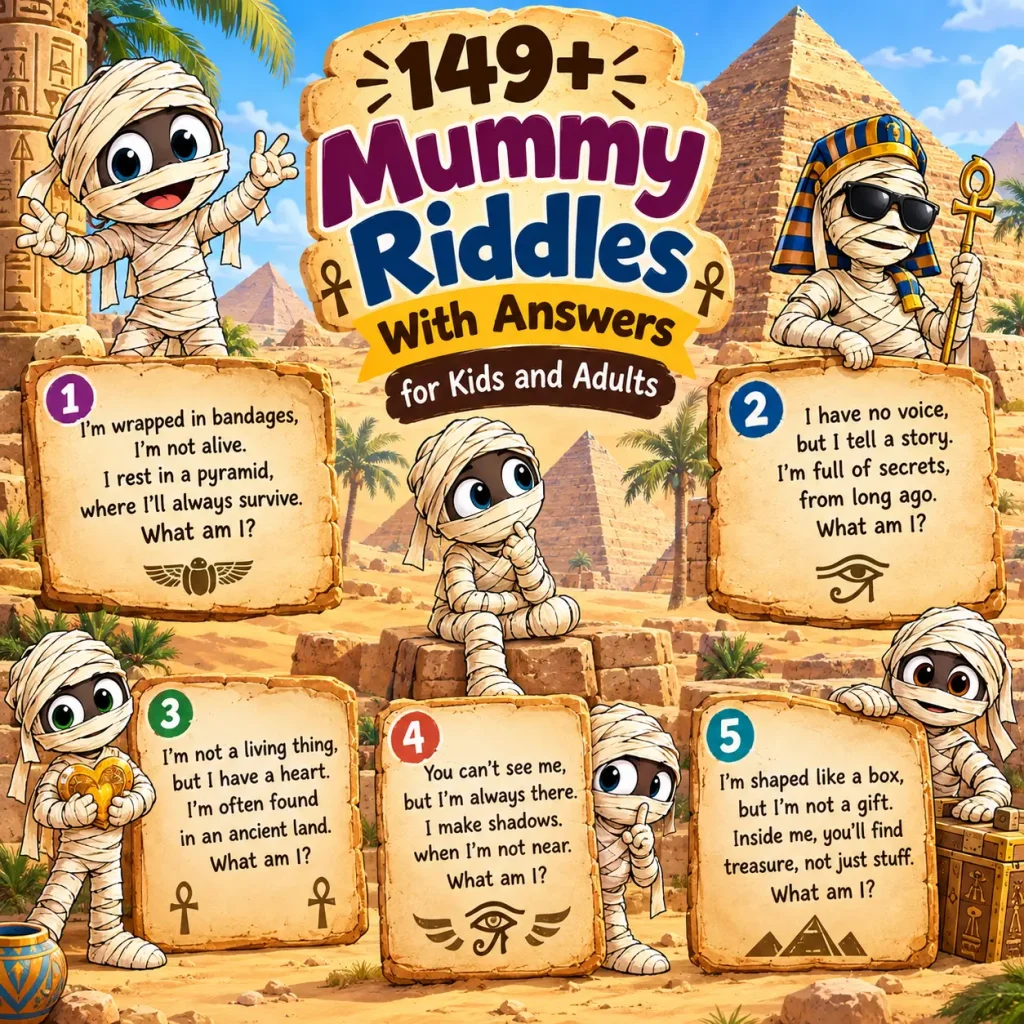
Looking for mummy riddles that are funny, spooky, easy, and challenging? You are in the right place! These mummy riddles with answers are perfect for kids, adults, Halloween parties, classroom activities, and anyone who enjoys a good brain teaser.
From ancient Egyptian tombs to wrapped-up creatures and clever bandage jokes, this collection offers something for every puzzle lover. You will find easy riddles, tricky questions, funny wordplay, and history-inspired puzzles. Each riddle includes an answer and a short explanation to help you understand the clues.
Try solving each question before looking at the answer. You can also challenge your friends, organize a classroom guessing game, or use these puzzles to add some mystery to your Halloween celebration.
Mummy Riddle of the Day
I am wrapped in linen, hidden from sight, and studied by experts to learn about ancient life. What am I?
Explanation: Researchers study mummies and their burial contexts to learn about the health, customs, and lives of people from the past.
Easy Mummy Riddles for Kids
These beginner-friendly mummy riddles use simple words and familiar clues. They are great for children, family game nights, and young readers who are learning to solve puzzles.
Mummy Riddle #1:
I am wrapped from head to toe, and in an ancient tomb I stay. Who am I, with a history that stretches far away?
Answer: A mummy.
Explanation: A mummy is a preserved body, often wrapped in linen in ancient Egypt.
Mummy Riddle #2:
I cover a mummy from its head to its feet. What am I, wrapped around it in every sheet?
Answer: Bandages.
Explanation: Linen bandages were used to wrap many ancient Egyptian mummies.
Mummy Riddle #3:
I am a giant stone home where a pharaoh might lie. I reach toward the desert and the bright blue sky. What am I?
Answer: A pyramid.
Explanation: Ancient Egyptians built pyramids as royal tombs.
Mummy Riddle #4:
I have no living voice, but my story can be told. I have rested for centuries, wrapped in cloth so old. What am I?
Answer: A mummy.
Explanation: Preserved bodies can help researchers learn about people who lived long ago.
Mummy Riddle #5:
I am a room underground where ancient treasures may stay. Explorers search for me when they study yesterday. What am I?
Answer: A tomb.
Explanation: A tomb is a place where a person is buried.
Mummy Riddle #6:
I have a face but cannot smile. I have rested in a tomb for quite a while. What am I?
Answer: A mummy.
Explanation: A mummy may still have recognizable facial features, but it is not alive.
Mummy Riddle #7:
I am a river through Egypt, with water flowing along. Ancient people lived beside me and made their homes strong. What am I?
Answer: The Nile River.
Explanation: The Nile supported farming, travel, and settlements in ancient Egypt.
Mummy Riddle #8:
I hold a mummy’s body and may be made of stone or wood. I am decorated for burial, just as ancient craftspeople would. What am I?
Answer: A sarcophagus.
Explanation: A sarcophagus is a decorated coffin, often made of stone or another durable material.
Mummy Riddle #9:
I have strange picture symbols that can tell a tale. On ancient Egyptian walls, my messages prevail. What am I?
Answer: Hieroglyphs.
Explanation: Hieroglyphs are symbols used in the ancient Egyptian writing system.
Mummy Riddle #10:
I am a ruler from ancient days, and Egypt was my land. My tomb might hold treasures made by a skilled hand. Who am I?
Answer: A pharaoh.
Explanation: Pharaoh was the title used for ancient Egyptian kings.
Mummy Riddle #11:
I am a small jar that once held something precious. Four special guardians protected what I carried. What am I?
Answer: A canopic jar.
Explanation: Ancient Egyptians used canopic jars to hold certain organs during mummification.
Mummy Riddle #12:
I crawl across ancient art with a shiny shell. Egyptians gave me special meaning in stories they tell. What am I?
Answer: A scarab beetle.
Explanation: Scarab beetles were important symbols in ancient Egyptian religion.
Mummy Riddle #13:
I am a black substance that helped preserve the dead. Ancient Egyptians used me during preparation instead. What am I?
Answer: Natron.
Explanation: Natron is a naturally occurring salt mixture used to dry bodies during mummification.
Mummy Riddle #14:
I am a special animal with a jackal-like face. In ancient Egyptian beliefs, I watched over burial places. Who am I?
Answer: Anubis.
Explanation: Anubis was an ancient Egyptian god associated with mummification and funerary practices.
Mummy Riddle #15:
I have no feet, yet I can travel through a museum. People stop to look at me, though I never move. What am I?
Answer: A mummy exhibit.
Explanation: A mummy displayed in a museum can attract visitors without moving.
Mummy Riddle #16:
I am found in a desert, but I am not sand. I am an ancient building made by many hands. What am I?
Answer: A pyramid.
Explanation: Ancient Egyptian pyramids were built by skilled workers using large stone blocks.
Mummy Riddle #17:
I have no heartbeat, but I can teach you about the past. Scientists study my remains to make discoveries that last. What am I?
Answer: A mummy.
Explanation: Researchers can study preserved bodies to learn about ancient people and their lives.
Interesting to Know
- Ancient Egyptians used linen strips to wrap many mummified bodies.
- Natron helped remove moisture during the mummification process.
- Not every mummy came from Egypt; different cultures preserved bodies in different ways.
- The Rosetta Stone helped scholars decipher ancient Egyptian hieroglyphs.
- Mummies can provide evidence about ancient diets, health, and burial customs.
Mummy Riddle #18:
I look like a box, but I am not for toys. I may hold a king from long ago. What am I?
Answer: A coffin.
Explanation: A coffin is used to contain a body for burial.
Mummy Riddle #19:
I am a long piece of cloth, and I wind around and around. I help cover a mummy without making a sound. What am I?
Answer: Linen bandage.
Explanation: Linen strips were used to wrap many mummified bodies.
Mummy Riddle #20:
I am a desert traveler with a hump on my back. I can cross hot sands and carry things in a pack. What am I?
Answer: A camel.
Explanation: Camels are well adapted to travel across dry desert environments.
Funny Mummy Riddles That Make You Laugh
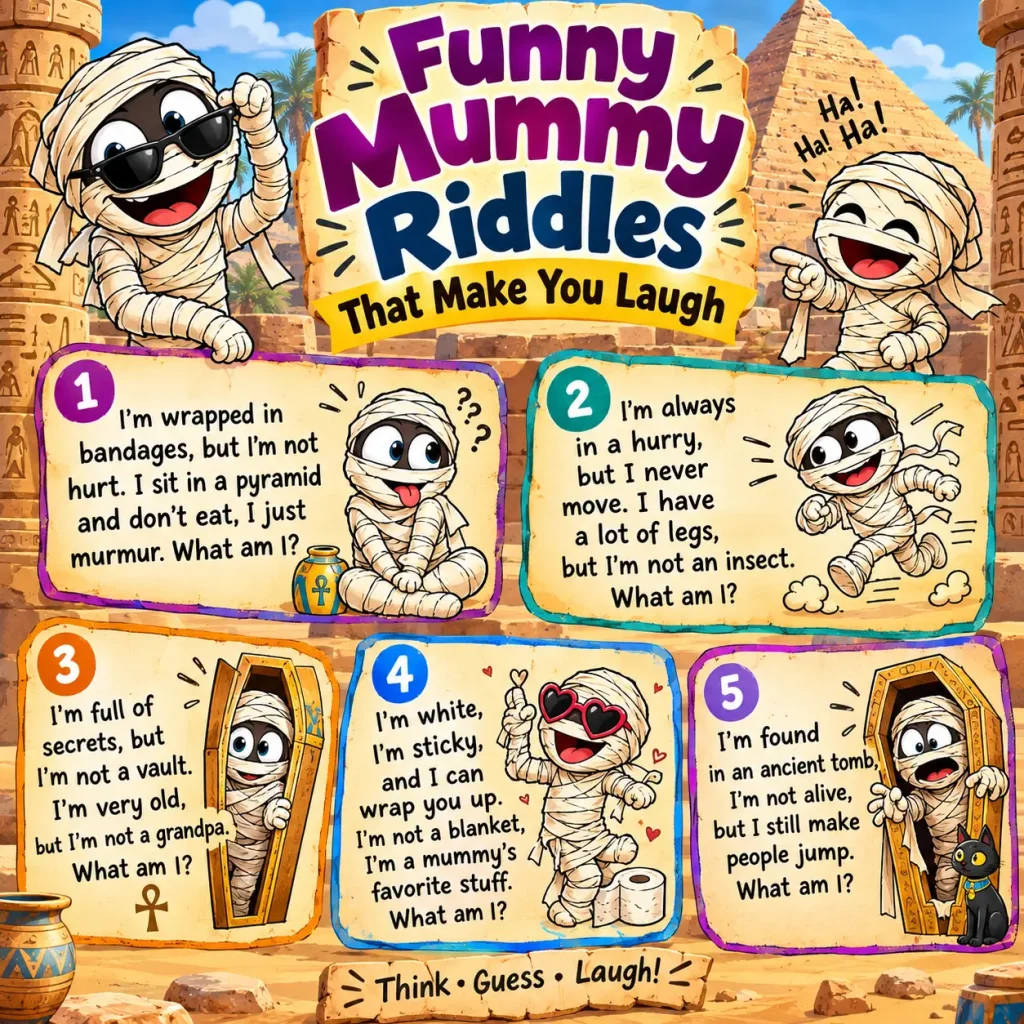
Ready for some wrapped-up wordplay? These funny mummy riddles use silly situations and playful jokes about bandages, ancient tombs, and life after thousands of years.
Mummy Riddle #21:
Why did the mummy avoid the swimming pool?
Answer: He did not want to unravel his look.
Explanation: Water could loosen the mummy’s imaginary bandages in this joke.
Mummy Riddle #22:
Why was the mummy so calm during the scary movie?
Answer: Nothing could get under his wraps.
Explanation: The joke plays on the phrase “get under your skin” and a mummy’s wrapping.
Mummy Riddle #23:
What is a mummy’s favorite type of music?
Answer: Wrap music.
Explanation: “Wrap” sounds like “rap,” a style of music.
Mummy Riddle #24:
Why did the mummy bring extra bandages to the party?
Answer: He wanted to be well wrapped up.
Explanation: The phrase means both being covered in bandages and being prepared.
Mummy Riddle #25:
What does a mummy say when someone tells a great joke?
Answer: That really cracks me up!
Explanation: The expression is funny because a mummy’s dried wrapping might crack in a cartoon.
Mummy Riddle #26:
Why did the mummy get a job at the gift shop?
Answer: He was great at wrapping presents.
Explanation: Mummies are wrapped in cloth, so gift wrapping seemed like a natural talent.
Mummy Riddle #27:
What is a mummy’s favorite kind of exercise?
Answer: The wrap-around.
Explanation: This made-up exercise name plays on a mummy’s wrapped body.
Mummy Riddle #28:
Why did the mummy refuse to tell a secret?
Answer: He was afraid the story would unravel.
Explanation: “Unravel” means to come apart or reveal something hidden.
Mummy Riddle #29:
What did the mummy say when he forgot where he parked his camel?
Answer: I have lost my desert direction!
Explanation: The joke mixes being lost with a desert setting.
Mummy Riddle #30:
Why did the mummy become a comedian?
Answer: He had a dry sense of humor.
Explanation: The phrase “dry humor” fits a fictional mummy’s dried appearance.
Mummy Riddle #31:
Why was the mummy bad at hide-and-seek?
Answer: His bandages kept giving him away.
Explanation: Loose strips of cloth would make a silly hiding disguise.
Mummy Riddle #32:
What does a mummy use to send a message?
Answer: A wrap-up note.
Explanation: It is a playful twist on the phrase “write-up” or “wrap-up.”
Mummy Riddle #33:
Why did the mummy go to the tailor?
Answer: His outfit was falling apart.
Explanation: The joke imagines his ancient bandages needing repairs.
Mummy Riddle #34:
What is a mummy’s favorite snack at the movies?
Answer: Pop-corn wrapped in mystery.
Explanation: The answer adds a spooky twist to an ordinary movie snack.
Mummy Riddle #35:
Why did the mummy win the costume contest?
Answer: He had the most authentic look.
Explanation: Unlike a modern costume, his wrapping was part of his mummy character.
Mummy Riddle #36:
What did the mummy say when he finished his homework?
Answer: That’s a wrap!
Explanation: “That’s a wrap” means something is finished, and it also refers to his bandages.
Mummy Riddle #37:
Why did the mummy take a map into the pyramid?
Answer: He did not want to get wrapped up in the wrong passage.
Explanation: The joke combines being lost in a maze-like tomb with mummy wrapping.
Mummy Riddle #38:
Why did the mummy never win a race?
Answer: He was always tied up.
Explanation: “Tied up” can mean busy or physically wrapped.
Mummy Riddle #39:
What did the mummy order at the café?
Answer: A cup of brew with a tomb-ble of sugar.
Explanation: This silly answer plays with the word “tomb.”
Mummy Riddle #40:
Why did the mummy bring a notebook to the museum?
Answer: He wanted to keep a wrap sheet.
Explanation: A “rap sheet” is a record of someone’s offenses, while “wrap” fits a mummy.
Short Mummy Riddles for Quick Fun
These short mummy riddles are ideal for quick rounds, social media posts, and guessing games. Read the question aloud and give everyone a few seconds to answer.
Mummy Riddle #41:
I am wrapped in cloth and sleep in a tomb. What am I?
Answer: A mummy.
Explanation: Mummies are often associated with wrapped bodies and ancient tombs.
Mummy Riddle #42:
What building has three triangular sides meeting at a point and is famous in Egypt?
Answer: A pyramid.
Explanation: Egyptian pyramids are known for their triangular faces and monumental size.
Mummy Riddle #43:
What do you call an ancient Egyptian king?
Answer: A pharaoh.
Explanation: Pharaoh was the title of Egypt’s rulers.
Mummy Riddle #44:
What cloth was commonly used to wrap Egyptian mummies?
Answer: Linen.
Explanation: Linen was made from flax fibers and used in ancient Egyptian burial practices.
Mummy Riddle #45:
What is a mummy’s ancient resting place called?
Answer: A tomb.
Explanation: A tomb is a burial place.
Mummy Riddle #46:
What river flows through Egypt and helped ancient farms grow?
Answer: The Nile.
Explanation: The Nile supplied water and fertile soil for farming.
Mummy Riddle #47:
What writing system used picture-like symbols in ancient Egypt?
Answer: Hieroglyphs.
Explanation: Hieroglyphs were used to record words and ideas.
Mummy Riddle #48:
What do archaeologists study to learn about ancient civilizations?
Answer: Artifacts and remains.
Explanation: Objects and physical remains can provide evidence about past societies.
Mummy Riddle #49:
What insect was a powerful symbol in ancient Egyptian culture?
Answer: The scarab beetle.
Explanation: Scarabs were associated with ideas such as renewal and protection.
Mummy Riddle #50:
What do you call the process of preserving a body after death?
Answer: Mummification.
Explanation: Mummification is a preservation process used in several cultures.
Mummy Riddle #51:
What does a mummy wear all around its body?
Answer: Bandages.
Explanation: Wrapping was part of many ancient Egyptian mummification practices.
Mummy Riddle #52:
What is a coffin made especially to hold a body called when it is a decorated stone container?
Answer: A sarcophagus.
Explanation: Sarcophagi were used in some ancient Egyptian burials.
Mummy Riddle #53:
What animal has a hump and travels well in the desert?
Answer: A camel.
Explanation: Camels can survive in dry environments and carry loads.
Mummy Riddle #54:
What do we call a person who studies ancient objects and sites?
Answer: An archaeologist.
Explanation: Archaeologists investigate evidence from past human life.
Mummy Riddle #55:
What is a room beneath the ground that may hold an ancient burial?
Answer: A burial chamber.
Explanation: Some tombs contain chambers built to hold a burial.
Mummy Riddle #56:
What do we call a puzzle with clues and a hidden answer?
Answer: A riddle.
Explanation: A riddle asks a question that requires thinking to solve.
Mummy Riddle #57:
What ancient Egyptian god is often shown with a jackal-like head?
Answer: Anubis.
Explanation: Anubis was connected with mummification and burial customs.
Mummy Riddle #58:
What do you call a preserved body displayed for visitors to study?
Answer: A mummy exhibit.
Explanation: Museums sometimes display mummies as part of historical collections.
Mummy Riddle #59:
What is a dry region with very little rainfall, like much of Egypt?
Answer: A desert.
Explanation: Deserts receive very little precipitation compared with wetter regions.
Mummy Riddle #60:
What do we call a clue that helps solve a mystery?
Answer: A hint.
Explanation: Hints guide people toward an answer without giving everything away.
Tricky Mummy Riddles to Test Your Brain
These medium-difficulty riddles require careful reading. Some depend on wordplay, while others ask you to think about objects and situations from a different angle.
Mummy Riddle #61:
I have a thousand years of stories but never speak. You can learn about my past without hearing me squeak. What am I?
Answer: An ancient artifact.
Explanation: Objects from the past can reveal information even though they cannot speak.
Mummy Riddle #62:
A mummy enters a room with no windows and one locked door. There is a mirror, a table, and a candle. How can the mummy see?
Answer: The mummy can see its reflection in the mirror if there is enough light.
Explanation: The mirror reflects light and images, but the riddle does not guarantee that the candle is lit. The answer depends on the room having a light source.
Mummy Riddle #63:
I have a top but no head, a base but no feet, and I may stand in a desert for thousands of years. What am I?
Answer: An ancient monument.
Explanation: A monument can have a top and base without having a head or feet.
Mummy Riddle #64:
The more you remove from an ancient tomb, the more evidence you may discover. What are you removing?
Answer: Layers of sand and soil.
Explanation: Archaeologists carefully uncover buried sites to study what lies beneath them.
Mummy Riddle #65:
I can be written on a wall, carved into stone, or painted on a coffin. I share a message without making a sound. What am I?
Answer: An inscription.
Explanation: An inscription is writing carved, engraved, or written on a surface.
Mummy Riddle #66:
A mummy has two bandages in one hand and three in the other. How many bandages does it have altogether?
Answer: Five bandages.
Explanation: Two plus three equals five. Sometimes a simple counting question appears inside a spooky story.
Mummy Riddle #67:
I can be ancient without being a mummy, and I can be valuable without being made of gold. What am I?
Answer: An artifact.
Explanation: An artifact is an object made or used by people in the past.
Mummy Riddle #68:
A tomb has four corners. A cat sits in each corner, and each cat sees three other cats. How many cats are there?
Answer: Four cats.
Explanation: Each corner has one cat, and every cat can see the other three.
Mummy Riddle #69:
I can open a locked door, but I am not a key. I can solve a mystery, but I am not a detective. What am I?
Answer: A clue.
Explanation: A clue can help someone discover a password, combination, or solution.
Mummy Riddle #70:
I am full of ancient writing, but I am not a book. I may cover the walls of a tomb. What am I?
Answer: A wall inscription.
Explanation: Tomb walls sometimes contain carved or painted texts.
Mummy Riddle #71:
You see a mummy in a photograph, but the mummy is not inside your room. What are you looking at?
Answer: An image of a mummy.
Explanation: A photograph shows a subject without bringing the real object into the room.
Mummy Riddle #72:
I become easier to understand when someone explains me, but I do not change my words. What am I?
Answer: A riddle.
Explanation: An explanation can make a riddle’s meaning clearer without changing its wording.
Mummy Riddle #73:
I can be buried for centuries and still help people learn about the past. What am I?
Answer: An ancient artifact.
Explanation: Archaeologists study preserved objects to understand past cultures.
Mummy Riddle #74:
A mummy walks into a room and sees three doors. One leads to a library, one to a garden, and one to a museum. Which door leads to the most historical objects?
Answer: The museum door.
Explanation: Museums often display historical objects, although libraries can also hold valuable historical materials.
Mummy Riddle #75:
I can be broken without being touched, and I can be kept without being held. What am I?
Answer: A promise.
Explanation: A promise can be broken by failing to keep it, and it can be kept by honoring it.
Hard Mummy Riddles for Adults
Ready for a greater challenge? These riddles mix logic, language, archaeology, and ancient Egyptian themes. Take your time and read every clue carefully.
Mummy Riddle #76:
A sealed tomb contains three boxes labeled Gold, Linen, and Scrolls. Every label is wrong. You may open one box and inspect one item. How can you begin correcting the labels?
Answer: Open the box labeled Gold and inspect its contents.
Explanation: Since every label is wrong, the box labeled Gold cannot contain gold. Its actual contents give you a starting point for correcting the labels. You would need the remaining labeling constraints to determine every box with certainty.
Mummy Riddle #77:
I am a number of letters found in the word “mummy.” Remove one letter and I become a word meaning “myself.” What letter do you remove?
Answer: There is no valid solution as written.
Explanation: Removing one letter from “mummy” does not produce a standard English word meaning “myself.” A fair riddle must have a verifiable answer.
Mummy Riddle #78:
An archaeologist finds a room with no windows and a sealed door. Inside is a lamp, but there is no fire or electricity. What must the archaeologist check before assuming the room was always dark?
Answer: Whether another light source or opening existed in the past.
Explanation: Present-day conditions do not prove that a room always had the same features.
Mummy Riddle #79:
I can preserve a clue, hide a clue, or destroy a clue. I am not a person, yet I can change what future researchers discover. What am I?
Answer: Time.
Explanation: Time can affect how materials survive, decay, or become buried.
Mummy Riddle #80:
A mummy has four sealed jars. One contains a clue, while the other three are empty. You can weigh the jars but cannot open them. What should you do first?
Answer: Compare their weights.
Explanation: If the clue is heavier than the empty jars, weighing may help identify it. If all jars weigh the same, weight alone cannot solve the puzzle.
Mummy Riddle #81:
I am not alive, yet I can tell you what someone ate, where they lived, and sometimes what illness they had. What am I?
Answer: Preserved human remains.
Explanation: Scientific analysis can reveal information about diet, living conditions, and some diseases.
Mummy Riddle #82:
A chamber has two passages. One leads outside, and the other leads deeper underground. A sign gives a clue, but the sign may be false. What should a careful explorer do before choosing?
Answer: Look for additional evidence.
Explanation: One uncertain clue is not enough to establish which passage is safe or correct.
Mummy Riddle #83:
I am a record of the past, but I may contain missing pages. Researchers can study me, yet they must not assume I tell the whole story. What am I?
Answer: A historical record.
Explanation: Historical sources can be incomplete and should be compared with other evidence.
Mummy Riddle #84:
You find a sealed container labeled “Royal Jewelry.” You have not opened it. Can you conclude that it contains gold?
Answer: No.
Explanation: A label is a claim, not proof of what the container holds.
Mummy Riddle #85:
I can be a king’s final home, but I am not a house. I can contain art and inscriptions, but I am not a gallery. What am I?
Answer: A royal tomb.
Explanation: Royal tombs were burial places that could include artwork, inscriptions, and funerary objects.
Mummy Riddle #86:
A secret code has three digits. The first digit is one greater than the second, the third is twice the second, and the digits add up to nine. What is the code?
Answer: 324.
Explanation: The second digit is 2, the first is 3, and the third is 4. Together, they add up to nine.
Mummy Riddle #87:
A mummy’s wrapping is old, but the story of its discovery is new. Which story might help historians more: a tale with no evidence or a documented excavation?
Answer: The documented excavation.
Explanation: Records, photographs, and careful notes allow researchers to verify how an object was found.
Mummy Riddle #88:
I can be copied perfectly but still fail to be the original. What am I?
Answer: A replica.
Explanation: A replica can look like an original artifact without being the historical object itself.
Mummy Riddle #89:
Two artifacts look alike. One was found in a recorded excavation, and the other has no known history. Which is easier to study reliably?
Answer: The artifact from the recorded excavation.
Explanation: Its documented context helps researchers understand where it came from and how it was used.
Mummy Riddle #90:
I may be hidden beneath sand, but sand is not my only covering. I can be protected by walls, sealed chambers, or layers of earth. What am I?
Answer: An archaeological site.
Explanation: Buried sites may contain several layers of material built up over time.
Halloween Mummy Riddles for Parties
Use these spooky but friendly riddles for costume parties, school events, and family Halloween games. They focus on mystery rather than frightening details.
Mummy Riddle #91:
I shuffle through the hallway wearing strips of white. Everyone laughs when I appear on Halloween night. Who am I?
Answer: A mummy costume.
Explanation: Mummy costumes are popular Halloween outfits made with bandage-like strips.
Mummy Riddle #92:
I glow beside a doorway and look spooky at night. I am carved from a vegetable and shine with a light. What am I?
Answer: A jack-o’-lantern.
Explanation: A carved pumpkin is often used as a Halloween decoration.
Mummy Riddle #93:
I am full of treats, but I am not a bakery. Children carry me around on Halloween. What am I?
Answer: A trick-or-treat bag.
Explanation: Children often collect candy in bags or buckets during Halloween.
Mummy Riddle #94:
I am a tiny paper creature with a wrapped-up face. I decorate a classroom or a party space. What am I?
Answer: A paper mummy decoration.
Explanation: Paper crafts can be made into simple mummy decorations.
Mummy Riddle #95:
I have no voice, but I make people scream when I suddenly appear in a haunted house. What am I?
Answer: A jump scare.
Explanation: A jump scare is a sudden surprise used to startle an audience.
Mummy Riddle #96:
I come in black and orange, and I can hang across a wall. I help make a Halloween party look spooky to all. What am I?
Answer: Halloween decorations.
Explanation: Decorations help create a festive atmosphere for Halloween.
Mummy Riddle #97:
I have eight legs and spin a home, but I am not a mummy and never roam. What am I?
Answer: A spider.
Explanation: Spiders make webs that can be used as spooky Halloween decorations.
Mummy Riddle #98:
I float in a story but cannot fly like a bird. I am a ghostly character without a spoken word. What am I?
Answer: A ghost.
Explanation: Ghosts are fictional or supernatural characters often featured in Halloween stories.
Mummy Riddle #99:
I am a small sweet hidden in a bowl. You may collect me while dressed as a troll. What am I?
Answer: Halloween candy.
Explanation: Candy is a familiar treat during trick-or-treating.
Mummy Riddle #100:
I have a pointy hat and may ride a broom. I appear in spooky tales and sometimes a magical room. Who am I?
Answer: A witch.
Explanation: Witches are common characters in Halloween folklore and fiction.
Mummy Riddle #101:
I cover a mummy’s body, but I am not a blanket. I am wrapped around and around. What am I?
Answer: Bandages.
Explanation: Bandages are the defining feature of many mummy costumes.
Mummy Riddle #102:
I am a game where you search for clues, solve puzzles, and race against a clock. What am I?
Answer: An escape room.
Explanation: Escape rooms challenge players to solve puzzles and discover clues within a time limit.
Mummy Riddle #103:
I am a paper invitation that asks you to join a spooky event. What am I?
Answer: A Halloween party invitation.
Explanation: Invitations tell guests when and where a party will take place.
Also read : 150+ Zombie Riddles to Test Your Brain Power!
Mummy Riddle #104:
I can be a mask, a cape, or a wrapped outfit. People wear me to become a character for one night. What am I?
Answer: A costume.
Explanation: Costumes let people dress as fictional, historical, or imaginative characters.
Mummy Riddle #105:
I am a dark shape on a wall, but I disappear when the light changes. What am I?
Answer: A shadow.
Explanation: Shadows change when the position of a light source or object changes.
Mummy Riddles for Classroom Activities
These classroom-friendly riddles can support vocabulary practice, critical thinking, and group discussions. Teachers can ask students to explain which clues helped them choose each answer.
Mummy Riddle #106:
I study ancient objects and investigate sites from long ago. What is my job?
Answer: Archaeologist.
Explanation: Archaeologists study evidence of past human life.
Mummy Riddle #107:
I am the study of past events, people, and civilizations. What subject am I?
Answer: History.
Explanation: History helps us understand how people lived and how societies changed.
Mummy Riddle #108:
A clock takes six seconds to strike six times. If the time between each strike stays the same, how long does it take to strike twelve times?
Answer: 13.2 seconds.
Explanation: Six strikes have five intervals. Each interval lasts 1.2 seconds, so twelve strikes have eleven intervals, taking 13.2 seconds.
Mummy Riddle #109:
Move each letter in the code DBU one step backward in the alphabet. What word do you get?
Answer: CAT.
Explanation: D becomes C, B becomes A, and U becomes T.
Mummy Riddle #110:
I have many pages and can hold information about ancient Egypt. What am I?
Answer: A history book.
Explanation: History books organize information about past events and civilizations.
Mummy Riddle #111:
I am a five-letter word. Remove my first and last letters, and the remaining three letters spell a word meaning “ten.” What am I?
Answer: Stone.
Explanation: Removing S and E from STONE leaves TON.
Mummy Riddle #112:
I show the location of places using symbols, lines, and labels. What am I?
Answer: A map.
Explanation: Maps represent places and features in a simplified form.
Mummy Riddle #113:
I am made from the remains of plants and can be used to make linen cloth. What am I?
Answer: Flax.
Explanation: Linen is made from fibers obtained from the flax plant.
Mummy Riddle #114:
I am a person who carefully examines objects to learn what they reveal about the past. What am I?
Answer: A researcher.
Explanation: Researchers use evidence and reliable methods to investigate questions.
Mummy Riddle #115:
I am a drawing or model that helps explain how something looked long ago. What am I?
Answer: A reconstruction.
Explanation: Reconstructions use available evidence to represent a past object or setting.
Mummy Riddle #116:
I can be measured, compared, and placed in order to show which event happened first. What am I?
Answer: Time.
Explanation: Timelines use dates and time to organize historical events.
Mummy Riddle #117:
I am a mark left behind by a person, animal, or object. Archaeologists may study me to learn about the past. What am I?
Answer: A trace.
Explanation: Traces can provide evidence of earlier activity.
Mummy Riddle #118:
A three-digit code has digits that add up to nine. The first digit is twice the second, and the third is one less than the first. What is the code?
Answer: There is no whole-number solution as written.
Explanation: If the second digit is x, the first is 2x and the third is 2x−1. Their sum is 5x−1=9, giving x=2, so the code is 414.
Read More : 150+ Mystery Riddles That Will Keep Them Guessing!
Mummy Riddle #119:
You have a five-liter jug and a three-liter jug, with no measuring marks. How can you measure exactly four liters?
Answer: Fill the five-liter jug and pour into the three-liter jug until it is full. Empty the three-liter jug, then pour the remaining two liters into it. Refill the five-liter jug and pour one liter into the three-liter jug to fill it, leaving four liters in the five-liter jug.
Explanation: Using the two jug capacities, you can measure the remaining amount without markings.
Mummy Riddle #120:
I can be a real object, a written record, or a scientific result used to support a conclusion. What am I?
Answer: Evidence.
Explanation: Evidence helps people evaluate claims and reach informed conclusions.
Ancient Egypt Riddles About Mummies
Discover the history behind the mystery! These educational riddles explore ancient Egyptian beliefs, burial objects, writing, and the methods used to preserve bodies.
Mummy Riddle #121:
I am a mixture of natural salts used to dry bodies during ancient Egyptian mummification. What am I?
Answer: Natron.
Explanation: Natron helped remove moisture from the body during the mummification process.
Mummy Riddle #122:
I am a decorated container that can protect a body after death. Some examples were made from stone. What am I?
Answer: A sarcophagus.
Explanation: Sarcophagi were used as burial containers in ancient Egypt and other cultures.
Mummy Riddle #123:
I have four special sons in ancient Egyptian religion, and I am associated with the protection of organs. What am I describing?
Answer: The Four Sons of Horus.
Explanation: These four figures were linked with the protection of organs placed in canopic jars.
Mummy Riddle #124:
I am a writing system that uses symbols and pictures. You may see me carved on ancient Egyptian monuments. What am I?
Answer: Egyptian hieroglyphs.
Explanation: Ancient Egyptians used hieroglyphs for religious texts, inscriptions, and other written messages.
Mummy Riddle #125:
I was a famous Egyptian queen whose name is connected with a beautifully decorated tomb discovered in the Valley of the Kings. Who am I?
Answer: Nefertari.
Explanation: Nefertari was a queen of ancient Egypt known for her richly decorated tomb in the Valley of the Queens.
Mummy Riddle #126:
I am a famous young pharaoh whose tomb was discovered largely intact in 1922. Who am I?
Answer: Tutankhamun.
Explanation: Howard Carter and his team discovered Tutankhamun’s tomb in the Valley of the Kings.
Mummy Riddle #127:
I am the ancient Egyptian god often associated with the weighing of the heart after death. Who am I?
Answer: Anubis.
Explanation: Anubis is commonly depicted in scenes connected with funerary rituals and the weighing of the heart.
Mummy Riddle #128:
I am a plant whose fibers were used to make linen, a fabric found in many ancient Egyptian burial practices. What am I?
Answer: Flax.
Explanation: Linen was made from flax fibers and was used for clothing and mummy wrapping.
Mummy Riddle #129:
I am a famous stone with the same message written in different scripts, helping researchers understand Egyptian hieroglyphs. What am I?
Answer: The Rosetta Stone.
Explanation: The Rosetta Stone helped scholars decipher ancient Egyptian hieroglyphs.
Mummy Riddle #130:
I am a place in Egypt famous for royal tombs cut into rock. Many pharaohs were buried here. What am I?
Answer: The Valley of the Kings.
Explanation: The site contains many tombs of rulers and nobles from ancient Egypt’s New Kingdom.
Mummy Riddle #131:
I am an ancient Egyptian god associated with the afterlife and often shown as a green-skinned figure. Who am I?
Answer: Osiris.
Explanation: Osiris was an important god associated with the afterlife, renewal, and kingship.
Mummy Riddle #132:
I am a large monument with a lion’s body and a human head near the pyramids at Giza. What am I?
Answer: The Great Sphinx of Giza.
Explanation: The Great Sphinx is one of Egypt’s best-known ancient monuments.
Mummy Riddle #133:
I am a sacred symbol shaped like a cross with a loop at the top. Ancient Egyptian art often shows gods holding me. What am I?
Answer: The ankh.
Explanation: The ankh was a symbol associated with life in ancient Egyptian culture.
Mummy Riddle #134:
I am a long strip of material made from a plant and used for writing in ancient Egypt. What am I?
Answer: Papyrus.
Explanation: Papyrus was made from the papyrus plant and used as a writing surface.
Mummy Riddle #135:
I am a large ancient Egyptian temple complex on the east bank of the Nile near Luxor. What am I?
Answer: Karnak Temple.
Explanation: Karnak is a vast religious complex built and expanded over many centuries.
Mummy Riddles With Hints
Want to solve a puzzle without immediately seeing its answer? Read Hint 1 first. If you are still stuck, try Hint 2 before checking the solution.
Mummy Riddle #136:
I help preserve a body by removing moisture. Ancient Egyptians used me before wrapping the dead. What am I?
Hint 1: I am a natural substance.
Hint 2: My name begins with N.
Answer: Natron.
Explanation: Natron is a naturally occurring salt mixture used to dry bodies during mummification.
Mummy Riddle #137:
I am a ruler whose tomb became one of the most famous archaeological discoveries in history. Who am I?
Hint 1: I was a young Egyptian pharaoh.
Hint 2: My tomb was discovered in 1922.
Answer: Tutankhamun.
Explanation: His tomb contained a remarkable collection of funerary objects.
Mummy Riddle #138:
I am a decorated container for the dead, sometimes made from stone and carved with images. What am I?
Hint 1: I am not usually a small jar.
Hint 2: My name begins with S.
Answer: A sarcophagus.
Explanation: A sarcophagus is a coffin or burial container, often made from stone.
Mummy Riddle #139:
I am an ancient Egyptian writing system made of symbols. What am I?
Hint 1: You may find me on temple walls.
Hint 2: My name begins with H.
Answer: Hieroglyphs.
Explanation: Hieroglyphs were used to write words and ideas in ancient Egypt.
Mummy Riddle #140:
I am a famous river that helped ancient Egyptian civilization flourish. What am I?
Hint 1: I flow through northeastern Africa.
Hint 2: My name begins with N.
Answer: The Nile River.
Explanation: The Nile supported farming, transport, and settlements in ancient Egypt.
Mummy Riddle #141:
I appear once in the word “year,” twice in “week,” and never in “day.” What am I?
Answer: The letter E.
Explanation: “Year” contains one E, “week” contains two Es, and “day” contains none.
Mummy Riddle #142:
I am a three-digit code. My first digit is twice the second, my third is one less than the first, and all three digits add up to nine. What am I?
Answer: 423.
Explanation: The first digit is 4, the second is 2, and the third is 3. Their sum is nine.
Mummy Riddle #143:
I am a symbol of life often held by ancient Egyptian gods in artwork. What am I?
Hint 1: I have a loop at the top.
Hint 2: My name begins with A.
Answer: Ankh.
Explanation: The ankh was an ancient Egyptian symbol associated with life.
Mummy Riddle #144:
I am a stone that helped scholars understand ancient Egyptian writing. What am I?
Hint 1: I was found in 1799.
Hint 2: My name begins with R.
Answer: The Rosetta Stone.
Explanation: Its inscriptions helped scholars decipher hieroglyphs.
Mummy Riddle #145:
I am an ancient Egyptian god linked with the afterlife and resurrection. What am I?
Hint 1: I am often shown with green skin.
Hint 2: My name begins with O.
Answer: Osiris.
Explanation: Osiris was an important god associated with the afterlife and renewal.
Mummy Riddle #146:
I am a giant statue with a lion’s body and a human head. What am I?
Hint 1: I stand near the Giza pyramids.
Hint 2: My name includes the word “Sphinx.”
Answer: The Great Sphinx of Giza.
Explanation: This famous monument combines human and lion features.
How to Create Your Own Mummy Riddles
You can make your own mummy riddles with a few simple steps.
- Choose a subject: Start with a mummy, pyramid, pharaoh, bandage, tomb, or ancient artifact.
- Write three clues: Include a feature, a location, and an unusual detail.
- Add a twist: Use wordplay or a surprising connection to make the riddle more interesting.
- Check the answer: Make sure the clues point to a clear and logical solution.
- Test it on someone: Ask a friend or family member to solve it without help.
For example, if your subject is a pyramid, you might write: “I rise from the desert, have triangular sides, and once served as a royal tomb. What am I?” The answer is a pyramid.
Frequently Asked Questions
What are mummy riddles?
Mummy riddles are puzzles inspired by mummies, ancient Egyptian history, bandages, tombs, pyramids, and spooky fictional characters. They can be funny, educational, or challenging.
What is an easy mummy riddle for kids?
I am wrapped from head to toe and rest in an ancient tomb. What am I?
Answer: A mummy.
What are some funny mummy riddles?
Funny mummy riddles use wordplay about bandages, wrapping, and ancient adventures. For example, why did the mummy get a job at the gift shop?
Answer: Because he was great at wrapping presents!
Are mummy riddles suitable for Halloween parties?
Yes! Family-friendly mummy riddles work well for Halloween parties, classroom activities, treasure hunts, and guessing games. You can give points for correct answers or offer hints to make the game easier.
How do you make a mummy riddle more challenging?
Use clues that require logical thinking, wordplay, or knowledge of ancient Egyptian objects. Make sure the clues still lead to a clear answer.
What is the difference between a mummy and a zombie?
A mummy is a preserved body, often associated with ancient burial practices. A zombie is a fictional or folkloric figure usually portrayed as an animated dead person.
What ancient Egyptian objects can inspire mummy riddles?
You can create riddles about pyramids, sarcophagi, canopic jars, linen bandages, hieroglyphs, papyrus, scarab beetles, and the Rosetta Stone.
Four Bonus Mummy Riddles
Mummy Riddle #147:
I have a loop at the top and represent life in ancient Egyptian art. What am I?
Answer: An ankh.
Explanation: The ankh was a symbol associated with life in ancient Egypt.
Mummy Riddle #148:
I am a written message carved into stone. I can tell a story long after the writer is gone. What am I?
Answer: An inscription.
Explanation: Inscriptions preserve names, messages, and other information on surfaces such as stone walls.
Mummy Riddle #149:
I am a plant-based material that ancient Egyptians used to make a writing surface. What am I?
Answer: Papyrus.
Explanation: Papyrus was made from a plant that grew in wet areas near the Nile.
Mummy Riddle #150:
I am a place filled with ancient objects, but I am not a tomb. Visitors come to learn about the past. What am I?
Answer: A museum.
Explanation: Museums preserve and display objects that help people learn about history and culture.
Final Thoughts
Mummy riddles bring together humor, mystery, history, and brain-teasing fun. Whether you are looking for easy riddles for kids, tricky challenges for adults, or spooky questions for Halloween, these puzzles offer plenty of ways to keep everyone entertained.
Try answering the riddles before reading the solutions, then challenge your friends to see who can solve the most. You can also use the ancient Egypt riddles for classroom activities and introduce children to historical objects through playful questions.