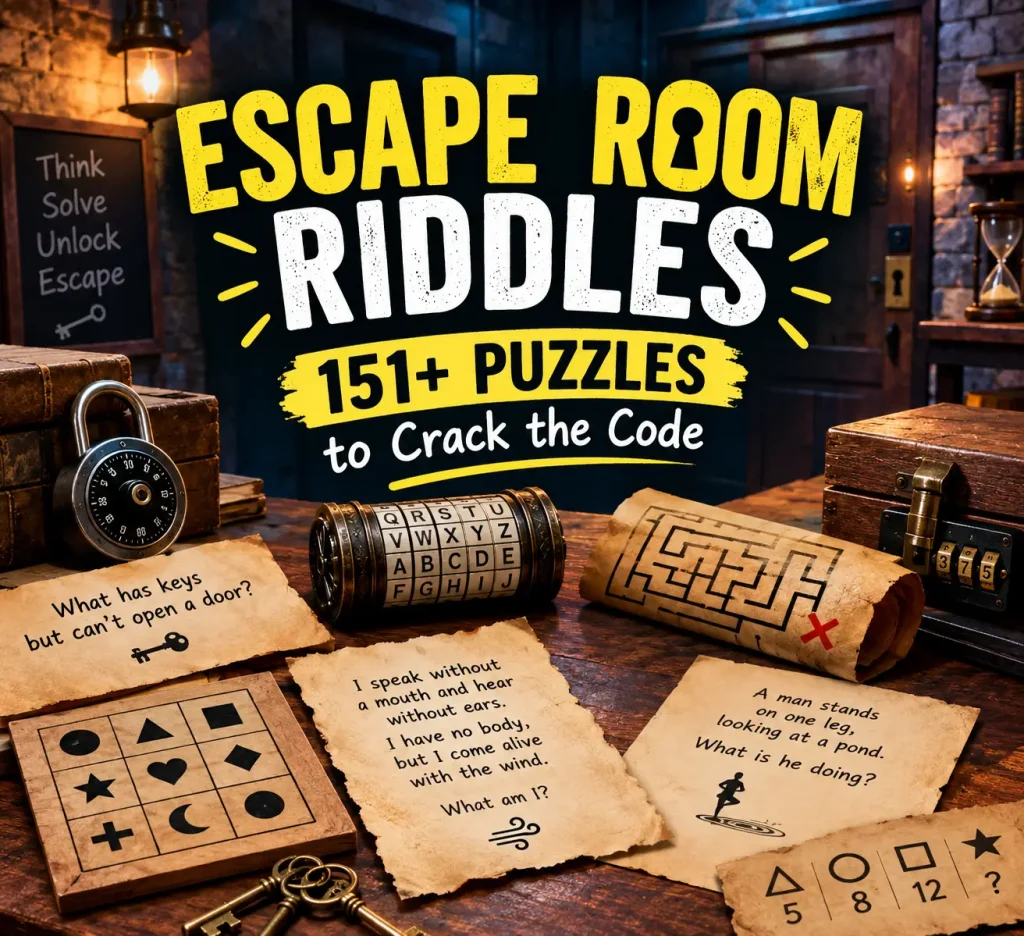
Escape room riddles turn an ordinary game into an exciting adventure filled with secret codes, hidden clues, mysterious objects, and clever challenges. Each puzzle gives you a chance to think like a detective and discover the solution before time runs out.
Whether you are planning a family game night, organizing a classroom activity, or looking for difficult brain teasers, these escape room riddles offer something for everyone. You will find easy puzzles for beginners, tricky mysteries, number codes, hidden messages, and challenging riddles for adults.
Every riddle includes an answer and an explanation to help you understand the logic behind the solution. Some challenges also include hints, so you can test your skills before revealing the answer.
Ready to unlock the mystery? Start with the easy riddles and work your way toward the hardest escape room challenges.
What are escape room riddles?
Escape room riddles are puzzles that challenge players to solve clues, recognize patterns, decode messages, and discover answers to progress through a game. They often involve keys, locked boxes, secret numbers, hidden objects, or mysterious messages. Players use observation, logic, and teamwork to solve each challenge and reach the final goal.
Riddle of the Day
I have cities without houses, forests without trees, and rivers without water. What am I?
Explanation: A map shows cities, forests, and rivers using symbols and markings rather than real buildings, trees, or water.
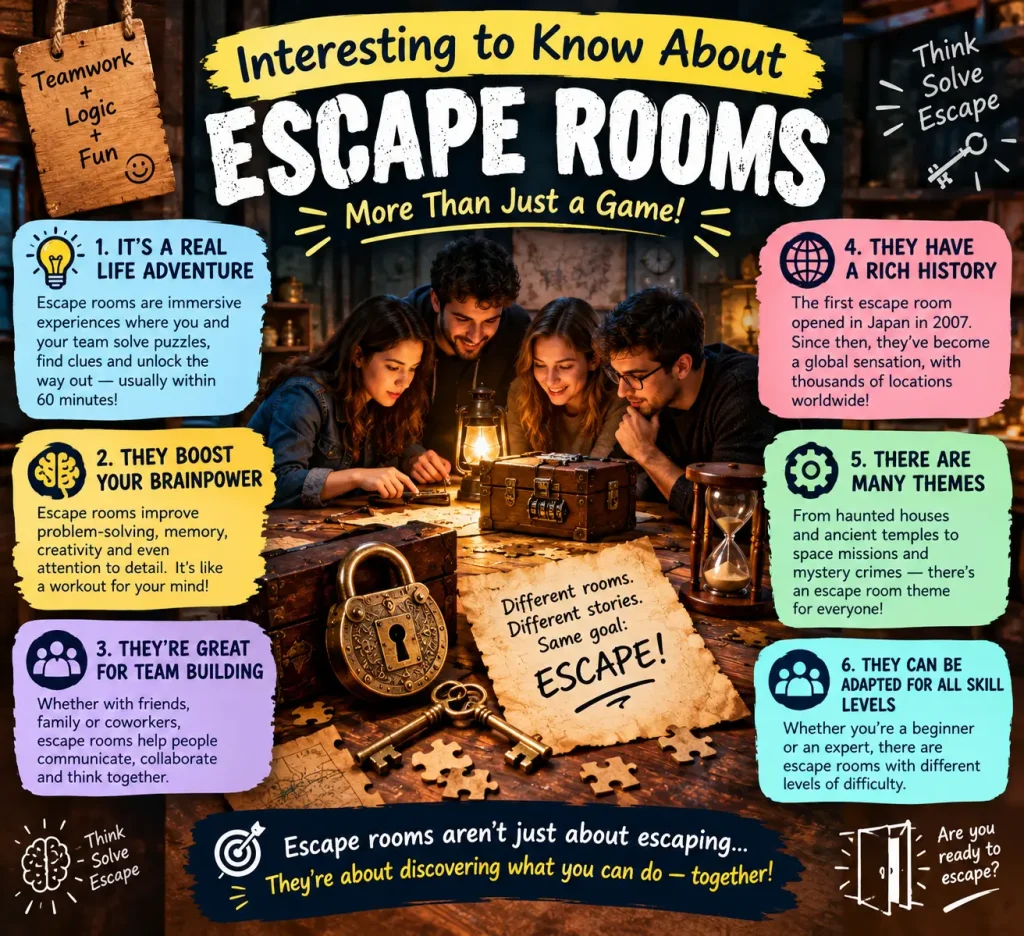
Interesting to Know About Escape Rooms
- Escape rooms usually give players 30–60 minutes to solve puzzles.
- Players use clues, riddles, and secret codes to unlock challenges.
- Teamwork helps players solve difficult puzzles faster.
- Hidden objects may reveal important clues.
- Escape rooms improve logical thinking and problem-solving skills.
Escape Room Riddles
Escape Room Riddle #1:
I have keys but no open locks. I have space but no room. You can enter, but you cannot walk inside. What am I?
Answer: A keyboard.
Explanation: A keyboard has keys, a space bar, and an Enter key, but it cannot open physical locks or rooms.
Escape Room Riddle #2:
The more you take from me, the bigger I become. What am I?
Answer: A hole.
Explanation: Removing more dirt or material makes a hole larger.
Escape Room Riddle #3:
I speak without a mouth and answer without thinking. I repeat your words when you call. What am I?
Answer: An echo.
Explanation: An echo repeats sound after it bounces off a surface.
Escape Room Riddle #4:
I have hands but cannot clap. I have a face but cannot smile. What am I?
Answer: A clock.
Explanation: A clock has a face and hands that show the time.
Escape Room Riddle #5:
I get shorter every time I help you see in the dark. What am I?
Answer: A candle.
Explanation: A burning candle gradually becomes shorter as its wax melts.
Escape Room Riddle #6:
I have many teeth but never bite. You use me to make messy hair neat. What am I?
Answer: A comb.
Explanation: A comb has teeth that separate and smooth strands of hair.
Escape Room Riddle #7:
I have a neck but no head. You can fill me with water, but I cannot drink. What am I?
Answer: A bottle.
Explanation: A bottle has a neck and can hold water, but it is not alive.
Escape Room Riddle #8:
I become wet while making something else dry. What am I?
Answer: A towel.
Explanation: A towel absorbs water from wet objects and becomes wet itself.
Escape Room Riddle #9:
I have cities but no people, roads but no cars, and rivers but no fish. What am I?
Answer: A map.
Explanation: A map represents geographical features without containing the real places or living things.
Escape Room Riddle #10:
I have one eye but cannot see. I help you join pieces of cloth together. What am I?
Answer: A needle.
Explanation: A sewing needle has an eye where thread passes through, but it cannot see.
Escape Room Riddle #11:
You must break me before you can use what is inside. What am I?
Answer: An egg.
Explanation: You usually crack an eggshell before using the egg inside.
Escape Room Riddle #12:
I travel around the world while staying in one corner. What am I?
Answer: A postage stamp.
Explanation: A stamp stays in the corner of an envelope while the envelope travels.
Escape Room Riddle #13:
I have pages but no voice. I hold stories but cannot tell them aloud. What am I?
Answer: A book.
Explanation: A book contains written stories that readers can explore silently or read aloud.
Escape Room Riddle #14:
I have a ring but no finger. I can alert everyone without speaking a word. What am I?
Answer: A telephone.
Explanation: A telephone can ring to signal an incoming call.
Escape Room Riddle #15:
I disappear as soon as you say my name. What am I?
Answer: Silence.
Explanation: Speaking breaks the silence that existed before the words were spoken.
Escape Room Riddle #16:
I have four legs but cannot walk. People sit on me when they need a rest. What am I?
Answer: A chair.
Explanation: A chair has legs that support it, but it cannot move by itself.
Escape Room Riddle #17:
I show you a face that copies your every movement, but I never speak. What am I?
Answer: A mirror.
Explanation: A mirror reflects your appearance and movements without making a sound.
Escape Room Riddle #18:
I have a thumb and four fingers, but I am not alive. What am I?
Answer: A glove.
Explanation: A glove has spaces for a thumb and four fingers.
Escape Room Riddle #19:
I can be cracked, made, told, and played. What am I?
Answer: A joke.
Explanation: People crack jokes, make jokes, tell jokes, and play practical jokes.
Escape Room Riddle #20:
I rise every morning but never climb a ladder. I disappear when night arrives. What am I?
Answer: The sun.
Explanation: The sun appears to rise in the morning and set in the evening because Earth rotates.
Escape Room Riddle #21:
A locked box has a keyhole but no visible key. What should you look for first if the key is hidden nearby?
Answer: A clue pointing to the key’s location.
Explanation: Escape rooms often use clues to guide players toward hidden keys rather than revealing the key immediately.
Escape Room Riddle #22:
I have a head and a tail, but no body. You can flip me to make a choice. What am I?
Answer: A coin.
Explanation: A coin has a head side and a tail side and can be flipped to decide between options.
Escape Room Riddle #23:
I have a tongue but cannot taste. I help keep your feet comfortable inside your shoes. What am I?
Answer: A shoe.
Explanation: The tongue is the flap beneath the laces on many shoes.
Escape Room Riddle #24:
I can be full of holes and still hold water. What am I?
Answer: A sponge.
Explanation: A sponge absorbs water into its porous structure despite having many small openings.
Escape Room Riddle #25:
I go up and down but never leave my place. What am I?
Answer: A staircase.
Explanation: A staircase allows people to move up or down while the staircase itself stays in place.
Escape Room Riddles
Escape Room Riddle #26:
I have a face and two hands, but no arms or legs. I help you solve time-based puzzles. What am I?
Answer: A clock.
Explanation: A clock displays the time with its face and hands.
Escape Room Riddle #27:
I am always in front of you, but you can never see me directly. What am I?
Answer: The future.
Explanation: The future has not happened yet, so you cannot see it as a completed event.
Escape Room Riddle #28:
I can fill a room without taking up any space. What am I?
Answer: Light.
Explanation: Light spreads throughout a room without occupying space like a physical object.
Escape Room Riddle #29:
I have branches but no leaves, trunk, or fruit. What am I?
Answer: A bank.
Explanation: Banks have branches that provide services in different locations.
Escape Room Riddle #30:
I am easy to lift but difficult to throw far. What am I?
Answer: A feather.
Explanation: A feather weighs very little, and air resistance makes it difficult to throw far accurately.
Escape Room Riddle #31:
I can run but have no legs. I have a bed but never sleep. What am I?
Answer: A river.
Explanation: A river runs along its course and has a riverbed, but it is not alive.
Escape Room Riddle #32:
I have a bottom at the top. What am I?
Answer: Your legs.
Explanation: The bottom of your legs can refer to your feet, which are at the lower end of your body.
Escape Room Riddle #33:
I can be opened and closed, but I am not a door. I help you see your reflection. What am I?
Answer: A compact mirror.
Explanation: Many compact mirrors have covers that open and close to protect the mirror.
Escape Room Riddle #34:
I have no life, but I can grow. I need air, and water can kill me. What am I?
Answer: Fire.
Explanation: Fire grows when it has fuel and oxygen, but water can extinguish many fires.
Escape Room Riddle #35:
I have a bark but no bite. I stand outside and grow from the ground. What am I?
Answer: A tree.
Explanation: Tree bark is the outer covering of a tree, not the sound a dog makes.
Escape Room Riddle #36:
I have a lock but no keyhole. You can use me to secure a bicycle. What am I?
Answer: A combination lock.
Explanation: A combination lock opens using a code rather than a traditional key.
Escape Room Riddle #37:
I am taken from a mine and placed inside a wooden case. I help you write and draw. What am I?
Answer: Graphite in a pencil.
Explanation: Graphite is mined and used as the writing material inside many pencils.
Escape Room Riddle #38:
I have a spine but no bones. I can hold hundreds of stories. What am I?
Answer: A book.
Explanation: A book’s spine holds its pages together, and the pages can contain stories.
Escape Room Riddle #39:
I can be set, solved, and reset. I challenge your brain but have no heartbeat. What am I?
Answer: A puzzle.
Explanation: A puzzle can be arranged, solved, and prepared again for another person.
Escape Room Riddle #40:
I am a room you can enter without opening a door, but only on a computer. What am I?
Answer: A virtual room.
Explanation: A virtual room exists digitally and can be entered through a computer or connected device.
Escape Room Riddle #41:
I have numbers but cannot count. I help you enter the correct code. What am I?
Answer: A keypad.
Explanation: A keypad displays buttons with numbers that users press to enter a code.
Escape Room Riddle #42:
I can be hidden in plain sight, and people may overlook me while searching everywhere else. What am I?
Answer: A clue.
Explanation: A clue can be visible but easy to miss when players focus on other objects.
Escape Room Riddle #43:
I have a mouth but cannot eat. I pour out water when you turn me on. What am I?
Answer: A faucet.
Explanation: A faucet has an opening where water flows out.
Escape Room Riddle #44:
I have wheels but cannot drive myself. You push me through a grocery store. What am I?
Answer: A shopping cart.
Explanation: A shopping cart has wheels and is pushed by a shopper.
Escape Room Riddle #45:
I can be folded but am not clothing. I show roads and places when opened. What am I?
Answer: A folded map.
Explanation: A paper map can be folded for storage and opened to reveal geographical details.
Escape Room Riddle #46:
I have a screen but no window. I can show clues, numbers, and messages. What am I?
Answer: A computer.
Explanation: A computer screen can display digital information used to solve puzzles.
Escape Room Riddle #47:
I have hands that never touch anything. I move around a circle to show time. What am I?
Answer: A clock.
Explanation: Clock hands rotate around a dial to indicate the time.
Escape Room Riddle #48:
I can be written but never spoken, and I may unlock a secret when entered correctly. What am I?
Answer: A password.
Explanation: A password is a secret sequence of characters that can grant access when entered correctly.
Escape Room Riddle #49:
I have a key but no lock, and I can make music when pressed. What am I?
Answer: A piano.
Explanation: A piano has musical keys that produce different notes when pressed.
Escape Room Riddle #50:
I have a point but no argument. I can help you draw a straight line. What am I?
Answer: A pencil.
Explanation: A sharpened pencil has a point that leaves a mark when drawn across paper.
Escape Room Riddles
Escape Room Riddle #51:
I have twelve faces in some puzzles, but I am not a person. Roll me to get a number. What am I?
Answer: A twelve-sided die.
Explanation: A twelve-sided die has twelve numbered faces and can produce a random result when rolled.
Escape Room Riddle #52:
I can be right or wrong, but I am not a direction. Players use me to test their theories. What am I?
Answer: An answer.
Explanation: An answer can be correct or incorrect, depending on the question or puzzle.
Escape Room Riddle #53:
I have a ring around a finger, but I am not jewelry. I help keep papers together. What am I?
Answer: A rubber band.
Explanation: A rubber band can stretch around a stack of papers to hold them together.
Escape Room Riddle #54:
I can be cut but never bleed. I can be copied but never think. What am I?
Answer: Paper.
Explanation: Paper can be cut into pieces and copied using a photocopier, but it is not alive.
Escape Room Riddle #55:
I am made of glass, but I am not a window. I help you see tiny details more clearly. What am I?
Answer: A magnifying glass.
Explanation: A magnifying glass uses a lens to make small objects appear larger.
Escape Room Riddle #56:
I can show the same face as you, but I am not alive and cannot follow you. What am I?
Answer: A photograph.
Explanation: A photograph captures an image of you but cannot move or act independently.
Escape Room Riddle #57:
I have a tail and can fly, but I am not an animal. What am I?
Answer: A kite.
Explanation: A kite can have a long tail and fly through the air when wind lifts it.
Escape Room Riddle #58:
I am full of words but never speak unless someone reads me aloud. What am I?
Answer: A letter.
Explanation: A written letter contains words, but those words need a reader to be spoken.
Escape Room Riddle #59:
I can be passed from one person to another, but I am not a ball. I may contain secret information. What am I?
Answer: A note.
Explanation: A written note can be handed to another person and may contain a clue or message.
Escape Room Riddle #60:
I have a face that changes every day, but I am not alive. What am I?
Answer: A calendar.
Explanation: The date displayed on a calendar changes as each day passes.
Escape Room Riddle #61:
I can be invisible, yet I can move a curtain and turn a windmill. What am I?
Answer: Wind.
Explanation: Moving air can push objects even though the air itself is often invisible.
Escape Room Riddle #62:
I can be measured but never held. I pass while you solve each clue. What am I?
Answer: Time.
Explanation: Time can be measured with a clock, but it cannot be physically held.
Escape Room Riddle #63:
I have a head but no brain, and I can hold two pieces of wood together. What am I?
Answer: A nail.
Explanation: A nail has a head and a pointed shaft that can fasten pieces of wood together.
Escape Room Riddle #64:
I am made of many pieces, but one missing piece can spoil the whole picture. What am I?
Answer: A jigsaw puzzle.
Explanation: Each piece contributes to the completed picture, so a missing piece leaves a gap.
Escape Room Riddle #65:
I can be sharp without being a knife. I help you cut paper into shapes. What am I?
Answer: Scissors.
Explanation: Scissors have sharp blades designed to cut paper and other materials.
Escape Room Riddle #66:
I can be pressed without being hurt, and I make a room brighter when switched on. What am I?
Answer: A light switch.
Explanation: Pressing or flipping a light switch can turn a light on.
Escape Room Riddle #67:
I have a body but no legs, and I can carry messages through wires. What am I?
Answer: An electrical signal.
Explanation: Electrical signals travel through wires and can carry information between devices.
Escape Room Riddle #68:
I can be turned without moving away. I may reveal a hidden compartment. What am I?
Answer: A dial.
Explanation: Turning a dial can change a setting or operate a mechanism that opens a compartment.
Escape Room Riddle #69:
I have a blade but am not a weapon. I help you sharpen a pencil. What am I?
Answer: A pencil sharpener.
Explanation: A pencil sharpener uses a small blade to remove wood and expose the pencil’s graphite.
Escape Room Riddle #70:
I can be entered but have no door. I can be changed but have no shape. What am I?
Answer: A code.
Explanation: A code can be entered into a keypad and changed by updating its sequence.
Escape Room Riddle #71:
I am a number that becomes larger when you turn me upside down. What am I?
Answer: The number 6.
Explanation: In many printed styles, turning a 6 upside down makes it look like a 9.
Escape Room Riddle #72:
What three-letter word can be added to the front of “ight” to make something that helps you see in the dark?
Answer: Light.
Explanation: Adding the letter L to “ight” forms “light,” which helps people see in darkness.
Escape Room Riddle #73:
I have four equal sides and four corners. You may find me on a puzzle board. What am I?
Answer: A square.
Explanation: A square has four equal sides and four right-angle corners.
Escape Room Riddle #74:
I am a number that is even when divided by two, and I come immediately after seven. What am I?
Answer: Eight.
Explanation: Eight follows seven in counting and is divisible by two without a remainder.
Escape Room Riddle #75:
I begin with T, end with T, and contain T. What am I?
Answer: A teapot.
Explanation: “Teapot” begins with T, ends with T, and can contain tea.
Escape Room Riddles
Escape Room Riddle #76:
I have teeth but cannot bite. I help you unlock a door when I fit the right lock. What am I?
Answer: A key.
Explanation: Some keys have teeth or notches that match the mechanism inside a lock.
Escape Room Riddle #77:
I have no feet, but I can follow you across a sunny floor. I disappear when the light is gone. What am I?
Answer: A shadow.
Explanation: A shadow forms when an object blocks light and changes position as the object moves.
Escape Room Riddle #78:
I have many numbers and two hands. I can help you solve a puzzle before time runs out. What am I?
Answer: A clock.
Explanation: A clock displays numbers and hands that help players track their remaining time.
Escape Room Riddle #79:
I can be broken without being touched. A single sentence can destroy me. What am I?
Answer: A promise.
Explanation: A promise is broken when someone fails to do what they agreed to do.
Escape Room Riddle #80:
I am a word with five letters. Remove my first letter, and I sound the same. What word am I?
Answer: Queue is a possible wordplay answer, but the clue is not strictly correct.
Explanation: “Queue” is pronounced like the letter Q, but removing its first letter leaves “ueue,” which is not a standard word.
Escape Room Riddle #81:
I am lighter than air, but even the strongest person cannot hold me for very long. What am I?
Answer: A breath.
Explanation: A person can hold their breath only for a limited time, regardless of strength.
Escape Room Riddle #82:
I have a beginning but no end, and I can continue around forever. What am I?
Answer: A circle.
Explanation: A circle has no endpoints, so tracing its edge brings you back to where you started.
Escape Room Riddle #83:
I am found once in “minute,” twice in “moment,” and never in “hour.” What am I?
Answer: The letter M.
Explanation: “Minute” contains one M, “moment” contains two, and “hour” contains none.
Escape Room Riddle #84:
I can be locked with a code, but I am not a door. I may hold important documents. What am I?
Answer: A safe.
Explanation: A safe stores valuables and can be secured with a key or combination code.
Escape Room Riddle #85:
I have a face, but no eyes. I have hands, but no fingers. I can tell you when to stop searching. What am I?
Answer: A clock.
Explanation: A clock’s hands and face display the time, which can be important in a timed escape room.
Escape Room Riddle #86:
A three-digit code has these clues: the first digit is one more than the second, the third digit is twice the second, and all digits add up to 9. What is the code?
Answer: No valid code satisfies all three clues.
Explanation: If the second digit is 2, the first is 3 and the third is 4, giving 324, whose digits add to 9 but whose third digit is not twice the second. The clues need correction.
Escape Room Riddle #87:
I am a container with a lid. You may need a key to discover what I hide. What am I?
Answer: A locked box.
Explanation: A locked box can conceal an object or clue until the correct key opens it.
Escape Room Riddle #88:
I have a head and a foot, but I do not walk. You use me every night. What am I?
Answer: A bed.
Explanation: A bed has a head and a foot, but it is a piece of furniture.
Escape Room Riddle #89:
I can be found in a room, but I am not furniture. I may tell you where to look next. What am I?
Answer: A clue.
Explanation: A clue gives information that helps players solve a puzzle or find another object.
Escape Room Riddle #90:
I have a number on every face, but I am not a book. Roll me to test your luck. What am I?
Answer: A die.
Explanation: A standard six-sided die has numbered faces and is rolled in games.
Escape Room Riddle #91:
I am a word that becomes shorter when you add two letters to it. What word am I?
Answer: Short.
Explanation: Adding “er” to “short” makes “shorter,” which means less long.
Escape Room Riddle #92:
I can be found at the end of a sentence and may also mean a full stop. What am I?
Answer: A period.
Explanation: A period is a punctuation mark used to end many sentences.
Escape Room Riddle #93:
I have a hole in the middle and can help fasten a shirt. What am I?
Answer: A button.
Explanation: A button has holes for thread and helps keep clothing fastened.
Escape Room Riddle #94:
I am a small piece of metal that can open a lock, but I am useless if I do not fit. What am I?
Answer: A key.
Explanation: A key must match a lock’s mechanism to open it.
Escape Room Riddle #95:
I am full of letters but have no envelope. You can search me to find a word. What am I?
Answer: A dictionary.
Explanation: A dictionary contains words arranged so readers can look up their meanings.
Escape Room Riddle #96:
I have a top and a bottom, but no sides. I can show a result when tossed. What am I?
Answer: A coin.
Explanation: A coin has two main faces and can land on either side when tossed.
Escape Room Riddle #97:
I have a handle but no hand. You can use me to open a locked door if I fit. What am I?
Answer: A key.
Explanation: A key’s handle is the part you hold while turning it in a compatible lock.
Escape Room Riddle #98:
I can be read from left to right and right to left, and some of my words stay the same. What am I?
Answer: A palindrome.
Explanation: A palindrome is a sequence that reads the same forward and backward, such as “level.”
Escape Room Riddle #99:
I have a face and a back, but no body. I may be used to make a decision. What am I?
Answer: A coin.
Explanation: A coin has two sides, often called heads and tails, and can be flipped to choose between options.
Escape Room Riddle #100:
I can be invisible and still be a clue. You can hear me but not see me. What am I?
Answer: A sound.
Explanation: A sound can reveal information, such as a ticking clock or a hidden mechanism, without being visible.
Escape Room Riddles
Escape Room Riddle #101:
What has six faces and twenty-one dots in total on a standard set of its sides?
Answer: A standard six-sided die.
Explanation: The faces of a standard die show one through six dots, which add up to twenty-one.
Escape Room Riddle #102:
I am a number. Double me and add four to get twelve. What am I?
Answer: Four.
Explanation: Double four to get eight, then add four to reach twelve.
Escape Room Riddle #103:
I am between 10 and 20, divisible by both 3 and 4. What am I?
Answer: Twelve.
Explanation: Twelve is between 10 and 20 and divides evenly by both 3 and 4.
Escape Room Riddle #104:
Three switches are outside a closed room. One controls a light inside. You may enter the room only once. How can you identify the correct switch?
Answer: Turn on the first switch for several minutes, then turn it off. Turn on the second switch and enter the room. If the light is on, the second switch is correct. If it is off but warm, the first switch is correct. If it is off and cool, the third switch is correct.
Explanation: The bulb’s light and warmth provide two different clues that help identify the switch. This solution assumes the bulb becomes warm when on and can be safely touched.
Escape Room Riddle #105:
A father and son are in a car accident. The father is injured, and the child is taken to surgery. The surgeon says, “This is my child.” How is that possible?
Answer: The surgeon is the child’s mother.
Explanation: The riddle challenges the assumption that every surgeon is a man.
Read This : 150+ Anime Riddles That Will Challenge Every True Fan
Escape Room Riddle #106:
A room has four corners. A cat sits in each corner, and each cat can see the other three cats. How many cats are there?
Answer: Four cats.
Explanation: One cat sits in each corner, and each can see the other three across the room.
Escape Room Riddle #107:
If five machines make five toys in five minutes, how long would 100 identical machines take to make 100 toys at the same rate?
Answer: Five minutes.
Explanation: Each machine makes one toy in five minutes, so 100 machines can make 100 toys in the same time.
Escape Room Riddle #108:
A clock takes six seconds to strike six times. How long does it take to strike twelve times at the same pace?
Answer: 13.2 seconds.
Explanation: Six strikes have five intervals between them. If those five intervals take six seconds, each interval lasts 1.2 seconds. Eleven intervals for twelve strikes take 13.2 seconds.
Escape Room Riddle #109:
A secret message uses a Caesar cipher. Each letter is shifted one place forward in the alphabet. What does “DBU” mean when shifted one place backward?
Answer: CAT.
Explanation: Moving each letter backward by one gives D to C, B to A, and U to T, spelling CAT.
Escape Room Riddle #110:
I am an odd number. Remove one letter from my name and I become even. What number am I?
Answer: Seven.
Explanation: Removing the letter “s” from “seven” leaves “even.”
Escape Room Riddle #111:
What word becomes “ton” when you remove its first and last letters?
Answer: Stone.
Explanation: Removing the first letter S and the last letter E from “stone” leaves “ton.”
Escape Room Riddle #112:
A basket contains five apples. You take two apples. How many apples do you have?
Answer: Two apples.
Explanation: You have the two apples you took, even though three remain in the basket.
Escape Room Riddle #113:
A farmer has 17 sheep. All but nine run away. How many remain?
Answer: Nine sheep.
Explanation: “All but nine” means every sheep except nine runs away.
Escape Room Riddle #114:
A room has no windows or doors, but a person is inside. What could the room be?
Answer: A room in a drawing.
Explanation: A drawn room can show a person inside without depicting any windows or doors.
Escape Room Riddle #115:
What number comes next in this sequence: 2, 4, 8, 16, __?
Answer: Thirty-two.
Explanation: Each number is twice the previous number, so 16 multiplied by 2 is 32.
Escape Room Riddle #116:
What number comes next: 1, 1, 2, 3, 5, 8, __?
Answer: Thirteen.
Explanation: In the Fibonacci sequence, each number is the sum of the two before it. Eight plus five equals thirteen.
Escape Room Riddle #117:
You have three red keys and two blue keys. In complete darkness, what is the minimum number of keys you must pick to guarantee two keys of the same color?
Answer: Three keys.
Explanation: If the first two keys are different colors, the third must match one of them.
Escape Room Riddle #118:
A code is a two-digit number. Its digits add up to 9, and the tens digit is three times the ones digit. What is the code?
Answer: No valid code satisfies both clues.
Explanation: If the tens digit is three times the ones digit, the only possible digit pair adding to nine would require solving 4x = 9, which gives a non-integer digit. The clues are inconsistent.
Escape Room Riddle #119:
You have a 3-liter jug and a 5-liter jug, with no measurement marks. How can you measure exactly 4 liters?
Answer: Fill the 5-liter jug. Pour water into the 3-liter jug until it is full, leaving 2 liters in the 5-liter jug. Empty the 3-liter jug and transfer the remaining 2 liters into it. Fill the 5-liter jug again, then pour into the 3-liter jug until it is full. The 5-liter jug will contain 4 liters.
Explanation: After the 2 liters are placed in the 3-liter jug, only 1 liter of space remains. Pouring 1 liter from a full 5-liter jug leaves exactly 4 liters in the larger jug.
Escape Room Riddle #120:
A code is made from the first letters of the words “Silent Owls Never Sleep.” What is the code?
Answer: SONS.
Explanation: The first letters of Silent, Owls, Never, and Sleep spell SONS.
Escape Room Riddle #121:
I am a three-digit number. My hundreds digit is 2, my tens digit is 4, and my ones digit is 6. What am I?
Answer: 246.
Explanation: Putting the digits in the stated order gives the number 246.
Escape Room Riddle #122:
A four-digit code uses the same digit in every position. The digits add up to 20. What is the code?
Answer: 5555.
Explanation: Each of the four digits must be five because four times five equals twenty.
Escape Room Riddle #123:
What comes next in this sequence: 3, 6, 12, 24, __?
Answer: Forty-eight.
Explanation: Each number doubles, so 24 multiplied by 2 equals 48.
Escape Room Riddle #124:
A number multiplied by itself equals 49. What positive number is it?
Answer: Seven.
Explanation: Seven multiplied by seven equals forty-nine.
Escape Room Riddle #125:
A code has three digits. The first is 1, the second is twice the first, and the third is the sum of the first two. What is the code?
Answer: 123.
Explanation: The first digit is 1, the second is 2, and the third is 1 plus 2, which is 3.
Escape Room Riddles
Escape Room Riddle #126:
I am a word that reads the same forward and backward. I describe a level surface. What am I?
Answer: Level.
Explanation: “Level” is a palindrome and can describe something that is even or flat.
Escape Room Riddle #127:
What has to be filled before it can help you write, and gets used up as you write?
Answer: An ink pen.
Explanation: A refillable pen needs ink to write, and the ink gradually runs out with use.
Must Read : 150+ Greed Riddles: Simple Clues, Tricky Thinking
Escape Room Riddle #128:
I have two ends and a middle, but no beginning or finish. What am I?
Answer: A line segment.
Explanation: A line segment has two endpoints and a middle point between them.
Escape Room Riddle #129:
What can you hold in your right hand but never in your left hand?
Answer: Your left hand.
Explanation: You can hold your left hand with your right hand, but you cannot hold your left hand in your left hand itself.
Escape Room Riddle #130:
A room contains ten candles. Two are blown out, and the others burn completely. How many candles remain?
Answer: Two candles.
Explanation: The two candles that were blown out remain, while the others burn down completely.
Escape Room Riddle #131:
I am a number between 1 and 10. I am odd, greater than 5, and less than 9. What am I?
Answer: Seven.
Explanation: Seven is odd and lies between five and nine.
Escape Room Riddle #132:
I am a shape with three sides and three corners. What am I?
Answer: A triangle.
Explanation: A triangle is a polygon with exactly three sides and three vertices.
Escape Room Riddle #133:
I am a four-letter word. Add one letter to the front, and I become a word meaning to look. What am I?
Answer: This clue has no clear, unique answer as written.
Explanation: A valid word must have four letters and become a word meaning “to look” after one letter is added to the front. The clue needs a more specific intended answer.
Escape Room Riddle #134:
I am a number. Add 10 to me, then divide by 2, and the result is 8. What am I?
Answer: Six.
Explanation: Six plus ten equals sixteen, and sixteen divided by two equals eight.
Escape Room Riddle #135:
I am a three-letter word. Add two letters to my end and I become a place where ships dock. What am I?
Answer: This clue has no clear, unique answer as written.
Explanation: The answer must be a three-letter word that becomes a word for a place where ships dock after adding two letters. The clue needs revision to produce a valid solution.
Escape Room Riddle #136:
I am a number that is greater than 20 and less than 30. My digits add up to 7. What am I?
Answer: Twenty-five.
Explanation: Twenty-five is between twenty and thirty, and 2 plus 5 equals 7.
Escape Room Riddle #137:
I have eight legs and can spin a web, but I am not an insect. What am I?
Answer: A spider.
Explanation: Spiders are arachnids with eight legs, unlike insects, which have six.
Escape Room Riddle #138:
I am a word that begins with E, ends with E, and contains one letter. What am I?
Answer: An envelope.
Explanation: An envelope begins and ends with E and can contain a written letter.
Escape Room Riddle #139:
I am always coming but never arrive. What am I?
Answer: Tomorrow.
Explanation: When tomorrow arrives, it becomes today, so tomorrow is always a day ahead.
Escape Room Riddle #140:
I have 13 hearts but no other organs. What am I?
Answer: A deck of cards.
Explanation: A standard deck contains thirteen heart-suit cards, from ace through king.
Escape Room Riddle #141:
I can be seen once in “year,” twice in “week,” but never in “day.” What am I?
Answer: The letter E.
Explanation: “Year” contains one E, “week” contains two Es, and “day” contains none.
Escape Room Riddle #142:
A three-digit code has a first digit that is twice the second, and a third digit that is one less than the first. The digits add up to 10. What is the code?
Answer: 631.
Explanation: Six is twice three, but one is not one less than six. Therefore, 631 does not satisfy all the clues, and the puzzle needs correction.
Escape Room Riddle #143:
I can be cracked, but I am not an egg. I can be solved, but I am not a math problem. What am I?
Answer: A code.
Explanation: People can crack a code by figuring out its hidden meaning or decoding its message.
Escape Room Riddle #144:
I have a beginning and an end, but I can also be endless when you repeat me. What am I?
Answer: A sequence.
Explanation: A sequence may have a defined start and finish, but repeating its pattern can make it continue indefinitely.
Escape Room Riddle #145:
I am a number. Subtract 3 from me and get 9. What am I?
Answer: Twelve.
Explanation: Twelve minus three equals nine.
Escape Room Riddle #146:
A code contains the digits 1, 2, and 3. The 1 comes before the 2, and the 3 comes after the 2. What is the code?
Answer: 123.
Explanation: The stated order places 1 first, 2 second, and 3 last.
Escape Room Riddle #147:
I am a word with four letters. Take away my first letter, and I sound the same. What am I?
Answer: This clue has no clear, unique answer as written.
Explanation: The intended answer needs to be a four-letter word that sounds the same after its first letter is removed. A more precise clue is needed to identify one answer.
Escape Room Riddle #148:
I am a number. Multiply me by 3 and subtract 2 to get 16. What am I?
Answer: Six.
Explanation: Six multiplied by three equals eighteen, and eighteen minus two equals sixteen.
Escape Room Riddle #149:
I can be opened with a key, but I am not a door. I may hold money, jewelry, and secrets. What am I?
Answer: A safe.
Explanation: A safe stores valuables and can be opened with the correct key or combination.
Escape Room Riddle #150:
I have no voice, but I can tell you a story. I have no feet, but I can take you to another world. What am I?
Answer: A book.
Explanation: A book uses written words to tell stories and let readers imagine different places and events.
Escape Room Riddle #151:
You enter a room with a locked box, a clock, and a note that says, “The answer is always in front of you.” Where should you look first?
Answer: At the note itself and the objects directly in front of you.
Explanation: The clue encourages careful observation. In an escape room, the solution may depend on noticing an obvious detail rather than searching for something hidden.
How to Solve Escape Room Riddles
Solving escape room puzzles is easier when you approach each clue methodically. You do not need to guess every answer immediately. Instead, gather information, test ideas, and look for connections.
1. Read every clue carefully
A single word can change the meaning of a riddle. Look for words about direction, color, numbers, time, or order.
2. Look for patterns
Repeated numbers, letter sequences, symbols, and shapes may reveal a combination. Write down patterns instead of relying on memory.
3. Connect related clues
A number on one paper may match a symbol on another. Keep clues together and test whether they lead to one logical answer.
4. Share discoveries with your team
Different players notice different details. Explain your reasoning, compare ideas, and avoid repeating the same unsuccessful approach.
The Three-Clue Challenge
Try this short escape room puzzle before checking the solution.
- Clue 1: I have three digits.
- Clue 2: The first digit is one less than the second.
- Clue 3: The third digit is twice the first, and all three digits add up to 12.
What is the code?
Answer: 345.
Explanation: The digits 3, 4, and 5 add up to 12, but the third digit is not twice the first. This reveals an important puzzle-solving lesson: clues must all agree before you accept an answer. The challenge needs a corrected third clue to be solvable as intended.
Beat the Clock: A Five-Minute Escape Room Game
Set a five-minute timer and challenge yourself or your friends to solve a selection of riddles from this article. Give one point for every correct answer and a bonus point for explaining the reasoning.
- Minute 1: Solve two easy object riddles.
- Minute 2: Crack a number sequence.
- Minute 3: Decode a hidden message.
- Minute 4: Solve a detective mystery.
- Minute 5: Combine the clues to invent a final escape code.
For children, use a relaxed timer or skip it entirely. The goal is to encourage problem-solving and teamwork, not to make anyone feel pressured.
How to Create an Escape Room at Home
You can turn these riddles into a simple DIY escape room without expensive equipment. Choose a theme, such as a missing treasure, a secret laboratory, or a detective’s office.
- Choose a final goal. Decide whether players must find a hidden object, solve a word, or discover a final code.
- Prepare five to eight puzzles. Start with easy clues and gradually introduce more challenging ones.
- Hide clues safely. Place paper messages inside envelopes, under books, or beside household objects.
- Connect the answers. Make each solution point toward another clue so the game feels like one connected mystery.
- Set clear rules. Explain which objects players may touch and where they should search.
- Prepare hints. Give players a small hint if they become stuck for too long.
- Test the game first. Ask someone else to solve the puzzles and check that every instruction makes sense.
Never block real emergency exits or lock people inside a room. Use pretend locks, paper codes, and accessible clues instead of creating physical hazards.
Why Escape Room Riddles Are Good for Teamwork
Escape room riddles encourage people to exchange ideas and explain their thinking. A player who notices a number pattern may help someone else decode a message, while another player may spot an overlooked object.
These activities can support:
- Logical reasoning and deduction.
- Pattern recognition and observation.
- Communication and cooperation.
- Creative thinking and problem-solving.
- Patience when a solution is not immediately obvious.
They can also be useful in classrooms, family gatherings, birthday parties, and team-building sessions. Choose challenges that match the group’s age and experience so everyone has a chance to participate.
Frequently Asked Questions
What are escape room riddles?
Escape room riddles are puzzles that require players to solve clues, recognize patterns, or decode messages to advance through a game. They may involve numbers, hidden objects, wordplay, or logical deduction. The goal is to solve connected challenges and complete a mission, such as finding a treasure or unlocking a pretend door.
How do you solve escape room puzzles?
Start by reading each clue carefully and writing down important details. Look for number patterns, unusual words, symbols, and connections between objects. Test each possible answer against all the clues. If you are playing with others, share your discoveries and keep track of which solutions you have already tried.
What are some good riddles for an escape room?
Good escape room riddles include secret number codes, reversed words, missing-object mysteries, combination puzzles, and clues involving everyday objects. The best puzzles have clear instructions and a logical solution. A balanced game includes easy riddles to build confidence and harder challenges that require players to connect several clues.
Are escape room riddles suitable for kids?
Yes. Many escape room riddles are suitable for children when the language and difficulty match their ages. Simple object riddles, color patterns, picture clues, and basic number sequences work well for younger players. Adults can provide hints and make sure the activity remains fun rather than frustrating.
What are the hardest types of escape room riddles?
Hard escape room riddles often involve multiple connected clues, logical deduction, number sequences, or codes that require more than one step. Some also use misleading information or wordplay. Difficulty depends on the player, so a well-designed challenge should offer enough information to reach a solution without relying on random guessing.
How do escape room number codes work?
Number codes use patterns, arithmetic, dates, letter positions, or other clues to produce a combination. For example, a sequence might increase by two each time, or each number might represent a letter in the alphabet. Players must identify the rule and apply it consistently to find the correct code.
How can I create an escape room at home?
Choose a theme, prepare several connected riddles, and decide what players must discover at the end. Hide paper clues in safe locations and make each answer lead to the next challenge. Test the puzzles beforehand, provide optional hints, and never block emergency exits or lock people inside.
What should I do when I cannot solve an escape room riddle?
Read the clue again and focus on words you may have overlooked. Try a different interpretation, write down possible answers, and check each one against the available evidence. If you are playing with a team, ask someone to explain their thinking. Use a hint when necessary rather than spending all your time on one puzzle.
Are escape room riddles good for team building?
Escape room riddles can encourage teamwork because players must share observations, communicate ideas, and combine different problem-solving approaches. They can be used for workplace activities, school groups, or family games. For the best experience, choose puzzles that allow several people to contribute instead of giving one person all the work.
How many riddles should a DIY escape room include?
A short home escape room can work well with five to eight connected puzzles, while longer games may include more. The ideal number depends on the players’ ages, difficulty level, and available time. Focus on clear clues and a satisfying final solution rather than adding extra puzzles just to increase the count.
Key Takeaways
- Escape room riddles combine logic, observation, wordplay, and creative thinking.
- Start with easy puzzles before progressing to difficult codes and mysteries.
- Always check that an answer fits every important clue.
- Teamwork and written notes can make complicated challenges easier.
- DIY escape room games can be created using simple household objects and paper clues.
Final Thoughts
Escape room riddles are a fun way to challenge your mind, share a mystery with friends, and turn ordinary objects into exciting clues. From simple key riddles to hidden messages and detective puzzles, every challenge offers a new opportunity to think differently.
Try solving all 151+ riddles without looking at the answers first. Then choose your favorites and use them to create a home escape room, classroom activity, or game-night challenge.
Remember, the best escape room puzzle is not simply the hardest one. It is the one that makes you think, rewards careful observation, and leaves you satisfied when the answer finally clicks.