Welcome to this fun collection of eye riddles with answers! Eyes are more than just the organs we use to see because they can also inspire clever wordplay, tricky questions, and entertaining brain teasers. In this collection, you will find 160 eye riddles ranging from easy questions for children to challenging puzzles for adults.
Some explore the parts and functions of the human eye, while others use the word “eye” in unexpected ways.Whether you enjoy eye riddles for kids, eye riddles for adults, funny puzzles, or difficult brain teasers, there is something here for everyone. Read each clue carefully, make your best guess, and then reveal the answer to see how well you did!
Easy Eye Riddles for Kids
These eye riddles for kids are a fun and simple way to introduce children to the fascinating world of eyes and vision. Each riddle uses easy clues that children can understand while encouraging them to think before revealing the answer. Kids can learn about seeing, blinking, tears, and simple eye parts while enjoying a playful brain challenge.

Parents and teachers can use these riddles at home, in classrooms, or during fun learning activities. The questions are suitable for young puzzle lovers and beginners. Read each clue carefully and see how many answers you can guess correctly!
And help you see each place.
What am I?
EXPLANATION
FIRST CLUE: Sits on the face
SECOND CLUE: Helps you see
LOGICAL CONNECTION: The eye is the organ responsible for vision
CONCLUSION: Eye is correct
EXPLANATION
FIRST CLUE: Looks like a dark opening
SECOND CLUE: Controls incoming light
LOGICAL CONNECTION: The pupil is the opening in the center of the iris
CONCLUSION: Pupil is correct
But I am not a painter.
I circle a tiny opening.
What am I?
EXPLANATION
FIRST CLUE: Can have different colors
SECOND CLUE: Surrounds the pupil
LOGICAL CONNECTION: The iris gives the eye its visible color and surrounds the pupil
CONCLUSION: Iris is correct
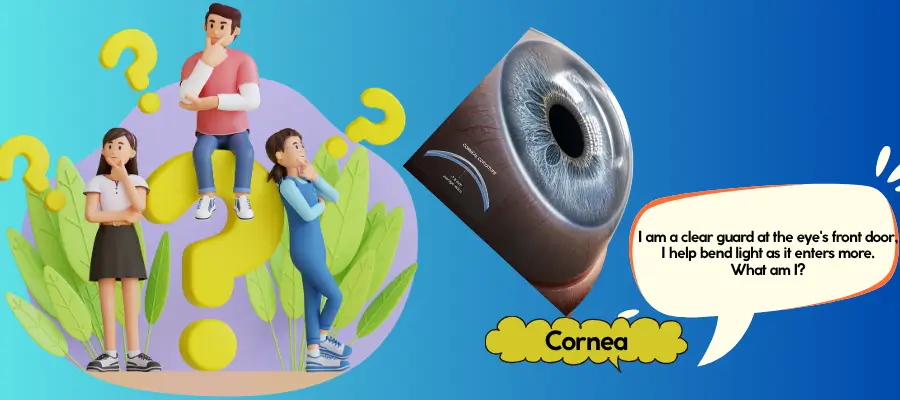
And light travels through me.
What am I?
EXPLANATION
FIRST CLUE: Transparent part of the eye
SECOND CLUE: Allows light to pass inside
LOGICAL CONNECTION: The cornea is the clear outer surface of the eye
CONCLUSION: Cornea is correct
And open to see some more.
What am I?
EXPLANATION
FIRST CLUE: Can open and close
SECOND CLUE: Covers the eye
LOGICAL CONNECTION: Eyelids protect the eyes and open for vision
CONCLUSION: Eyelid is correct
Like a tiny protective hedge.
What am I?
EXPLANATION
FIRST CLUE: Grows along the eyelid
SECOND CLUE: Helps protect the eye
LOGICAL CONNECTION: Eyelashes help keep dust and particles away
CONCLUSION: Eyelash is correct
Keeping dryness far away.
What am I?
EXPLANATION
FIRST CLUE: Blinks regularly
SECOND CLUE: Needs moisture
LOGICAL CONNECTION: Blinking spreads tears across the eye and helps keep it moist
CONCLUSION: Eye is correct
Through me, rays of light pass by.
What am I?
EXPLANATION
FIRST CLUE: Is an opening
SECOND CLUE: Lets light enter
LOGICAL CONNECTION: The pupil allows light to enter the eye
CONCLUSION: Pupil is correct
I keep your eyes wet when they are dry.
What am I?
EXPLANATION
FIRST CLUE: Produces tears
SECOND CLUE: Helps keep the eye moist
LOGICAL CONNECTION: Lacrimal glands produce the watery part of tears
CONCLUSION: Lacrimal gland is correct
EXPLANATION
FIRST CLUE: Located behind the iris
SECOND CLUE: Helps focus light
LOGICAL CONNECTION: The lens changes shape to focus light onto the retina
CONCLUSION: Lens is correct
I catch the light inside your eye.
What am I?
EXPLANATION
FIRST CLUE: Found at the back of the eye
SECOND CLUE: Detects incoming light
LOGICAL CONNECTION: The retina contains light-sensitive cells
CONCLUSION: Retina is correct
So your brain knows what passes by.
What am I?
EXPLANATION
FIRST CLUE: Connects the eye and brain
SECOND CLUE: Carries visual information
LOGICAL CONNECTION: The optic nerve transmits signals from the retina to the brain
CONCLUSION: Optic nerve is correct
EXPLANATION
FIRST CLUE: Can appear bright in photos
SECOND CLUE: Is part of the face
LOGICAL CONNECTION: Light reflecting from the eye can create a sparkle
CONCLUSION: Eye is correct
Yet I can show surprise.
What am I?
EXPLANATION
FIRST CLUE: Has no mouth
SECOND CLUE: Can communicate emotion
LOGICAL CONNECTION: Eyes can help express surprise and other emotions
CONCLUSION: Eyes are correct
Sitting at the front of your sight.
What am I?
EXPLANATION
FIRST CLUE: Clear and curved
SECOND CLUE: Covers the front of the eye
LOGICAL CONNECTION: The cornea is the transparent curved surface at the front of the eye
CONCLUSION: Cornea is correct
But I can also appear from laughter.
What am I?
EXPLANATION
FIRST CLUE: Can flow during sadness
SECOND CLUE: Can also happen during strong laughter
LOGICAL CONNECTION: Tears are produced for emotional and physical reasons
CONCLUSION: Tear is correct
But I am not a shield.
I move whenever you blink.
What am I?
EXPLANATION
FIRST CLUE: Protects the eye
SECOND CLUE: Moves during blinking
LOGICAL CONNECTION: The eyelid covers the eye to protect its surface
CONCLUSION: Eyelid is correct
And sit around the pupil all day.
What am I?
EXPLANATION
FIRST CLUE: Has different colors
SECOND CLUE: Surrounds the pupil
LOGICAL CONNECTION: The iris determines much of the visible color of the eye
CONCLUSION: Iris is correct
And cover the front of your eye.
What am I?
EXPLANATION
FIRST CLUE: Keeps the eye surface wet
SECOND CLUE: Covers the exposed eye
LOGICAL CONNECTION: The tear film coats and protects the eye surface
CONCLUSION: Tear film is correct
But I am not a rainbow.
I work inside your eyes.
What am I?
EXPLANATION
FIRST CLUE: Helps detect colors
SECOND CLUE: Found in the retina
LOGICAL CONNECTION: Cone cells are photoreceptors responsible for color vision
CONCLUSION: Cone cell is correct
Eye Parts Riddles
These eye related riddles focus on the different parts of the human eye and the important jobs they perform. The clues may describe the pupil, iris, lens, retina, cornea, or other eye structures without giving away the answer. They turn basic eye anatomy into an entertaining puzzle activity that makes learning more memorable.
Students can use these riddles to review simple facts about how the eye works.Parents and teachers can also include them in educational games and activities. Test your knowledge and discover how well you know the different parts of the eye.
But I am not a flashlight or spark.
What am I?
EXPLANATION
FIRST CLUE: Helps with vision in dim light
SECOND CLUE: Found inside the retina
LOGICAL CONNECTION: Rod cells are highly sensitive to low levels of light
CONCLUSION: Rod Cell is correct
Protected in a special place.
What am I?
EXPLANATION
FIRST CLUE: Has a rounded shape
SECOND CLUE: Sits inside the eye socket
LOGICAL CONNECTION: The eyeball is the rounded organ protected by the bony eye socket
CONCLUSION: Eyeball is correct
I help keep its shape while sitting nearby.
What am I?
EXPLANATION
FIRST CLUE: Has a jelly-like consistency
SECOND CLUE: Fills much of the inside of the eye
LOGICAL CONNECTION: Vitreous humor is a clear gel that helps maintain the shape of the eyeball
CONCLUSION: Vitreous Humor is correct
Found in the front of your eye.
What am I?
EXPLANATION
FIRST CLUE: Is a clear fluid
SECOND CLUE: Located in the front part of the eye
LOGICAL CONNECTION: Aqueous humor fills the chambers between the cornea and lens
CONCLUSION: Aqueous Humor is correct
Strong enough to help it keep its shape.
What am I?
EXPLANATION
FIRST CLUE: Appears white
SECOND CLUE: Helps maintain the eye’s structure
LOGICAL CONNECTION: The sclera is the tough outer layer of the eyeball
CONCLUSION: Sclera is correct
And help make blurry things clear.
What am I?
EXPLANATION
FIRST CLUE: Located behind the iris
SECOND CLUE: Helps focus light
LOGICAL CONNECTION: The lens focuses incoming light onto the retina
CONCLUSION: Lens is correct
But I am actually an opening.
What am I?
EXPLANATION
FIRST CLUE: Appears as a dark circle
SECOND CLUE: Is an opening rather than a solid object
LOGICAL CONNECTION: The pupil is the opening in the center of the iris
CONCLUSION: Pupil is correct
But I never take a walk.
What am I?
EXPLANATION
FIRST CLUE: Helps move the eye
SECOND CLUE: Does not move the body
LOGICAL CONNECTION: Extraocular muscles control the direction of eye movement
CONCLUSION: Eye Muscle is correct
Then disappear when you blink.
What am I?
EXPLANATION
FIRST CLUE: Covers the eye
SECOND CLUE: Moves during blinking
LOGICAL CONNECTION: Eyelids open and close to protect and moisten the eyes
CONCLUSION: Eyelid is correct
And sometimes make your cheeks wet.
What am I?
EXPLANATION
FIRST CLUE: Can appear when the eye is irritated
SECOND CLUE: Can flow down the cheeks
LOGICAL CONNECTION: Tears help wash irritating particles from the eye
CONCLUSION: Tears are correct
EXPLANATION
FIRST CLUE: Carries information
SECOND CLUE: Connects the eye with the brain
LOGICAL CONNECTION: The optic nerve carries visual signals from the retina to the brain
CONCLUSION: Optic Nerve is correct
And I surround most of your eye.
What am I?
EXPLANATION
FIRST CLUE: Is tough tissue
SECOND CLUE: Forms most of the outer eye wall
LOGICAL CONNECTION: The sclera protects the inner structures of the eye
CONCLUSION: Sclera is correct
EXPLANATION
FIRST CLUE: Can reflect light
SECOND CLUE: Covers the front of the eye
LOGICAL CONNECTION: The curved cornea can reflect light and create a visible highlight
CONCLUSION: Cornea is correct
But I never need a battery.
What am I?
EXPLANATION
FIRST CLUE: Forms visual images
SECOND CLUE: Does not require an external battery
LOGICAL CONNECTION: The eye focuses light and sends visual information to the brain
CONCLUSION: Eye is correct
But become bigger in the dark.
What am I?
EXPLANATION
FIRST CLUE: Changes size
SECOND CLUE: Responds to changes in light
LOGICAL CONNECTION: The pupil constricts in bright light and dilates in darkness
CONCLUSION: Pupil is correct
But I am not the eyelid itself.
What am I?
EXPLANATION
FIRST CLUE: Controls eyelid movement
SECOND CLUE: Helps close the eye
LOGICAL CONNECTION: Muscles around the eye control eyelid closure
CONCLUSION: Eyelid Muscle is correct
With a dark opening in my center.
What am I?
EXPLANATION
FIRST CLUE: Has a visible color
SECOND CLUE: Surrounds the pupil
LOGICAL CONNECTION: The iris is the colored part of the eye around the pupil
CONCLUSION: Iris is correct
And help you see the world.
What am I?
EXPLANATION
FIRST CLUE: Is housed inside the skull
SECOND CLUE: Provides vision
LOGICAL CONNECTION: The eyeball sits inside the bony eye socket and supports vision
CONCLUSION: Eyeball is correct
I sense light,
And I work best when the world is dim.
What am I?
EXPLANATION
FIRST CLUE: Is a light-sensitive cell
SECOND CLUE: Works well in dim conditions
LOGICAL CONNECTION: Rod cells are specialized for low-light vision
CONCLUSION: Rod Cell is correct
And sometimes reveal how you feel.
What am I?
EXPLANATION
FIRST CLUE: Can communicate emotions
SECOND CLUE: Does not require speech
LOGICAL CONNECTION: Eye expressions can reveal feelings and reactions
CONCLUSION: Eyes are correct
What Has an Eye but Cannot See?
These clever riddles what has an eye but cannot see use the word “eye” in surprising and creative ways. The answer may not be a real eye at all, so you need to think beyond the obvious meaning of the word. You might encounter objects, natural features, or unusual things that are described as having an eye even though they cannot see.
These puzzles are excellent for improving observation, vocabulary, and logical thinking. Read every clue carefully because the answer may be hiding behind a clever word connection. Can you solve them before checking the answer?
I help a thread pass through me.
What am I?
EXPLANATION
FIRST CLUE: Has an opening called an eye
SECOND CLUE: Thread passes through it
LOGICAL CONNECTION: A sewing needle has an eye designed to hold thread
CONCLUSION: Needle is correct
I sit in the middle of a storm.
What am I?
EXPLANATION
FIRST CLUE: Is called an eye
SECOND CLUE: Sits at the center of a storm
LOGICAL CONNECTION: A storm or hurricane can have a central region called its eye
CONCLUSION: Storm Eye is correct

I grow beneath the ground.
What am I?
EXPLANATION
FIRST CLUE: Has small parts called eyes
SECOND CLUE: Grows underground
LOGICAL CONNECTION: Potato eyes are buds that can produce new growth
CONCLUSION: Potato is correct
EXPLANATION
FIRST CLUE: Has an opening near its top
SECOND CLUE: Is used for fishing
LOGICAL CONNECTION: The eye of a fishing hook is where the fishing line is attached
CONCLUSION: Fish Hook is correct
EXPLANATION
FIRST CLUE: Is a small opening
SECOND CLUE: Holds or guides a shoelace
LOGICAL CONNECTION: An eyelet is a hole or fitting used for laces
CONCLUSION: Eyelet is correct
EXPLANATION
FIRST CLUE: Has two lens openings
SECOND CLUE: Helps improve vision
LOGICAL CONNECTION: Glasses sit in front of the eyes and use lenses to help correct vision
CONCLUSION: Glasses are correct
But I am not a pair of eyelids.
I can block bright sunlight.
What am I?
EXPLANATION
FIRST CLUE: Sits in front of the eyes
SECOND CLUE: Reduces bright sunlight
LOGICAL CONNECTION: Sunglasses reduce glare and help protect the eyes from UV radiation
CONCLUSION: Sunglasses are correct
Curved at the front of your eye.
What am I?
EXPLANATION
FIRST CLUE: Is transparent
SECOND CLUE: Covers the front of the eye
LOGICAL CONNECTION: The cornea is the clear curved outer surface of the eye
CONCLUSION: Cornea is correct
Surrounded by a colorful ring.
What am I?
EXPLANATION
FIRST CLUE: Looks like a dark opening
SECOND CLUE: Is surrounded by the iris
LOGICAL CONNECTION: The pupil is the opening at the center of the iris
CONCLUSION: Pupil is correct
And I surround the pupil every day.
What am I?
EXPLANATION
FIRST CLUE: Can have different colors
SECOND CLUE: Surrounds the pupil
LOGICAL CONNECTION: The iris is the colored part of the eye around the pupil
CONCLUSION: Iris is correct
And open when you wake.
I guard the eye all day.
What am I?
EXPLANATION
FIRST CLUE: Opens and closes over the eye
SECOND CLUE: Protects the eye
LOGICAL CONNECTION: Eyelids cover the eyes during sleep and protect them throughout the day
CONCLUSION: Eyelid is correct
Standing guard at your eye.
What am I?
EXPLANATION
FIRST CLUE: Made of small hairs
SECOND CLUE: Grows along the eyelid
LOGICAL CONNECTION: Eyelashes help keep dust and small particles away from the eye
CONCLUSION: Eyelashes are correct
And I am made of tiny hairs.
What am I?
EXPLANATION
FIRST CLUE: Is located above the eye
SECOND CLUE: Is covered with hair
LOGICAL CONNECTION: The eyebrow is the hair-covered ridge above the eye
CONCLUSION: Eyebrow is correct
EXPLANATION
FIRST CLUE: Comes from the eyes
SECOND CLUE: Can happen during laughter or sadness
LOGICAL CONNECTION: Tears can be produced by emotions as well as physical irritation
CONCLUSION: Tear is correct
But I am not a watering can.
What am I?
EXPLANATION
FIRST CLUE: Covers the eye surface
SECOND CLUE: Provides moisture
LOGICAL CONNECTION: The tear film keeps the front surface of the eye lubricated
CONCLUSION: Tear Film is correct
Strong and protective from inside to outside.
What am I?
EXPLANATION
FIRST CLUE: Is usually white
SECOND CLUE: Forms the outer wall of the eyeball
LOGICAL CONNECTION: The sclera is a tough layer that protects the internal eye structures
CONCLUSION: Sclera is correct
And catch the light that enters.
What am I?
EXPLANATION
FIRST CLUE: Is located at the back of the eye
SECOND CLUE: Detects incoming light
LOGICAL CONNECTION: The retina contains photoreceptors that respond to light
CONCLUSION: Retina is correct
And deliver the message to your brain.
What am I?
EXPLANATION
FIRST CLUE: Connects the eye and brain
SECOND CLUE: Carries visual signals
LOGICAL CONNECTION: The optic nerve sends information from the retina toward the brain
CONCLUSION: Optic Nerve is correct
But I am too tiny to see without help.
What am I?
EXPLANATION
FIRST CLUE: Is microscopic
SECOND CLUE: Supports color vision
LOGICAL CONNECTION: Cone cells are specialized retinal cells that help detect color
CONCLUSION: Cone Cell is correct
But colors are not my show.
What am I?
EXPLANATION
FIRST CLUE: Works well in dim light
SECOND CLUE: Does not provide normal color vision
LOGICAL CONNECTION: Rod cells are highly sensitive to low light and mainly support night vision
CONCLUSION: Rod Cell is correct
Eye Related Riddles
These eye related riddles explore different aspects of eyes, vision, and basic eye anatomy through fun and creative clues. You will find puzzles about eye parts, tears, light, vision, and the functions that help us see the world around us. Each riddle turns a simple eye fact into an enjoyable brain teaser.
The explanations also help readers understand why each answer fits the clues. These puzzles can be enjoyed by students, adults, parents, and anyone who loves learning through riddles. Challenge yourself and see how many eye-related answers you can discover.
I let light enter as people pass.
What am I?
EXPLANATION
FIRST CLUE: I am transparent
SECOND CLUE: I allow light to enter the eye
LOGICAL CONNECTION: The cornea is the clear front surface of the eye that helps focus incoming light
CONCLUSION: Cornea is correct
Helping your vision focus on each face.
What am I?
EXPLANATION
FIRST CLUE: Can change its shape
SECOND CLUE: Helps focus on objects at different distances
LOGICAL CONNECTION: The eye lens changes shape to focus light clearly on the retina
CONCLUSION: Eye Lens is correct
Yet I help your vision work normally.
What am I?
EXPLANATION
FIRST CLUE: I am a small area inside the retina
SECOND CLUE: I supports detailed central vision
LOGICAL CONNECTION: The macula is a specialized part of the retina responsible for sharp central vision
CONCLUSION: Macula is correct
And see details near and far.
What am I?
EXPLANATION
FIRST CLUE: Helps with detailed tasks
SECOND CLUE: Supports reading and recognizing details
LOGICAL CONNECTION: Central vision allows you to focus directly on objects and fine details
CONCLUSION: Central Vision is correct
But light passes through me.
I sit at the front of your eye.
What am I?
EXPLANATION
FIRST CLUE: Located at the front of the eye
SECOND CLUE: Allows light to pass through
LOGICAL CONNECTION: The cornea is a transparent outer layer that lets light enter the eye
CONCLUSION: Cornea is correct
And my opening changes size.
What am I?
EXPLANATION
FIRST CLUE: Has a visible color
SECOND CLUE: Controls the size of the pupil
LOGICAL CONNECTION: The iris adjusts the pupil to regulate how much light enters the eye
CONCLUSION: Iris is correct
Taking pictures of light to your brain.
What am I?
EXPLANATION
FIRST CLUE: Carries information
SECOND CLUE: Connects the eye with the brain
LOGICAL CONNECTION: The optic nerve carries visual signals from the retina to the brain
CONCLUSION: Optic Nerve is correct
And light is the job I enjoy.
What am I?
EXPLANATION
FIRST CLUE: Responds to light
SECOND CLUE: Is found in the retina
LOGICAL CONNECTION: Photoreceptors detect light and begin the process of visual signaling
CONCLUSION: Photoreceptor is correct
But I am much too small for you to view.
What am I?
EXPLANATION
FIRST CLUE: Supports color vision
SECOND CLUE: Is microscopic
LOGICAL CONNECTION: Cone cells in the retina detect different wavelengths of light and support color vision
CONCLUSION: Cone Cell is correct
Helping you see where you go.
What am I?
EXPLANATION
FIRST CLUE: Works well in dim conditions
SECOND CLUE: Helps with low-light vision
LOGICAL CONNECTION: Rod cells are highly sensitive to low levels of light
CONCLUSION: Rod Cell is correct
And I let light travel through.
What am I?
EXPLANATION
FIRST CLUE: Located in the center of the iris
SECOND CLUE: Allows light to enter the eye
LOGICAL CONNECTION: The pupil is an opening that lets light pass toward the inner eye
CONCLUSION: Pupil is correct
But I am not the brain.
What am I?
EXPLANATION
FIRST CLUE: Located inside the eye
SECOND CLUE: Detects incoming light
LOGICAL CONNECTION: The retina receives light and converts it into signals that travel to the brain
CONCLUSION: Retina is correct
Where tears may gather.
What am I?
EXPLANATION
FIRST CLUE: Found near the inner corner of the eyelid
SECOND CLUE: Helps drain tears
LOGICAL CONNECTION: The lacrimal punctum is a tiny opening that helps tears drain from the eye
CONCLUSION: Lacrimal Punctum is correct
But I am not feeling sad.
What am I?
EXPLANATION
FIRST CLUE: Produces tears
SECOND CLUE: Does not need emotions to work
LOGICAL CONNECTION: The lacrimal gland produces the watery part of tears that keeps the eye moist
CONCLUSION: Lacrimal Gland is correct
And tears pass through me.
What am I?
EXPLANATION
FIRST CLUE: Helps move tears away from the eye
SECOND CLUE: Connects the eye area to the nasal drainage system
LOGICAL CONNECTION: Tear ducts provide a pathway for tears to drain
CONCLUSION: Tear Duct is correct
But I am not afraid of the night.
What am I?
EXPLANATION
FIRST CLUE: The eye is housed inside the eye socket
SECOND CLUE: Helps detect light and images
LOGICAL CONNECTION: The eyeball is protected inside a bony socket while supporting vision
CONCLUSION: Eye is correct
EXPLANATION
FIRST CLUE: Connects tear drainage pathways
SECOND CLUE: Helps move tears toward the nose
LOGICAL CONNECTION: The tear drainage system carries tears from the eye into the nasal cavity
CONCLUSION: Tear Drainage System is correct
And I close before danger reaches your eye.
What am I?
EXPLANATION
FIRST CLUE: Can close over the eye
SECOND CLUE: Helps protect against dust and objects
LOGICAL CONNECTION: Eyelids provide a physical barrier that protects the eye
CONCLUSION: Eyelid is correct
Standing along the edge of your eye.
What am I?
EXPLANATION
FIRST CLUE: Made of hair
SECOND CLUE: Grows along the eyelid
LOGICAL CONNECTION: Eyelashes help protect the eye from dust and other small particles
CONCLUSION: Eyelash is correct
And I can stop sweat from reaching them.
What am I?
EXPLANATION
FIRST CLUE: Located above the eyes
SECOND CLUE: Helps direct sweat away from the eyes
LOGICAL CONNECTION: Eyebrows can help divert sweat and moisture away from the eyes
CONCLUSION: Eyebrow is correct
Hard Eye Riddles
If you enjoy a serious brain challenge, these eye riddles hard puzzles are made for you. The clues are more detailed and may require you to understand eye anatomy, vision, and the functions of different eye structures. Some answers are not immediately obvious, so you will need to connect the clues before making your guess.
These riddles are suitable for older kids, teens, and adults who enjoy challenging puzzles. Take your time, think about every word, and avoid rushing to the answer. How many of these difficult eye riddles can you solve without looking at the answer?
I open wider when the light is shy.
What am I?
EXPLANATION
FIRST CLUE: I am an opening in the eye
SECOND CLUE: I become larger in dim light
LOGICAL CONNECTION: The pupil expands when less light is available
CONCLUSION: Pupil is correct
With a little hole in my middle.
What am I?
EXPLANATION
FIRST CLUE: I have a visible color
SECOND CLUE: I surround the pupil
LOGICAL CONNECTION: The iris is the colored ring surrounding the pupil
CONCLUSION: Iris is correct
But I am part of your eye.
I bend incoming light.
What am I?
EXPLANATION
FIRST CLUE: I am transparent
SECOND CLUE: I help bend light entering the eye
LOGICAL CONNECTION: The cornea is the clear front surface that provides much of the eye’s focusing power
CONCLUSION: Cornea is correct
And I can change my shape.
I help make images sharp.
What am I?
EXPLANATION
FIRST CLUE: I am located behind the iris
SECOND CLUE: I can change shape
LOGICAL CONNECTION: The lens changes shape to focus light onto the retina
CONCLUSION: Lens is correct
Where light turns into a message.
What am I?
EXPLANATION
FIRST CLUE: I am located at the back of the eye
SECOND CLUE: I respond to incoming light
LOGICAL CONNECTION: The retina contains cells that convert light into neural signals
CONCLUSION: Retina is correct
From your eye toward your brain.
What am I?
EXPLANATION
FIRST CLUE: I connect the eye with the brain
SECOND CLUE: I carry visual signals
LOGICAL CONNECTION: The optic nerve transmits visual information from the retina toward the brain
CONCLUSION: Optic Nerve is correct
Mostly white and strong.
What am I?
EXPLANATION
FIRST CLUE: I form the outer layer of the eyeball
SECOND CLUE: I am usually white
LOGICAL CONNECTION: The sclera is the strong outer covering that protects the eye
CONCLUSION: Sclera is correct
Filling much of your eye.
I help the eyeball keep its shape.
What am I?
EXPLANATION
FIRST CLUE: I have a gel-like texture
SECOND CLUE: I fill the large space behind the lens
LOGICAL CONNECTION: Vitreous humor is a clear gel that helps maintain the shape of the eyeball
CONCLUSION: Vitreous Humor is correct
Found near the front of your eye.
I help nourish its tissues.
What am I?
EXPLANATION
FIRST CLUE: I am a clear watery fluid
SECOND CLUE: I am found in the front part of the eye
LOGICAL CONNECTION: Aqueous humor provides nutrients and helps maintain pressure inside the eye
CONCLUSION: Aqueous Humor is correct
But you cannot spot me with your eyes.
What am I?
EXPLANATION
FIRST CLUE: I am a microscopic retinal cell
SECOND CLUE: I support color vision
LOGICAL CONNECTION: Cone cells help the eye detect colors and fine details in brighter conditions
CONCLUSION: Cone Cell is correct
Helping you notice shapes instead of colors.
What am I?
EXPLANATION
FIRST CLUE: Works well in low light
SECOND CLUE: Is not responsible for normal color vision
LOGICAL CONNECTION: Rod cells are sensitive to dim light and support night vision
CONCLUSION: Rod Cell is correct
Keeping your eyes fresh and wet.
What am I?
EXPLANATION
FIRST CLUE: Produces tears
SECOND CLUE: Helps keep the eye moist
LOGICAL CONNECTION: The lacrimal gland produces tears that lubricate and protect the eye
CONCLUSION: Lacrimal Gland is correct
Where tears begin their journey away.
What am I?
EXPLANATION
FIRST CLUE: I am a small opening near the eyelid
SECOND CLUE: I receives tears
LOGICAL CONNECTION: The lacrimal punctum is a tiny opening that helps drain tears from the eye
CONCLUSION: Lacrimal Punctum is correct
With tiny hairs standing in a row.
What am I?
EXPLANATION
FIRST CLUE: I am made of small hairs
SECOND CLUE: I grow along the eyelid
LOGICAL CONNECTION: Eyelashes help protect the eye from dust and other particles
CONCLUSION: Eyelashes are correct
And I can help keep sweat away.
What am I?
EXPLANATION
FIRST CLUE: I am above the eye
SECOND CLUE: I can redirect sweat away from the eyes
LOGICAL CONNECTION: Eyebrows can help prevent sweat from flowing directly into the eyes
CONCLUSION: Eyebrow is correct
And open when everything is clear.
What am I?
EXPLANATION
FIRST CLUE: Can close over the eye
SECOND CLUE: Protects the eye from possible harm
LOGICAL CONNECTION: Eyelids can close quickly as a protective response
CONCLUSION: Eyelid is correct
Born inside your eye.
I can appear when you laugh or cry.
What am I?
EXPLANATION
FIRST CLUE: Comes from the eye
SECOND CLUE: Can appear during strong emotions
LOGICAL CONNECTION: Tears can be produced by emotions, irritation, or other eye responses
CONCLUSION: Tear is correct
Spread across the front of your eye.
What am I?
EXPLANATION
FIRST CLUE: Covers the eye surface
SECOND CLUE: Keeps the front of the eye moist
LOGICAL CONNECTION: The tear film forms a protective layer over the cornea and conjunctiva
CONCLUSION: Tear Film is correct
And I help shield the front of your eye.
What am I?
EXPLANATION
FIRST CLUE: I am a thin transparent membrane
SECOND CLUE: Covers parts of the front eye area
LOGICAL CONNECTION: The conjunctiva covers the white part of the eye and lines the inside of the eyelids
CONCLUSION: Conjunctiva is correct
Where sharp vision likes to stay.
What am I?
EXPLANATION
FIRST CLUE: I am located within the retina
SECOND CLUE: I supports the sharpest central vision
LOGICAL CONNECTION: The fovea contains a high concentration of cone cells and provides very detailed central vision
CONCLUSION: Fovea is correct
Eye Test Riddles With Answers
These eye test riddles with answers combine vision-related facts with fun guessing challenges. The riddles cover topics such as color vision, focusing, light detection, sharp sight, and different structures inside the eye. Instead of simply reading facts, you can test yourself by using the clues to find the correct answer.
Each puzzle includes an answer and explanation so you can understand the reasoning behind it. These riddles are useful for students, teachers, adults, and anyone who enjoys educational brain games. Put your vision knowledge to the test and see how many you can answer correctly.
I help turn light into signals nearby.
What am I?
EXPLANATION
FIRST CLUE: Responds to incoming light
SECOND CLUE: Is found in the retina
LOGICAL CONNECTION: Photoreceptors detect light and begin the process of creating visual signals
CONCLUSION: Photoreceptor is correct
But I help you see things clearly.
I sit inside the retina.
What am I?
EXPLANATION
FIRST CLUE: Found in the retina
SECOND CLUE: Supports very sharp vision
LOGICAL CONNECTION: The fovea is a small retinal area responsible for detailed central vision
CONCLUSION: Fovea is correct
Into messages your brain can understand.
What am I?
EXPLANATION
FIRST CLUE: Detects incoming light
SECOND CLUE: Starts visual signal processing
LOGICAL CONNECTION: The retina converts light information into electrical signals that travel through the visual system
CONCLUSION: Retina is correct
But I can tell you when someone is surprised.
What am I?
EXPLANATION
FIRST CLUE: Can show emotional reactions
SECOND CLUE: Does not need words
LOGICAL CONNECTION: Changes in the eyes can reveal surprise and other emotions
CONCLUSION: Eyes are correct
Across a surface that needs to stay wet.
What am I?
EXPLANATION
FIRST CLUE: Moves across the eye
SECOND CLUE: Helps spread moisture
LOGICAL CONNECTION: Blinking moves the eyelid across the eye and spreads the tear film
CONCLUSION: Eyelid is correct
Standing above your eyes.
I help keep sweat away.
What am I?
EXPLANATION
FIRST CLUE: Is located above the eyes
SECOND CLUE: Can help direct sweat away
LOGICAL CONNECTION: Eyebrows can help divert sweat and moisture from the eyes
CONCLUSION: Eyebrow is correct
And I decide how much light enters.
What am I?
EXPLANATION
FIRST CLUE: Has visible color
SECOND CLUE: Controls the pupil
LOGICAL CONNECTION: The iris changes pupil size to regulate the amount of light entering the eye
CONCLUSION: Iris is correct
But I am really an opening.
I let light enter your eye.
What am I?
EXPLANATION
FIRST CLUE: Appears dark
SECOND CLUE: Is an opening in the center of the iris
LOGICAL CONNECTION: The pupil allows light to pass into the eye
CONCLUSION: Pupil is correct
But I am not a window.
I cover the front of your eye.
What am I?
EXPLANATION
FIRST CLUE: Is transparent
SECOND CLUE: Covers the front of the eye
LOGICAL CONNECTION: The cornea forms the clear outer surface at the front of the eye and helps focus light
CONCLUSION: Cornea is correct
And I help turn blurry views into clear ones.
What am I?
EXPLANATION
FIRST CLUE: Located behind the pupil
SECOND CLUE: Focuses incoming light
LOGICAL CONNECTION: The lens adjusts focus so light can form a clear image on the retina
CONCLUSION: Lens is correct
Protecting the soft parts of your eye.
What am I?
EXPLANATION
FIRST CLUE: Forms the outer layer of the eyeball
SECOND CLUE: Provides structural protection
LOGICAL CONNECTION: The sclera is the tough outer layer that helps protect and maintain the shape of the eye
CONCLUSION: Sclera is correct
And I fill the largest space inside your eye.
What am I?
EXPLANATION
FIRST CLUE: Has a gel-like texture
SECOND CLUE: Fills the large chamber behind the lens
LOGICAL CONNECTION: Vitreous humor is a clear gel that occupies much of the inside of the eyeball
CONCLUSION: Vitreous Humor is correct
And I live near the front of your eye.
What am I?
EXPLANATION
FIRST CLUE: Is a clear fluid
SECOND CLUE: Is located in the front part of the eye
LOGICAL CONNECTION: Aqueous humor fills the space between the cornea and lens and helps nourish eye tissues
CONCLUSION: Aqueous Humor is correct
Running from your eye to your brain.
What am I?
EXPLANATION
FIRST CLUE: Connects the eye and brain
SECOND CLUE: Carries visual information
LOGICAL CONNECTION: The optic nerve transmits signals from the retina toward the brain
CONCLUSION: Optic Nerve is correct
And I help you notice colors.
What am I?
EXPLANATION
FIRST CLUE: Is a light-sensitive cell
SECOND CLUE: Supports color vision
LOGICAL CONNECTION: Cone cells detect different wavelengths of light and help create color vision
CONCLUSION: Cone Cell is correct
Helping you see when light is low.
What am I?
EXPLANATION
FIRST CLUE: Works well in low light
SECOND CLUE: Is highly sensitive to dim light
LOGICAL CONNECTION: Rod cells support vision in dark or dim conditions
CONCLUSION: Rod Cell is correct
But I am smaller than a pea.
What am I?
EXPLANATION
FIRST CLUE: Is a very small retinal area
SECOND CLUE: Supports the sharpest central vision
LOGICAL CONNECTION: The fovea provides the highest visual detail in the central field of vision
CONCLUSION: Fovea is correct
EXPLANATION
FIRST CLUE: Produces tears
SECOND CLUE: Is located near the upper outer part of the eye
LOGICAL CONNECTION: The lacrimal gland produces the watery part of tears
CONCLUSION: Lacrimal Gland is correct
And tears pass through me.
Where am I?
EXPLANATION
FIRST CLUE: Is a small opening near the eyelid
SECOND CLUE: Helps collect tears
LOGICAL CONNECTION: The lacrimal punctum is an opening that drains tears from the eye
CONCLUSION: Lacrimal Punctum is correct
EXPLANATION
FIRST CLUE: Carries tears away from the eye
SECOND CLUE: Helps drain tears toward the nose
LOGICAL CONNECTION: The tear drainage system moves tears from the eyes into the nasal passages
CONCLUSION: Tear Duct is correct
Funny Eye Riddles With Answers
Get ready to laugh and think with these funny eye riddles with answers. This collection mixes eye-related topics with playful clues, unexpected answers, and clever wordplay. Some riddles may sound confusing at first, but the answer becomes clear once you notice the hidden connection.
They are perfect for sharing with friends, family, classmates, or fellow puzzle lovers. You can also use them during parties, game nights, classroom activities, or social media posts. Read the clues, make your guess, and then reveal the answer to see if you were right.
And watch the world without moving around.
What am I?
EXPLANATION
FIRST CLUE: Can communicate through a wink
SECOND CLUE: Helps observe the world
LOGICAL CONNECTION: An eye can communicate expressions and provide vision
CONCLUSION: Eye is correct
But underneath me is a dark doorway.
What am I?
EXPLANATION
FIRST CLUE: Has visible color
SECOND CLUE: Surrounds a dark opening
LOGICAL CONNECTION: The iris is the colored part of the eye that surrounds the pupil
CONCLUSION: Iris is correct
And light walks through me.
What am I?
EXPLANATION
FIRST CLUE: Is an opening
SECOND CLUE: Allows light to enter the eye
LOGICAL CONNECTION: The pupil is the opening in the center of the iris
CONCLUSION: Pupil is correct
Clear enough for light to pass.
What am I?
EXPLANATION
FIRST CLUE: Covers the front of the eye
SECOND CLUE: Is transparent
LOGICAL CONNECTION: The cornea forms the clear front surface of the eye and helps focus light
CONCLUSION: Cornea is correct
And I change shape to sharpen your sight.
What am I?
EXPLANATION
FIRST CLUE: Located behind the pupil
SECOND CLUE: Changes shape for focusing
LOGICAL CONNECTION: The lens adjusts its shape to focus light onto the retina
CONCLUSION: Lens is correct
Hidden at the back of your eye.
What am I?
EXPLANATION
FIRST CLUE: Located at the back of the eye
SECOND CLUE: Receives focused light
LOGICAL CONNECTION: The retina detects light and begins the process of creating visual signals
CONCLUSION: Retina is correct
But I never carry a photograph.
What am I?
EXPLANATION
FIRST CLUE: Carries visual information
SECOND CLUE: Connects the eye to the brain
LOGICAL CONNECTION: The optic nerve transmits visual signals from the retina to the brain
CONCLUSION: Optic Nerve is correct
Wrapping around your eye.
What am I?
EXPLANATION
FIRST CLUE: Is a tough tissue
SECOND CLUE: Forms most of the outer eye wall
LOGICAL CONNECTION: The sclera protects the inner parts of the eye and helps maintain its shape
CONCLUSION: Sclera is correct
Filling the space behind the lens.
What am I?
EXPLANATION
FIRST CLUE: Has a gel-like texture
SECOND CLUE: Is found behind the lens
LOGICAL CONNECTION: Vitreous humor fills much of the inside of the eyeball and helps it maintain its shape
CONCLUSION: Vitreous Humor is correct
And I live in the front chamber of your eye.
What am I?
EXPLANATION
FIRST CLUE: Is a watery fluid
SECOND CLUE: Found in the front portion of the eye
LOGICAL CONNECTION: Aqueous humor fills the front chambers and helps nourish eye tissues
CONCLUSION: Aqueous Humor is correct
But I am far too small to see alone.
What am I?
EXPLANATION
FIRST CLUE: Is a microscopic cell
SECOND CLUE: Helps detect colors
LOGICAL CONNECTION: Cone cells in the retina support color vision and detailed vision
CONCLUSION: Cone Cell is correct
Helping you notice things in the dark.
What am I?
EXPLANATION
FIRST CLUE: Responds strongly to low light
SECOND CLUE: Helps with night vision
LOGICAL CONNECTION: Rod cells are specialized photoreceptors that support vision in dim conditions
CONCLUSION: Rod Cell is correct
Right in the center of your vision.
What am I?
EXPLANATION
FIRST CLUE: Is a small area of the retina
SECOND CLUE: Supports detailed central vision
LOGICAL CONNECTION: The fovea provides the sharpest central vision
CONCLUSION: Fovea is correct
Making the drops that keep your eyes wet.
What am I?
EXPLANATION
FIRST CLUE: Produces tears
SECOND CLUE: Helps keep the eyes moist
LOGICAL CONNECTION: The lacrimal gland produces the watery part of tears
CONCLUSION: Lacrimal Gland is correct
Where tears begin their trip away.
What am I?
EXPLANATION
FIRST CLUE: Is a tiny opening near the eyelid
SECOND CLUE: Receives tears for drainage
LOGICAL CONNECTION: The lacrimal punctum is an opening that helps tears enter the drainage system
CONCLUSION: Lacrimal Punctum is correct
Moving tears toward your nose.
What am I?
EXPLANATION
FIRST CLUE: Part of the tear drainage pathway
SECOND CLUE: Moves tears toward the nose
LOGICAL CONNECTION: Tear drainage passages carry tears away from the eye
CONCLUSION: Tear Duct is correct
EXPLANATION
FIRST CLUE: Consists of small hairs
SECOND CLUE: Grows along the eyelid edges
LOGICAL CONNECTION: Eyelashes help protect the eye from dust and other particles
CONCLUSION: Eyelashes are correct
And my hairs form a curved line.
What am I?
EXPLANATION
FIRST CLUE: Located above the eye
SECOND CLUE: Made of short hairs
LOGICAL CONNECTION: The eyebrow is the curved hair-covered area above the eye
CONCLUSION: Eyebrow is correct
But my journey begins in your eyes.
What am I?
EXPLANATION
FIRST CLUE: Begins in the eye
SECOND CLUE: Can travel down the cheeks
LOGICAL CONNECTION: Tears can flow from the eyes onto the cheeks
CONCLUSION: Tear is correct
Spread across your eye with every blink.
What am I?
EXPLANATION
FIRST CLUE: Forms a thin layer over the eye
SECOND CLUE: Spreads during blinking
LOGICAL CONNECTION: The tear film keeps the eye surface lubricated and protected
CONCLUSION: Tear Film is correct
Eye Riddles for Adults & Tricky Eye Puzzles
These eye riddles for adults offer a collection of clever, tricky, and entertaining puzzles for readers who enjoy more unusual challenges. Some riddles use the word “eye” in creative ways, while others explore objects and natural features associated with the word. You may come across ideas involving needles, potatoes, storms, vision, and the human eye.
The clues are designed to make you slow down and look at each question from a different angle. They are great for parties, trivia games, puzzle nights, and casual brain workouts. Challenge yourself and see if you can solve these tricky eye puzzles before revealing the answers.
I can be found in a potato’s skin.
What am I?
EXPLANATION
FIRST CLUE: Has an “eye” but cannot see
SECOND CLUE: Appears on the surface of a potato
LOGICAL CONNECTION: Potato eyes are small buds that can grow into new potato plants
CONCLUSION: Potato Eye is correct
And a thread can pass through my space.
What am I?
EXPLANATION
FIRST CLUE: Contains an opening called an eye
SECOND CLUE: Thread passes through the opening
LOGICAL CONNECTION: A sewing needle has an eye designed for threading
CONCLUSION: Needle is correct
But I never see a thing.
I help hold your clothes together.
What am I?
EXPLANATION
FIRST CLUE: Can have a small opening called an eye
SECOND CLUE: Is used with clothing
LOGICAL CONNECTION: Some buttons have holes or “eyes” through which thread passes
CONCLUSION: Button is correct
But I live above the ground.
I can watch the land from the sky.
What am I?
EXPLANATION
FIRST CLUE: Has a central area called an eye
SECOND CLUE: Forms high above the ground
LOGICAL CONNECTION: A hurricane has an eye at its center and develops in the atmosphere
CONCLUSION: Hurricane is correct
But I am usually calmer than my surroundings.
What am I?
EXPLANATION
FIRST CLUE: Is located at the center of a storm
SECOND CLUE: Can be relatively calm compared with the eyewall
LOGICAL CONNECTION: The eye of a hurricane is the central region surrounded by the powerful eyewall
CONCLUSION: Eye of a Hurricane is correct
But I am not an eyeball.
I can be a special spot people visit.
What am I?
EXPLANATION
FIRST CLUE: Uses “eye” as part of a place name
SECOND CLUE: Is connected with a lake
LOGICAL CONNECTION: “Eye of the Lake” can describe a notable central or scenic feature associated with a lake
CONCLUSION: Eye of the Lake is correct
But I cannot look around.
What am I?
EXPLANATION
FIRST CLUE: Is part of a needle
SECOND CLUE: Does not provide vision
LOGICAL CONNECTION: The needle eye is the small opening used to pass thread through
CONCLUSION: Needle Eye is correct
Depending on how your eye focuses.
What am I?
EXPLANATION
FIRST CLUE: Can be clear or unclear
SECOND CLUE: Depends partly on how the eye focuses light
LOGICAL CONNECTION: Vision is the ability to perceive the world through the visual system
CONCLUSION: Vision is correct
But I am not a camera.
I can notice colors, shapes, and light.
What am I?
EXPLANATION
FIRST CLUE: Used for seeing
SECOND CLUE: Detects light, colors, and shapes
LOGICAL CONNECTION: The eyes collect visual information that the brain interprets
CONCLUSION: Eyes are correct
EXPLANATION
FIRST CLUE: Works with eye health and vision
SECOND CLUE: Performs or provides eye examinations
LOGICAL CONNECTION: Eye doctors examine vision and help identify or manage eye conditions
CONCLUSION: Eye Doctor is correct
Where specialists help them see better.
What am I?
EXPLANATION
FIRST CLUE: Provides eye-related medical care
SECOND CLUE: Has eye specialists
LOGICAL CONNECTION: An eye hospital provides diagnosis, treatment, and care for eye conditions
CONCLUSION: Eye Hospital is correct
But I am not a spelling exam.
What am I?
EXPLANATION
FIRST CLUE: Uses letters or symbols in some tests
SECOND CLUE: Checks how well someone can see
LOGICAL CONNECTION: An eye test can measure visual acuity and other aspects of vision
CONCLUSION: Eye Test is correct
And you must spot it to win.
What am I?
EXPLANATION
FIRST CLUE: Requires careful looking
SECOND CLUE: Involves finding something hidden
LOGICAL CONNECTION: An eye-spy puzzle challenges you to visually search for a hidden object, letter, or detail
CONCLUSION: Eye Spy Puzzle is correct
Where hidden things are waiting to be found.
What am I?
EXPLANATION
FIRST CLUE: Requires observation
SECOND CLUE: Involves finding hidden objects
LOGICAL CONNECTION: Eye Spy games encourage players to search carefully for specific items
CONCLUSION: Eye Spy is correct
And I help turn light into signals.
What am I?
EXPLANATION
FIRST CLUE: Has a rounded shape
SECOND CLUE: Contains structures that detect light
LOGICAL CONNECTION: The eyeball contains the retina and other structures needed for vision
CONCLUSION: Eyeball is correct
So tears come to give me relief.
What am I?
EXPLANATION
FIRST CLUE: Is exposed to the environment
SECOND CLUE: Needs a protective tear film
LOGICAL CONNECTION: The eye surface depends on tears for moisture, lubrication, and protection
CONCLUSION: Eye Surface is correct
But I am not paint on the ground.
What am I?
EXPLANATION
FIRST CLUE: Can describe the visible color of an eye
SECOND CLUE: Is influenced by the iris
LOGICAL CONNECTION: Eye color refers mainly to the color of the iris
CONCLUSION: Eye Color is correct
Sometimes seen when your eyes are closed.
What am I?
EXPLANATION
FIRST CLUE: Can appear as a flash or pattern of light
SECOND CLUE: Can occur without normal external light entering the eye
LOGICAL CONNECTION: A phosphene is a perception of light caused by stimulation of the visual system
CONCLUSION: Phosphene is correct
But I am not a window or a door.
What am I?
EXPLANATION
FIRST CLUE: Is connected with seeing
SECOND CLUE: Helps you experience your surroundings visually
LOGICAL CONNECTION: Sight is the sense that allows the eyes and brain to perceive the visual world
CONCLUSION: Sight is correct
I can appear when a storm begins.
What am I?
EXPLANATION
FIRST CLUE: Has an “eye” but no vision
SECOND CLUE: Is connected to a powerful storm
LOGICAL CONNECTION: The eye is the central region of a tropical cyclone, where conditions can be calmer than in the surrounding eyewall
CONCLUSION: Storm Eye is correct
Frequently Asked Questions
What are eye riddles?
Eye riddles are brain teasers based on eyes, vision, eye anatomy, or the word “eye.” Some focus on real eye parts, while others use clever wordplay and unexpected meanings.
What are the best eye riddles for kids?
Easy eye riddles for kids usually have short clues and familiar answers. They can introduce children to basic ideas about eyes, seeing, blinking, tears, and vision while keeping learning entertaining.
What has an eye but cannot see?
Many things can have an “eye” without having the ability to see. Common riddle answers include a needle, potato, and the eye of a storm. The exact answer depends on the clues given.
Are eye riddles good for adults?
Yes! Eye riddles for adults can include harder clues, wordplay, unusual meanings, and more challenging eye-related facts. They are great for brain games, parties, trivia, and puzzle activities.
What are eye test riddles?
Eye test riddles are puzzles that ask you to identify something by looking carefully at clues related to vision, colors, focus, or eye anatomy. They are designed as entertainment rather than medical eye examinations.
What are funny eye riddles?
Funny eye riddles with answers use humor, surprising clues, and playful meanings to create an entertaining challenge. They are especially fun to share with friends and family.
What are eye spy riddles?
Eye spy riddles are observation-based puzzles that ask you to find or identify something hidden through clues. They can be played as simple guessing games or turned into visual challenges.
Can eye riddles help children learn?
Yes. Simple riddles can encourage children to read carefully, think logically, improve vocabulary, and remember basic information about the world around them. They can be a fun addition to educational activities.
What are eyeball riddles?
Eyeball riddles are puzzles that focus specifically on the eyeball or the structures inside and around it. They can cover topics such as the pupil, iris, lens, retina, cornea, and other parts of the eye.
Can these riddles be used for classroom activities?
Absolutely. Teachers can use eye related riddles as warm-up questions, science activities, group games, or quick knowledge checks. Students can work individually or compete in teams to solve them.
Final Thoughts
These eye riddles offer a fun mix of learning, wordplay, observation, and brain-challenging entertainment. With 160 original puzzles, you can start with easy questions and gradually move toward harder challenges. Children can enjoy simple riddles while adults can test themselves with tricky clues and clever answers.
From eye test riddles with answers and funny eye riddles to puzzles about eye parts and things that have an eye but cannot see, every section brings a different type of challenge. Take your time, think carefully, and have fun discovering how many riddles you can solve without looking at the answers!