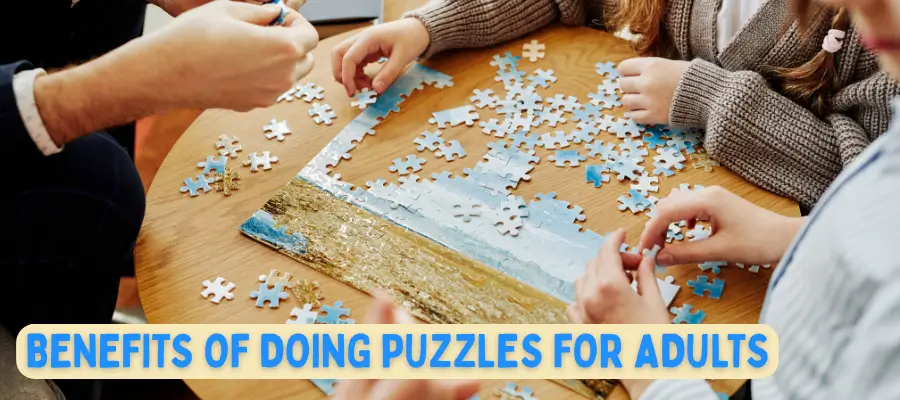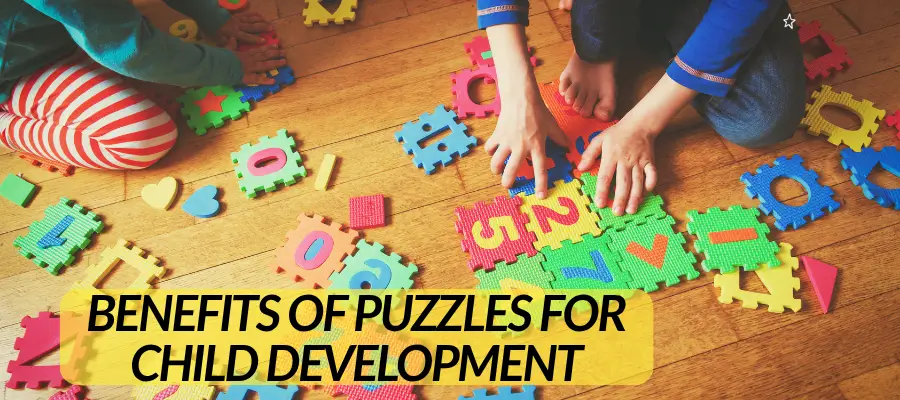
Puzzles often get treated like a way to pass a rainy afternoon, but there’s more happening on that table than it looks. Every time a child picks up a piece, turns it, and tries to figure out where it fits, they’re practicing a small set of skills that show up again and again in school, at home, and in everyday problem-solving.
So, what are the benefits of puzzles for child development? Age-appropriate puzzles give children a chance to practice problem-solving, visual-spatial skills, fine motor control, concentration, memory, patience, and independent thinking all through an activity that feels like play rather than a lesson. The exact benefits a child gets will depend on their age, the type of puzzle, how difficult it is, and how often they play, but the underlying opportunity to practice these skills is fairly consistent across puzzle types.
This guide walks through those benefits in detail, breaks them down by age, and gives parents and teachers practical ways to use puzzles for child development at home or in the classroom.
What are puzzles, and what are the benefits of puzzles for child development?
A puzzle is any activity that presents a problem with a clear goal matching pieces, filling a shape, completing a picture, or solving a pattern and leaves the child to figure out how to get there. That simple structure is what makes puzzles for child development so useful: there’s a target, but no fixed path to it, so the child has to test ideas.
Puzzles for kids come in many forms, and each one tends to lean on slightly different skills:
- Jigsaw puzzles — visual matching, patience, spatial reasoning
- Matching puzzles — memory, attention to detail
- Shape puzzles — early spatial awareness, fine motor control
- Wooden puzzles — hand strength, precision for younger children
- Number puzzles — early math reasoning, sequencing
- Word puzzles — vocabulary, language development
- Logic puzzles — reasoning, planning, deduction
- Floor puzzles — large motor movement combined with visual matching
- Maze puzzles — planning ahead, spatial tracking
Because different puzzle types support different skills, a well-rounded puzzle rotation rather than one type used constantly tends to give children the broadest range of educational puzzle benefits.
10 Benefits of Puzzles for Child Development

1. Improve Problem-Solving Skills
Puzzles and problem-solving skills go hand in hand almost by definition. A child looks at a puzzle piece, tries it in a spot, notices it doesn’t fit, and adjusts. That loop try, notice, adjust is the basic shape of problem-solving, and puzzles let children practice it in a low-stakes way, over and over, without an adult stepping in to solve it for them.
2. Support Cognitive Development
Puzzles and cognitive development are closely linked because puzzles ask children to think, compare, remember, and decide, often within the same minute. Sorting pieces by color, comparing shapes, and deciding which piece to try next all draw on reasoning skills that carry over into schoolwork and everyday decision-making.
3. Develop Fine Motor Skills
Picking up small pieces, rotating them, and placing them precisely all rely on the small muscles in a child’s hands and fingers. Puzzles and fine motor skills develop together naturally, since almost every puzzle interaction pinching, twisting, sliding a piece into place asks those muscles to work with more control than most other toys require.
4. Improve Hand-Eye Coordination
Puzzles ask children to coordinate what they see with what their hands do. A child has to look at a gap, judge its shape and size, and then guide a piece into that exact spot. That back-and-forth between the eyes and the hands is a skill children will keep using for writing, drawing, sports, and countless daily tasks.
5. Build Visual-Spatial Skills
Puzzles and spatial awareness build together as children learn how shapes relate to one another, how a piece needs to rotate to fit, how the picture forms across the whole board, and how pieces of different sizes and positions connect. This kind of spatial reasoning supports later skills like reading maps, understanding geometry, and even organizing physical space.
6. Increase Concentration and Attention
Puzzles and concentration reinforce each other because a puzzle usually can’t be solved in a few seconds; it takes sustained attention on one task until it’s finished. For children who are used to switching quickly between activities, puzzles offer useful practice in staying with something long enough to see it through.
7. Strengthen Memory
Puzzles and memory skills connect in a few ways: children remember which pieces they’ve already tried, what shapes and colors go where, and which strategies worked on a previous puzzle. Over repeated sessions, this kind of recall becomes more automatic, which can support memory skills used in other learning contexts too.
8. Encourage Patience and Persistence
Not every piece fits on the first try, and not every puzzle gets finished in one sitting. That’s part of the value. Puzzles teach children that some problems take multiple attempts before they succeed, which is a useful lesson well beyond the puzzle table.
9. Support Language Development
Puzzles create natural opportunities to introduce descriptive vocabulary words like “corner,” “edge,” “color,” “shape,” “bigger,” “smaller,” “inside,” “outside,” “above,” “below,” “match,” “rotate,” and “connect.” When a parent or teacher narrates what’s happening (“try rotating that piece” or “look for the edge pieces first”), the puzzle becomes a language-rich activity as much as a visual one.
10. Build Confidence and Independence
Finishing an age-appropriate puzzle gives a child a real, visible sense of accomplishment. That small win, especially when they got there mostly on their own, can encourage children to approach the next challenge with more confidence and a greater willingness to work through it independently.
Puzzles and Different Areas of Child Development
| Development Area | How Puzzles Help | Example |
|---|---|---|
| Cognitive | Encourages reasoning and decision-making | Finding where a piece belongs |
| Fine motor | Builds hand and finger control | Picking up puzzle pieces |
| Visual-spatial | Teaches shapes and positions | Rotating a piece to fit |
| Memory | Encourages recall | Remembering where pieces belong |
| Language | Introduces descriptive words | Naming colors and shapes |
| Social | Encourages cooperation | Completing a puzzle with a parent |
| Emotional | Builds patience and persistence | Trying again after a mistake |
| Attention | Encourages focused play | Working until the puzzle is complete |
Benefits of Puzzles by Age
Puzzles for Babies and Toddlers
For this age group, puzzles for toddlers usually mean large pieces, knobs to grip, simple shapes, and familiar objects like animals or vehicles. The focus at this stage is less about complexity and more about foundational skills:
- Hand-eye coordination
- Fine motor skills
- Shape recognition
- Basic problem-solving
- Vocabulary
Puzzles for Preschoolers
Puzzles for preschoolers typically increase in piece count and complexity, which lets children build on the basics they picked up as toddlers. At this stage, puzzles tend to support:
- Concentration
- Memory
- Visual-spatial skills
- Language
- Problem-solving
Puzzles for School-Age Children
Older children can take on more complex jigsaw, logic, word, number, and strategy puzzles. These educational puzzles for kids tend to focus on:
- Reasoning
- Planning
- Critical thinking
- Persistence
- Pattern recognition
Developmental abilities vary quite a bit between children of the same age, so it’s usually more useful to choose a puzzle based on what a specific child can already do rather than relying on the age range printed on the box.
How Puzzles Support Cognitive Development
The thinking process behind solving a puzzle follows a fairly consistent pattern:
- Observe the pieces.
- Identify differences and similarities.
- Make a prediction about where a piece might go.
- Test the piece or solution.
- Notice whether it works.
- Change the strategy if it doesn’t.
- Complete the task.
That cycle gives children repeated practice with flexible thinking, the ability to try an idea, see that it isn’t working, and shift approach without giving up. It’s a habit of mind that transfers well beyond puzzles themselves.
How Puzzles Improve Fine Motor Skills
Solving a puzzle involves a surprising range of small hand movements: picking up pieces, turning them to check orientation, sliding them across the board, holding them steady, connecting them to neighboring pieces, and placing them accurately into a gap. Each of these movements asks for a bit more hand control than the last, which is part of why puzzles are often recommended as a simple way to build fine motor strength and precision over time.
How Puzzles Encourage Social Development
Puzzles don’t have to be a solo activity. A lot of the value comes out when children work on them alongside someone else, a parent, sibling, teacher, or classmate. A few common examples:
- Parent-child puzzle time
- Small-group puzzle activities
- Classroom puzzle stations
- Puzzle-solving teams
Working through a puzzle together naturally involves sharing pieces, taking turns, listening to another person’s idea, and communicating about what’s been tried already all useful social skills that don’t need to be taught directly when a puzzle brings them out on their own.
How Puzzles Support Emotional Development
Puzzles also give children low-pressure practice with a set of emotional skills that are harder to teach directly:
- Patience
- Persistence
- Self-control
- Handling mistakes
- Coping with frustration
- Celebrating achievement
It’s worth being realistic here: not every child sails through a hard puzzle calmly. Some will get frustrated, and that’s a normal part of the process. Adult support a hint, a word of encouragement, or simply sitting nearby can help a child work through that frustration rather than give up on the activity altogether.
How to Choose the Right Puzzle for a Child
- Consider the child’s age and current abilities, not just the age listed on the box.
- Start with a puzzle that’s achievable, not one that’s likely to frustrate right away.
- Choose safe, age-appropriate pieces, especially for younger children who still put things in their mouths.
- Increase difficulty gradually as the child masters easier puzzles.
- Pick subjects and themes the child actually enjoys dinosaurs, vehicles, animals, whatever holds their interest.
- Avoid puzzles that are consistently too difficult, since repeated failure can discourage rather than build confidence.
- Let children attempt solutions on their own before jumping in to help.
How Parents Can Use Puzzles at Home
Puzzle Time. Set aside a short, regular period for puzzle play rather than treating it as an occasional activity.
Talk While Solving. Ask open questions that encourage thinking instead of giving answers:
- “Where do you think this piece goes?”
- “What shape is this?”
- “Which pieces have straight edges?”
- “What could you try next?”
Let Children Lead. Give children the time and space to explore and work through problems themselves, even if it takes longer than if you stepped in.
Celebrate the Process. Praise the effort, patience, and problem-solving along the way not just the finished picture.
How Teachers Can Use Puzzles in the Classroom
Puzzles for child development also work well in a classroom setting, where they can be built into rotating activities:
- Puzzle stations — small groups rotate through independent puzzle-solving.
- Shape-matching activities — build early spatial and vocabulary skills.
- Group jigsaw challenges — practice cooperation and communication.
- Pattern puzzles — support early math and logical reasoning.
- Number puzzles — reinforce sequencing and counting.
- Word puzzles — build vocabulary and spelling recognition.
- Classroom mystery puzzles — combine reasoning with storytelling for older students.
Each of these can be matched to a specific skill a teacher is trying to reinforce that week, making puzzles a flexible addition to classroom planning rather than a standalone activity.
Puzzles vs. Other Educational Activities
| Activity | Skills Commonly Practiced |
|---|---|
| Puzzles | Problem-solving, spatial skills, concentration |
| Drawing | Creativity, fine motor control |
| Building blocks | Spatial reasoning, planning |
| Reading | Language, vocabulary, comprehension |
| Board games | Strategy, communication, turn-taking |
| Outdoor play | Motor skills, coordination, social interaction |
Puzzles aren’t a replacement for these other activities; they’re best used as one part of a varied mix of play and learning experiences.
Are Puzzles Good for Child Development?
Overall, yes, puzzles can offer real opportunities for children to practice problem-solving, spatial reasoning, memory, fine motor control, language, patience, and independent thinking. But it’s worth being honest about the limits: the benefits depend heavily on choosing puzzles that match a child’s current skill level and letting them explore without too much pressure to finish quickly or “get it right.”
Puzzles work best as one piece of a broader routine that also includes reading, imaginative play, physical activity, social time, and creative activities like drawing or building.
Common Mistakes Parents Should Avoid
| Mistake | Better Approach |
|---|---|
| Choosing puzzles that are too difficult | Start slightly below the child’s assumed level and build up |
| Solving the puzzle for the child | Offer a hint or ask a guiding question instead |
| Correcting every mistake immediately | Let the child notice and self-correct when possible |
| Turning puzzle time into a competition | Keep the focus on individual progress, not speed or winning |
| Forcing a child to continue when frustrated | Take a short break and return to it later |
| Using only one type of puzzle | Rotate puzzle types to build a broader range of skills |
Example: A Simple Puzzle Activity for Child Development
Age: 4–6 years
Puzzle Type: 24-piece animal-themed jigsaw puzzle
Skills Practiced: Problem-solving, fine motor skills, visual-spatial reasoning, concentration, vocabulary
How to Play:
- Spread the pieces face-up on a table or flat surface.
- Sort the edge pieces from the inside pieces together.
- Build the border first, then fill in the middle.
- Encourage the child to rotate pieces to test different fits.
- Celebrate when the puzzle is complete.
Questions to Ask:
- “Which pieces have a flat edge?”
- “What animal do you think this is going to be?”
- “Does this piece look like it belongs here? Why or why not?”
- “What could you try if this piece doesn’t fit?”
- “How did you figure that last piece out?”
What the Child Learns: Through this simple activity, a child practices visual comparison, hand-eye coordination, patience with trial and error, and the vocabulary needed to describe shapes and positions all while working toward a clear, satisfying goal.
Frequently Asked Questions
What are the benefits of puzzles for child development?
Puzzles give children a chance to practice problem-solving, cognitive skills, fine motor control, visual-spatial reasoning, concentration, memory, language, patience, and independence all through play.
How do puzzles help children’s brains?
Puzzles ask children to observe, compare, predict, test, and adjust, which exercises reasoning and decision-making, the same mental processes used in many academic and everyday tasks.
Do puzzles improve problem-solving skills?
Yes. The core structure of a puzzle, a clear goal reached through trial and error, gives children repeated, low-stakes practice at identifying and solving problems.
How do puzzles improve fine motor skills?
Picking up, rotating, sliding, and placing puzzle pieces all require small, controlled hand and finger movements, which helps build strength and precision over time.
Can puzzles improve concentration in children?
Puzzles typically take sustained attention to complete, which gives children practice staying focused on a single task for longer stretches than many other activities require.
Do puzzles help with memory?
Yes. Children use memory to recall which pieces they’ve tried, where certain shapes or colors go, and which strategies worked before, reinforcing recall skills along the way.
How do puzzles develop spatial awareness?
Puzzles require children to judge shape, size, and orientation to fit pieces together, which builds an understanding of how objects relate to one another in space.
Are puzzles good for toddlers?
Yes, as long as they’re age-appropriate large pieces, simple shapes, and familiar images work best for toddlers, focusing on coordination and basic problem-solving.
What age should children start doing puzzles?
Many children can start with simple knob or shape puzzles around 12–18 months, though this varies by child. The right starting point depends more on ability than a fixed age.
How many puzzle pieces should a child use?
This depends on age and experience; toddlers often start with 2–6 large pieces, preschoolers with 12–24, and school-age children can typically handle 50 pieces or more.
Can puzzles help children learn vocabulary?
Yes. Talking through a puzzle with words like corner, edge, rotate, and match introduces useful descriptive language in a natural, hands-on context.
Are puzzles good for cognitive development?
Generally, yes. Puzzles give children structured opportunities to reason, compare, and make decisions, which supports broader cognitive development alongside other varied activities.
Conclusion
Puzzles offer more than a quiet activity for a rainy day. Used regularly and matched to a child’s current abilities, they give kids the chance to practice problem-solving, concentration, memory, fine motor control, spatial awareness, language, patience, and independent thinking all while having fun.
The practical takeaway for parents and teachers: choose puzzles that offer an enjoyable but manageable challenge, resist the urge to jump in and solve it for the child, and give them enough time to work out the solution on their own. That balance is where most of the real benefit of puzzles for child development comes from.
Benefits of Riddles for Students: 10 Smart Reasons to Try Them