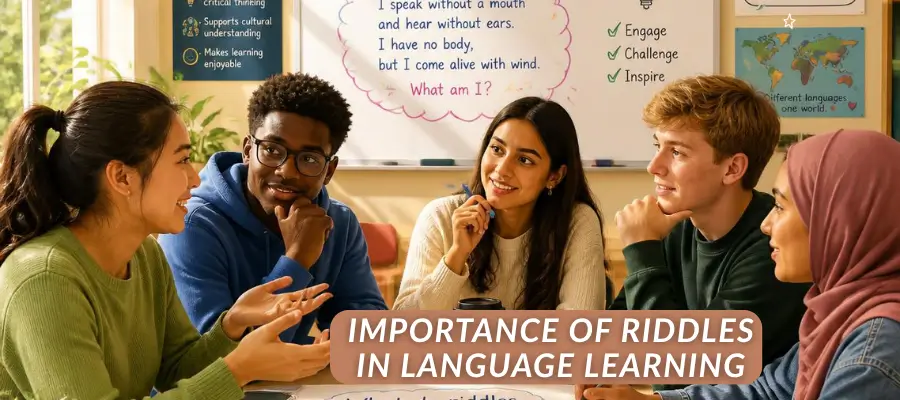
Learning a language is not just about memorizing word lists.What is the importance of riddles in language learning? It is about understanding context, noticing patterns, and using words in real situations. This is exactly why riddles in language learning have become such a popular tool for teachers, parents, and learners of all ages.
What is the importance of riddles in language learning?
Riddles are important because they combine vocabulary, reading comprehension, listening, reasoning, and creativity into one short, engaging activity. Instead of simply memorizing a word, a learner has to think about its meaning, its context, and how it connects to other clues. This makes riddles for English learners a natural bridge between passive memorization and active language use.
A good riddle gives learners a reason to pay attention to word meanings, sentence structure, and multiple meanings of the same word. That small mental challenge of figuring out the answer is what makes the learning stick.
What are riddles?
A riddle is a short question or statement that hides its answer inside clever clues. The reader has to use reasoning, vocabulary knowledge, and sometimes a little imagination to work out what is being described.
Most riddles share three features:
- A set of clues, often written in figurative or descriptive language
- A logical connection between the clues and the answer
- A single word or short phrase as the solution
Example riddle:
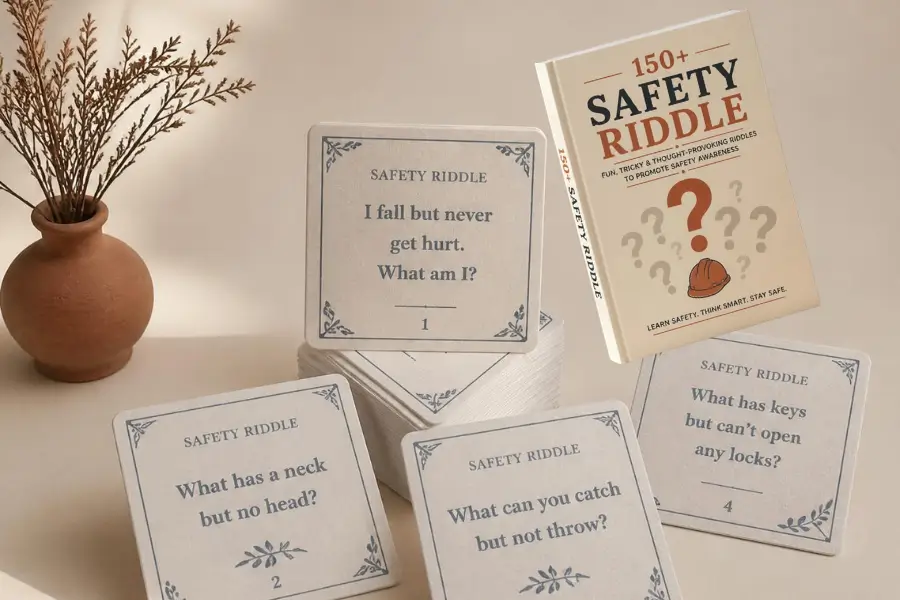
“I have keys but no locks. I have space but no room. You can enter, but you can’t go outside. What am I?”
Answer: A keyboard.
To solve it, the learner has to notice that “keys,” “space,” and “enter” are also computer-related words. This is a simple example of how riddles teach multiple meanings and context clues at the same time.
Why Are Riddles Important in Language Learning?
Riddles support language development in several distinct ways. Below are the core benefits of riddles for language learners.
1. Build Vocabulary
Riddles naturally introduce new words. Because the meaning is not given directly, learners must think about a word’s definition, connotation, and use in context a much deeper form of vocabulary development than simple word lists.
2. Improve Reading Comprehension
To solve a riddle, a learner must read every clue carefully. Skimming will not work. This close-reading habit strengthens reading comprehension skills that transfer directly to textbooks, stories, and everyday communication.
3. Develop Critical Thinking
Riddles ask learners to compare clues, rule out wrong answers, and connect separate pieces of information. This process builds critical thinking skills, the same skills used in problem-solving, decision-making, and logical reasoning in other subjects.
4. Improve Problem-Solving Skills
A riddle is essentially a small language puzzle. Working through it step by step from confusion to a confident answer mirrors the kind of problem-solving learners need when facing unfamiliar grammar or vocabulary in real conversations.
5. Teach Words in Context
Vocabulary lists show a word in isolation. Riddles show a word working inside a full sentence, surrounded by clues. This context-based learning helps learners understand how a word is actually used, not just what it means in a dictionary.

6. Encourage Creativity
Because riddles often hide their answer behind indirect language, learners must think beyond the obvious meaning of a word. This kind of creative, flexible thinking is valuable not only in language learning but also in science, math, and everyday communication.
7. Improve Understanding of Multiple Meanings
Many riddles rely on homonyms, wordplay, double meanings, and metaphors. A riddle about a “bank,” for example, might play with both a riverbank and a financial bank. Working through this ambiguity helps learners understand English idioms and expressions, which are often difficult to learn any other way.
8. Strengthen Listening Skills
When a teacher or parent reads a riddle aloud, learners must listen carefully for each clue instead of relying on visual text. This builds listening comprehension, a skill that is often harder to practice than reading.
9. Encourage Speaking and Discussion
Riddles naturally lead to conversation. Learners explain their guesses, defend their reasoning, and sometimes disagree with classmates before reaching the answer. This kind of guided discussion builds communication skills in a low-pressure, enjoyable setting.
10. Increase Motivation and Engagement
The challenge of solving a riddle and the small reward of getting it right makes language practice feel like a game rather than a drill. This boost in motivation and engagement often means learners remember the vocabulary from a riddle far longer than a word from a static list.
How Riddles Help Different Language Skills
| Language Skill | How Riddles Help | Example Activity |
|---|---|---|
| Vocabulary | Introduce and reinforce new words | Find the meaning of unfamiliar clue words |
| Reading | Encourage careful reading | Highlight important clues |
| Listening | Practice understanding spoken clues | Solve a riddle read aloud |
| Speaking | Encourage explanation and discussion | Explain why an answer fits |
| Writing | Practice sentence construction | Write an original riddle |
| Critical Thinking | Connect clues and ideas | Eliminate incorrect answers |
Importance of Riddles for English Language Learners
Riddles for English learners are especially useful for people learning English as a second or foreign language (ESL/ELL). They offer:
- Vocabulary building through repeated exposure to new words in context
- Grammar exposure, since riddles use complete sentences and natural word order
- Context clues that help learners guess meaning without a dictionary
- Idioms and expressions, which are often confusing when taught in isolation
- Wordplay that trains learners to notice puns, homophones, and double meanings
- Sentence comprehension through the need to process a full clue, not just a single word
- Confidence in using English, since solving a riddle correctly is a small, motivating win
For adult ESL learners and children alike, riddles turn abstract grammar rules into something they can actually use and enjoy.

Riddles for Children Learning a New Language
For young learners, riddles for kids work best when they match the child’s current level. Good practice includes:
- Using simple vocabulary the child already partly knows
- Keeping sentences short and clear
- Choosing familiar topics like animals, food, or school objects
- Adding visual clues or pictures when helpful
- Adjusting difficulty as the child’s vocabulary grows
A riddle that is too hard can frustrate a young learner, while one that is too easy loses its value. The best language learning activities for children sit just slightly above their current ability.
How Teachers Can Use Riddles in the Classroom
Educational riddles fit naturally into many classroom formats:
- Riddle of the Day — Start class with one riddle to warm up vocabulary and attention.
- Group Riddle Challenge — Small teams work together, building both language and teamwork skills.
- Vocabulary Riddles — Focus each riddle on a specific set of target words.
- Picture Riddles — Pair riddles with images to support visual learners.
- Create Your Own Riddle — Students write riddles, practicing sentence structure and creativity.
- Riddle Guessing Game — A fast-paced format that builds listening and speaking confidence.
- Riddle Reading Practice — Students read riddles aloud to practice pronunciation and fluency.
- Team Competition — Points-based riddle contests increase motivation and engagement.
Each activity reinforces a different combination of vocabulary, reading, listening, and speaking practice, making riddles a flexible tool for almost any lesson plan.
How Parents Can Use Riddles at Home
Riddles do not need a classroom to be effective. Parents can build them into everyday routines:
- Ask one riddle at breakfast to start the day with a quick language challenge.
- Use riddles during reading time as a fun break between chapters.
- Let children explain their answers instead of just saying “yes” or “no.”
- Encourage children to create their own riddles about family, pets, or favorite objects.
- Choose riddles based on the child’s current vocabulary level.
- Turn any unfamiliar word into a short, friendly vocabulary lesson.
These small, consistent habits help reinforce riddles and reading comprehension without feeling like formal schoolwork.
Example:
How One Riddle Can Teach Language
Take this riddle: “What has hands but cannot clap?” Answer: A clock.
Here is everything a learner practices with just this one line:
- New vocabulary: hands (in a non-body meaning), clap
- Sentence meaning: understanding a question written in present tense
- Clues: “has hands,” “cannot clap” — both point away from a person
- Grammar: correct use of “has” and “cannot” in a question structure
- Reasoning: connecting an object with hands that don’t clap to a clock
- Final answer: clock
One short riddle becomes a complete mini-lesson in vocabulary, grammar, and reasoning proof that riddles and vocabulary development go hand in hand.
Riddles vs. Traditional Vocabulary Practice
| Method | Main Benefit | Engagement |
|---|---|---|
| Vocabulary lists | Memorization | Low to moderate |
| Flashcards | Word recognition | Moderate |
| Riddles | Context + reasoning + vocabulary | High |
| Reading passages | Context and comprehension | Moderate to high |
| Language games | Practice and interaction | High |
Riddles are not automatically better than every other method. They work best as one part of a broader language-learning strategy that also includes reading, writing practice, conversation, and structured grammar lessons.
Are Riddles Effective for Language Learning?
Yes, but with some balance. Riddles are effective because they provide meaningful, context-rich language practice that feels more like play than study. However, their real impact depends on:
- The learner’s age and current language level
- How difficult the riddle’s vocabulary and wordplay are
- Whether the activity includes discussion, not just a quick answer
- How consistently riddles are used alongside other learning methods
Riddles alone will not teach a language. But used regularly, they add a layer of engagement and reasoning that many traditional methods lack.
Common Challenges When Using Riddles
| Challenge | Solution |
|---|---|
| Riddles may contain unfamiliar vocabulary | Pre-teach key words before presenting the riddle |
| Wordplay can be difficult for beginners | Start with literal riddles before introducing puns |
| Cultural references may confuse learners | Choose riddles with universal, familiar topics |
| Very difficult riddles can discourage students | Offer hints and celebrate effort, not just correct answers |
Tips for Choosing Good Language-Learning Riddles
- Match the riddle to the learner’s level.
- Introduce difficult vocabulary before presenting the riddle.
- Avoid overly complex wordplay for beginners.
- Use familiar, everyday subjects.
- Ask learners to explain their reasoning, not just state the answer.
- Increase difficulty gradually over time.
- Choose riddles with clear, solvable clues rather than trick questions.
Frequently Asked Questions
What is the importance of riddles in language learning?
Riddles combine vocabulary, reading, listening, and reasoning into one engaging activity, helping learners understand words in context rather than in isolation.
How do riddles improve vocabulary?
Riddles introduce new words inside meaningful clues, encouraging learners to work out meaning from context instead of memorizing definitions.
Can riddles improve English speaking skills?
Yes, explaining an answer, discussing possibilities with classmates, and creating original riddles all build speaking confidence and fluency.
How do riddles improve reading comprehension?
Solving a riddle requires careful, close reading of every clue, which strengthens comprehension skills used in longer texts.
Are riddles good for children learning English?
Yes, as long as the vocabulary and difficulty level match the child’s current ability. Simple, age-appropriate riddles work best.
Can riddles improve critical thinking?
Yes. Riddles require comparing clues, eliminating wrong answers, and connecting ideas logically core critical thinking skills.
How can teachers use riddles in the classroom?
Teachers can use riddles as warm-up activities, group challenges, vocabulary practice, or team competitions to build multiple language skills at once.
How can parents use riddles for language learning?
Parents can ask a riddle during breakfast, reading time, or car rides and encourage children to explain their answers and create their own riddles.
Are riddles suitable for beginner English learners?
Yes, if the riddles use simple vocabulary and clear clues. Difficulty should increase gradually as the learner’s skills grow.
What skills do riddles develop?
Riddles develop vocabulary, reading comprehension, listening, speaking, critical thinking, problem-solving, and creativity.
Conclusion
Riddles turn ordinary vocabulary and comprehension practice into an active challenge. Instead of memorizing isolated words, learners read carefully, listen closely, reason through clues, and often talk through their thinking with others. This combination of context, reasoning, and communication is exactly what makes riddles in language learning so effective.
What is the importance of riddles in language learning? Riddles work best as part of a wider language-learning strategy, alongside reading, conversation, and structured grammar practice. Used consistently, they help learners of all ages build vocabulary, sharpen reading comprehension, and improve communication skills all while keeping learning genuinely fun.
Whether you are a teacher planning a warm-up activity, a parent looking for a five-minute language game, or a learner practicing on your own, start with one riddle a day. Small, consistent practice with riddles for improving English builds real, lasting language skills over time.