Puzzles are not just for kids on a rainy afternoon. More and more adults are picking up jigsaw puzzles, crosswords, and Sudoku books, and there’s a good reason for it. The benefits of doing puzzles for adults go far beyond simple fun. Puzzles can support brain health, sharpen problem-solving skills, and give your mind a healthy dose of mental stimulation all while helping you unwind after a long day.
In short: doing puzzles regularly can support memory, concentration, and cognitive function, offer stress relief, and keep your mind mentally active as you age. They won’t turn you into a genius overnight, and they aren’t a guaranteed cure for memory problems, but they are a simple, low-cost way to give your brain a regular workout.
Puzzling has also become more visible in everyday adult life. Coffee shops keep jigsaw puzzles on side tables, offices place them in break rooms, and puzzle apps regularly top the download charts. Part of this popularity comes from how puzzles fit into a busy schedule without demanding much preparation.
You don’t need special equipment, a subscription, or a set amount of free time. A puzzle book fits in a bag, a crossword takes up half a page of the newspaper, and a puzzle app lives right on your phone.
In this article, we’ll break down exactly how puzzles affect the brain, look at the best puzzle types for adults, and share practical tips on how to make puzzling part of your weekly routine. We’ll also cover how often you should puzzle, how to pick the right difficulty level, and whether puzzles are genuinely worthwhile for older adults.
What Are Puzzles and Why Do Adults Enjoy Them?
A puzzle is any activity that challenges you to find a solution using logic, memory, pattern recognition, or creativity. That covers everything from a 1,000-piece jigsaw puzzle spread across the dining table to a quick daily crossword on your phone.
Adults enjoy puzzles for a few simple reasons. First, puzzles offer a break from screens and endless scrolling. Second, they give your brain a satisfying challenge without any pressure — there’s no boss, no deadline, and no one grading your work. Third, puzzles deliver a genuine sense of accomplishment. Finishing a hard Sudoku grid or fitting the last jigsaw piece into place feels good, and that feeling keeps people coming back.
Puzzles also fit into busy adult lives. You can do a crossword during a coffee break, work on a jigsaw puzzle while watching TV, or solve a quick brain teaser while waiting in line. This flexibility is a big part of why puzzles have stayed popular with adults of every age.
10 Benefits of Doing Puzzles for Adults
1. Supports Brain Health
One of the most talked-about benefits of doing puzzles for adults is how they support overall brain health. When you solve a puzzle, your brain builds and strengthens connections between brain cells. Regularly challenging your mind with new problems — instead of doing the same easy tasks over and over — helps keep your thinking sharp. Puzzles are essentially a form of brain exercise, similar to how a workout challenges your muscles.
2. Improves Problem-Solving Skills
Puzzles are built around one core idea: there’s a problem, and you need to figure out how to solve it. Whether you’re deciding which jigsaw piece fits next or working out a logic puzzle’s hidden pattern, you’re practicing problem-solving skills you can use in everyday life — from planning a busy week to troubleshooting a work issue.
3. May Improve Memory
Many puzzles ask you to recall shapes, colors, patterns, or previous clues. Over time, this kind of repeated practice may help support memory, especially short-term memory. It’s worth noting that puzzles are not a proven treatment for memory loss or a guaranteed way to prevent memory-related conditions, but as part of a mentally active lifestyle, they can be a helpful habit.
4. Boosts Concentration and Focus
Puzzles require sustained attention. You can’t finish a crossword or a Sudoku grid while your mind wanders in five different directions. Practicing this kind of focused attention regularly can help improve your concentration and your attention span over time, which can carry over into work tasks, reading, and other daily activities.
5. Encourages Critical Thinking
Logic puzzles and brain teasers, in particular, push you to think several steps ahead, test ideas, and adjust your approach when something doesn’t work. This process builds critical thinking the ability to look at a problem from different angles and make smart decisions based on evidence rather than guesswork.
6. Helps With Stress Relief and Relaxation
Puzzles offer a rare kind of focus that pushes everyday worries into the background. When you’re deep in a jigsaw puzzle or a word search, your mind has less room to dwell on stress. Many people describe puzzling as a calming, almost meditative activity, making it a simple form of stress relief and relaxation you can do at home.
7. Develops Visual-Spatial Skills
Jigsaw puzzles, in particular, are excellent for building visual-spatial skills — your ability to judge shapes, sizes, and how pieces fit together in space. This skill isn’t just useful at the puzzle table. It also helps with everyday tasks like packing a suitcase, reading a map, parking a car, or arranging furniture in a room.
8. Keeps the Mind Mentally Active
Passive activities like watching TV don’t ask much of your brain. Puzzles are different — they keep your mind mentally active by constantly presenting new problems to solve. Staying mentally active is considered a healthy habit for adults of all ages, and puzzles are one of the easiest ways to build this into daily life.
9. Can Improve Attention to Detail
Many puzzles hinge on small details — a slightly different shade of color in a jigsaw piece, a repeated number in Sudoku, or a subtle clue in a crossword. Practicing this kind of careful observation can improve your attention to detail, which is useful in work tasks that require accuracy, like proofreading, data entry, or quality checks.
10. Provides a Fun Way to Learn and Challenge Yourself
Finally, puzzles are simply enjoyable. Word puzzles can expand your vocabulary. Number puzzles can sharpen your math skills. Trivia-based puzzles can teach you new facts. Puzzles let you learn and challenge yourself in a low-pressure, genuinely fun way — which is a big reason people stick with the habit long term.
How Do Puzzles Affect the Brain?
When you work on a puzzle, several parts of your brain activate at once. Depending on the type of puzzle, your brain may use areas responsible for cognitive function, memory, language, logic, and spatial awareness.
For example, jigsaw puzzles engage the areas of your brain responsible for visual processing and spatial reasoning, since you’re constantly comparing shapes and images. Crossword puzzles and word puzzles activate language centers, pulling from your vocabulary and memory.
Sudoku and number puzzles rely more heavily on logical reasoning and short-term memory, since you need to track numbers and rules across the grid.
This kind of varied mental activity is sometimes described as cognitive skills training. The idea is simple: the more you use different parts of your brain in structured, challenging ways, the more you practice and reinforce those skills. It’s similar to how lifting weights builds specific muscles different puzzles “exercise” different mental muscles.
It’s important to have realistic expectations here. Puzzles are a form of healthy mental wellness activity, not a medical treatment. They can be part of a mentally active lifestyle, but they should not be viewed as a guaranteed way to boost intelligence or prevent brain-related conditions.

Another reason puzzles are so effective is the feedback loop they create. Every time you place a jigsaw piece correctly or fill in the right crossword answer, your brain registers a small win. That sense of progress keeps you engaged and motivated to continue, which is part of why puzzling can feel so satisfying compared to more passive activities. This steady cycle of challenge and reward is exactly what makes puzzles such a natural fit for regular brain exercise.
Different Types of Puzzles for Adults
Not all puzzles work the same part of your brain. Mixing up puzzle types can give you a more well-rounded mental workout.
Jigsaw Puzzles
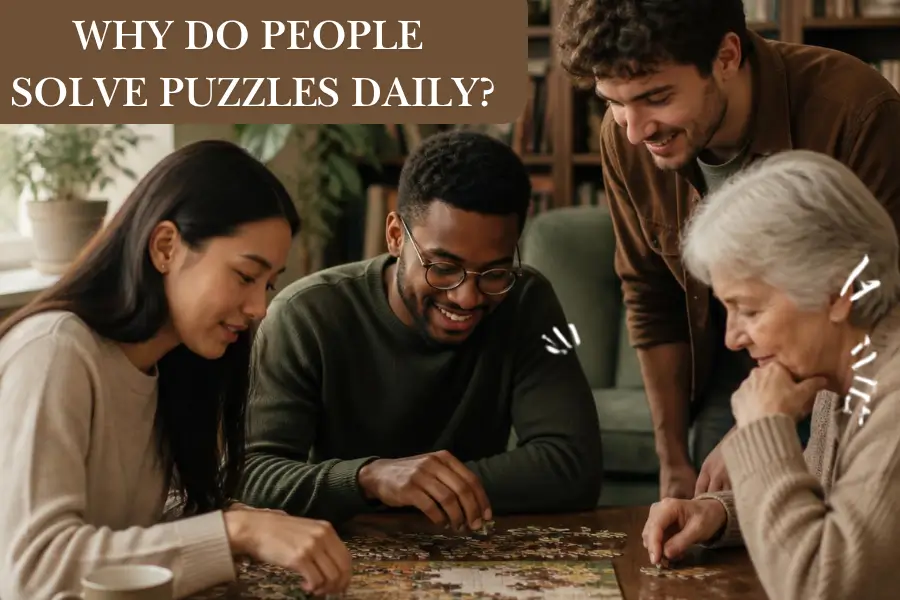
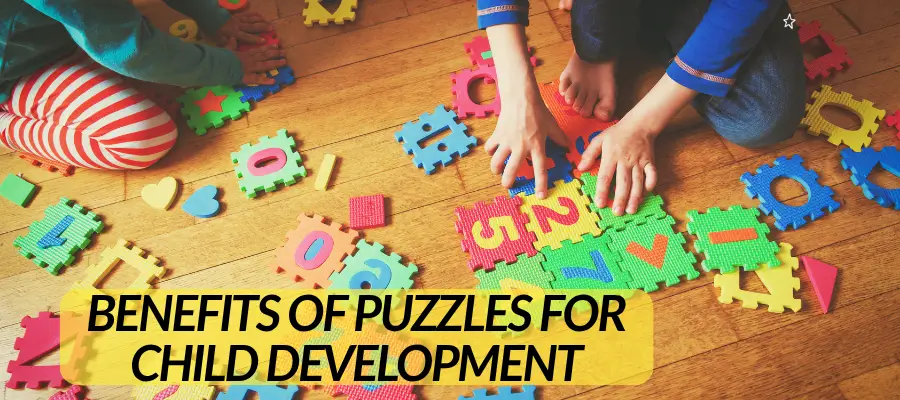
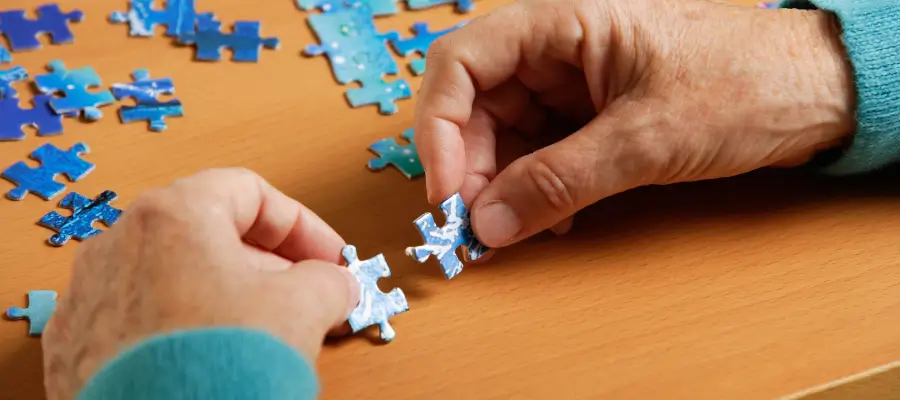
Jigsaw puzzles are great for building visual-spatial skills, patience, and attention to detail. They’re also naturally social many adults enjoy working on a jigsaw puzzle with a partner, friend, or family member, which adds a nice bonus of connection and conversation.
Crossword Puzzles
Crossword puzzles are ideal for language lovers. They challenge your vocabulary, general knowledge, and memory, and they’re a great daily habit since most newspapers and apps offer a fresh crossword every day.
Sudoku
Sudoku is a number-based logic puzzle that sharpens your reasoning and short-term memory. Since it doesn’t rely on language, it’s a great option for anyone who wants a purely logical challenge.
Logic Puzzles
Logic puzzles, like grid-based deduction puzzles or lateral thinking problems, are excellent for building critical thinking. They require you to eliminate possibilities step-by-step, which is great practice for structured decision-making.
Word Puzzles
Word searches, anagrams, and word scrambles are simple but effective. They build vocabulary and pattern recognition and are especially good for a quick, low-effort mental warm-up.
Number Puzzles
Beyond Sudoku, number puzzles like KenKen or number sequences challenge your math and logic skills together. These are a good pick for people who enjoy a more analytical style of puzzle.
Riddles and Brain Teasers
Riddles and brain teasers are short, punchy challenges that require creative and lateral thinking. They’re perfect for a quick mental boost during a break, and they’re often fun to share and solve with others.
Are Puzzles Good for Older Adults?
Puzzles are often recommended as part of a mentally active lifestyle for older adults, and for good reason. As people age, staying socially and mentally engaged becomes increasingly important for overall well-being. Puzzles offer a low-cost, accessible way to stay mentally active without needing special equipment or a gym membership.
Many senior communities include group puzzle activities specifically because they combine mental stimulation with social interaction two things that support healthy aging. Working on a jigsaw puzzle with friends, family, or fellow residents adds a social element that solo screen time simply can’t match.
That said, it’s important to be clear: puzzles can support cognitive activity, but they should not be presented as a guaranteed way to prevent dementia, Alzheimer’s disease, or any other medical condition. Research on brain games and puzzles is ongoing, and while staying mentally active is generally considered a healthy habit, puzzles work best as one part of a broader healthy lifestyle that also includes physical activity, good sleep, social connection, and a balanced diet.
For older adults specifically, puzzles offer a gentle way to stay sharp without physical strain. Unlike some forms of exercise, puzzles can be done seated, at any pace, and adjusted to any skill level, which makes them accessible even for those with limited mobility. Family members can also use puzzles as a shared activity during visits, turning a simple jigsaw puzzle or crossword into quality time that benefits both mood and cognitive engagement at once.
How Often Should Adults Do Puzzles?
There’s no strict rule, but many experts suggest aiming for short, regular sessions rather than occasional long ones. Doing a puzzle for 15 to 30 minutes a day, several times a week, is a reasonable and sustainable goal for most adults.
Consistency matters more than intensity. A quick daily crossword or a few Sudoku puzzles during your morning coffee can be just as valuable as a longer weekend jigsaw puzzle session. The key is making it a regular habit rather than a one-time activity, since your brain benefits most from ongoing, varied mental challenges.
How to Choose the Right Puzzle for Your Skill Level
| Skill Level | Puzzle Type | Recommended Difficulty | Why It’s a Good Choice |
|---|---|---|---|
| Beginner | Jigsaw Puzzle | 50–300 pieces | Easy to understand and helps build focus |
| Beginner | Crossword Puzzle | Easy clues | Improves vocabulary and word skills without being overwhelming |
| Beginner | Sudoku | Easy | Builds basic logic and number skills |
| Beginner | Word Search | Simple | Improves attention and visual scanning |
| Intermediate | Jigsaw Puzzle | 300–750 pieces | Provides a greater challenge and requires more concentration |
| Intermediate | Crossword Puzzle | Medium | Strengthens vocabulary, memory, and problem-solving skills |
| Intermediate | Sudoku | Medium | Requires more logical thinking and planning |
| Intermediate | Logic Puzzles | Medium | Helps develop reasoning and critical-thinking skills |
| Advanced | Jigsaw Puzzle | 1,000+ pieces | Requires patience, visual-spatial skills, and sustained attention |
| Advanced | Crossword Puzzle | Difficult | Challenges memory, vocabulary, and general knowledge |
| Advanced | Sudoku | Hard/Expert | Requires advanced logic and careful planning |
| Advanced | Logic Puzzles | Difficult | Provides a strong mental challenge and tests complex reasoning |
| Expert | Brain Teasers | Challenging | Encourages creative thinking and problem-solving |
| Expert | Cryptic Crosswords | Very Difficult | Tests advanced vocabulary, wordplay, and lateral thinking |
Tip: Start with a puzzle that feels challenging but not frustrating. As your skills improve, gradually increase the difficulty to keep your brain engaged.
It also helps to rotate puzzle types rather than sticking to just one. If you always do the same kind of Sudoku grid, your brain adapts and the challenge shrinks over time. Mixing in a jigsaw puzzle one day, a crossword the next, and a logic puzzle later in the week keeps your brain guessing and ensures you’re exercising a wider range of cognitive skills instead of just one.
Can Puzzles Help Reduce Stress?
Yes, puzzles can be a genuinely effective tool for stress relief. When you focus on a puzzle, your brain shifts attention away from daily worries and onto the task in front of you. This kind of focused, low-stakes activity can promote a sense of calm and relaxation, similar to other mindfulness-based habits.
Puzzles also offer a healthy alternative to stress-relief habits that involve screens, like scrolling social media, which can sometimes leave people feeling more anxious rather than less. Working on a puzzle gives your hands and mind something productive to do, which many people find more satisfying and calming than passive screen time.
Puzzles vs. Other Brain Exercises
Puzzles are one of many options for mental exercise, and they compare well to other popular brain-training activities.
- Puzzles vs. reading: Reading builds vocabulary and imagination, while puzzles more directly challenge logic, memory, and spatial reasoning. Both are valuable, and combining them offers a well-rounded mental routine.
- Puzzles vs. learning a new language: Learning a language is a deeper, longer-term cognitive challenge, but puzzles offer a quicker, more flexible way to get daily mental stimulation.
- Puzzles vs. brain-training apps: Many brain-training apps are essentially digital puzzles. Traditional puzzles, like jigsaw puzzles and crosswords, offer the same style of challenge without a subscription fee.
- Puzzles vs. physical exercise: Physical exercise benefits the brain in different ways, largely through improved blood flow. Puzzles and physical activity work well together as part of a balanced routine that supports both body and mind.
No single brain exercise is “the best.” The most effective approach is variety — mixing puzzles with reading, physical activity, and social time. Think of puzzles as one tool in a larger toolbox for mental wellness, rather than a stand-alone solution. The adults who get the most out of puzzling tend to be the ones who treat it as an enjoyable habit, not a chore or a strict brain-training regimen.
Frequently Asked Questions
What are the benefits of doing puzzles for adults?
Puzzles can support memory, concentration, problem-solving skills, and stress relief. They also keep the mind mentally active and offer a fun, low-cost way to challenge yourself regularly.
Are puzzles good for your brain?
Yes. Puzzles engage multiple areas of the brain, including memory, logic, and visual-spatial skills. Regular puzzling is considered a healthy form of mental stimulation and brain exercise.
Do puzzles improve memory?
Puzzles may help support short-term memory through repeated practice, but they are not a proven medical treatment for memory loss or memory-related conditions.
Can puzzles improve concentration?
Yes. Puzzles require sustained focus, and practicing this regularly can help strengthen concentration and attention span over time.
Are jigsaw puzzles good for adults?
Absolutely. Jigsaw puzzles are especially good for building visual-spatial skills, patience, and attention to detail, and they can also be a fun social activity.
How long should an adult do puzzles each day?
Most experts suggest 15 to 30 minutes a day, several times a week, though even shorter sessions done consistently can be beneficial.
Are puzzles good for seniors?
Yes, puzzles are a popular and accessible way for seniors to stay mentally and socially active. However, they should be seen as one part of a healthy lifestyle, not a guaranteed way to prevent memory-related conditions.
Can puzzles help with stress?
Yes. Puzzles can promote relaxation by shifting focus away from daily worries and onto a calm, engaging task, making them a simple form of stress relief.
Final Thoughts
The benefits of doing puzzles for adults are real, practical, and easy to access. From supporting brain health and problem-solving skills to offering genuine stress relief, puzzles are a simple habit that fits easily into a busy adult life. Whether you prefer jigsaw puzzles, crosswords, Sudoku, or brain teasers, the important thing is choosing puzzles you genuinely enjoy and can stick with over time.
Puzzles won’t replace a healthy diet, good sleep, or regular exercise, and they aren’t a guaranteed fix for memory or cognitive conditions. But as part of a balanced, mentally active lifestyle, they offer a fun, low-pressure way to keep your mind sharp, relaxed, and engaged one piece, clue, or puzzle at a time.
Benefits of Riddles for Students: 10 Smart Reasons to Try Them