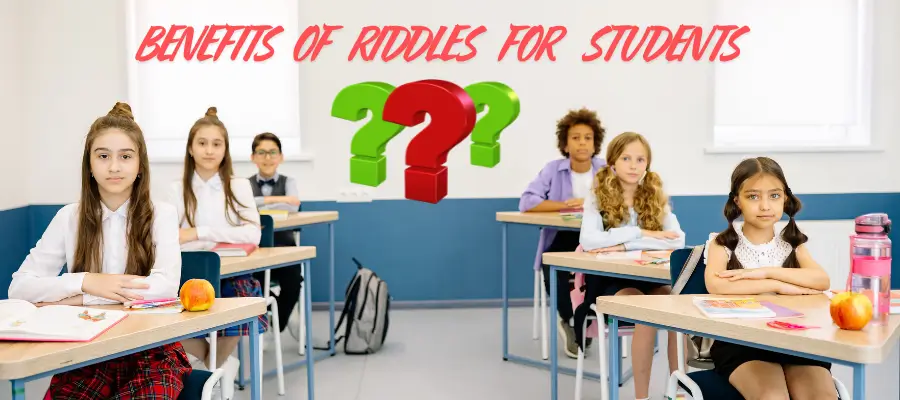
Most students light up the moment a puzzle appears. A riddle turns a quiet classroom into a room full of raised hands, guesses, and “wait, I think I’ve got it” moments. That reaction isn’t an accident; riddles tap into something students naturally enjoy: figuring things out. Here we explain the benefits of riddles for students
What are the benefits of riddles for students?
Riddles give students a fun, low-pressure way to practice critical thinking, problem-solving, vocabulary, reading comprehension, creativity, communication, and memory all at once. They work as a supplement to classroom teaching, not a replacement for it, but when used well, they turn ordinary practice into an activity students actually look forward to.
This guide breaks down exactly how riddles support learning, how they can be used across subjects and age groups, and how teachers and parents can use them effectively.
A riddle is a short question or statement that describes something in an indirect or puzzling way, challenging the listener to figure out the answer using clues, logic, and creative thinking. Riddles for students usually combine language, reasoning, and prior knowledge students have to read carefully, notice hints, and connect them to something they already know.

Here’s a simple example:
“I have keys but no locks. I have space but no room. You can enter, but you can’t go outside.
What am I?” (Answer: A keyboard.)
To solve it, a student has to consider each clue, rule out the literal meaning of words like “keys” and “room,” and think about the answer from a new angle. That process of reading, analyzing, and reasoning is exactly why educational riddles are so useful for learning.
10 Benefits of Riddles for Students
1. Improve Critical Thinking
Riddles and critical thinking go hand in hand. To solve a riddle, students have to analyze each clue, compare different possible answers, and figure out which one makes logical sense. This kind of reasoning is the same skill students need for science experiments, math word problems, and reading between the lines in literature.
2. Develop Problem-Solving Skills
A good riddle rarely gives away the answer right away. Students have to break the question into smaller parts, test out ideas, and adjust their thinking when an answer doesn’t fit. That’s the core of riddles and problem-solving: learning to work through a challenge step by step instead of giving up at the first sign of difficulty.
3. Expand Vocabulary
Many riddles use unfamiliar words, double meanings, or wordplay that students have to figure out from context. This makes riddles for improving vocabulary especially useful, since students learn new words naturally, through curiosity, rather than through memorization alone.
4. Improve Reading Comprehension
Riddles require close reading. A student who skims the clues will likely get the wrong answer, so riddles push students to slow down, reread if needed, and pay attention to small but important details. This directly supports riddles and reading comprehension, a skill that carries over into every subject.
5. Encourage Creativity
Riddles rarely have an obvious answer. Students have to consider unusual interpretations, unexpected meanings, and creative possibilities before landing on the right one. This kind of flexible thinking strengthens riddles and creativity, encouraging students to look at problems from more than one angle.
6. Strengthen Memory
Solving a riddle often means recalling vocabulary, facts, or prior experiences and connecting them to new clues. This blend of memory and reasoning gives students useful mental practice, especially when riddles are tied to topics they’ve already studied.
7. Improve Language Skills
Beyond vocabulary, riddles help students notice sentence structure, word meanings, idioms, and language patterns. Puns and wordplay, in particular, teach students that words can carry more than one meaning, an important skill for reading, writing, and communication.
8. Build Confidence
There’s a real sense of achievement when a student finally solves a tricky riddle. That small win can boost their confidence and make them more willing to try harder problems in the future, whether it’s a math equation or a class discussion.
9. Encourage Communication and Discussion
Riddles work especially well in pairs or groups. Students explain their reasoning, defend their answer, and listen to other viewpoints even when someone else’s answer turns out to be right. This back-and-forth builds communication skills in a low-stakes, engaging way.
10. Make Learning More Engaging
Perhaps the simplest benefit riddles make learning fun. As one of many fun learning activities for students, riddles turn routine review or downtime into an interactive challenge, which helps keep students focused and motivated.
Benefits of Riddles for Different Age Groups
Riddles for Elementary Students
For younger learners, riddles for kids should focus on simple vocabulary, observation, and basic reasoning. Short riddles help build early confidence and introduce students to the idea that questions can have more than one layer of meaning.
Riddles for Middle School Students
Middle schoolers can handle riddles that require more logic and language skills. At this stage, riddles for learning can strengthen critical thinking and problem-solving while introducing more complex vocabulary and multi-step reasoning.
Riddles for High School Students
Older students benefit from riddles that involve abstract thinking, layered wordplay, and open-ended reasoning. These riddles often spark deeper discussion, encouraging students to explain and defend their thinking, which is useful practice for debate, writing, and analytical subjects.
How Riddles Support Different Learning Skills
| Skill | How Riddles Help | Example |
|---|---|---|
| Critical thinking | Students analyze clues | Compare possible answers |
| Problem-solving | Students work through clues | Eliminate incorrect answers |
| Vocabulary | Students learn words in context | Identify unfamiliar clue words |
| Reading | Students practice careful reading | Find important details |
| Creativity | Students explore different ideas | Think beyond the obvious answer |
| Communication | Students explain their answers | Discuss reasoning with classmates |
| Memory | Students recall information | Connect clues with prior knowledge |
How Teachers Can Use Riddles in the Classroom
Riddles for classroom activities don’t require much setup, which makes them easy to fit into any lesson plan.
- Riddle of the Day — Start class with one riddle on the board. Students think about it quietly before sharing guesses, which helps focus attention right from the bell.
- Team Riddle Challenge — Split the class into small teams and give each one a set of riddles to solve together. This builds collaboration and healthy competition.
- Subject-Based Riddles — Write riddles tied to the day’s lesson, such as a science riddle about the water cycle. Students practice content knowledge while solving the puzzle.
- Vocabulary Riddles — Base riddles around new vocabulary words so students learn definitions through context instead of a plain list.
- Riddle Writing Activity — Ask students to write their own riddles for classmates to solve. This reinforces language skills and creative thinking from the other direction.
- Riddle Competition — Hold a class or grade-level riddle contest, which works well for quiz bowls or academic clubs looking for brain teasers for students.
- Mystery Riddle Stations — Set up several riddle stations around the room that students rotate through, each tied to a different subject or skill.
- Exit-Ticket Riddles — End class with a riddle related to the day’s material. Students who solve it show they understood the key concept.
How Riddles Can Be Used Across School Subjects
Riddles aren’t limited to English class. With small adjustments, they fit almost any subject:
- English — Use riddles built around synonyms, homophones, or figurative language.
- Math — Create number riddles, such as “I am a two-digit number. My digits add up to 9, and I am even. What number am I?”
- Science — Write riddles about natural phenomena, like “I have no legs, but I can travel across the sky and bring rain. What am I?” (A cloud.)
- History — Turn key events or figures into riddles, such as “I signed a famous declaration but never wore a uniform in battle. Who am I?”
- Geography — Use riddles about landmarks, countries, or natural features.
- Computer Science — Create riddles about coding logic or technology terms.
- General Knowledge — Mix riddles across topics for trivia-style challenges.
Riddles and Critical Thinking: Why Do They Work?
Solving a riddle follows a clear thinking process, which is exactly why riddles are considered effective student learning activities:
- Read the clues carefully.
- Identify the most important information.
- Make an initial prediction.
- Compare possible answers.
- Eliminate answers that don’t fit.
- Reach a logical conclusion.
- Explain the reasoning behind the answer.
This step-by-step process mirrors the kind of reasoning students need for science labs, math proofs, and analytical essays, which is why the skill transfers well beyond the riddle itself.
Riddles vs. Traditional Learning Activities
| Activity | Main Learning Benefit | Student Engagement |
|---|---|---|
| Memorization | Recall | Moderate |
| Worksheets | Practice | Moderate |
| Flashcards | Vocabulary recall | Moderate |
| Riddles | Reasoning + language + problem-solving | High |
| Group puzzles | Collaboration + reasoning | High |
Riddles tend to generate more engagement than traditional drills because they combine several skills at once and feel more like a game than an assignment. That said, riddles work best as a supplement to regular instruction not a replacement for structured teaching, direct instruction, or assessment.
How to Choose Good Riddles for Students
- Match the difficulty level to the student’s age and ability.
- Use clear, well-written clues without confusing grammar.
- Introduce a few unfamiliar vocabulary words, but not too many at once.
- Avoid overly complicated wordplay for younger students.
- Rotate between different topics to keep things interesting.
- Give students enough time to think before revealing the answer.
- Ask students to explain how they reached their answer, not just what it is.
- Increase difficulty gradually as students build confidence.
Common Mistakes When Using Riddles in Education
Even a great educational riddle can fall flat if it’s used the wrong way. Watch out for:
- Riddles that are too difficult, which can frustrate students instead of engaging them.
- Focusing only on the correct answer, rather than the reasoning behind it.
- Ignoring the learning goal, so the riddle becomes pure entertainment with no academic value.
- Using culturally unfamiliar references that some students won’t recognize.
- Giving students too little time to think, which discourages real problem-solving.
- Skipping the discussion, missing the chance to reinforce reasoning skills.
Teachers can avoid these issues by choosing age-appropriate riddles, connecting them to a specific skill or lesson, and always following up with a short discussion about how students arrived at their answers.
Example Classroom Riddle Activity
Riddle: “I get smaller every time I take a bath. What am I?”
Learning Goal: Practice inference and vocabulary in context.
Vocabulary: shrink, dissolve, lather, texture
Thinking Process: Students should think about what objects change size when they get wet, then consider what “bath” might represent besides an actual bathtub.
Discussion Questions:
- What clue word helped you the most?
- Did you think of more than one possible answer? What were they?
- How did you decide which answer made the most sense?
Answer: A bar of soap gets physically smaller each time it’s used in water.
Frequently Asked Questions
What are the main benefits of riddles for students?
Riddles help students build critical thinking, problem-solving, vocabulary, reading comprehension, creativity, communication, and memory skills, all through a fun and engaging activity.
How do riddles improve critical thinking?
Riddles require students to analyze clues, compare possible answers, and use logical reasoning to reach a conclusion, the same process used in critical thinking exercises across subjects.
Do riddles help students improve problem-solving skills?
Yes. Riddles encourage students to break a complex question into smaller, manageable parts, which is a foundational problem-solving strategy.
Can riddles improve vocabulary?
Riddles often introduce new or unusual words and require students to figure out meaning from context, which supports natural vocabulary growth.
Are riddles useful in the classroom?
Riddles work well as warm-ups, brain breaks, exit tickets, or subject-based activities, making them a flexible addition to classroom instruction.
How do riddles improve reading comprehension?
Solving a riddle requires careful, attentive reading, since missing a small clue can lead to the wrong answer; this builds close-reading habits.
Can riddles help students become more creative?
Yes. Riddles push students to consider unexpected interpretations and unusual possibilities, strengthening flexible and creative thinking.
What age is best for riddles?
Riddles can be adapted for almost any age, from simple riddles for young elementary students to abstract, wordplay-heavy riddles for high schoolers.
How can teachers use riddles for learning?
Teachers can use riddles as warm-ups, subject-based challenges, vocabulary practice, group activities, or exit tickets tied to the day’s lesson.
Are riddles educational or just for fun?
Riddles can be both. When chosen carefully and tied to a learning goal, they combine entertainment with real academic value.
Final Thoughts
The benefits of riddles for students go well beyond entertainment. Riddles for students build critical thinking, sharpen problem-solving skills, expand vocabulary, strengthen reading comprehension, encourage creativity, and support communication all while keeping learning enjoyable. They work best as classroom activities that complement traditional teaching, not replace it.
When riddles match a student’s age and learning level, they turn ordinary practice into an engaging challenge, encouraging students to think, read, reason, communicate, and learn one clue at a time.