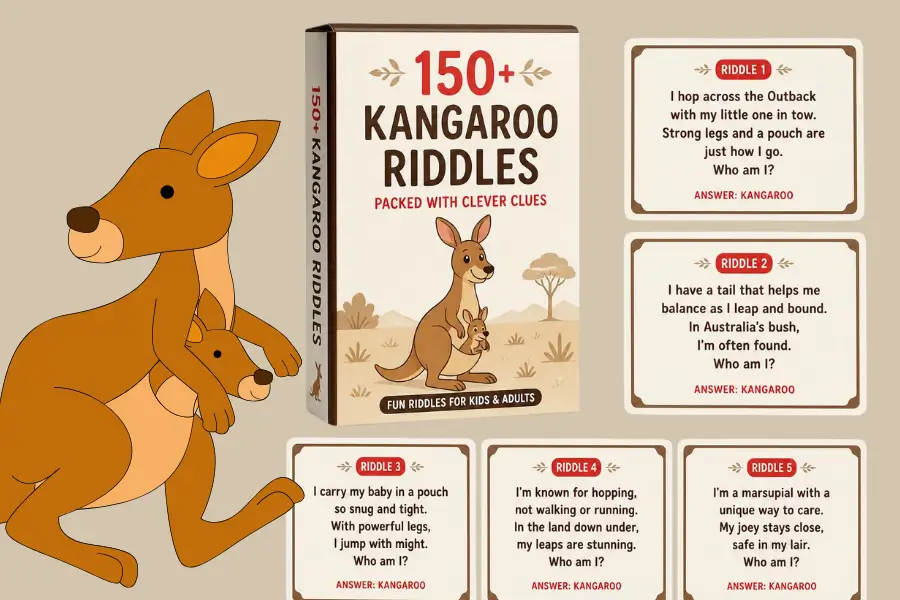
Kangaroos are one of the most fascinating animals in the world. Known for their powerful back legs, long tails, hopping movement, and special pouches, these Australian animals are easy to recognize but can still surprise us with their unique abilities. If you enjoy puzzles and animals, these kangaroo riddles with answers are a fun way to learn while testing your thinking skills.
In this collection, you will find 160 original riddles about kangaroos. Some are simple enough for kids, while others are tricky brain teasers that require a little more thought. Each riddle includes an answer and a short explanation so readers can understand how the clues connect to the correct answer.
These riddles can also work as fun kangaroo quiz questions for classrooms, family activities, animal lessons, or game nights. Whether you are learning about kangaroo biology or simply looking for entertaining puzzles, this collection has something for everyone.
Basic Kangaroo Riddles
This section introduces readers to simple and fun kangaroo riddles with answers. The clues focus on easy-to-recognize features such as hopping, strong legs, a long tail, the pouch, and life in Australia. These riddles are ideal for kids, beginners, and anyone learning basic facts about kangaroos.
I leap across the land without a flag.
Who am I?
EXPLANATION
FIRST CLUE: Has a pouch
SECOND CLUE: Leaps across land
LOGICAL CONNECTION: Kangaroos are marsupials known for their pouches and powerful jumps
CONCLUSION: Kangaroo is correct.
But I have no wings in the sky.
Who am I?
EXPLANATION
FIRST CLUE: Has two strong legs
SECOND CLUE: Moves with powerful leaps
LOGICAL CONNECTION: Kangaroos use their powerful hind legs to hop
CONCLUSION: Kangaroo is correct.
Safe from danger and from harm.
Where does it stay?
EXPLANATION
FIRST CLUE: Holds a baby
SECOND CLUE: Provides protection
LOGICAL CONNECTION: A mother kangaroo carries her joey in her pouch
CONCLUSION: Kangaroo’s Pouch is correct.
I help me balance and never stop.
What am I?
EXPLANATION
FIRST CLUE: Stretches behind the body
SECOND CLUE: Helps with balance
LOGICAL CONNECTION: A kangaroo’s strong tail supports balance and movement
CONCLUSION: Kangaroo’s Tail is correct.
In my mother’s pouch I grow and thrive.
Who am I?
EXPLANATION
FIRST CLUE: Tiny at birth
SECOND CLUE: Grows in a pouch
LOGICAL CONNECTION: A young kangaroo is called a joey
CONCLUSION: Joey is correct.

Get Free Printable Worksheets Here
Across wide lands I make my sweep.
Who am I?
EXPLANATION
FIRST CLUE: Big and strong
SECOND CLUE: Travels by leaping
LOGICAL CONNECTION: Kangaroos are built with powerful hind limbs for hopping
CONCLUSION: Kangaroo is correct.
My famous jumps are widely read.
Who am I?
EXPLANATION
FIRST CLUE: Lives Down Under
SECOND CLUE: Famous for jumping
LOGICAL CONNECTION: Kangaroos are iconic Australian animals
CONCLUSION: Kangaroo is correct.
Across the grass I travel in large amounts.
Who am I?
EXPLANATION
FIRST CLUE: Can bounce
SECOND CLUE: Travels across grass
LOGICAL CONNECTION: Kangaroos move through powerful hops rather than frog-like jumps
CONCLUSION: Kangaroo is correct.
And a tail that follows me around.
Who am I?
EXPLANATION
FIRST CLUE: Has powerful feet
SECOND CLUE: Has a long tail
LOGICAL CONNECTION: These are distinctive kangaroo features
CONCLUSION: Kangaroo is correct.
Yet my great jumps look very neat.
Who am I?
EXPLANATION
FIRST CLUE: Has large feet
SECOND CLUE: Uses them for jumping
LOGICAL CONNECTION: Kangaroos have large hind feet adapted for powerful hopping
CONCLUSION: Kangaroo is correct.

For my baby it is soft and cozy.
What am I?
EXPLANATION
FIRST CLUE: Carries a home on the belly
SECOND CLUE: Protects a baby
LOGICAL CONNECTION: A female kangaroo has a pouch for her joey
CONCLUSION: Kangaroo is correct.
Keeping my body steady and aligned.
Who am I?
EXPLANATION
FIRST CLUE: Can sit using its tail
SECOND CLUE: Uses the tail for support
LOGICAL CONNECTION: Kangaroos can use their strong tails as support
CONCLUSION: Kangaroo is correct.
EXPLANATION
FIRST CLUE: Refers to a baby kangaroo
SECOND CLUE: Has a special name
LOGICAL CONNECTION: A baby kangaroo is called a joey
CONCLUSION: Joey is correct.
EXPLANATION
FIRST CLUE: Uses rear legs
SECOND CLUE: Springs forward
LOGICAL CONNECTION: Kangaroos have powerful hind legs designed for hopping
CONCLUSION: Kangaroo is correct.
Through open country I can go.
Who am I?
EXPLANATION
FIRST CLUE: Has fur
SECOND CLUE: Moves through open country
LOGICAL CONNECTION: Kangaroos are furry mammals commonly found in open Australian habitats
CONCLUSION: Kangaroo is correct.
My baby stays close to me as such.
Who am I?
EXPLANATION
FIRST CLUE: Is a mammal
SECOND CLUE: Has a pouch
LOGICAL CONNECTION: Kangaroos are pouch-bearing marsupial mammals
CONCLUSION: Kangaroo is correct.
Green food makes my diet complete.
Who am I?
EXPLANATION
FIRST CLUE: Eats plants
SECOND CLUE: Feeds on vegetation
LOGICAL CONNECTION: Kangaroos commonly eat grasses and other plant material
CONCLUSION: Kangaroo is correct.
EXPLANATION
FIRST CLUE: Has upright ears
SECOND CLUE: Uses senses to watch surroundings
LOGICAL CONNECTION: Kangaroos have prominent ears and alert senses
CONCLUSION: Kangaroo is correct.
With powerful legs my speed is revealed.
Who am I?
EXPLANATION
FIRST CLUE: Hops across fields
SECOND CLUE: Has powerful legs
LOGICAL CONNECTION: Kangaroos use strong hind limbs for rapid movement
CONCLUSION: Kangaroo is correct.
My giant jumps are my signature mode.
Who am I?
EXPLANATION
FIRST CLUE: Australian animal
SECOND CLUE: Known for giant jumps
LOGICAL CONNECTION: Kangaroos are among Australia’s best-known animals and are famous for hopping
CONCLUSION: Kangaroo is correct.
Also Read : 100+Squirrel Riddles That Boost Brain Skills in a Fun Way!
Fun Kangaroo Facts
These riddles turn interesting kangaroo facts into entertaining questions. Readers will discover clues about their food, habitat, ears, feet, movement, and baby joeys while solving each riddle. This section combines education and entertainment in a simple way.
I hop across fields and make my way soon.
What am I?
EXPLANATION
FIRST CLUE: Carries a baby in a pouch
SECOND CLUE: Hops across fields
LOGICAL CONNECTION: Kangaroos carry their young in pouches and move by hopping
CONCLUSION: Kangaroo is correct.
I bounce along without a sidewalk.
Who am I?
EXPLANATION
FIRST CLUE: Has powerful hind legs
SECOND CLUE: Moves by bouncing and hopping
LOGICAL CONNECTION: Kangaroos use their strong hind legs for their famous hopping movement
CONCLUSION: Kangaroo is correct.
When I hop, I rarely lose my stance.
What am I?
EXPLANATION
FIRST CLUE: Has a long powerful tail
SECOND CLUE: Uses it for balance
LOGICAL CONNECTION: A kangaroo’s tail helps stabilize its body while moving and standing
CONCLUSION: Kangaroo is correct.
But give me space when I start to fall.
Who am I?
EXPLANATION
FIRST CLUE: Can stand upright
SECOND CLUE: Has powerful legs and a strong body
LOGICAL CONNECTION: Kangaroos can appear calm but are strong wild animals that need space
CONCLUSION: Kangaroo is correct.
My little passenger enjoys the joins.
What am I?
EXPLANATION
FIRST CLUE: Has a pouch
SECOND CLUE: Carries a young baby
LOGICAL CONNECTION: Female kangaroos use their pouches to protect and carry their young
CONCLUSION: Kangaroo is correct.
My feet barely stay on the ground.
Who am I?
EXPLANATION
FIRST CLUE: Takes long leaps
SECOND CLUE: Moves quickly by hopping
LOGICAL CONNECTION: Kangaroos can travel efficiently by taking long powerful hops
CONCLUSION: Kangaroo is correct.
With grass and leaves I make my treat.
What am I?
EXPLANATION
FIRST CLUE: Eats plants
SECOND CLUE: Feeds on vegetation such as grasses
LOGICAL CONNECTION: Kangaroos are herbivores that commonly feed on grasses and other vegetation
CONCLUSION: Kangaroo is correct.
I hop instead of making a walking sound.
Who am I?
EXPLANATION
FIRST CLUE: Lives in open habitats
SECOND CLUE: Uses hopping as its main movement
LOGICAL CONNECTION: Many kangaroos live in open Australian grasslands and woodlands
CONCLUSION: Kangaroo is correct.
EXPLANATION
FIRST CLUE: Baby is born very small
SECOND CLUE: Baby develops inside a pouch
LOGICAL CONNECTION: Kangaroo babies continue growing after birth while protected in the mother’s pouch
CONCLUSION: Kangaroo is correct.
I watch the world as it passes by.
Who am I?
EXPLANATION
FIRST CLUE: Has noticeable upright ears
SECOND CLUE: Uses its ears to detect sounds
LOGICAL CONNECTION: Kangaroos have large ears that help them listen for sounds around them
CONCLUSION: Kangaroo is correct.
Then use my tail when I need a seat.
What am I?
EXPLANATION
FIRST CLUE: Has strong hind feet
SECOND CLUE: Can use its tail for support
LOGICAL CONNECTION: Kangaroos use their tail as an important support when sitting or moving slowly
CONCLUSION: Kangaroo is correct.
My powerful legs do most of the thing.
Who am I?
EXPLANATION
FIRST CLUE: Hops forward
SECOND CLUE: Has powerful hind legs
LOGICAL CONNECTION: Kangaroos rely on their strong hind legs to make large forward hops
CONCLUSION: Kangaroo is correct.
But I am a wild Australian child.
What am I?
EXPLANATION
FIRST CLUE: Can have a gentle-looking face
SECOND CLUE: Is a wild Australian animal
LOGICAL CONNECTION: Kangaroos are iconic wild animals native to Australia
CONCLUSION: Kangaroo is correct.
My own strong legs set the pace.
Who am I?
EXPLANATION
FIRST CLUE: Has strong natural legs
SECOND CLUE: Can move quickly by hopping
LOGICAL CONNECTION: Kangaroos can travel at speed using their own powerful legs
CONCLUSION: Kangaroo is correct.
My baby rides there while I take a rest.
What am I?
EXPLANATION
FIRST CLUE: Has a pouch
SECOND CLUE: Baby stays inside the pouch
LOGICAL CONNECTION: The kangaroo’s pouch provides a protected place for its young
CONCLUSION: Kangaroo is correct.
It helps support me as I move along.
Who am I?
EXPLANATION
FIRST CLUE: Has a strong tail
SECOND CLUE: Tail helps with balance and support
LOGICAL CONNECTION: The kangaroo’s tail plays an important role in balance and movement
CONCLUSION: Kangaroo is correct.
I make big hops with every ride.
What am I?
EXPLANATION
FIRST CLUE: Travels through hopping
SECOND CLUE: Can make long leaps
LOGICAL CONNECTION: Kangaroos use efficient hopping to cover considerable distances
CONCLUSION: Kangaroo is correct.
I notice movement passing by.
Who am I?
EXPLANATION
FIRST CLUE: Has large ears
SECOND CLUE: Can detect sounds around it
LOGICAL CONNECTION: Kangaroos use their hearing to stay aware of their surroundings
CONCLUSION: Kangaroo is correct.
In Australia my story is unfurled.
What am I?
EXPLANATION
FIRST CLUE: Famous worldwide
SECOND CLUE: Strongly associated with Australia
LOGICAL CONNECTION: The kangaroo is one of Australia’s best-known native animals
CONCLUSION: Kangaroo is correct.
With powerful legs my journey is sprung.
Who am I?
EXPLANATION
FIRST CLUE: Jumps using powerful legs
SECOND CLUE: Carries young in a pouch
LOGICAL CONNECTION: These are distinctive characteristics of kangaroos
CONCLUSION: Kangaroo is correct.

Kangaroo Brain Teasers
This section contains riddle brain teasers with answers that require a little more thinking. The clues describe kangaroo behavior, body parts, family life, and special characteristics without always giving the answer away immediately. They are perfect for readers who enjoy a small challenge.
I travel by hops instead of steps.
Who am I?
EXPLANATION
FIRST CLUE: Has small forearms
SECOND CLUE: Has powerful hind legs
LOGICAL CONNECTION: Kangaroos use their strong hind legs for hopping.
CONCLUSION: Kangaroo is correct.
But no stroller will you ever see.
Who am I?
EXPLANATION
FIRST CLUE: Carries a young baby
SECOND CLUE: Uses a special pouch
LOGICAL CONNECTION: A mother kangaroo carries her joey in her pouch.
CONCLUSION: Kangaroo is correct.
And my strong legs help me advance.
Who am I?
EXPLANATION
FIRST CLUE: Uses a large tail
SECOND CLUE: Hops with strong legs
LOGICAL CONNECTION: A kangaroo uses its tail for balance and support while moving.
CONCLUSION: Kangaroo is correct.
I can travel many yards in a while.
Who am I?
EXPLANATION
FIRST CLUE: Has a special jumping style
SECOND CLUE: Can cover distance through leaps
LOGICAL CONNECTION: Kangaroos move efficiently by hopping over long distances.
CONCLUSION: Kangaroo is correct.
But I am a wild animal, so give me space.
Who am I?
EXPLANATION
FIRST CLUE: Can look calm
SECOND CLUE: Lives as a wild animal
LOGICAL CONNECTION: Wild kangaroos should be watched from a safe distance.
CONCLUSION: Kangaroo is correct.
EXPLANATION
FIRST CLUE: Eats plants
SECOND CLUE: Often feeds on grasses
LOGICAL CONNECTION: Kangaroos are herbivores that commonly eat grasses and other vegetation.
CONCLUSION: Kangaroo is correct.
They help me hear sounds nearby.
Who am I?
EXPLANATION
FIRST CLUE: Has tall ears
SECOND CLUE: Uses ears to hear
LOGICAL CONNECTION: Kangaroos have large ears that help them detect sounds around them.
CONCLUSION: Kangaroo is correct.
It stays with me before growing strong.
Who am I?
EXPLANATION
FIRST CLUE: Has a specially named baby
SECOND CLUE: Baby develops with the mother’s care
LOGICAL CONNECTION: A baby kangaroo is called a joey and spends time developing in its mother’s pouch.
CONCLUSION: Kangaroo is correct.
Then hop away quickly when I flee.
Who am I?
EXPLANATION
FIRST CLUE: Can stand upright
SECOND CLUE: Can move quickly by hopping
LOGICAL CONNECTION: Kangaroos can stand tall and use powerful hops to move away.
CONCLUSION: Kangaroo is correct.
Across Australian lands I go.
Who am I?
EXPLANATION
FIRST CLUE: Lives in open habitats
SECOND CLUE: Is strongly associated with Australia
LOGICAL CONNECTION: Kangaroos live across many parts of Australia in different habitats.
CONCLUSION: Kangaroo is correct.
They make my jumping movement seem.
Who am I?
EXPLANATION
FIRST CLUE: Has strong hind legs
SECOND CLUE: Uses them together for hopping
LOGICAL CONNECTION: Kangaroos rely on their powerful hind legs for their famous hopping movement.
CONCLUSION: Kangaroo is correct.
A tiny baby finds shelter there.
Who am I?
EXPLANATION
FIRST CLUE: Mother has a special pouch
SECOND CLUE: Baby uses the pouch for protection
LOGICAL CONNECTION: A joey stays in its mother’s pouch during early development.
CONCLUSION: Kangaroo is correct.
Two strong hind legs get the job done.
Who am I?
EXPLANATION
FIRST CLUE: Has two powerful hind legs
SECOND CLUE: Uses hopping instead of ordinary running
LOGICAL CONNECTION: Kangaroos are built for powerful movement using their hind legs.
CONCLUSION: Kangaroo is correct.
My long tail can help me stay right.
Who am I?
EXPLANATION
FIRST CLUE: Can sit in an upright position
SECOND CLUE: Has a long tail
LOGICAL CONNECTION: Kangaroos can use their tails as support when sitting or moving.
CONCLUSION: Kangaroo is correct.
My family is known for powerful hops.
Who am I?
EXPLANATION
FIRST CLUE: Belongs to a family of hopping animals
SECOND CLUE: Has powerful hind legs
LOGICAL CONNECTION: Kangaroos belong to the macropod family, which includes other large-footed hopping animals.
CONCLUSION: Kangaroo is correct.
A group gives us company in the wild.
Who am I?
EXPLANATION
FIRST CLUE: Can live around other kangaroos
SECOND CLUE: May form social groups
LOGICAL CONNECTION: Kangaroos often gather in groups called mobs.
CONCLUSION: Kangaroo is correct.
My baby is the treasure it joins.
Who am I?
EXPLANATION
FIRST CLUE: Has a pouch
SECOND CLUE: Carries a developing baby
LOGICAL CONNECTION: The female kangaroo’s pouch provides a protected place for her joey.
CONCLUSION: Kangaroo is correct.
My special movement keeps me off the ground.
Who am I?
EXPLANATION
FIRST CLUE: Moves by hopping
SECOND CLUE: Has an efficient form of movement
LOGICAL CONNECTION: Kangaroos can move efficiently over distance through their distinctive hopping motion.
CONCLUSION: Kangaroo is correct.
Across wide ground my journeys sweep.
Who am I?
EXPLANATION
FIRST CLUE: Has large hind feet
SECOND CLUE: Uses them for powerful leaps
LOGICAL CONNECTION: Kangaroos have large hind feet that support their strong hopping movement.
CONCLUSION: Kangaroo is correct.
My jumping shape is easy to spot.
Who am I?
EXPLANATION
FIRST CLUE: Is strongly associated with Australia
SECOND CLUE: Has a recognizable hopping shape
LOGICAL CONNECTION: The kangaroo is one of Australia’s most recognizable animals and symbols.
CONCLUSION: Kangaroo is correct.
Kangaroo Ability Riddles
These riddles explore the amazing kangaroo ability to hop, jump, balance, and travel across open land. Clues focus on their powerful hind legs, large feet, strong tail, and unique movement. Readers can learn how kangaroos are specially built for their active lifestyle.
It helps me balance as I hop along.
Who am I?
EXPLANATION
FIRST CLUE: Has a long, strong tail
SECOND CLUE: Uses the tail for balance
LOGICAL CONNECTION: Kangaroos use their powerful tails to support balance and movement.
CONCLUSION: Kangaroo is correct.
When danger comes, I won’t retreat.
Who am I?
EXPLANATION
FIRST CLUE: Has powerful hind legs
SECOND CLUE: Can defend itself with its legs
LOGICAL CONNECTION: Kangaroos can use their strong hind legs when defending themselves.
CONCLUSION: Kangaroo is correct.
For its early life, I keep it cozy.
Who am I?
EXPLANATION
FIRST CLUE: Has a baby called a joey
SECOND CLUE: Protects its young
LOGICAL CONNECTION: A female kangaroo carries her joey in her pouch during early development.
CONCLUSION: Kangaroo is correct.
With tall ears that look quite wise.
Who am I?
EXPLANATION
FIRST CLUE: Has a recognizable face
SECOND CLUE: Has large upright ears
LOGICAL CONNECTION: Kangaroos have distinctive faces and large ears that help them hear their surroundings.
CONCLUSION: Kangaroo is correct.
I bounce along my own special course.
Who am I?
EXPLANATION
FIRST CLUE: Does not move like a horse
SECOND CLUE: Uses hopping as its main fast movement
LOGICAL CONNECTION: Kangaroos are famous for moving by powerful hops.
CONCLUSION: Kangaroo is correct.
Green plants make my meals worthwhile.
Who am I?
EXPLANATION
FIRST CLUE: Is a herbivore
SECOND CLUE: Eats vegetation
LOGICAL CONNECTION: Kangaroos mainly eat grasses, leaves, and other plant material.
CONCLUSION: Kangaroo is correct.
EXPLANATION
FIRST CLUE: Travels without vehicles
SECOND CLUE: Has powerful legs
LOGICAL CONNECTION: Kangaroos use their strong hind legs to cover large distances by hopping.
CONCLUSION: Kangaroo is correct.
Then hop away when I need to retreat.
Who am I?
EXPLANATION
FIRST CLUE: Can stand upright
SECOND CLUE: Can quickly hop away
LOGICAL CONNECTION: Kangaroos can stand upright and use hopping to move away from danger.
CONCLUSION: Kangaroo is correct.
Across the land I keep advancing.
Who am I?
EXPLANATION
FIRST CLUE: Has large hind feet
SECOND CLUE: Uses them for hopping
LOGICAL CONNECTION: A kangaroo’s powerful hind feet are specially adapted for its hopping movement.
CONCLUSION: Kangaroo is correct.
Yet it grows strong as the months crawl.
Who am I?
EXPLANATION
FIRST CLUE: Gives birth to a very small young
SECOND CLUE: The joey develops after birth
LOGICAL CONNECTION: A newborn kangaroo is tiny and continues developing in its mother’s pouch.
CONCLUSION: Kangaroo is correct.

With my hopping silhouette easy to know.
Who am I?
EXPLANATION
FIRST CLUE: Is found in Australia’s wild landscapes
SECOND CLUE: Has a famous hopping shape
LOGICAL CONNECTION: Kangaroos are among Australia’s best-known native animals.
CONCLUSION: Kangaroo is correct.
They can help me when I need.
Who am I?
EXPLANATION
FIRST CLUE: Has smaller front limbs
SECOND CLUE: Uses them for different tasks
LOGICAL CONNECTION: Kangaroos use their forelimbs for activities such as handling food and grooming.
CONCLUSION: Kangaroo is correct.
When the sunny heat is strong.
Who am I?
EXPLANATION
FIRST CLUE: May rest during hot conditions
SECOND CLUE: Can seek shade
LOGICAL CONNECTION: Kangaroos may rest in shaded areas to avoid excessive heat.
CONCLUSION: Kangaroo is correct.
My powerful legs make travel neat.
Who am I?
EXPLANATION
FIRST CLUE: Moves with a bouncing motion
SECOND CLUE: Has powerful hind legs
LOGICAL CONNECTION: Kangaroos use their hind legs to produce their characteristic hopping movement.
CONCLUSION: Kangaroo is correct.
And wild open spaces can be found.
Who am I?
EXPLANATION
FIRST CLUE: Can live in grassy habitats
SECOND CLUE: Uses open spaces
LOGICAL CONNECTION: Many kangaroo species live in grasslands, woodlands, and other open habitats.
CONCLUSION: Kangaroo is correct.
EXPLANATION
FIRST CLUE: Moves by hopping
SECOND CLUE: Is much larger than a rabbit
LOGICAL CONNECTION: Kangaroos are large hopping marsupials, unlike rabbits.
CONCLUSION: Kangaroo is correct.
Some are smaller and some are large.
Who am I?
EXPLANATION
FIRST CLUE: Has related hopping animals
SECOND CLUE: Relatives come in different sizes
LOGICAL CONNECTION: Kangaroos belong to the macropod family, which includes wallabies and wallaroos.
CONCLUSION: Kangaroo is correct.
A wild group is sometimes easy to find.
Who am I?
EXPLANATION
FIRST CLUE: Can gather with others
SECOND CLUE: Lives in social groups
LOGICAL CONNECTION: Groups of kangaroos are commonly called mobs.
CONCLUSION: Kangaroo is correct.
My bouncing movement can go a great length.
Who am I?
EXPLANATION
FIRST CLUE: Uses an efficient movement
SECOND CLUE: Can travel through repeated hops
LOGICAL CONNECTION: Kangaroo hopping can be an energy-efficient way to travel at suitable speeds.
CONCLUSION: Kangaroo is correct.
But I have a famous jumping force.
Who am I?
EXPLANATION
FIRST CLUE: Is not a deer or horse
SECOND CLUE: Has powerful jumping legs
LOGICAL CONNECTION: A kangaroo is a marsupial known for its powerful hind legs and distinctive hopping.
CONCLUSION: Kangaroo is correct.
Must Read : 100+Bug Riddles That Turn Learning Into a Fun Game!
Kangaroo Baby and Family Riddles
This collection focuses on kangaroo babies, known as joeys, and their unusual family life. The riddles explore the pouch, motherhood, early development, and kangaroo groups. They make learning about the kangaroo life cycle fun and memorable.
My little joey stays safe from harm.
Who am I?
EXPLANATION
FIRST CLUE: Has a pouch
SECOND CLUE: Carries a joey
LOGICAL CONNECTION: A mother kangaroo uses her pouch to protect and carry her young.
CONCLUSION: Kangaroo is correct.
With powerful legs I make my stand.
Who am I?
EXPLANATION
FIRST CLUE: Moves with leaps
SECOND CLUE: Has powerful hind legs
LOGICAL CONNECTION: Kangaroos use their strong hind legs to make long hops.
CONCLUSION: Kangaroo is correct.
It helps support me without fail.
Who am I?
EXPLANATION
FIRST CLUE: Has a large tail
SECOND CLUE: Uses the tail for support
LOGICAL CONNECTION: A kangaroo’s strong tail helps with balance and support during movement.
CONCLUSION: Kangaroo is correct.
Grass and leaves make my meal complete.
Who am I?
EXPLANATION
FIRST CLUE: Eats plants
SECOND CLUE: Feeds on grass and vegetation
LOGICAL CONNECTION: Kangaroos are herbivores that feed mainly on plant material.
CONCLUSION: Kangaroo is correct.
They help me listen all around.
Who am I?
EXPLANATION
FIRST CLUE: Has large ears
SECOND CLUE: Uses ears to detect sounds
LOGICAL CONNECTION: Kangaroos have mobile ears that help them listen to their surroundings.
CONCLUSION: Kangaroo is correct.
Across the Australian land I roam.
Who am I?
EXPLANATION
FIRST CLUE: Can have reddish-brown coloring
SECOND CLUE: Lives in Australia
LOGICAL CONNECTION: The red kangaroo is Australia’s largest kangaroo species and is known for its reddish coloring.
CONCLUSION: Red Kangaroo is correct.
Many of my kind may share my home.
Who am I?
EXPLANATION
FIRST CLUE: Can live with others
SECOND CLUE: Forms social groups
LOGICAL CONNECTION: Kangaroos often gather in groups called mobs.
CONCLUSION: Kangaroo is correct.
But one day I become big and strong.
Who am I?
EXPLANATION
FIRST CLUE: Begins life very small
SECOND CLUE: Grows into a large animal
LOGICAL CONNECTION: A newborn kangaroo is extremely small and continues developing after birth.
CONCLUSION: Kangaroo is correct.
While my little arms stay in front.
Who am I?
EXPLANATION
FIRST CLUE: Has large hind legs
SECOND CLUE: Has smaller forelimbs
LOGICAL CONNECTION: Kangaroos have powerful hind legs and much smaller front limbs.
CONCLUSION: Kangaroo is correct.
With every hop I cover more around.
Who am I?
EXPLANATION
FIRST CLUE: Travels across open ground
SECOND CLUE: Uses repeated hops
LOGICAL CONNECTION: Kangaroos can cover considerable distances through their hopping movement.
CONCLUSION: Kangaroo is correct.
It begins life small and helpless.
Who am I?
EXPLANATION
FIRST CLUE: Has a baby called a joey
SECOND CLUE: The newborn needs significant care
LOGICAL CONNECTION: Kangaroo babies are called joeys and continue developing after birth.
CONCLUSION: Kangaroo is correct.
When I move, it helps control my whole.
Who am I?
EXPLANATION
FIRST CLUE: Has a strong tail
SECOND CLUE: Tail helps with balance
LOGICAL CONNECTION: Kangaroos rely on their tails for balance and support while moving.
CONCLUSION: Kangaroo is correct.
My young develop with extra care.
Who am I?
EXPLANATION
FIRST CLUE: Is a mammal
SECOND CLUE: Belongs to the marsupial group
LOGICAL CONNECTION: Kangaroos are marsupials whose young continue developing outside the womb, including in the mother’s pouch.
CONCLUSION: Kangaroo is correct.
Then rise and hop without a trail.
Who am I?
EXPLANATION
FIRST CLUE: Can use its tail for support
SECOND CLUE: Can rise and hop away
LOGICAL CONNECTION: Kangaroos can use their tail as support while sitting or moving slowly.
CONCLUSION: Kangaroo is correct.
You can recognize me from afar.
Who am I?
EXPLANATION
FIRST CLUE: Is adapted for hopping
SECOND CLUE: Has a recognizable body shape
LOGICAL CONNECTION: Kangaroos have powerful hind legs, large feet, and a long tail that make their hopping style distinctive.
CONCLUSION: Kangaroo is correct.
The cooler hours may suit me well.
Who am I?
EXPLANATION
FIRST CLUE: Can be active during cooler hours
SECOND CLUE: May avoid the hottest part of the day
LOGICAL CONNECTION: Many kangaroo species are most active during cooler periods such as early morning and evening.
CONCLUSION: Kangaroo is correct.
It hops through bushes with ease.
Who am I?
EXPLANATION
FIRST CLUE: Has smaller related animals
SECOND CLUE: Some relatives are adapted to different habitats
LOGICAL CONNECTION: Wallabies are smaller relatives of kangaroos within the macropod family.
CONCLUSION: Kangaroo is correct.
Green food is often what I feel.
Who am I?
EXPLANATION
FIRST CLUE: Searches for food
SECOND CLUE: Eats plant material
LOGICAL CONNECTION: Kangaroos use their senses to locate vegetation that forms an important part of their diet.
CONCLUSION: Kangaroo is correct.
But when I rest, I may sit deep.
Who am I?
EXPLANATION
FIRST CLUE: Can make powerful hops
SECOND CLUE: Also spends time resting
LOGICAL CONNECTION: Kangaroos alternate between periods of movement and rest depending on conditions and activity.
CONCLUSION: Kangaroo is correct.
With a pouch and a powerful tail.
Who am I?
EXPLANATION
FIRST CLUE: Is famous in Australia
SECOND CLUE: Has a pouch and powerful tail
LOGICAL CONNECTION: Kangaroos are iconic Australian marsupials known for their pouches, strong tails, and hopping ability.
CONCLUSION: Kangaroo is correct.
Australian Kangaroo Riddles
These riddles about kangaroos highlight their connection with Australia. The clues cover Australian landscapes, natural habitats, wildlife, kangaroo groups, and their famous appearance. This section is especially useful for readers looking for educational kangaroo quiz questions.
EXPLANATION
FIRST CLUE: Has powerful legs
SECOND CLUE: Uses them for leaping
LOGICAL CONNECTION: Kangaroos have strong hind legs that allow them to make powerful hops.
CONCLUSION: Kangaroo is correct.
But my greatest trick is how I rise.
Who am I?
EXPLANATION
FIRST CLUE: Has normal mammal features
SECOND CLUE: Can rise and hop using strong legs
LOGICAL CONNECTION: Kangaroos have a distinctive upright posture and powerful hopping ability.
CONCLUSION: Kangaroo is correct.
So into my pouch it goes.
Who am I?
EXPLANATION
FIRST CLUE: Gives birth to a very undeveloped young
SECOND CLUE: The young continues developing in the pouch
LOGICAL CONNECTION: A newborn kangaroo is tiny and moves into the mother’s pouch after birth.
CONCLUSION: Kangaroo is correct.
It keeps me steady when I move.
Who am I?
EXPLANATION
FIRST CLUE: Has a large tail
SECOND CLUE: Uses it for stability
LOGICAL CONNECTION: A kangaroo’s strong tail helps maintain balance during movement.
CONCLUSION: Kangaroo is correct.
Because my jumps are my way of travel.
Who am I?
EXPLANATION
FIRST CLUE: Travels across fields
SECOND CLUE: Uses jumps instead of ordinary walking
LOGICAL CONNECTION: Kangaroos travel efficiently by hopping across open ground.
CONCLUSION: Kangaroo is correct.
They help me travel all day long.
Who am I?
EXPLANATION
FIRST CLUE: Has large hind feet
SECOND CLUE: Has strong hind legs
LOGICAL CONNECTION: Kangaroos have large feet and powerful hind limbs adapted for hopping.
CONCLUSION: Kangaroo is correct.
Then lift my head to look around.
Who am I?
EXPLANATION
FIRST CLUE: Eats grass
SECOND CLUE: Watches its surroundings while feeding
LOGICAL CONNECTION: Kangaroos commonly graze on vegetation while remaining alert to their environment.
CONCLUSION: Kangaroo is correct.
It sounds cute and small.
Who am I?
EXPLANATION
FIRST CLUE: Has a specially named baby
SECOND CLUE: Baby has a distinctive name
LOGICAL CONNECTION: A baby kangaroo is called a joey.
CONCLUSION: Kangaroo is correct.
But my back legs do most of my hopping work.
Who am I?
EXPLANATION
FIRST CLUE: Has shorter forelimbs
SECOND CLUE: Relies on powerful hind limbs
LOGICAL CONNECTION: Kangaroos use their powerful hind legs as the main force behind their hopping.
CONCLUSION: Kangaroo is correct.
My famous shape is known around the world.
Who am I?
EXPLANATION
FIRST CLUE: Is a mammal native to Australia
SECOND CLUE: Has a globally recognizable shape
LOGICAL CONNECTION: Kangaroos are iconic Australian marsupials recognized worldwide.
CONCLUSION: Kangaroo is correct.
When the afternoon becomes hot.
Who am I?
EXPLANATION
FIRST CLUE: Can rest during hot weather
SECOND CLUE: May seek shaded areas
LOGICAL CONNECTION: Kangaroos may rest in shade to reduce exposure to heat.
CONCLUSION: Kangaroo is correct.
And a tail that follows behind.
Who am I?
EXPLANATION
FIRST CLUE: Has powerful hind legs
SECOND CLUE: Has a long tail
LOGICAL CONNECTION: Kangaroos combine strong hind legs with a long tail that supports balance and movement.
CONCLUSION: Kangaroo is correct.
My young receive special care.
Who am I?
EXPLANATION
FIRST CLUE: Is a marsupial
SECOND CLUE: Cares for young after birth
LOGICAL CONNECTION: Kangaroos are marsupials whose young continue developing after birth with maternal care.
CONCLUSION: Kangaroo is correct.
But it is attached to me.
Who am I?
EXPLANATION
FIRST CLUE: Has a special baby-carrying place
SECOND CLUE: The pouch is part of the mother’s body
LOGICAL CONNECTION: A female kangaroo has a pouch where her joey develops and receives care.
CONCLUSION: Kangaroo is correct.
Then another follows.
Who am I?
EXPLANATION
FIRST CLUE: Moves through repeated hops
SECOND CLUE: Uses hopping as a major form of travel
LOGICAL CONNECTION: Kangaroos naturally move through a series of powerful hops.
CONCLUSION: Kangaroo is correct.
Standing tall with ears held high.
Who am I?
EXPLANATION
FIRST CLUE: Can stand upright
SECOND CLUE: Has tall ears
LOGICAL CONNECTION: Kangaroos often sit or stand upright and use their large ears to monitor sounds.
CONCLUSION: Kangaroo is correct.
And many relatives can hop.
Who am I?
EXPLANATION
FIRST CLUE: Belongs to the macropod family
SECOND CLUE: Has hopping relatives
LOGICAL CONNECTION: The name Macropodidae refers to the large-footed marsupial family that includes kangaroos and wallabies.
CONCLUSION: Kangaroo is correct.
My bouncing rhythm carries me forward.
Who am I?
EXPLANATION
FIRST CLUE: Does not rely on galloping
SECOND CLUE: Uses a bouncing motion
LOGICAL CONNECTION: Kangaroos have a distinctive hopping gait that allows them to move quickly.
CONCLUSION: Kangaroo is correct.
Together we move through the wild.
Who am I?
EXPLANATION
FIRST CLUE: Can live in a group
SECOND CLUE: A group of kangaroos is called a mob
LOGICAL CONNECTION: Kangaroos often form social groups known as mobs.
CONCLUSION: Kangaroo is correct.
A long tail, and a famous hop.
Who am I?
EXPLANATION
FIRST CLUE: Has a pouch
SECOND CLUE: Has a long tail and famous hopping ability
LOGICAL CONNECTION: These features strongly identify the kangaroo.
CONCLUSION: Kangaroo is correct.
Tricky Kangaroo Riddles
These riddles use less obvious clues to make the challenge more interesting. Readers must think about kangaroo habits, body features, food, movement, and behavior before revealing the answer. They are suitable for older kids and readers who enjoy tricky puzzles.
My little joey finds it the best.
Who am I?
EXPLANATION
FIRST CLUE: Has a pouch
SECOND CLUE: A joey uses the pouch
LOGICAL CONNECTION: Female kangaroos carry and care for their young in a pouch.
CONCLUSION: Kangaroo is correct.
EXPLANATION
FIRST CLUE: Can jump naturally
SECOND CLUE: Has powerful hind legs
LOGICAL CONNECTION: Kangaroos use their strong hind legs to create powerful hops without any equipment.
CONCLUSION: Kangaroo is correct.
Yet my big hind feet help me leap.
Who am I?
EXPLANATION
FIRST CLUE: Has large hind feet
SECOND CLUE: Uses them for hopping
LOGICAL CONNECTION: Kangaroos have large hind feet that help power their distinctive movement.
CONCLUSION: Kangaroo is correct.
EXPLANATION
FIRST CLUE: Has a milk-feeding young
SECOND CLUE: Young stays close to the mother
LOGICAL CONNECTION: A joey receives milk from its mother during early development.
CONCLUSION: Kangaroo is correct.
It follows me through every bounce.
Who am I?
EXPLANATION
FIRST CLUE: Has a long tail
SECOND CLUE: Uses it for balance
LOGICAL CONNECTION: A kangaroo’s strong tail helps stabilize its body during movement.
CONCLUSION: Kangaroo is correct.
Then hop across the land.
Who am I?
EXPLANATION
FIRST CLUE: Eats grass
SECOND CLUE: Hops across land
LOGICAL CONNECTION: Kangaroos are herbivores that commonly feed on grasses and move by hopping.
CONCLUSION: Kangaroo is correct.
A distant sound may catch my attention.
Who am I?
EXPLANATION
FIRST CLUE: Has movable ears
SECOND CLUE: Uses them to hear sounds
LOGICAL CONNECTION: Kangaroos can move their ears to help detect sounds around them.
CONCLUSION: Kangaroo is correct.
My name is known across the world.
Who am I?
EXPLANATION
FIRST CLUE: Is a marsupial
SECOND CLUE: Is strongly associated with Australia
LOGICAL CONNECTION: Kangaroos are famous Australian marsupials recognized around the world.
CONCLUSION: Kangaroo is correct.
Two strong legs carry me ahead.
Who am I?
EXPLANATION
FIRST CLUE: Has two powerful hind legs
SECOND CLUE: Uses them for forward movement
LOGICAL CONNECTION: Kangaroos use their hind legs to propel themselves while hopping.
CONCLUSION: Kangaroo is correct.
With every hop I gain more distance.
Who am I?
EXPLANATION
FIRST CLUE: Makes long hops
SECOND CLUE: Covers distance efficiently
LOGICAL CONNECTION: Kangaroos can cover significant distances through their powerful hopping movement.
CONCLUSION: Kangaroo is correct.
But one day it will leave my pouch.
Who am I?
EXPLANATION
FIRST CLUE: Has a tiny newborn
SECOND CLUE: Young eventually leaves the pouch
LOGICAL CONNECTION: A joey develops in its mother’s pouch and later begins spending more time outside it.
CONCLUSION: Kangaroo is correct.
With my tail supporting me.
Who am I?
EXPLANATION
FIRST CLUE: Can sit upright
SECOND CLUE: Has a strong supporting tail
LOGICAL CONNECTION: Kangaroos can use their tail as support while sitting.
CONCLUSION: Kangaroo is correct.
My relatives have large feet.
Who am I?
EXPLANATION
FIRST CLUE: Belongs to a special animal family
SECOND CLUE: Family members have large hind feet
LOGICAL CONNECTION: Kangaroos belong to the macropod family, whose name refers to large feet.
CONCLUSION: Kangaroo is correct.
Then move when the air is cooler.
Who am I?
EXPLANATION
FIRST CLUE: May rest during hot periods
SECOND CLUE: Can become active during cooler times
LOGICAL CONNECTION: Many kangaroos adjust their activity around the hottest parts of the day.
CONCLUSION: Kangaroo is correct.
But my back legs are built for power.
Who am I?
EXPLANATION
FIRST CLUE: Has smaller forelimbs
SECOND CLUE: Has powerful hind limbs
LOGICAL CONNECTION: Kangaroos have shorter front limbs and strong hind legs adapted for hopping.
CONCLUSION: Kangaroo is correct.
Across many Australian habitats I roam.
Who am I?
EXPLANATION
FIRST CLUE: Can live among grasses
SECOND CLUE: Lives in different Australian habitats
LOGICAL CONNECTION: Different kangaroo species live in habitats ranging from grasslands to woodlands.
CONCLUSION: Kangaroo is correct.
Our group has a special name.
Who am I?
EXPLANATION
FIRST CLUE: Can gather in groups
SECOND CLUE: The group has a special name
LOGICAL CONNECTION: A group of kangaroos is commonly called a mob.
CONCLUSION: Kangaroo is correct.
And keep myself clean.
Who am I?
EXPLANATION
FIRST CLUE: Has fur
SECOND CLUE: Performs self-grooming
LOGICAL CONNECTION: Kangaroos groom themselves as part of normal body care.
CONCLUSION: Kangaroo is correct.
A tail made for balance,
And a pouch for my young.
Who am I?
EXPLANATION
FIRST CLUE: Has a body adapted for hopping
SECOND CLUE: Has a strong tail and pouch
LOGICAL CONNECTION: These features are characteristic of kangaroos.
CONCLUSION: Kangaroo is correct.
An Australian animal known far and wide.
Who am I?
EXPLANATION
FIRST CLUE: Is a large hopping animal
SECOND CLUE: Is famous in Australia
LOGICAL CONNECTION: Kangaroos are large marsupials famous for their powerful hopping ability and connection to Australia.
CONCLUSION: Kangaroo is correct.
Kangaroo Challenge Riddles
The final section brings together the most challenging and interesting kangaroo clues. It covers hopping, joeys, body structure, abilities, habitats, behavior, and Australian wildlife. These riddles provide a fun final challenge for readers who want to test how much they have learned.
My baby makes it a special home.
Who am I?
EXPLANATION
FIRST CLUE: Has a pouch
SECOND CLUE: A baby uses the pouch
LOGICAL CONNECTION: A mother kangaroo carries her joey in her pouch during early development.
CONCLUSION: Kangaroo is correct.
Then suddenly I am flying around.
Who am I?
EXPLANATION
FIRST CLUE: Pushes against the ground
SECOND CLUE: Makes powerful hops
LOGICAL CONNECTION: Kangaroos use their strong hind legs to push off the ground and hop forward.
CONCLUSION: Kangaroo is correct.
My famous shape represents my home.
Who am I?
EXPLANATION
FIRST CLUE: Is a famous symbol
SECOND CLUE: Represents Australia
LOGICAL CONNECTION: The kangaroo is widely recognized as an Australian national symbol.
CONCLUSION: Kangaroo is correct.
And a long tail that helps me go.
Who am I?
EXPLANATION
FIRST CLUE: Has powerful hind legs
SECOND CLUE: Has a long tail
LOGICAL CONNECTION: Kangaroos have strong hind limbs and a large tail that supports balance and movement.
CONCLUSION: Kangaroo is correct.
My long tail stays by my side.
Who am I?
EXPLANATION
FIRST CLUE: Has a bouncing stride
SECOND CLUE: Has a long tail
LOGICAL CONNECTION: Kangaroos use hopping as a major form of movement and their tails help with balance.
CONCLUSION: Kangaroo is correct.
Green food keeps me satisfied.
Who am I?
EXPLANATION
FIRST CLUE: Eats plants
SECOND CLUE: Feeds on vegetation
LOGICAL CONNECTION: Kangaroos are herbivores and commonly eat grasses and other plant material.
CONCLUSION: Kangaroo is correct.
And tall ears that help me hear.
Who am I?
EXPLANATION
FIRST CLUE: Has two eyes
SECOND CLUE: Has large upright ears
LOGICAL CONNECTION: Kangaroos have large ears that help them detect sounds in their surroundings.
CONCLUSION: Kangaroo is correct.
Yet I may grow tall on Australian land.
Who am I?
EXPLANATION
FIRST CLUE: Newborns are extremely small
SECOND CLUE: Grows into a large animal
LOGICAL CONNECTION: A newborn kangaroo is tiny compared with its eventual adult size and continues developing after birth.
CONCLUSION: Kangaroo is correct.
My strong back legs help me move.
Who am I?
EXPLANATION
FIRST CLUE: Has smaller forelimbs
SECOND CLUE: Has powerful hind limbs
LOGICAL CONNECTION: Kangaroos depend mainly on their powerful hind legs for hopping.
CONCLUSION: Kangaroo is correct.
One hop takes me farther than a step.
Who am I?
EXPLANATION
FIRST CLUE: Can travel across open land
SECOND CLUE: Uses long hops
LOGICAL CONNECTION: Kangaroos can cover large areas through their powerful hopping movement.
CONCLUSION: Kangaroo is correct.
But still stays close while growing strong.
Who am I?
EXPLANATION
FIRST CLUE: Has a joey
SECOND CLUE: Young gradually becomes independent
LOGICAL CONNECTION: A joey eventually leaves the pouch but continues receiving care from its mother.
CONCLUSION: Kangaroo is correct.
Especially when I sit or move slowly.
Who am I?
EXPLANATION
FIRST CLUE: Has a strong tail
SECOND CLUE: Can use it as support
LOGICAL CONNECTION: A kangaroo’s tail can act as an important support when sitting or moving.
CONCLUSION: Kangaroo is correct.
Some members are called wallabies.
Who am I?
EXPLANATION
FIRST CLUE: Has hopping relatives
SECOND CLUE: Wallabies belong to the same broader family
LOGICAL CONNECTION: Kangaroos and wallabies are members of the macropod family.
CONCLUSION: Kangaroo is correct.
Then search for food when it cools.
Who am I?
EXPLANATION
FIRST CLUE: May rest during hot conditions
SECOND CLUE: Can feed during cooler periods
LOGICAL CONNECTION: Kangaroos often adjust their activity to avoid the hottest parts of the day.
CONCLUSION: Kangaroo is correct.
And strong legs below.
Who am I?
EXPLANATION
FIRST CLUE: Has fur
SECOND CLUE: Has strong hind legs
LOGICAL CONNECTION: Kangaroos are furry mammals with powerful hind limbs adapted for hopping.
CONCLUSION: Kangaroo is correct.
My ears listen for every sound.
Who am I?
EXPLANATION
FIRST CLUE: Can pause and observe
SECOND CLUE: Uses large ears to hear
LOGICAL CONNECTION: Kangaroos use their senses to remain aware of what is happening around them.
CONCLUSION: Kangaroo is correct.
My young need time before leaving home.
Who am I?
EXPLANATION
FIRST CLUE: Has highly undeveloped newborns
SECOND CLUE: Young need extended care
LOGICAL CONNECTION: Kangaroo joeys continue developing after birth and depend on their mothers for care.
CONCLUSION: Kangaroo is correct.
With my tail stretched behind me.
Who am I?
EXPLANATION
FIRST CLUE: Hops across land
SECOND CLUE: Keeps its long tail behind its body
LOGICAL CONNECTION: Kangaroos use their powerful hind legs for hopping while their tail helps with balance.
CONCLUSION: Kangaroo is correct.
But my ears and eyes are working.
Who am I?
EXPLANATION
FIRST CLUE: Can remain still while alert
SECOND CLUE: Uses its senses to monitor the surroundings
LOGICAL CONNECTION: Kangaroos can pause while staying aware of nearby sounds and movement.
CONCLUSION: Kangaroo is correct.
My Australian story is widely sung.
Who am I?
EXPLANATION
FIRST CLUE: Hops and eats vegetation
SECOND CLUE: Female carries her young in a pouch
LOGICAL CONNECTION: These features make the kangaroo one of Australia’s most recognizable marsupials.
CONCLUSION: Kangaroo is correct.
Frequently Asked Questions
What attracts kangaroos?
Kangaroos are naturally attracted to suitable food, water, shelter, and safe habitats. In the wild, they may visit areas where grasses and other natural vegetation are available. People should avoid feeding wild kangaroos because human food can be unhealthy and approaching wildlife can create safety problems.
How to attract kangaroos safely?
The safest way to see kangaroos is to visit a suitable wildlife area or observe them from a respectful distance. Do not chase, corner, touch, or feed wild kangaroos. Always follow local wildlife guidelines and allow the animals plenty of space.
What is a kangaroo’s most famous ability?
A kangaroo’s most famous ability is hopping. Its powerful hind legs and large feet allow it to move efficiently across the ground. Its long tail also helps with balance and support.
What is a baby kangaroo called?
A baby kangaroo is called a joey. A newborn joey is very small and underdeveloped. It continues growing and developing inside its mother’s pouch during its early life.
Are kangaroos marsupials?
Yes. Kangaroos are marsupials. Female kangaroos have a pouch where their young continue developing after birth.
What do kangaroos eat?
Most kangaroos mainly eat plants. Depending on the species and habitat, their diet can include grasses, leaves, shoots, and other vegetation.
What is a kangaroo’s tail used for?
A kangaroo’s strong tail helps with balance during movement and provides support when the animal is sitting or moving slowly. It is an important part of the kangaroo’s body structure.
What is Kangaroo Class 6?
A kangaroo class 6 lesson usually refers to educational material about kangaroos that is suitable for sixth-grade students. Topics may include their habitat, diet, body structure, movement, reproduction, and interesting adaptations.
Can kangaroos swim?
Yes. Kangaroos can swim when necessary. Their strong legs help them move through water, and their tail can assist with movement and balance.
Why are kangaroos good for riddles?
Kangaroos have many unusual features that make excellent riddle clues. Their pouch, joey, powerful legs, hopping movement, long tail, and Australian habitat give writers many different ways to create fun and educational puzzles.
Final Thoughts
These 160 kangaroo riddles are more than just a collection of fun questions. They introduce readers to the fascinating world of kangaroos while encouraging observation, memory, and problem-solving skills. From easy clues about hopping and pouches to trickier questions about their abilities and behavior, each section offers a different challenge.
You can use these kangaroo riddles with answers at home, in classrooms, during animal-themed activities, or simply when you want to challenge your friends. Read the clues carefully, think about every detail, and try to solve each riddle before revealing the answer.
Most importantly, remember that kangaroos are wild animals. Enjoy learning about them and watching them from a safe distance while respecting their natural environment.