You’re scrolling through a text, and your friend replies with just “OHRD.” No punctuation, no explanation, just those four letters sitting there. You reread it twice, hoping it’ll click. It doesn’t. So you do what most people do: you search it.
What is ohrd meaning in text? Here’s the short version. OHRD is internet slang that most commonly works as a quick way of saying “okay” or “got it.” It’s not a phrase you’ll find in a dictionary, and it doesn’t have one confirmed origin. Different corners of the internet use it slightly differently, so the exact feeling behind it usually comes down to whatever was said right before it.
What is Ohrd meaning in text?
OHRD usually means “okay,” “got it,” or “I understand.”
People type it as a fast way to acknowledge something without writing a full reply. It’s not an official abbreviation with a fixed dictionary definition; it functions more like a texting habit that spread informally, similar to how people type “kk” or “aight” instead of full sentences.
- What the letters represent: There’s no single confirmed expansion. It isn’t consistently spelled out the same way across the sites and chats that use it.
- What the phrase communicates: A short acknowledgment that the sender received the message and is moving on.
- Typical tone: Neutral to casual. It can read as flat if there’s no emoji or follow-up or relaxed and friendly when paired with one.
- When it shows up: Right after someone shares news, gives an update, or says something that doesn’t need a long response.
| Abbreviation | Meaning | Typical Tone |
|---|---|---|
| OHRD | Okay / Got it / I understand (most common reading, though not universally agreed on) | Neutral to casual |
If someone uses OHRD to mean something closer to “oh, really?” or “oh, word,” that’s a real but less common reading more on that below.
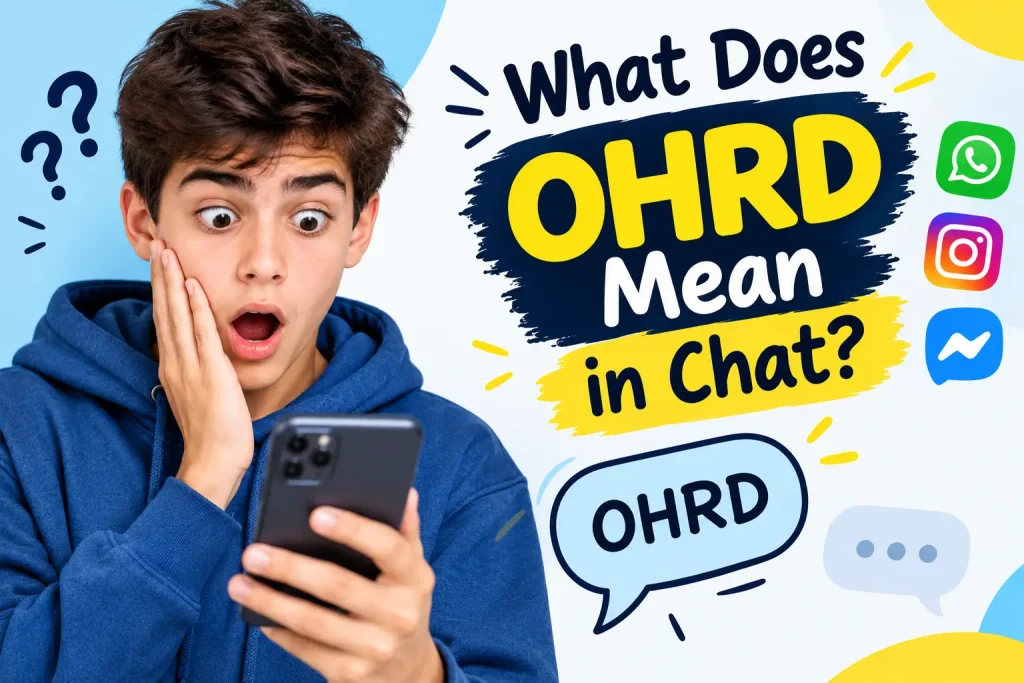
What Does OHRD Mean in Text?
OHRD functions as an initialism, a set of letters standing in for a phrase, said letter by letter rather than as a new word. The tricky part is that no single phrase has become the agreed-upon “official” expansion. It’s the kind of shorthand that seems to have grown out of fast typing rather than being deliberately created and defined.
In practice, though, its most common job in a conversation is acknowledgment. When someone types OHRD after you’ve told them something, they’re usually saying “I saw that” or “understood” without spelling it out. It works the same way as replying with just “k” or a thumbs-up emoji short, low-effort, and functional rather than expressive.
The emotional weight behind it is usually small. It’s not meant to carry excitement or disappointment on its own. Its main job is closing out a small piece of the conversation so the exchange can move forward. People shorten phrases like this mostly out of habit: texting rewards speed, and once a group of people start using a shortcut, others start recognizing and repeating it, even without a formal definition ever being agreed upon.
Why Do People Use OHRD?
There are a few practical reasons someone might type OHRD instead of a full sentence:
- Speed. Four letters take less time to type than “okay, got it” or “I understand.”
- Low-effort replies. In fast-moving chats, a short acknowledgment keeps the conversation moving without requiring real thought.
- Casual texting habits. Between close friends, spelling things out fully can feel unnecessary or even a little stiff.
- Group chat pacing. In a group chat with a lot of messages flying by, a quick OHRD lets someone confirm they read something without derailing the thread.
- Personality. Some people just prefer slang shorthand over standard replies because it feels more like how they’d talk out loud.
OHRD Meaning Depends on Context
Because OHRD doesn’t have one locked-in definition, the surrounding conversation usually tells you more than the letters themselves. A few things to pay attention to:
- The message right before it — this is the biggest clue.
- Your relationship with the sender — close friends might use it more loosely than someone you don’t know well.
- The topic — a serious topic changes how a short reply lands.
- Punctuation — “OHRD.” feels more final than “OHRD?” or “ohrd lol.”
- Emojis — they can soften or sharpen the tone significantly.
- Platform — a gaming chat and a family group chat carry different norms.
- Overall tone of the conversation — playful exchanges read short replies differently than serious ones.
Here are five original examples showing how the same word shifts meaning:
Person A: “I moved the meeting to 3pm.”
Person B: “OHRD.”
Here, OHRD is a plain acknowledgment that Person B saw the update and doesn’t need more information.
Person A: “I think I left my wallet at your place.”
Person B: “OHRD, I’ll check when I get home.”
This reads as reassurance. It confirms the message landed and a next step is coming.
Person A: “Guess who just got engaged.”
Person B: “OHRD?! Wait, who??”
The question mark and follow-up push this closer to surprise, similar to “oh, really?” rather than a flat “okay.”
Person A: “Can you send me the notes from class?”
Person B: “ohrd”
No punctuation and lowercase letters can come across as flat or distracted, even if that’s not the intent.
Person A: “I’m not really feeling up for tonight.”
Person B: “OHRD, no worries at all.”
Paired with reassurance, OHRD softens into something supportive rather than dismissive.
Must Read : BFFR Meaning in Text: The Real Meaning Behind This Slang
OHRD in Different Conversations
OHRD in a Text Message
Most often a one-word reply confirming a plan or update. Example: “Running 10 minutes late.” / “OHRD, no rush.”
OHRD in a Group Chat
Used to show you’ve read something without interrupting the flow. Example: “Meeting moved to Thursday.” / “ohrd 👍”
OHRD on Snapchat
Tends to appear in quick back-and-forth captions or chat replies, functioning the same as in texting a fast acknowledgment rather than a platform-specific term.
OHRD on TikTok
Shows up in comment sections reacting to a video, sometimes closer to “oh, word” as a reaction to something surprising rather than a plain “okay.”
OHRD on Instagram
Common in DMs as a short reply to a story reply or message, usually meaning “got it” or “noted.”
OHRD on Discord
In server chats, especially gaming servers, it can double as a quick confirmation during fast conversation, similar to “roger” or “bet.”
OHRD in Gaming Chats
Players often need short replies mid-match, so OHRD works as a fast “understood” without pulling focus from the game.
None of these platforms have their own official version of OHRD; the surrounding community’s texting habits shape how it lands more than the app itself does.
OHRD Examples in Real Text Conversations
- Friendship: “I can’t hang out tonight; something came up.” / “OHRD, we’ll do it another time.” Understanding, no hard feelings.
- School: “The homework got pushed to Monday.” / “OHRD, thank god.” Relief mixed with acknowledgment.
- Work (informal team chat): “Standup moved to 9:30.” / “ohrd” Simple confirmation.
- Dating: “I’m not really looking for anything serious right now.” / “OHRD, appreciate you being upfront.” Acknowledgment with maturity.
- Family: “Dinner’s at 6 tonight.” / “OHRD be there.”Casual confirmation.
- Social media DM: “Just posted the photos from the trip!” / “OHRD omg, going to look now.” Acknowledgment with excitement layered on top.
- Gaming: “Rotate to B site” / “ohrd” Fast in-game confirmation.
- Awkward situation: “That thing I said earlier was a joke, by the way.” / “OHRD… okay, good.” Relief after confusion.
- Joke/banter: “I just beat my own high score.” / “OHRD show off.” Playful, teasing acknowledgment.
- Casual catch-up: “Work’s been crazy this week.” / “OHRD, same here honestly.” Shared understanding.
- Plans changing last minute: “Actually let’s meet at 7 instead.” / “OHRD works for me.” Quick agreement.
- Reacting to news: “I got the job!!” / “OHRD LET’S GOOO” Excitement stacked on top of acknowledgment.
- Mild surprise: “I actually agree with you this time.” / “OHRD, wow, didn’t expect that.” Leans toward the “oh, really” reading.
- Low-effort reply: “See you tomorrow.” / “ohrd” Flat, functional, nothing more.
- Support: “Today was rough.” / “OHRD, I’m here if you want to talk.” Acknowledgment paired with care.
OHRD Tone and Emotion
On its own, OHRD tends to sound neutral. It doesn’t automatically carry excitement, sarcasm, or frustration; those come from what’s added around it. A bare “OHRD” with a period can feel a little cold or distracted. “OHRD!!” or “ohrd” pulls the same word toward something warmer or more animated.
Punctuation matters more than people expect with a word this short. A period tends to close a conversation. A question mark opens curiosity or disbelief. No punctuation at all often reads as casual or rushed rather than intentional.
Also Read : ICL Meaning in Text: The Real Meaning Explained
Is OHRD Positive, Negative, or Neutral?
By default, OHRD is neutral. It’s an acknowledgment, not a judgment. Whether it feels warm or dismissive comes almost entirely from tone markers around it.
- “OHRD, thanks for letting me know” reads warmly.
- “ohrd” can read “distant” or “uninterested,” especially with no other context.
- “OHRD?!” reads surprised rather than negative.
It’s rarely used to be intentionally rude, but a flat delivery in a sensitive conversation can come across that way even if that wasn’t the intent.
Alternative Meanings of OHRD
| Possible Meaning | Typical Context | Tone |
|---|---|---|
| Okay / Got it / Understood (most commonly reported) | General texting, group chats, casual replies | Neutral to casual |
| “Oh, word” (a reaction of mild surprise) | TikTok comments, casual banter | Curious, informal |
| “Oh, really?” | Reacting to unexpected news | Surprised, sometimes skeptical |
| “Oh, I heard” | Reacting to something someone mentioned | Casual, conversational |
Most commonly reported meaning: A short acknowledgment along the lines of “okay” or “got it.” This shows up most consistently across the sources that discuss the term.
Less common or context-dependent meanings: The “oh, word,” “oh, really,” and “oh, I heard” readings appear in some places but aren’t as widely echoed, and they sometimes contradict each other. Because of that, it’s worth treating them as possible readings rather than settled definitions.
Outside of texting, the letters occasionally get used as shorthand in unrelated professional or academic contexts (such as human resource development terminology), but that’s a completely separate usage from the slang version and almost never comes up in casual chat.
How to Know Which OHRD Meaning Someone Intends
- Reread the message sent right before OHRD.
- Identify what the conversation is actually about.
- Check whether “okay/got it” fits naturally in that spot.
- Think about how well you know the sender and how they usually text.
- Look for punctuation or emojis that hint at tone.
- Consider whether the overall exchange is serious or lighthearted.
- If it’s still unclear, just ask a quick “Wait, what do you mean by that?” solves it faster than guessing.
OHRD vs. Similar Texting Abbreviations
| Abbreviation | Meaning | Main Difference |
|---|---|---|
| K / KK | Okay | More clearly just “okay,” with less ambiguity |
| Bet | Agreement or confirmation | Carries more enthusiasm than a flat acknowledgment |
| Aight | Alright | Closer to a full word, less letter-based |
| IKR | I know, right | Reacts to something with agreement, not just acknowledgment |
| Noted | Acknowledgment | More formal-sounding than OHRD |
These aren’t identical to OHRD they can overlap in function but carry slightly different weight depending on how casual or enthusiastic the reply is meant to sound.
Must Read:
How to Respond to OHRD
Friendly: “Glad that’s sorted!”
Funny: “OHRD noted, boss.”
Supportive: “OHRD, let me know if you need anything.”
Casual: “Bet, talk soon.”
Serious: “Okay, thanks for letting me know.”
There’s no single correct way to reply it depends on what the original OHRD was acknowledging in the first place.
Should You Use OHRD?
Appropriate situations:
- Texting close friends
- Casual group chats
- Social media DMs
- Informal online conversations
Situations where it may be unclear:
- Professional emails
- Academic writing
- Formal documents
- Customer service messages
- Conversations with someone who might not recognize internet shorthand
If there’s any chance the other person won’t understand it, spelling out “okay” or “got it” avoids confusion entirely.
OHRD Capitalization and Variations
- OHRD — standard, neutral
- ohrd — casual, common in relaxed texting
- Ohrd — uncommon, no real tone shift
- OHRD! — more enthusiastic
- OHRD? — leans toward surprise or confusion
- OHRD lol — playful, softens the reply
- OHRD — often used humorously or dramatically
Capitalization rarely changes the core meaning, but punctuation and emojis shift the tone noticeably.
Common Mistakes When Interpreting OHRD
- Assuming it only ever means one thing
- Ignoring the message that came right before it
- Treating a niche reading (like “oh, really”) as the universal meaning
- Taking the letters too literally when there’s no confirmed expansion
- Assuming a specific platform has an “official” version of the term
- Guessing instead of just asking the sender
- Mixing it up with similar-looking texting abbreviations
Is OHRD a Common Texting Abbreviation?
OHRD isn’t as widely recognized as terms like “OMG” or “IDK.” It shows up in scattered corners of texting culture, but recognition varies a lot depending on age group, friend group, and platform. Some people will instantly understand it; others will have never seen it before.
There isn’t reliable data on exactly how widespread it is, so it’s fair to call it a niche or inconsistently used term rather than a mainstream one.
Frequently Asked Questions
What does OHRD mean in text?
It’s most often used as a short way to say “okay” or “got it.” There’s no single official definition, so the exact meaning can shift slightly depending on the conversation.
What does OHRD stand for?
There isn’t one confirmed expansion. Different sources describe it differently, so it’s best understood as a casual shorthand rather than a fixed acronym.
What does OHRD mean in texting?
In most everyday texting, it works as a quick acknowledgment similar to replying “okay” without typing the full word.
What does OHRD mean in chat?
Same idea as in texting: a fast way to confirm you’ve read or understood something, with the exact tone shaped by what was said before it.
Is OHRD slang?
Yes. It’s informal internet shorthand rather than a standard word or dictionary term.
Is OHRD a bad word?
No. It’s neutral by default and isn’t considered offensive.
Is OHRD rude?
Not inherently. It can come across as flat or distant without extra context, but that’s more about delivery than the word itself.
How do you respond to OHRD?
Any short, natural reply works, confirming, thanking them, or just continuing the conversation normally.
Can OHRD have more than one meaning?
Yes. While “okay/got it” is the most commonly reported reading, some contexts lean it closer to surprise, like “oh, really.”
What does OHRD mean on social media?
It functions the same way as in texting a quick acknowledgment, sometimes with more personality added through emojis or tone.
Key Takeaways
- OHRD most commonly functions as a short way of saying “okay” or “got it.”
- Context, especially the message right before it matters more than the letters themselves.
- Its tone is neutral by default, shaped mostly by punctuation and emojis.
- Less common readings (like “oh, really”) exist but aren’t as widely agreed upon.
- It fits casual conversations best and isn’t suited for formal or professional writing.
Conclusion
What is ohrd meaning in text ?OHRD isn’t a term with one official, agreed-upon definition. In most everyday texting, it works as a quick acknowledgement, a stand-in for “okay” or “got it,” that lets a conversation keep moving without a full sentence. Because it isn’t standardized, the exact feeling behind it depends heavily on what was said right before it, plus any punctuation or emojis attached.
If you’re ever unsure which way someone meant it, the fastest fix is just to ask. And if you’re the one sending it to someone unfamiliar with texting shorthand, spelling out “okay” avoids any mix-up entirely.
CBFW Meaning in Text, Chat and Social Media
ATP Meaning in Text: The Complete Guide to This Confusing Chat Slang