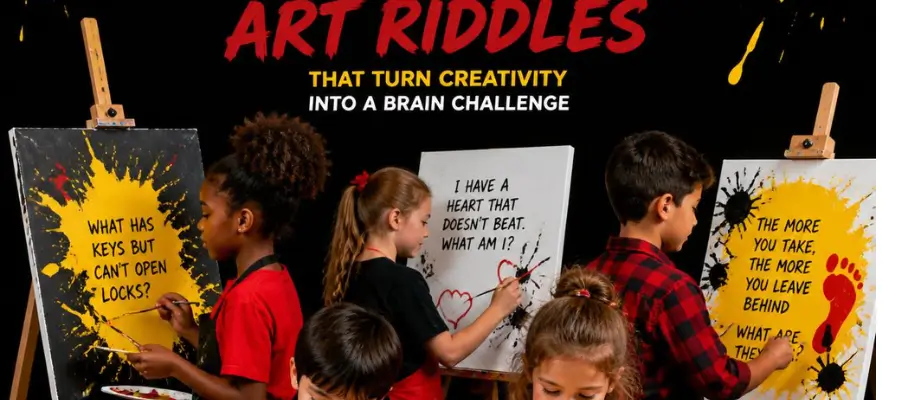
Art is a wonderful way to express ideas, feelings, and imagination. But what happens when art meets a good riddle? You get a fun challenge that can make you think while enjoying the creative world of colors, paintings, drawing, and design.
This collection of 160+ art riddles with answers is made for curious minds of all ages. Whether you are looking for art riddles for kids, art riddles for adults, or art riddles for kids with answers, you will find plenty of creative challenges here.
Some riddles are easy enough for children, while others use clever clues and wordplay that may make adults stop and think. You will also find funny art riddles, artist riddles, word art riddles, clip art riddles, and other art related riddles.
These art themed riddles can be used at home, in classrooms, during art activities, or simply when you want a quick brain challenge. Read each clue carefully, make your guess, and then reveal the answer to see if you were right.
So grab your creative thinking cap and get ready to explore the colorful world of art through riddles!
Art Riddles for Kids
Simple and playful riddles about drawing, painting, colors, crayons, brushes, and basic art concepts.

Artists place their colorful dreams on my ground.
What am I?
EXPLANATION
FIRST CLUE: Holds a picture
SECOND CLUE: Artists create on it
LOGICAL CONNECTION: A canvas gives artists a surface for their artwork
CONCLUSION: Canvas is correct.
In an artist’s hand, I help colors roam.
What am I?
EXPLANATION
FIRST CLUE: Has many hairs
SECOND CLUE: Spreads colors
LOGICAL CONNECTION: A paintbrush has bristles that carry paint
CONCLUSION: Paintbrush is correct.
Artists mix shades on me for one another.
What am I?
EXPLANATION
FIRST CLUE: Flat surface
SECOND CLUE: Holds mixed colors
LOGICAL CONNECTION: Artists use palettes to hold and mix paint
CONCLUSION: Paint Palette is correct.
Yet artists use me to create with awe.
What am I?
EXPLANATION
FIRST CLUE: Draws pictures
SECOND CLUE: Gets shorter with use
LOGICAL CONNECTION: A pencil becomes smaller as its graphite is used
CONCLUSION: Pencil is correct.
After I work, the wrong mark has disappeared.
What am I?
EXPLANATION
FIRST CLUE: Removes marks
SECOND CLUE: Fixes drawing mistakes
LOGICAL CONNECTION: Erasers remove pencil marks
CONCLUSION: Eraser is correct.
EXPLANATION
FIRST CLUE: Comes in many shades
SECOND CLUE: Adds life to artwork
LOGICAL CONNECTION: Color makes artwork more expressive
CONCLUSION: Color is correct.
I hold an artist’s work while they have fun.
What am I?
EXPLANATION
FIRST CLUE: Has three legs
SECOND CLUE: Holds artwork
LOGICAL CONNECTION: An easel supports a canvas while an artist works
CONCLUSION: Easel is correct.
Artists fill my pages when inspiration they meet.
What am I?
EXPLANATION
FIRST CLUE: Contains pages
SECOND CLUE: Holds artistic ideas
LOGICAL CONNECTION: Artists use sketchbooks for drawings and ideas
CONCLUSION: Sketchbook is correct.
Artists create me so someone’s features appear clearer.
What am I?
EXPLANATION
FIRST CLUE: Shows a face
SECOND CLUE: Is created by an artist
LOGICAL CONNECTION: A portrait represents a person
CONCLUSION: Portrait is correct.
People look at me and imagine glory.
What am I?
EXPLANATION
FIRST CLUE: Tells a story silently
SECOND CLUE: People look at it
LOGICAL CONNECTION: Paintings can communicate stories without words
CONCLUSION: Painting is correct.
Draw me once and I look like a ball.
What am I?
EXPLANATION
FIRST CLUE: Round shape
SECOND CLUE: Has no corners
LOGICAL CONNECTION: A circle is a round artistic shape
CONCLUSION: Circle is correct.
Artists use me in many designs and joints.
What am I?
EXPLANATION
FIRST CLUE: Has three sides
SECOND CLUE: Has three points
LOGICAL CONNECTION: A triangle is a basic geometric art shape
CONCLUSION: Triangle is correct.
Four equal sides make me look bright.
What am I?
EXPLANATION
FIRST CLUE: Has four sides
SECOND CLUE: All sides are equal
LOGICAL CONNECTION: A square is a four-sided geometric shape
CONCLUSION: Square is correct.
Without me, many drawings would feel disturbed.
What am I?
EXPLANATION
FIRST CLUE: Can be straight or curved
SECOND CLUE: Builds drawings
LOGICAL CONNECTION: Lines are basic elements of art
CONCLUSION: Line is correct.
EXPLANATION
FIRST CLUE: Creates darker areas
SECOND CLUE: Shows form
LOGICAL CONNECTION: Shading gives drawings depth and dimension
CONCLUSION: Shading is correct.
EXPLANATION
FIRST CLUE: Empty area around objects
SECOND CLUE: Artists plan it
LOGICAL CONNECTION: Negative space is an important part of composition
CONCLUSION: Negative Space is correct.
Artists use me to make forms clear.
What am I?
EXPLANATION
FIRST CLUE: Shows light and dark
SECOND CLUE: Helps define forms
LOGICAL CONNECTION: Value describes the lightness or darkness of an artwork
CONCLUSION: Value is correct.
Artists show me even when I am not real.
What am I?
EXPLANATION
FIRST CLUE: Can look rough or smooth
SECOND CLUE: Can be shown in artwork
LOGICAL CONNECTION: Texture describes how a surface looks or feels
CONCLUSION: Texture is correct.
Artists use me to give pictures depth for all.
What am I?
EXPLANATION
FIRST CLUE: Makes distant objects smaller
SECOND CLUE: Creates depth
LOGICAL CONNECTION: Perspective creates the appearance of distance
CONCLUSION: Perspective is correct.
A blank surface waiting for creative wins.
What am I?
EXPLANATION
FIRST CLUE: Starts as an empty surface
SECOND CLUE: Waits for an artist
LOGICAL CONNECTION: Artists often begin a painting with a blank canvas
CONCLUSION: Blank Canvas is correct.
Art Riddles for Adults
More challenging clues about creativity, artistic techniques, famous art concepts, galleries, and visual expression.

Each little part helps create something better.
What am I?
EXPLANATION
FIRST CLUE: Uses separate pieces
SECOND CLUE: Pieces form one artwork
LOGICAL CONNECTION: A collage combines different materials or images
CONCLUSION: Collage is correct.
I turn plain spaces into colorful views.
What am I?
EXPLANATION
FIRST CLUE: Appears on walls
SECOND CLUE: Can be very large
LOGICAL CONNECTION: Murals are artworks created on walls
CONCLUSION: Mural is correct.
EXPLANATION
FIRST CLUE: Starts as wet earth
SECOND CLUE: Can be shaped
LOGICAL CONNECTION: Artists use clay to create sculptures
CONCLUSION: Clay is correct.
You can walk around me for different impressions.
What am I?
EXPLANATION
FIRST CLUE: Has three dimensions
SECOND CLUE: Can be viewed from many sides
LOGICAL CONNECTION: Sculpture is three-dimensional art
CONCLUSION: Sculpture is correct.
EXPLANATION
FIRST CLUE: Bright like sunlight
SECOND CLUE: Used in cheerful artwork
LOGICAL CONNECTION: Yellow is a bright warm color
CONCLUSION: Yellow is correct.
Artists reach for me when nature is what their picture needs.
What am I?
EXPLANATION
FIRST CLUE: Looks like grass
SECOND CLUE: Common in nature scenes
LOGICAL CONNECTION: Green is strongly associated with plants
CONCLUSION: Green is correct.
EXPLANATION
FIRST CLUE: Seen in sky and ocean
SECOND CLUE: Often suggests calmness
LOGICAL CONNECTION: Blue is a common cool color
CONCLUSION: Blue is correct.
EXPLANATION
FIRST CLUE: Resembles fire
SECOND CLUE: Creates strong visual impact
LOGICAL CONNECTION: Red is a bold warm color
CONCLUSION: Red is correct.
Sometimes I become a brand-new shade that looks complete.
What am I?
EXPLANATION
FIRST CLUE: Combines colors
SECOND CLUE: Creates another shade
LOGICAL CONNECTION: Mixing colors can produce new colors
CONCLUSION: Color Mix is correct.
But I can carry every drawing shown.
What am I?
EXPLANATION
FIRST CLUE: Usually has no color added
SECOND CLUE: Holds drawings
LOGICAL CONNECTION: Paper is a common art surface
CONCLUSION: Paper is correct.
Children hold me when creating pictures.
What am I?
EXPLANATION
FIRST CLUE: Small art tool
SECOND CLUE: Comes in colors
LOGICAL CONNECTION: Crayons are popular drawing tools for children
CONCLUSION: Crayon is correct.
Artists choose me when they need variety.
What am I?
EXPLANATION
FIRST CLUE: Contains many colors
SECOND CLUE: Gives artists choices
LOGICAL CONNECTION: A color set provides several shades for artwork
CONCLUSION: Color Set is correct.
I make letters beautiful when artists think.
What am I?
EXPLANATION
FIRST CLUE: Carries ink
SECOND CLUE: Can create artistic lettering
LOGICAL CONNECTION: Pens can be used for drawing and lettering
CONCLUSION: Pen is correct.
Letters become art when I dance.
What am I?
EXPLANATION
FIRST CLUE: Changes the appearance of words
SECOND CLUE: Turns letters into visual designs
LOGICAL CONNECTION: Lettering is the artistic creation of letters
CONCLUSION: Lettering is correct.
I give written letters their visual skin.
What am I?
EXPLANATION
FIRST CLUE: Changes letter appearance
SECOND CLUE: Can be bold or thin
LOGICAL CONNECTION: Fonts control how text looks
CONCLUSION: Font is correct.
My letters gather like colorful birds.
What am I?
EXPLANATION
FIRST CLUE: Uses words as visual material
SECOND CLUE: Creates a picture-like design
LOGICAL CONNECTION: Word art turns text into decorative artwork
CONCLUSION: Word Art is correct.
You can place me beside words or a line.
What am I?
EXPLANATION
FIRST CLUE: Ready-made image
SECOND CLUE: Used in designs
LOGICAL CONNECTION: Clip art provides reusable decorative graphics
CONCLUSION: Clip Art is correct.
An artist arranges me with careful skill.
What am I?
EXPLANATION
FIRST CLUE: Shows objects
SECOND CLUE: Objects remain still
LOGICAL CONNECTION: Still life art focuses on arranged objects
CONCLUSION: Still Life is correct.
I capture outdoor scenes with artistic ease.
What am I?
EXPLANATION
FIRST CLUE: Shows outdoor scenery
SECOND CLUE: Includes natural places
LOGICAL CONNECTION: Landscape art focuses on scenery and nature
CONCLUSION: Landscape Art is correct.
Yet artists make me visible with a brush.
What am I?
EXPLANATION
FIRST CLUE: Cannot be physically touched
SECOND CLUE: Can be represented through art
LOGICAL CONNECTION: Artists often use visual elements to express emotions
CONCLUSION: Emotion is correct.
Art Riddles With Answers
General art-themed brain teasers covering tools, materials, styles, colors, and creative ideas.

Artists use me to set the mood around.
What am I?
EXPLANATION
FIRST CLUE: Can feel soft or strong
SECOND CLUE: Changes mood
LOGICAL CONNECTION: Color can influence the mood of artwork
CONCLUSION: Color is correct.
Artists place me carefully so I stand out at my best.
What am I?
EXPLANATION
FIRST CLUE: Gets attention first
SECOND CLUE: Is carefully positioned
LOGICAL CONNECTION: A focal point attracts the viewer’s attention
CONCLUSION: Focal Point is correct.
So an artwork feels complete rather than scattered.
What am I?
EXPLANATION
FIRST CLUE: Arranges parts
SECOND CLUE: Creates unity
LOGICAL CONNECTION: Composition organizes visual elements
CONCLUSION: Composition is correct.
Artists use me to make a picture feel steady.
What am I?
EXPLANATION
FIRST CLUE: Creates visual steadiness
SECOND CLUE: Relates different areas
LOGICAL CONNECTION: Balance distributes visual weight
CONCLUSION: Balance is correct.
My repetition can decorate artwork for hours.
What am I?
EXPLANATION
FIRST CLUE: Repeats visual elements
SECOND CLUE: Creates decoration
LOGICAL CONNECTION: Patterns are created through repetition
CONCLUSION: Pattern is correct.
A clever artist can make me look like I sprint.
What am I?
EXPLANATION
FIRST CLUE: Looks like movement
SECOND CLUE: Artwork itself stays still
LOGICAL CONNECTION: Artists use poses and lines to suggest motion
CONCLUSION: Dynamic Drawing is correct.
Artists use me when they want attention found.
What am I?
EXPLANATION
FIRST CLUE: Makes elements stand apart
SECOND CLUE: Draws attention
LOGICAL CONNECTION: Contrast creates visual differences
CONCLUSION: Contrast is correct.
My rhythm can make artwork feel lively at every stage.
What am I?
EXPLANATION
FIRST CLUE: Uses repetition
SECOND CLUE: Creates visual movement
LOGICAL CONNECTION: Visual rhythm guides the viewer through repetition
CONCLUSION: Rhythm is correct.
While distant objects seem smaller.
What am I?
EXPLANATION
FIRST CLUE: Changes apparent size
SECOND CLUE: Shows distance
LOGICAL CONNECTION: Perspective creates spatial depth
CONCLUSION: Perspective is correct.
But I come from an artist rather than a camera’s place.
What am I?
EXPLANATION
FIRST CLUE: Shows someone’s face
SECOND CLUE: Made by an artist
LOGICAL CONNECTION: A painted portrait represents a person visually
CONCLUSION: Painted Portrait is correct.
An artist can show a city, room, or open space.
What am I?
EXPLANATION
FIRST CLUE: Shows a location
SECOND CLUE: Can show different environments
LOGICAL CONNECTION: A scene depicts a particular setting
CONCLUSION: Scene is correct.
Two sharp blades meet me there.
What am I?
EXPLANATION
FIRST CLUE: Cuts paper
SECOND CLUE: Has two blades
LOGICAL CONNECTION: Scissors are common tools for paper art
CONCLUSION: Scissors is correct.
EXPLANATION
FIRST CLUE: Joins materials
SECOND CLUE: Can be sticky
LOGICAL CONNECTION: Glue attaches paper and other art materials
CONCLUSION: Glue is correct.
EXPLANATION
FIRST CLUE: Holds water
SECOND CLUE: Used to clean brushes
LOGICAL CONNECTION: Artists often use water containers while painting
CONCLUSION: Water Cup is correct.
I make artwork look finished on the wall’s ledge.
What am I?
EXPLANATION
FIRST CLUE: Surrounds artwork
SECOND CLUE: Gives a finished appearance
LOGICAL CONNECTION: Frames surround and display artwork
CONCLUSION: Frame is correct.
Yet I can tell you who made the artwork.
What am I?
EXPLANATION
FIRST CLUE: Usually small
SECOND CLUE: Identifies the creator
LOGICAL CONNECTION: Artists often sign their work
CONCLUSION: Signature is correct.
Visitors walk through me and stop to look.
What am I?
EXPLANATION
FIRST CLUE: Contains artwork
SECOND CLUE: Visitors view art there
LOGICAL CONNECTION: Galleries display artwork for visitors
CONCLUSION: Art Gallery is correct.
People visit me to learn about art and history.
What am I?
EXPLANATION
FIRST CLUE: Protects valuable works
SECOND CLUE: Teaches history and art
LOGICAL CONNECTION: Museums preserve and display cultural objects
CONCLUSION: Museum is correct.
Who made it and what it may contain.
What am I?
EXPLANATION
FIRST CLUE: Stands near artwork
SECOND CLUE: Provides information
LOGICAL CONNECTION: Museum and gallery labels identify and describe artwork
CONCLUSION: Artwork Label is correct.
Visitors see different creations in one place.
What am I?
EXPLANATION
FIRST CLUE: Displays multiple artworks
SECOND CLUE: Visitors view it
LOGICAL CONNECTION: An exhibition presents selected works for viewing
CONCLUSION: Exhibition is correct.
Funny Art Riddles
Lighthearted and humorous riddles about artists, paintings, brushes, pencils, and funny situations in the art world.
Children press me onto paper to make pictures.
What am I?
EXPLANATION
FIRST CLUE: Soft material
SECOND CLUE: Can be shaped
LOGICAL CONNECTION: Modeling clay is used to create artistic forms
CONCLUSION: Modeling Clay is correct.
Children use me to color their hearts.
What am I?
EXPLANATION
FIRST CLUE: Comes in sticks
SECOND CLUE: Leaves colorful marks
LOGICAL CONNECTION: Crayons are common coloring tools
CONCLUSION: Crayon is correct.
I can cover a canvas with a colorful rush.
What am I?
EXPLANATION
FIRST CLUE: Comes from a tube
SECOND CLUE: Spreads across canvas
LOGICAL CONNECTION: Paint is applied to surfaces to create artwork
CONCLUSION: Paint is correct.
Artists mix me into paint in a special way.
What am I?
EXPLANATION
FIRST CLUE: Added to artistic materials
SECOND CLUE: Can affect paint
LOGICAL CONNECTION: Art mediums can change the handling or appearance of paint
CONCLUSION: Medium is correct.
Also Read : 150+ Monkey Riddles That Will Test Your Thinking!
Artists use me to create quick drawings.
What am I?
EXPLANATION
FIRST CLUE: Often creates black marks
SECOND CLUE: Useful for drawing
LOGICAL CONNECTION: Charcoal is a traditional drawing material
CONCLUSION: Charcoal is correct.
Yet I can create colorful drawings.
What am I?
EXPLANATION
FIRST CLUE: Soft drawing material
SECOND CLUE: Creates colorful marks
LOGICAL CONNECTION: Pastels are soft artistic sticks used for drawing
CONCLUSION: Pastel is correct.
I often meet paper rather than canvas.
What am I?
EXPLANATION
FIRST CLUE: Liquid art medium
SECOND CLUE: Often used on paper
LOGICAL CONNECTION: Watercolor paint is diluted and commonly applied to paper
CONCLUSION: Watercolor is correct.
I can cover a surface with strong color.
What am I?
EXPLANATION
FIRST CLUE: Can create strong coverage
SECOND CLUE: Used for painting
LOGICAL CONNECTION: Acrylic paint is a versatile painting medium
CONCLUSION: Acrylic Paint is correct.
Colors can blend while I remain fine.
What am I?
EXPLANATION
FIRST CLUE: Dries slowly
SECOND CLUE: Allows blending
LOGICAL CONNECTION: Oil paint is known for its slow drying time
CONCLUSION: Oil Paint is correct.
Artists use me when details must appear.
What am I?
EXPLANATION
FIRST CLUE: Art tool
SECOND CLUE: Helps create small details
LOGICAL CONNECTION: Fine brushes are useful for detailed painting
CONCLUSION: Fine Brush is correct.
I help an artist create a thin expression.
What am I?
EXPLANATION
FIRST CLUE: Has a point
SECOND CLUE: Creates thin marks
LOGICAL CONNECTION: Fine-tip pens create precise artistic lines
CONCLUSION: Fine-Tip Pen is correct.
I help create circles with precision.
What am I?
EXPLANATION
FIRST CLUE: Drawing tool
SECOND CLUE: Creates circles
LOGICAL CONNECTION: A compass is used to draw accurate circles
CONCLUSION: Compass is correct.
Artists use me to keep shapes in order.
What am I?
EXPLANATION
FIRST CLUE: Measures length
SECOND CLUE: Helps create straight shapes
LOGICAL CONNECTION: Rulers help artists measure and draw accurately
CONCLUSION: Ruler is correct.
Without me, painting may take too long.
What am I?
EXPLANATION
FIRST CLUE: Helps control painted areas
SECOND CLUE: Supports clean edges
LOGICAL CONNECTION: Painter’s tape can mask areas while painting
CONCLUSION: Painter’s Tape is correct.
Look closely and my secret appears.
What am I?
EXPLANATION
FIRST CLUE: Uses tiny squares
SECOND CLUE: Forms a larger picture
LOGICAL CONNECTION: Pixel art builds images from individual pixels
CONCLUSION: Pixel Art is correct.
My tools may never touch a physical canvas.
What am I?
EXPLANATION
FIRST CLUE: Created digitally
SECOND CLUE: Uses electronic tools
LOGICAL CONNECTION: Digital art is created using computers or digital devices
CONCLUSION: Digital Art is correct.
Filters and edits can change my view.
What am I?
EXPLANATION
FIRST CLUE: Changes photographs
SECOND CLUE: Uses digital adjustments
LOGICAL CONNECTION: Photo editing modifies images creatively
CONCLUSION: Photo Editing is correct.
Yet artists can turn me into creative drama.
What am I?
EXPLANATION
FIRST CLUE: Uses a camera
SECOND CLUE: Works with light
LOGICAL CONNECTION: Photography creates images by capturing light
CONCLUSION: Photography is correct.
But I live inside a frame without moving.
What am I?
EXPLANATION
FIRST CLUE: Shows people or places
SECOND CLUE: Is displayed in a frame
LOGICAL CONNECTION: A photograph captures a visual moment
CONCLUSION: Photograph is correct.
One moment is frozen in my glory.
What am I?
EXPLANATION
FIRST CLUE: Is a picture
SECOND CLUE: Can tell a story
LOGICAL CONNECTION: Illustrations visually communicate ideas and stories
CONCLUSION: Illustration is correct.
Artist Riddles
Riddles focused on artists, their creative habits, studios, tools, and the process of making art.
An artist studies me to draw with greater accuracy.
What am I?
EXPLANATION
FIRST CLUE: Used for observation
SECOND CLUE: Helps artists draw accurately
LOGICAL CONNECTION: References provide visual information for artwork
CONCLUSION: Reference is correct.
I do not need to be perfect before it can appear.
What am I?
EXPLANATION
FIRST CLUE: Rough drawing
SECOND CLUE: Used before final work
LOGICAL CONNECTION: A sketch helps artists plan an artwork
CONCLUSION: Sketch is correct.
Artists use me to understand body position.
What am I?
EXPLANATION
FIRST CLUE: Studies movement
SECOND CLUE: Shows body position
LOGICAL CONNECTION: Gesture drawing captures action and pose
CONCLUSION: Gesture Drawing is correct.
Artists use me to practice reality.
What am I?
EXPLANATION
FIRST CLUE: Draws from observation
SECOND CLUE: Practices seeing accurately
LOGICAL CONNECTION: Observation drawing studies real subjects
CONCLUSION: Observation Drawing is correct.
Artists use me so rooms and roads do not look cheap.
What am I?
EXPLANATION
FIRST CLUE: Creates visual distance
SECOND CLUE: Adds realism
LOGICAL CONNECTION: Depth makes a two-dimensional artwork appear spatial
CONCLUSION: Depth is correct.
Artists use me to make perspective complete.
What am I?
EXPLANATION
FIRST CLUE: Appears in perspective
SECOND CLUE: Lines seem to meet there
LOGICAL CONNECTION: A vanishing point helps create linear perspective
CONCLUSION: Vanishing Point is correct.
Artists use me when drawing scenes nearby.
What am I?
EXPLANATION
FIRST CLUE: Relates to sky and ground
SECOND CLUE: Used in perspective
LOGICAL CONNECTION: The horizon line helps establish eye level
CONCLUSION: Horizon Line is correct.
Artists use me when light is near.
What am I?
EXPLANATION
FIRST CLUE: Bright area
SECOND CLUE: Shows light
LOGICAL CONNECTION: Highlights represent areas receiving strong light
CONCLUSION: Highlight is correct.
Artists draw me to make forms look fine.
What am I?
EXPLANATION
FIRST CLUE: Appears behind an object
SECOND CLUE: Caused by light
LOGICAL CONNECTION: A cast shadow forms when an object blocks light
CONCLUSION: Cast Shadow is correct.
Artists use me to give objects stronger form.
What am I?
EXPLANATION
FIRST CLUE: Very dark area
SECOND CLUE: Adds form
LOGICAL CONNECTION: Deep shadows help show three-dimensional structure
CONCLUSION: Deep Shadow is correct.
Artists choose me carefully to control the feel.
What am I?
EXPLANATION
FIRST CLUE: Relates to color
SECOND CLUE: Helps describe color appearance
LOGICAL CONNECTION: Hue identifies the basic color family
CONCLUSION: Hue is correct.
Artists use me when softer shades are the aim.
What am I?
EXPLANATION
FIRST CLUE: Creates a lighter color
SECOND CLUE: Keeps the basic hue
LOGICAL CONNECTION: A tint is made by adding white to a color
CONCLUSION: Tint is correct.
Artists use me when strong shadows they need.
What am I?
EXPLANATION
FIRST CLUE: Makes color darker
SECOND CLUE: Creates deeper tones
LOGICAL CONNECTION: A shade is a darker version of a hue
CONCLUSION: Shade is correct.
Artists change me when they want different appeals.
What am I?
EXPLANATION
FIRST CLUE: Relates to color strength
SECOND CLUE: Can make colors vivid or muted
LOGICAL CONNECTION: Saturation describes color intensity
CONCLUSION: Saturation is correct.
Artists choose me to make their work feel better.
What am I?
EXPLANATION
FIRST CLUE: Contains selected colors
SECOND CLUE: Creates visual unity
LOGICAL CONNECTION: A color palette organizes colors used in artwork
CONCLUSION: Color Palette is correct.
Artists use me to make a picture start.
What am I?
EXPLANATION
FIRST CLUE: Uses different colors
SECOND CLUE: Creates visual separation
LOGICAL CONNECTION: Color contrast makes colors stand out
CONCLUSION: Color Contrast is correct.
Happy, sad, peaceful, or full of weight.
What am I?
EXPLANATION
FIRST CLUE: Creates a feeling
SECOND CLUE: Can vary from happy to sad
LOGICAL CONNECTION: Mood describes the emotional atmosphere of artwork
CONCLUSION: Mood is correct.
Reality is not always my artistic norm.
What am I?
EXPLANATION
FIRST CLUE: Uses unusual forms
SECOND CLUE: Does not need to copy reality
LOGICAL CONNECTION: Abstract art focuses on shapes, colors, forms, and ideas
CONCLUSION: Abstract Art is correct.
Artists use me when realism is the key.
What am I?
EXPLANATION
FIRST CLUE: Copies visual reality
SECOND CLUE: Aims for accurate appearance
LOGICAL CONNECTION: Realistic art represents subjects in recognizable detail
CONCLUSION: Realistic Art is correct.
I help artists make ideas of every kind.
What am I?
EXPLANATION
FIRST CLUE: Lives in the mind
SECOND CLUE: Creates ideas
LOGICAL CONNECTION: Imagination helps artists develop original concepts
CONCLUSION: Imagination is correct.
Word Art & Clip Art Riddles
Wordplay-based riddles involving letters, shapes, symbols, clip art, and visual designs.
Artists use me to express creativity.
What am I?
EXPLANATION
FIRST CLUE: Starts with an idea
SECOND CLUE: Becomes visible
LOGICAL CONNECTION: Artwork is a physical or digital expression of creativity
CONCLUSION: Artwork is correct.
The closer you look, the more dots you’ve got.
What am I?
EXPLANATION
FIRST CLUE: Uses dots
SECOND CLUE: Dots build an image
LOGICAL CONNECTION: Pointillism creates images from individual dots or marks
CONCLUSION: Pointillism is correct.
Then ink helps me appear on another line.
What am I?
EXPLANATION
FIRST CLUE: Creates an image from a prepared design
SECOND CLUE: Can use ink
LOGICAL CONNECTION: Printmaking transfers designs onto surfaces
CONCLUSION: Printmaking is correct.
Artists use me to make copies of a design.
What am I?
EXPLANATION
FIRST CLUE: Transfers an image
SECOND CLUE: Can create copies
LOGICAL CONNECTION: A print is an image transferred to another surface
CONCLUSION: Print is correct.
My surface carries the artist’s design.
What am I?
EXPLANATION
FIRST CLUE: Made from wood
SECOND CLUE: Used in printing
LOGICAL CONNECTION: Woodblocks can carry carved designs for printmaking
CONCLUSION: Woodblock is correct.
Ink helps reveal my hidden design.
What am I?
EXPLANATION
FIRST CLUE: Uses engraved lines
SECOND CLUE: Can involve ink
LOGICAL CONNECTION: Engraving creates images by cutting lines into a surface
CONCLUSION: Engraving is correct.
Together they form one beautiful scene.
What am I?
EXPLANATION
FIRST CLUE: Uses small pieces
SECOND CLUE: Pieces form a larger picture
LOGICAL CONNECTION: Mosaics combine small pieces of material into artwork
CONCLUSION: Mosaic is correct.
Light passing through me can create colorful beauty.
What am I?
EXPLANATION
FIRST CLUE: Uses glass
SECOND CLUE: Works with light and color
LOGICAL CONNECTION: Stained glass creates colored designs from pieces of glass
CONCLUSION: Stained Glass is correct.
One flat sheet can become something clever.
What am I?
EXPLANATION
FIRST CLUE: Uses paper
SECOND CLUE: Depends on folding
LOGICAL CONNECTION: Origami creates forms by folding paper
CONCLUSION: Origami is correct.
No paint is needed for my artistic escape.
What am I?
EXPLANATION
FIRST CLUE: Uses paper
SECOND CLUE: Creates shapes
LOGICAL CONNECTION: Paper crafts create decorative objects from paper
CONCLUSION: Paper Craft is correct.
Pieces of paper become a picture through planning.
What am I?
EXPLANATION
FIRST CLUE: Uses cut paper
SECOND CLUE: Arranges pieces
LOGICAL CONNECTION: Paper collage creates pictures from arranged paper pieces
CONCLUSION: Paper Collage is correct.
People can see me from far away.
What am I?
EXPLANATION
FIRST CLUE: Large wall artwork
SECOND CLUE: Visible from a distance
LOGICAL CONNECTION: Large murals cover substantial wall surfaces
CONCLUSION: Large Mural is correct.
Artists can create bold shapes with a rush.
What am I?
EXPLANATION
FIRST CLUE: Uses sprayed material
SECOND CLUE: Creates bold designs
LOGICAL CONNECTION: Spray art uses spray paint or similar tools
CONCLUSION: Spray Art is correct.
My words are also part of the picture.
What am I?
EXPLANATION
FIRST CLUE: Uses letters
SECOND CLUE: Words become visual elements
LOGICAL CONNECTION: Typography can be used as an artistic design element
CONCLUSION: Typography Art is correct.
My letters may curl and dance across the page.
What am I?
EXPLANATION
FIRST CLUE: Artistic writing
SECOND CLUE: Uses decorative letterforms
LOGICAL CONNECTION: Calligraphy focuses on beautiful written forms
CONCLUSION: Calligraphy is correct.
Yet my details can be very hard.
What am I?
EXPLANATION
FIRST CLUE: Can be very small
SECOND CLUE: Can contain detailed work
LOGICAL CONNECTION: Miniature art focuses on small-scale artwork
CONCLUSION: Miniature Art is correct.
But I am not a shopping basket.
Artists use me to create unusual pictures.
What am I?
EXPLANATION
FIRST CLUE: Uses multiple materials
SECOND CLUE: Creates artwork
LOGICAL CONNECTION: Mixed-media art combines different artistic media
CONCLUSION: Mixed-Media Art is correct.
Old paper, fabric, and objects can become art.
What am I?
EXPLANATION
FIRST CLUE: Uses found materials
SECOND CLUE: Combines objects
LOGICAL CONNECTION: Assemblage builds artwork from collected materials
CONCLUSION: Assemblage is correct.
But I was created to make you think about art.
What am I?
EXPLANATION
FIRST CLUE: Can focus on an idea
SECOND CLUE: Encourages thought
LOGICAL CONNECTION: Conceptual art emphasizes ideas and concepts
CONCLUSION: Conceptual Art is correct.
My meaning may change from viewer to viewer.
What am I?
EXPLANATION
FIRST CLUE: Encourages questions
SECOND CLUE: Can have different meanings
LOGICAL CONNECTION: Some art invites personal interpretation
CONCLUSION: Interpretive Art is correct.
Art-Themed & Art-Related Riddles
Broader riddles about museums, galleries, sculptures, paintings, photography, design, and artistic expression.
Paint, pencils, clay, or pixels may be my tools.
Who am I?
EXPLANATION
FIRST CLUE: Creates artwork
SECOND CLUE: Uses artistic tools
LOGICAL CONNECTION: An artist creates visual or other forms of art
CONCLUSION: Artist is correct.
My work may hang in galleries and halls.
Who am I?
EXPLANATION
FIRST CLUE: Creates paintings
SECOND CLUE: Artwork may be displayed
LOGICAL CONNECTION: A painter creates artwork with paint
CONCLUSION: Painter is correct.
My artwork can stand in three dimensions today.
Who am I?
EXPLANATION
FIRST CLUE: Shapes solid materials
SECOND CLUE: Creates three-dimensional art
LOGICAL CONNECTION: Sculptors create sculptures
CONCLUSION: Sculptor is correct.
My images help stories come alive.
Who am I?
EXPLANATION
FIRST CLUE: Creates pictures
SECOND CLUE: Supports stories
LOGICAL CONNECTION: Illustrators create visual material for books and publications
CONCLUSION: Illustrator is correct.
EXPLANATION
FIRST CLUE: Uses a computer
SECOND CLUE: Creates digital artwork
LOGICAL CONNECTION: Digital artists use electronic tools to create art
CONCLUSION: Digital Artist is correct.
My work can appear on signs and invitations.
Who am I?
EXPLANATION
FIRST CLUE: Creates decorative letters
SECOND CLUE: Works on written designs
LOGICAL CONNECTION: Lettering artists create visual letterforms
CONCLUSION: Lettering Artist is correct.
Images and words are part of my scenes.
Who am I?
EXPLANATION
FIRST CLUE: Creates visual designs
SECOND CLUE: Uses images and words
LOGICAL CONNECTION: Graphic designers combine visual elements for communication
CONCLUSION: Graphic Designer is correct.
I study details most people might not have seen.
Who am I?
EXPLANATION
FIRST CLUE: Studies artwork
SECOND CLUE: Discusses meaning and quality
LOGICAL CONNECTION: Art critics analyze and evaluate art
CONCLUSION: Art Critic is correct.
I help plan what an exhibition will be.
Who am I?
EXPLANATION
FIRST CLUE: Organizes artworks
SECOND CLUE: Plans exhibitions
LOGICAL CONNECTION: Curators select and organize collections or exhibitions
CONCLUSION: Curator is correct.
I look at art from different times and places.
Who am I?
EXPLANATION
FIRST CLUE: Studies art history
SECOND CLUE: Examines different periods
LOGICAL CONNECTION: Art historians research art across time and cultures
CONCLUSION: Art Historian is correct.
People study my work long after my start.
Who am I?
EXPLANATION
FIRST CLUE: Created notable artwork
SECOND CLUE: Work remains studied
LOGICAL CONNECTION: Famous artists leave influential bodies of work
CONCLUSION: Famous Artist is correct.
New creations to visitors below.
What am I?
EXPLANATION
FIRST CLUE: Displays artwork
SECOND CLUE: Visitors can view creations
LOGICAL CONNECTION: Gallery spaces can display artists’ work
CONCLUSION: Studio Gallery is correct.
Paint, tools, and unfinished ideas may surround me.
What am I?
EXPLANATION
FIRST CLUE: Artist’s workplace
SECOND CLUE: Contains art materials
LOGICAL CONNECTION: A studio is a space for creating art
CONCLUSION: Art Studio is correct.
I decorate a room while showing creativity.
What am I?
EXPLANATION
FIRST CLUE: Decorates walls
SECOND CLUE: Can contain creative designs
LOGICAL CONNECTION: Wall art is artwork intended for wall display
CONCLUSION: Wall Art is correct.
My colors can change the feeling of a room.
What am I?
EXPLANATION
FIRST CLUE: Hung on a wall
SECOND CLUE: Changes room appearance
LOGICAL CONNECTION: Decorative paintings add visual character to spaces
CONCLUSION: Decorative Painting is correct.
But I am created from an artist’s imagination.
What am I?
EXPLANATION
FIRST CLUE: Shows visual subjects
SECOND CLUE: Can come from imagination
LOGICAL CONNECTION: Illustrations can depict real or imaginary subjects
CONCLUSION: Illustration is correct.
EXPLANATION
FIRST CLUE: Uses ordinary objects
SECOND CLUE: Gives them artistic meaning
LOGICAL CONNECTION: Artists can transform everyday objects into creative works
CONCLUSION: Object Art is correct.
Wind, time, or people may change me.
What am I?
EXPLANATION
FIRST CLUE: Does not last permanently
SECOND CLUE: Can change over time
LOGICAL CONNECTION: Some artworks are intentionally temporary
CONCLUSION: Temporary Art is correct.
Nature may become part of my design.
What am I?
EXPLANATION
FIRST CLUE: Created outdoors
SECOND CLUE: Uses natural surroundings
LOGICAL CONNECTION: Land art incorporates landscapes and natural materials
CONCLUSION: Land Art is correct.
EXPLANATION
FIRST CLUE: Uses natural materials
SECOND CLUE: Includes outdoor elements
LOGICAL CONNECTION: Nature art incorporates materials or subjects from nature
CONCLUSION: Nature Art is correct.
Tricky Art Riddles
The most challenging group, combining clever wordplay, visual-thinking clues, art concepts, and unexpected answers.
An artist creates me to make people think forever.
What am I?
EXPLANATION
FIRST CLUE: Can have many styles
SECOND CLUE: Encourages thought
LOGICAL CONNECTION: Creative artwork can communicate unusual ideas
CONCLUSION: Creative Artwork is correct.
Only careful viewers may notice the mixture.
What am I?
EXPLANATION
FIRST CLUE: Contains a hidden idea
SECOND CLUE: Requires observation
LOGICAL CONNECTION: Symbolic art uses visual elements to represent deeper meanings
CONCLUSION: Symbolic Art is correct.
My trick is making your eyes believe.
What am I?
EXPLANATION
FIRST CLUE: Tricks the eyes
SECOND CLUE: Looks different from reality
LOGICAL CONNECTION: Optical illusion art creates visual effects that challenge perception
CONCLUSION: Optical Illusion Art is correct.
Artists use visual tricks to make me appear tall.
What am I?
EXPLANATION
FIRST CLUE: Creates an illusion of depth
SECOND CLUE: Uses visual tricks
LOGICAL CONNECTION: Illusion art manipulates visual perception
CONCLUSION: Illusion Art is correct.
Look closely and you will find many individual parts.
What am I?
EXPLANATION
FIRST CLUE: Uses many pieces
SECOND CLUE: Pieces form one image
LOGICAL CONNECTION: Mosaic art combines small units into a larger design
CONCLUSION: Mosaic Art is correct.
Instead of adding, an artist removes material.
What am I?
EXPLANATION
FIRST CLUE: Removes material
SECOND CLUE: Reveals a design
LOGICAL CONNECTION: Carving creates art by cutting away material
CONCLUSION: Carving is correct.
Clay is one material I may use.
What am I?
EXPLANATION
FIRST CLUE: Adds material
SECOND CLUE: Can use clay
LOGICAL CONNECTION: Modeling shapes and builds forms from workable materials
CONCLUSION: Modeling is correct.
An artist may use a camera to create me.
What am I?
EXPLANATION
FIRST CLUE: Does not require a paintbrush
SECOND CLUE: Can use a camera
LOGICAL CONNECTION: Photography can be used as an artistic medium
CONCLUSION: Photographic Art is correct.
But I am not ice and can look sublime.
What am I?
EXPLANATION
FIRST CLUE: Captures a moment
SECOND CLUE: Does not literally freeze anything
LOGICAL CONNECTION: A photograph records a visual moment
CONCLUSION: Photograph is correct.
My line travels without stopping its artistic journey.
What am I?
EXPLANATION
FIRST CLUE: Uses one continuous line
SECOND CLUE: Line keeps moving
LOGICAL CONNECTION: Continuous line drawing is created without lifting the drawing tool
CONCLUSION: Continuous Line Drawing is correct.
Yet viewers can recognize the person from the start.
What am I?
EXPLANATION
FIRST CLUE: Uses few marks
SECOND CLUE: Represents a face
LOGICAL CONNECTION: Minimalist portraits simplify facial details
CONCLUSION: Minimalist Portrait is correct.
Yet my picture can still tell a story.
What am I?
EXPLANATION
FIRST CLUE: Uses few colors
SECOND CLUE: Still communicates an idea
LOGICAL CONNECTION: Artists can create strong work with a limited palette
CONCLUSION: Limited Palette Art is correct.
Artists use me when color is not the scene.
What am I?
EXPLANATION
FIRST CLUE: Uses one color family or neutral values
SECOND CLUE: May avoid many colors
LOGICAL CONNECTION: Monochrome artwork is based around one color or value range
CONCLUSION: Monochrome Art is correct.
Light, dark, bright, and soft versions appear.
What am I?
EXPLANATION
FIRST CLUE: Uses one color family
SECOND CLUE: Includes variations
LOGICAL CONNECTION: Monochromatic art explores different values and intensities of one hue
CONCLUSION: Monochromatic Art is correct.
EXPLANATION
FIRST CLUE: Shows arranged objects
SECOND CLUE: Objects remain still
LOGICAL CONNECTION: Still life paintings focus on non-moving subjects
CONCLUSION: Still Life Painting is correct.
Trees, mountains, rivers, and skies may fill my field.
What am I?
EXPLANATION
FIRST CLUE: Shows nature
SECOND CLUE: Includes scenery
LOGICAL CONNECTION: Landscape painting focuses on outdoor environments
CONCLUSION: Landscape Painting is correct.
Artists use me when the face is the main focus.
What am I?
EXPLANATION
FIRST CLUE: Focuses on a person
SECOND CLUE: Shows the upper body
LOGICAL CONNECTION: A bust portrait commonly shows the head and upper torso
CONCLUSION: Bust Portrait is correct.
Artists use me when the whole pose must show.
What am I?
EXPLANATION
FIRST CLUE: Shows the entire person
SECOND CLUE: Includes the full pose
LOGICAL CONNECTION: A full-body portrait depicts the subject from head to feet
CONCLUSION: Full-Body Portrait is correct.
The artist adds me when the work is almost complete.
What am I?
EXPLANATION
FIRST CLUE: Comes near the end
SECOND CLUE: Finishes part of the artwork
LOGICAL CONNECTION: A final brushstroke can complete or refine a painting
CONCLUSION: Final Brushstroke is correct.
Then become lines, colors, shapes, and meaning.
What am I?
EXPLANATION
FIRST CLUE: Starts as an idea
SECOND CLUE: Becomes a visual creation
LOGICAL CONNECTION: Art transforms creative ideas into expressive forms
CONCLUSION: Art is correct.
Frequently Asked Questions
What are art riddles?
Art riddles are brain teasers based on art, creativity, colors, drawing, painting, artists, art supplies, sculptures, galleries, and other creative ideas. They use clues to help you discover a hidden answer.
Are these art riddles suitable for kids?
Yes. Many of these art riddles for kids use simple clues and familiar art objects. Younger children can solve them with a parent, teacher, or older sibling.
Are there art riddles for adults?
Yes. The collection also includes art riddles for adults with more challenging clues, wordplay, and creative connections.
Where can I find art riddles with answers?
This collection includes art riddles with answers throughout the article. Try solving each riddle before opening the answer reveal.
What are funny art riddles?
Funny art riddles combine art-related clues with humor and unexpected answers. They are a great choice for parties, classrooms, family activities, or a casual game with friends.
What are artist riddles?
Artist riddles focus on people who create art, their tools, creative habits, studios, and the process of making artwork.
What are word art riddles?
Word art riddles use letters, words, symbols, shapes, or clever language as part of the puzzle. They can test both your vocabulary and creative thinking.
What are clip art riddles?
Clip art riddles use the idea of simple digital illustrations and visual symbols as inspiration for creative puzzles. They can be useful for classroom games and digital activities.
Can art riddles be used in the classroom?
Absolutely. Teachers can use art-themed riddles as warm-up activities, creative-thinking exercises, or fun questions during an art lesson. They can also encourage students to look at familiar objects in new ways.
Are all art riddles easy to solve?
No. The collection includes easy, medium, funny, and tricky riddles. If you cannot solve one immediately, look at each clue again and think about different meanings.
Are these riddles connected to famous books or artists?
The riddles in this collection are original creative puzzles designed around general art ideas. Some keywords people search for include Arthurian riddles, Arthur Bliss: A Knot of Riddles, art of the trickster riddles, articulation riddles, and other unusual riddle topics. Those phrases refer to different subjects and are not necessarily about visual art.
What are House Flipper 2 art gallery riddles?
House Flipper 2 art gallery riddles refers to a specific type of game-related puzzle search. They are different from general art riddles because they relate to the House Flipper 2 game and its puzzle content.
What are Arthur riddles?
The phrase “Arthur riddles” can refer to riddles connected with the name Arthur, including Arthurian themes. These should not be confused with general art riddles.
Final Thoughts
Art and riddles have something important in common: both encourage us to look at things differently. A simple brush can become a clue, a color can hide an answer, and an ordinary art tool can turn into a clever brain teaser.
This collection of 160+ art riddles gives you plenty of ways to test your creativity. From art riddles for kids and funny art riddles with answers to tricky art-related riddles and artist riddles, there is something for different ages and skill levels.
Take your time, enjoy the clues, and do not worry if you miss an answer. The goal is not only to get every riddle right. It is also to have fun, think creatively, and enjoy the wonderful world of art.
Which art riddle was your favorite? Try sharing it with a friend and see if they can solve it!