What Does NGL Mean in Text? Meaning, Uses, Examples, and More. If you’ve received a text that says “NGL,” you might be wondering what those three letters are supposed to tell you. Texting abbreviations exist because people want to communicate faster, and sometimes a short string of letters can carry more emotional weight than a full sentence would.
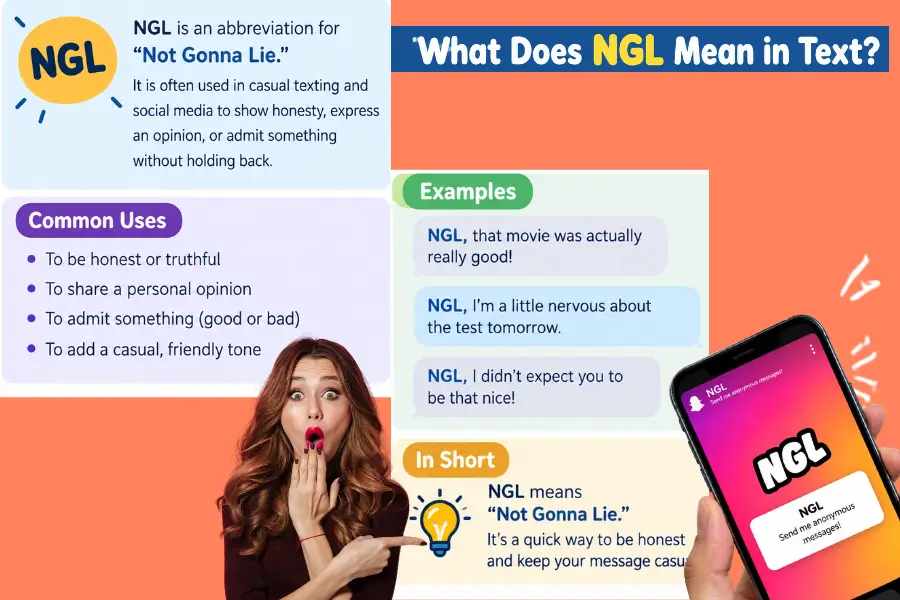
In casual texting, NGL most commonly means “Not Gonna Lie.” People use it right before sharing an honest opinion, especially one that might be a little blunt, awkward, or unexpected. It signals that what follows is the truth, even if it’s not what the other person wants to hear.
For example:
How was my presentation
Here, NGL is preparing the listener for honest, possibly uncomfortable feedback.
Another example:
“I tried making pasta from scratch.”
“NGL, that looks amazing.”
In this case, the person is emphasizing that their compliment is genuine, not just polite small talk. I find NGL useful to understand because its real function isn’t about literal honesty; it’s about framing. It tells the reader, “Brace yourself, this is real,” whether the truth that follows is good, bad, or somewhere in between.
In this article, I’ll explain what NGL means in text, how people use it, what it means in different types of conversations, how to respond to it, and when it might be better left out.
What Does NGL Mean in Text?
NGL usually means “Not Gonna Lie” in text messages. It’s an informal abbreviation used right before someone shares an honest, sometimes unfiltered opinion or feeling.
The phrase literally means the speaker is choosing not to lie or sugarcoat what comes next.
For example:
The second person is essentially saying:
“I’m going to be straight with you here.”
Another example:
Person 1: “What did you think of the movie?”
Person 2: “NGL, I fell asleep halfway through.”
This means:
“I’ll be honest, it didn’t hold my attention.”
NGL therefore works as a small verbal cue that prepares the reader for candor.
What Does NGL Stand For?
NGL stands for:
N = Not G = Gonna L = Lie
So:
NGL = Not Gonna Lie
It’s built from the first letters of each word, much like many other texting abbreviations.
The point of NGL is speed and emphasis; instead of typing out “I’m not going to lie to you,” someone can just type three letters and get the same effect.
For example:
“That haircut? NGL, it suits you way more than the old one.”
The sender is signaling that their opinion is sincere, not just a throwaway compliment.
What Is the Simple Meaning of NGL?
The easiest way to understand NGL is
“To be honest.”
Depending on the situation, it can mean:
- “I’ll be straight with you.”
- “Honestly speaking.”
- “I’m not going to sugarcoat this.”
- “This is my real opinion.”
- “I have to admit.”
- “Truthfully.”
- “I won’t pretend otherwise.”
- “Just so you know, this is genuine.”
The exact tone depends on what follows it.
For example:
“NGL, I was a little nervous about meeting your parents.”
could mean:
“I’ll admit something I might not normally say out loud.”
But:
“NGL, this is the best burger I’ve had all year.”
could mean:
“I mean this compliment sincerely.”
This is why NGL can sound vulnerable in one message and enthusiastic in the next, even though the underlying phrase stays the same.
Why Do People Use NGL in Text Messages?
People use NGL because it’s a fast way to flag that a statement is sincere, especially when the statement might be surprising, critical, or a little too honest for polite conversation.
Imagine a friend asks whether you liked their new haircut, and you actually don’t. Typing:
“NGL, I liked the old one better.”
softens the blow slightly by signaling that you’re being upfront rather than harsh.
Another common use is adding weight to a compliment or admission that might otherwise sound insincere.
For example:
“You’ve gotten so much better at guitar.”
“NGL, that meant a lot to hear.”
The response suggests genuine appreciation, not just a polite reply.
NGL can make a conversation feel more authentic, especially between people who trust each other enough to be direct.
How Is NGL Used in a Conversation?
NGL is generally placed at the start of a sentence, right before the honest statement itself.
For example:
Here, Friend 2 is giving genuine advice, not just what Friend 1 wants to hear.
Another example:
Friend 1: “I’m thinking about dyeing my hair blue.”
Friend 2: “NGL, I don’t think that’s really your vibe.”
This could mean:
“I want to be honest instead of just agreeing with you.”
NGL can appear at the beginning of a sentence, in the middle, or standing almost alone.
Examples include:
“NGL, that was rough.”
“I was scared, ngl.”
“NGL, bro, you did great.”
“NGL, I didn’t expect that.”
“NGL, that hit different.”
What Does NGL Mean, From a Friend?
If a friend sends you NGL, they’re usually signaling that they’re about to say something real, even if it’s a little uncomfortable.
For example:
You: “Be honest, was my joke at dinner weird?”
Friend: “NGL, kind of, but it was still funny.”
Your friend is basically saying:
“I’m not going to lie to spare your feelings.”
Another example:
You: “Did you like the gift I got you?”
Friend: “NGL, I wasn’t sure at first, but it’s grown on me.”
This can mean:
“Here’s the truth, even though it’s a little complicated.”
Friends often use NGL because it fits naturally into relationships built on trust and directness.
What Does NGL Mean From a Crush?
If someone you have a crush on sends NGL, the abbreviation itself doesn’t carry a built-in romantic meaning.
It usually still means:
“Not gonna lie.”
However, because it often precedes an honest feeling, it can feel more personal or vulnerable in a flirty context.
For example:
You: “Were you nervous texting me first?”
Crush: “NGL, a little.”
This kind of honesty can feel meaningful, especially early in a conversation.
Another example:
You: “Do you actually like hanging out with me?”
Crush: “NGL, more than I expected to.”
This could mean:
“I’m choosing to be open with you about this.”
Still, it’s worth remembering that NGL simply flags honesty; it doesn’t guarantee romantic intent. The words that follow it matter far more than the abbreviation itself.
Does NGL Have a Romantic Meaning?
No, NGL does not have a standard romantic meaning.
Its usual meaning is “Not Gonna Lie.”
It can appear in conversations between:
- Friends
- Couples
- Family members
- Coworkers
- Classmates
- Online acquaintances
- People who are flirting
For example:
“NGL, I kind of missed talking to you.”
The sentiment itself feels affectionate, but that comes from the words following NGL, not from the abbreviation.
Is NGL a Positive Expression?
It depends entirely on what comes after it.
NGL is neutral by itself; it just signals honesty, not a particular emotion.
For example:
“NGL, you crushed that presentation.”
That’s clearly a positive statement.
But:
“NGL, I forgot we had plans today.”
That’s an admission of a mistake, not a compliment.
The tone of NGL always depends on the sentence that follows it, which is different from an abbreviation like “SNM,” whose tone is usually upbeat by default.
Can NGL Be Used as a Joke?
Yes. NGL is often used humorously, especially to exaggerate a small, harmless confession.
For example:
Friend: “I ate the entire pizza by myself.”
You: “NGL, I would’ve done the same thing.”
The humor comes from treating a minor confession like a big honest reveal.
Another example:
“NGL, I’ve watched that show four times this month.”
The joke lies in openly admitting something slightly embarrassing but not actually serious.
NGL Meaning on Snapchat
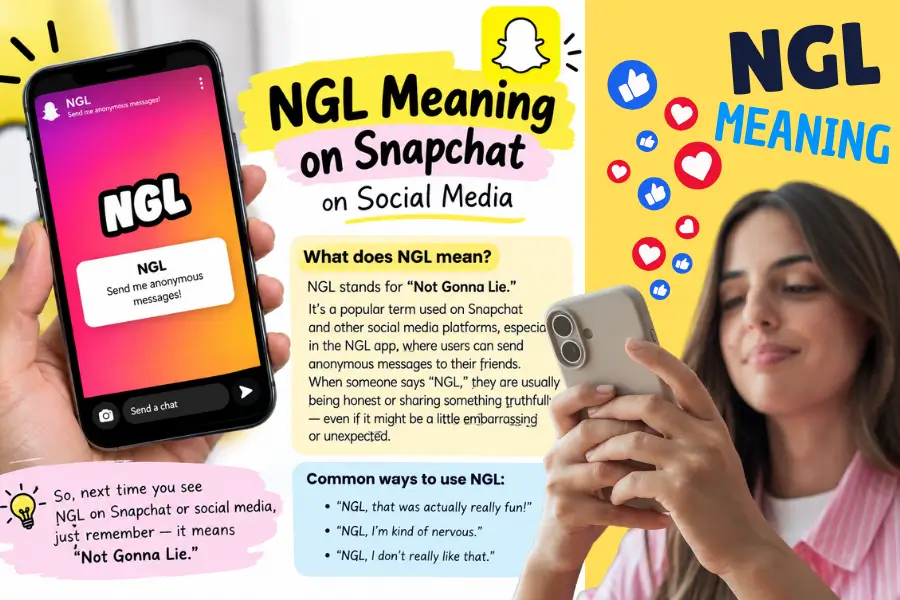
On Snapchat, NGL is extremely common, largely thanks to the popular “NGL” anonymous-messaging app that lets friends send honest, anonymous compliments or opinions through Snapchat stories.
Outside of the app itself, it’s also used casually in chats.
For example:
“NGL, your story was really funny today.”
The person is emphasizing that the compliment is genuine.
Another example:
“NGL, I almost didn’t recognize you in that photo.”
The sender is being straightforward, in a lighthearted way.
Because Snapchat conversations tend to be quick and informal, NGL fits naturally into short exchanges.
NGL Meaning on Instagram
NGL frequently appears in Instagram direct messages, comments, and captions.
For example:
“NGL, this is one of your best posts yet.”
This signals sincerity behind the compliment.
Another example:
“NGL, I almost didn’t post this.”
The caption suggests a moment of hesitation the poster is being honest about.
In comments, NGL is often used to add weight to praise or critique of a photo or video.
NGL Meaning on TikTok
TikTok comment sections are full of short slang, and NGL shows up constantly as a way to preface genuine reactions to videos.
For example, someone might comment on a cooking video:
“NGL, I did not expect that to actually taste good.”
This means the commenter is being sincere about their surprise.
Another example:
“NGL, this song has been stuck in my head all week.”
The commenter is emphasizing that the admission is real, not exaggerated for effect.
Also Read : IHHT Meaning in Text: What Does It Really Mean?
NGL Meaning in Gaming
NGL also appears often in gaming chats, usually to admit something honestly, whether it’s a mistake, a compliment, or a frustration.

For example:
Player 1: “That last round was rough for me.”
Player 2: “NGL, you carried us anyway.”
This can mean:
“I’m being honest, you still played well.”
Another example:
“NGL, that new update fixed a lot of issues.”
The player is giving a sincere assessment rather than a generic reaction.
NGL Meaning in Group Chats
In group chats, NGL is often used to give an honest take that stands out from a lighter conversation.
For example:
Friend 1: “Who’s cooking for the trip?”
Friend 2: “NGL, I can’t cook at all.”
Friend 3: “Same, honestly.”
Here, NGL introduces an honest confession that shifts the conversation slightly.
Another example:
Friend 1: “Rate the new group photo.”
Friend 2: “NGL, it’s actually really good.”
Friend 3: “Agreed.”
The abbreviation quickly signals a genuine opinion without a long explanation.
What Does “NGL Bro” Mean?
If someone says:
“NGL bro”
they’re usually saying:
“Not gonna lie, bro.”
For example:
“NGL bro, that was a great game.”
This means:
“I mean this honestly, and I’m saying it in a casual, friendly way.”
The word “bro” simply adds a relaxed, familiar tone to the honesty.
Must Read :What Does HW Mean in Text? Full Meaning Explained!
What Does “NGL” Mean in a Flirty Conversation?
In a flirty conversation, NGL often introduces a vulnerable or complimentary admission.
For example:
“NGL, I’ve been thinking about our conversation from earlier.”
The honesty makes the message feel more genuine and personal.
Another example:
“NGL, you’re kind of hard to stop thinking about.”
This is a direct, honest compliment framed with NGL to emphasize sincerity.
Still, NGL itself isn’t inherently flirty — the words that follow determine the tone.
Is NGL Rude?
NGL is generally not rude, but it can come across as blunt.
Because it introduces honesty, it sometimes precedes criticism, which can feel harsh depending on delivery.
For example:
“NGL, that outfit isn’t really working for you.”
This is honest, but it could sting if said carelessly.
On the other hand:
“NGL, that’s one of the kindest things anyone’s said to me.”
This use is warm, not rude at all.
So NGL’s tone depends heavily on the sentence that follows it, more so than most texting abbreviations.
Is NGL Formal or Informal?
NGL is informal texting slang.
It fits naturally in:
- Text messages
- Group chats
- Social media comments
- Gaming chats
- Casual conversations with friends
I would avoid using NGL in:
- Formal emails
- Business communication
- Academic writing
- Professional reports
- Official documents
Instead of writing:
“NGL, I don’t think this plan will work.”
in a professional context, you could write:
“Honestly, I have some concerns about this plan.”
or:
“To be candid, I think we should reconsider this approach.”
The full phrasing reads as more professional and is clearer to anyone unfamiliar with the abbreviation.
Can I Use NGL at Work?
It depends on your workplace culture.
If your team communicates casually, especially in informal chat channels, NGL might be perfectly normal.
For example:
Coworker: “How do you think the meeting went?”
You: “NGL, it ran way too long.”
That might be fine in an internal, casual channel.
However, I’d avoid NGL in emails to clients, managers, or external partners. Instead, you could say:
“Honestly speaking…”
“To be transparent…”
“I want to be upfront…”
These phrases carry the same meaning with a more professional tone.
NGL vs. TBH
NGL and TBH (“To Be Honest”) are extremely similar, but they carry slightly different implications.
NGL = Not Gonna Lie — often introduces something the speaker might otherwise be tempted to hide or soften.
TBH = To Be Honest — is more general and can introduce any honest opinion, big or small.
For example:
“TBH, I think blue looks better than red.”
This is a simple honest opinion.
But:
“NGL, I was a little jealous when I saw that.”
This suggests a slightly more vulnerable or reluctant admission.
The two are often used interchangeably, but NGL tends to carry a bit more emotional weight.
NGL vs. IMO
IMO means “In My Opinion.”
NGL means “Not Gonna Lie.”
For example:
“IMO, the sequel was better than the original.”
This is simply framing a personal opinion.
But:
“NGL, I didn’t expect to like the sequel as much as I did.”
This carries a sense of surprise or admission, not just an opinion.
They’re related, but NGL leans more toward candid confession, while IMO is a neutral way to present a viewpoint.
NGL vs. LMK
LMK means “Let Me Know.”
NGL means “Not Gonna Lie.”
For example:
“LMK if you’re free this weekend.”
This is a request for information.
But:
“NGL, I hope you’re free this weekend.”
This is an honest statement of feeling.
The two serve very different purposes in a conversation.
How Do I Respond to NGL?
Your response depends on what follows the abbreviation.
If someone sends something like:
“NGL, I really needed to hear that today.”
you might respond with:
- “I’m glad I could say it.”
- “Anytime.”
- “You deserve to hear it.”
- “I meant every word.”
- “That makes me happy to know.”
If the honesty is more critical, like:
“NGL, I think we should talk about what happened.”
you could respond with:
- “You’re right, let’s talk.”
- “I appreciate you being honest.”
- “Okay, I’m listening.”
- “Thanks for telling me straight.”
Matching the emotional tone of the message usually works best.
How Do I Know What NGL Means in Context?
When you see NGL in a message, look closely at what follows it.
Ask yourself:
Is the sentence a compliment?
If yes, NGL likely means:
“This praise is sincere.”
Is the sentence a confession or admission?
If yes, NGL likely means:
“I’m being honest, even if it’s uncomfortable.”
Is the sentence critical or blunt?
If yes, NGL likely means:
“I don’t want to sugarcoat this.”
Is the sentence emotional or vulnerable?
If yes, NGL likely means:
“I’m choosing to be open with you.”
Context is the most reliable way to interpret NGL, since its tone shifts completely based on the statement attached to it.
Common Examples of NGL in Text Messages
Here are some simple examples of how NGL appears in everyday conversations.
Example 1: Honest Compliment
Person 1: “What did you think of my speech?”
Person 2: “NGL, it was really well done.”
Meaning: “I’m being sincere with this praise.”
Example 2: Awkward Admission
Person 1: “Did you forget my birthday?”
Person 2: “NGL, I did.”
Meaning: “I won’t pretend otherwise.”
Example 3: Surprising Opinion
Person 1: “Did you like the new restaurant?”
Person 2: “NGL, better than I expected.”
Meaning: “Honestly, it exceeded my expectations.”
Example 4: Gaming
Person 1: “How’d I do in that match?”
Person 2: “NGL, you carried the team.”
Meaning: “I’m giving you an honest, positive assessment.”
Example 5: Weekend Plans
Person 1: “Are you actually excited for the trip?”
Person 2: “NGL, more than I thought I’d be.”
Meaning: “I’m admitting a genuine feeling.”
Example 6: Shopping
Person 1: “Should I buy these shoes?”
Person 2: “NGL, they’re not really your style.”
Meaning: “I’m giving you a blunt, honest opinion.”
Example 7: Movie
Person 1: “Did you cry during the ending?”
Person 2: “NGL, a little.”
Meaning: “I’m not going to hide that it affected me.”
Example 8: Apology
Person 1: “Are you still upset with me?”
Person 2: “NGL, a bit, but I’m getting over it.”
Meaning: “I’m being transparent about how I feel.”
When Should I Use NGL?
I’d use NGL when I want to flag that what I’m about to say is genuinely true, especially if it’s something I might otherwise hesitate to admit.
It works well when giving honest feedback.
For example:
“NGL, the ending felt rushed.”
It also works when admitting something personal or slightly vulnerable.
For example:
“NGL, I was nervous about texting you first.”
The phrase signals sincerity without needing a long explanation.
When Should I Avoid Using NGL?
I’d avoid NGL in situations that call for more sensitivity or formality.
For example, if a friend shares serious news, such as:
“I just found out I didn’t get the job.”
Responding with something like:
“NGL, that sucks.”
might come across as dismissive rather than supportive, even if it’s honest.
I’d also avoid NGL in professional or formal writing, where the abbreviation can look unpolished or overly casual.
Other Possible Meanings of NGL
Although “Not Gonna Lie” is the dominant meaning in texting, NGL can occasionally refer to something else depending on context.
NGL as an App Name
As mentioned earlier, “NGL” is also the name of a popular anonymous-messaging app used with Snapchat and Instagram stories. In that context, “NGL” refers to the app itself, not the phrase.
For example:
“Send me questions on my NGL.”
This is a reference to the app, not an abbreviation mid-sentence.
NGL in Specialized Communities
Certain industries, gaming communities, or niche online spaces may use NGL as shorthand for something entirely different, such as a brand name, project name, or internal term.
If the context feels unrelated to honesty or casual conversation, it’s worth considering an alternate meaning.
NGL in a Username
Someone might use “NGL” as part of a username or handle, where it may not relate to “Not Gonna Lie” at all.
Does NGL Mean the Same Thing Everywhere?
No.Like most texting abbreviations, its meaning depends on the surrounding conversation.
In a normal text exchange:
“NGL, that was a great idea.”
almost certainly means “Not Gonna Lie.”
But paired with the Snapchat feature:
“Drop questions on my NGL link.”
it refers to the app instead.
The safest approach is to read the full message and consider the platform before assuming the meaning.
Frequently Asked Questions
What does NGL mean in text?
“NGL” most commonly means “Not Gonna Lie.” It’s used to signal that the statement following it is honest, even if it’s blunt or unexpected.
What does NGL stand for?
NGL stands for “Not Gonna Lie.”
Is NGL a texting abbreviation?
Yes. NGL is widely used in texting, social media, and online chats as an informal way to introduce an honest statement.
What does “NGL 😭” mean?
“NGL 😭” usually means “Not gonna lie” with added emotional intensity, whether that’s sadness, embarrassment, or exaggerated humor.
What does NGL mean, from a friend?
When a friend uses NGL, they’re usually signaling that they’re about to say something genuinely true, even if it’s a little uncomfortable.
What does NGL mean from a crush?
NGL doesn’t have a built-in romantic meaning, but in a flirty context it often introduces a vulnerable or sincere admission.
Is NGL a positive response?
It depends entirely on the sentence that follows. NGL can introduce both compliments and criticism.
What does NGL mean on Snapchat?
On Snapchat, NGL is used both as a casual phrase and as the name of a popular anonymous-messaging app.
What does NGL mean on Instagram?
On Instagram, NGL is used in comments, captions, and messages to add sincerity to a statement.
What does NGL mean on TikTok?
On TikTok, NGL commonly appears in comments to introduce a genuine reaction or opinion.
What does NGL mean in gaming?
In gaming chats, NGL is used to give an honest assessment of a play, match, or update.
Is NGL rude?
NGL isn’t inherently rude, but it can sound blunt, especially when it introduces criticism.
Is NGL formal?
No. NGL is informal texting slang and isn’t well suited to professional or academic writing.
What should I reply to NGL?
Your reply should match the tone of what followed it appreciation for a compliment or openness if it was a more critical or vulnerable statement.
Conclusion
NGL usually means “Not Gonna Lie” in text messages. People use it to flag that what they’re about to say is honest, whether that’s a compliment, a confession, a criticism, or something more emotionally vulnerable.
“NGL, I think we should talk about this.” This signals honesty, even if the topic is uncomfortable. NGL can carry warmth, vulnerability, humor, or bluntness depending entirely on the sentence attached to it. Unlike more consistently upbeat abbreviations, its tone shifts based entirely on context.
The most important thing to remember is that NGL is a framing device, not a fixed emotion. It tells you honesty is coming, but what kind of honesty depends on everything that follows. So when you see NGL in a text, the meaning to remember is NGL = Not Gonna Lie. In simple words, it means, “I’m being honest with you right now, whatever that honesty happens to be.“