You’re scrolling through a group chat, and someone drops “SOL” after describing a bad situation. Or maybe you saw it in a legal document, a text from a friend, or a comment on TikTok. What is the “sol” meaning in text? The letters look simple, but SOL carries several completely different meanings, and picking the wrong one can leave you confused about what someone actually said.
The short version: in casual texting and slang, SOL almost always means “shit out of luck,” a phrase used to describe a hopeless or unlucky situation. But SOL also has established meanings in law, science, and other languages. Which one applies depends entirely on where you saw it.
Table of Contents
ToggleQuick Answer
| Term | Meaning | Context |
|---|---|---|
| SOL | Shit out of luck | Texting, slang, social media |
| SOL | Statute of limitations | Legal, financial |
| SOL | Sun (sol) | Spanish, and scientific references to a Martian day |
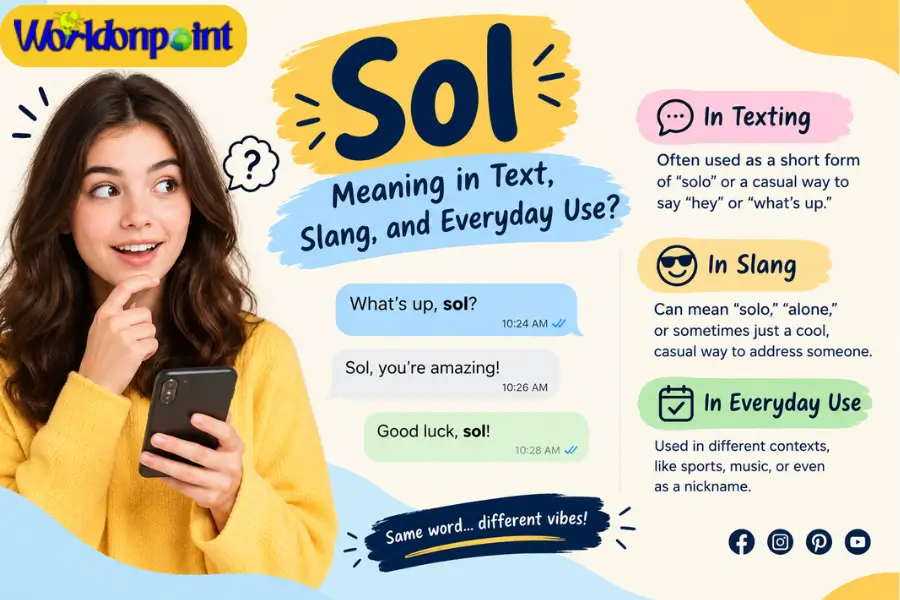
In texting and everyday slang, SOL means someone is out of options, out of time, or facing bad luck with no easy fix. It’s usually written after describing a problem, often as a short, blunt reaction. “Missed the deadline? You’re SOL” means there’s nothing left to do about it.
What Does SOL Mean?
SOL is a three-letter initialism, and its meaning changes based on where you encounter it. In everyday texting and internet slang, it stands for a phrase describing bad luck or a situation with no good options. In legal writing, it refers to a completely different concept tied to court deadlines. In Spanish, it’s simply the word for “sun.”
Most people searching for this term are trying to figure out the slang usage, since that’s the version that shows up most in messages, comments, and casual conversation. The rest of this guide breaks down that meaning first, then covers the other legitimate uses so you can identify the right one based on context.
SOL as Slang
In slang, SOL stands for “shit out of luck.” Some older or more polite references list it as “strictly out of luck” or “soldier out of luck,” softened versions that mean the same thing. All of them describe someone who has run out of options, time, or luck in a specific situation.
The phrase carries a resigned, sometimes blunt tone. It’s not used to describe mild disappointment. It’s used when something is genuinely over, unfixable, or too late to change. Someone might use SOL to describe their own situation or to tell someone else that their situation is hopeless.
It sits firmly in casual language. You wouldn’t use it in a professional email or a formal conversation, but it fits naturally in texts, comments, and talk between friends.
Example: If a friend says they left their charger at home before a long flight, replying “SOL” means there’s nothing to be done about it now.
SOL Meaning in Text
Texting is where most people encounter SOL, and the usage stays fairly consistent across one-on-one messages, group chats, and comment sections. Here are five original examples showing different situations.
Friend: “I forgot to submit the assignment before midnight.”
You: “SOL.”
Meaning: The deadline passed, so there’s no way to fix it now.
Coworker: “The store closes in five minutes, and I still need to grab a gift.”
You: “Yeah, you’re SOL on that one.”
Meaning: There isn’t enough time left to get there.
Group chat: “Anyone have an extra ticket? Sold out everywhere.”
Reply: “SOL unless someone’s selling last minute.”
Meaning: The situation looks hopeless unless something unexpected happens.
Sibling: “Mom said no phone until my grades improve.”
You: “SOL till report cards then 😂”
Meaning: Pointing out a temporary but unavoidable consequence.
Comment on a post about a canceled flight: “SOL for anyone who booked that connection.”
Meaning: People affected by the cancellation have no good options left.
SOL Meaning in Different Contexts
SOL in Texting
Used the same way described above: a quick, informal reaction to a situation with no good outcome.
SOL in Chat
In live chat apps and comment threads, SOL often appears as a one-word reply to someone describing bad luck, sometimes paired with a laughing or crying emoji to soften the blow.
SOL on Social Media
On platforms like TikTok, Instagram, and Snapchat, SOL shows up in captions or comments under posts about missed opportunities, bad timing, or unlucky outcomes. The meaning doesn’t change by platform. It’s the same slang usage, just applied to whatever the post is about.
SOL in Gaming
Players sometimes use SOL in chat when a match, item drop, or in-game event doesn’t go their way, especially when there’s no way to undo the outcome.
SOL in Work Conversations
This one is worth flagging directly: SOL rarely appears in professional messages because of the underlying phrase. If it shows up between coworkers informally, it’s still meant casually, but it’s not something to use with clients, managers, or in official communication.
SOL in Everyday Conversation
Spoken casually between friends or family, SOL is often said as an initialism (“ess-oh-el”) rather than spelled out, especially in front of kids or in mixed company.
Other Meanings of SOL
SOL isn’t exclusively slang. Depending on the field, it stands for something else entirely.
| SOL Meaning | Context | Example | Usage |
|---|---|---|---|
| Statute of limitations | Legal, financial | “The SOL on that debt expired two years ago.” | Common in legal and credit discussions |
| Speed of light | Physics, science | Used in formulas and scientific writing | Specialized |
| Standards of Learning | Education (notably Virginia, US) | “Students take SOL tests every spring.” | Common in that regional context |
| Sleep onset latency | Sleep science, medicine | Measured in sleep studies | Specialized |
| A Martian solar day | Space science, NASA missions | “The rover has been active for 500 sols.” | Specialized |
| Solana (cryptocurrency) | Finance, crypto | “SOL is trading higher this week.” | Common in crypto communities |
None of these compete with the slang meaning in everyday conversation. They exist in their own fields, and readers in those fields will usually recognize which one applies immediately.
SOL Meaning in Different Languages
Spanish: “Sol” is the everyday word for “sun.” It’s used constantly in weather talk, song lyrics, and names. “Hace mucho sol hoy” means “It’s very sunny today.”
French: “Sol” refers to the ground or soil, as in flooring or earth. It’s a completely unrelated word from the slang usage and shouldn’t be confused with it.
Music (solfège): In the movable-do solfège system used in music education, “sol” (or “so”) is the name of the fifth note of a major scale, corresponding to the note G.
These meanings are tied to spelling, not the capitalized internet acronym, so context makes it obvious which one is intended. Nobody texting slang is referring to sunlight or a musical note.
SOL as an Abbreviation or Acronym
Language nerds sometimes ask whether SOL is technically an acronym or an initialism. An acronym is pronounced as a word (like NASA). An initialism is pronounced letter by letter (like FBI). Since people say “ess-oh-el” rather than a single word, SOL functions as an initialism in nearly all of its meanings, including the slang usage, the legal usage, and the scientific ones.
Why Do People Use SOL?
People reach for SOL instead of spelling things out for a few practical reasons:
- Speed: Three letters are faster to type than a full phrase.
- Casual tone: It softens a blunt phrase into something that reads more like slang than profanity.
- Familiarity: It’s been used in English since World War I, so it’s deeply embedded in casual speech.
- Humor: It’s often used to add a joking or exaggerated tone to a small inconvenience.
- Shorthand for sympathy or resignation: It communicates “there’s nothing you can do” in one word.
SOL Tone and Emotional Meaning
The tone behind SOL depends heavily on context, punctuation, and what surrounds it.
- Humorous: “SOL 😂” after a minor mishap reads as lighthearted teasing.
- Frustrated: “SOL. again,” with a period and no emoji, can read as genuinely annoyed.
- Casual: A quick “sol lol” between friends softens the phrase even further.
- Serious: In longer messages discussing real consequences, SOL can carry real weight rather than humor.
- Sarcastic: “Oh great, SOL as usual” pairs sarcasm with the phrase to vent about a recurring problem.
- Resigned: A flat “SOL” with no punctuation often just states a fact without much emotion attached.
Emojis and punctuation do a lot of the emotional work here. The same word can read as a joke or a complaint depending on what’s around it.
Must Read : ATP Meaning in Text: The Complete Guide to This Confusing Chat Slang
SOL Examples
- Missing the last train home: “Well, that’s it, SOL until morning.”
- A group project partner not showing up: “If she doesn’t submit her part, we’re all SOL.”
- Losing wifi during an online exam: “SOL, guess I’m emailing my professor.”
- Forgetting an anniversary: “Yeah bro, you’re SOL this weekend.”
- A canceled concert with no refunds listed: “SOL on getting that money back.”
- Losing a ranked match in the final round: “SOL, that was our best shot.”
- A store running out of a limited item: “Got there ten minutes late, SOL.”
- A dating app match cancelling plans last minute: “SOL for tonight, I guess.”
- A sibling breaking a shared phone charger: “Now we’re both SOL until payday.”
- Missing a job application deadline by an hour: “SOL, they don’t do late submissions.”
- A parent taking away weekend plans over chores: “SOL till Sunday, apparently.”
- A flight delay causing a missed connection: “Everyone on that flight is SOL right now.”
- Realizing the return window closed yesterday: “SOL on returning this.”
- A friend group chat joke about a bad haircut: “SOL till it grows back 💀”
- A coworker missing a meeting invite: “SOL, that one’s on you this time.”
How to Know Which SOL Meaning Someone Intends
Context almost always makes the intended meaning clear. Check these signals:
- The surrounding sentence – does it describe bad luck, or something legal, scientific, or financial?
- The subject of the conversation – a lawsuit points to the statute of limitations; a missed deadline points to slang.
- The relationship between speakers – friends and casual acquaintances lean toward slang.
- The platform – texts, comments, and social captions lean slang; legal or credit forums lean statute of limitations.
- Capitalization – lowercase “sol” in Spanish or French text usually signals sun or ground, not slang.
- Punctuation – a period suggests something serious; no punctuation is often casual.
- Emojis – a laughing emoji signals humor; no emoji can read more flatly.
- Tone of the conversation – serious discussions rarely use the slang meaning for comic effect.
- Whether another meaning fits better – if the sentence involves debt, lawsuits, or deadlines in a legal sense, it’s likely not slang.
Context determines meaning. When in doubt, look at the sentence before and after SOL, not just the word itself.
SOL vs. Similar Terms
| Term | Meaning | Difference From SOL |
|---|---|---|
| FML | “F my life,” expressing frustration about a situation | Broader complaint, not necessarily about lacking options |
| NGL | “Not gonna lie,” a phrase introducing honesty | Unrelated meaning, often confused due to similar texting style |
| SMH | “Shaking my head,” expressing disbelief or disappointment | Reaction to something, not a statement about being out of luck |
| RIP | Used casually to mean something failed or is over | Similar resigned tone, but broader and less tied to luck specifically |
How to Respond to SOL
Funny Response
“SOL squad, we out here 😂”
Friendly Response
“Ugh, that’s rough. Let me know if I can help.”
Supportive Response
“That really stinks; I’m sorry that happened.”
Casual Response
“Yeah, that’s SOL for sure. Better luck next time.”
Serious Response
“That’s a tough spot. Is there anything that can still be done?”
Which response fits depends on how serious the situation actually is. A missed sale online calls for humor. A missed deadline with real consequences calls for something more supportive.
Should You Use SOL?
Good for:
- Texting friends
- Group chats
- Social media captions and comments
- Gaming chat
- Informal, joking conversations
Avoid or explain it first in:
- Formal emails
- Academic writing
- Professional documents
- Customer service communication
- Conversations where the reader might not recognize slang, including some older relatives or non-native speakers
In formal settings, a clearer phrase like “out of options” or “there’s nothing that can be done at this point” gets the same idea across without relying on slang.
SOL Capitalization and Variations
- SOL – standard, all-caps slang usage
- sol – often signals the Spanish or French word, not slang
- Sol – frequently a name, or the start of a sentence using the word
- SOL! – adds emphasis or shock
- SOL? – used when reacting with disbelief, almost asking “Seriously?”
- SOL lol – softens the phrase into a joke
- SOL 😭 – dramatizes a situation, often humorously
Capitalization doesn’t change the core meaning within slang; it mostly signals tone and emphasis. A lowercase “sol” used mid-sentence in another language, though, points to a different word entirely.
Common Misunderstandings About SOL
- Assuming SOL only ever means “shit out of luck,” when legal and scientific meanings are also well established.
- Automatically reading it as slang in professional or legal documents where it clearly isn’t.
- Ignoring language context when “sol” appears in Spanish or French text.
- Treating the abbreviation and its full phrase as identical in every setting, when tone and audience matter.
- Assuming a platform like TikTok created a brand-new meaning when the usage is the same slang applied to a new topic.
- Treating a specialized meaning like sleep onset latency as common when it only appears in specific fields.
Is “SOL” a Bad Word?
The abbreviation itself isn’t considered profanity. It’s the expanded phrase behind the slang meaning that includes a swear word. Because of that, SOL functions as a milder, more casual stand-in, similar to how other abbreviations soften stronger language.
In casual texting between friends, it’s widely accepted and rarely seen as offensive. In formal writing or professional settings, it’s better avoided, not because the letters themselves are inappropriate, but because of what they represent.
Also Read : BFFR Meaning in Text: The Real Meaning Behind This Slang
Is SOL rude?
Not inherently. Most of the time, it’s neutral or even sympathetic, used to acknowledge that someone’s situation is genuinely unlucky. It can read as blunt in a serious moment, but it’s rarely intended as an insult.
- Neutral use: “SOL on tickets, they’re all sold out.”
- Humorous use: “SOL, guess I’m walking home 😂”
- Blunt use: “SOL. Should’ve left earlier.”
- Potentially rude use: Directed at someone during an already tense conversation, where it can come across as dismissive rather than sympathetic.
Frequently Asked Questions
What does SOL mean?
SOL most commonly means “shit out of luck” in slang and texting, describing a situation with no good options left. It also has separate meanings in law (statute of limitations), science, and other languages, depending on context.
What does SOL mean in text?
In texts, SOL is used to describe a situation as hopeless or unfixable. It’s usually a short, casual reaction to bad luck or a missed opportunity, often paired with humor or resignation.
What does SOL mean in texting?
Same meaning as general texting use: “shit out of luck.” It appears after describing a problem, signaling that nothing more can be done about it.
What does SOL mean in slang?
In slang, SOL describes being out of luck or out of options. It’s informal, blunt, and commonly used among friends rather than in formal writing.
What does SOL stand for?
Depending on context, SOL can stand for “shit out of luck,” “statute of limitations,” “speed of light,” or “Standards of Learning,” among other specialized meanings.
Is SOL a bad word?
The abbreviation isn’t considered profanity itself, though the full phrase behind it includes a swear word. It’s generally accepted in casual conversation but avoided in formal writing.
What does SOL mean in chat?
In live chat and messaging apps, SOL keeps its slang meaning, used as a quick reaction to someone describing an unlucky or hopeless situation.
What does SOL mean on social media?
On platforms like TikTok, Instagram, and Snapchat, SOL is used in captions and comments the same way it’s used in texting, reacting to bad luck or missed chances.
Can SOL have more than one meaning?
Yes. Beyond slang, SOL is an established initialism in law, physics, education, sleep science, and other fields. The surrounding context makes clear which meaning applies.
How do you respond to SOL?
Responses range from humorous (“SOL squad”) to supportive (“that really stinks”) depending on how serious the situation actually is. Matching the other person’s tone works best.
How do I know which SOL meaning someone intends?
Look at the topic of conversation, the platform, punctuation, and emojis. Legal or financial topics point to the statute of limitations, while casual conversation about bad luck points to the slang meaning.
Key Takeaways
- SOL most commonly means “shit out of luck” in slang, texting, and social media.
- It also stands for statute of limitations in legal contexts and has separate meanings in science, education, and other languages.
- The abbreviation is casual and generally not considered offensive on its own, even though the full phrase includes profanity.
- Tone shifts based on punctuation, emojis, and the seriousness of the conversation.
- Context, not the letters alone, determines which meaning applies in any given message.
Conclusion
What is sol meaning in text? SOL isn’t a one-note term. In texting and slang, it means “shit out of luck,” describing a situation with no good options left. Outside of casual conversation, it stands for entirely different things, from the statute of limitations in legal writing to the sun in Spanish.
None of these meanings compete with each other in real use, because the setting usually makes the intended one obvious. If you’re trying to figure out which SOL someone meant, look at the conversation around it.
A legal discussion points one direction, and a group chat about bad luck points another. Once you check the context, the right meaning becomes easy to spot.