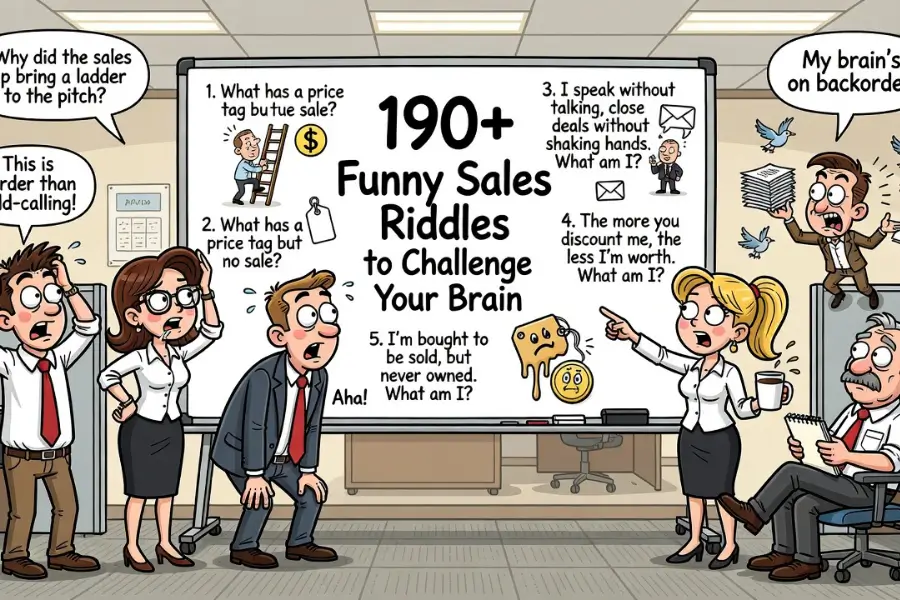
Are you ready to test your business knowledge with some clever puzzles? These 190+ sales riddles combine humor, logic, shopping situations, marketing concepts, and everyday business challenges to keep your brain active.
Whether you work in sales, manage a business, study marketing, or simply enjoy solving puzzles, this collection has something for you. You will find easy sales riddles, funny questions, tricky brain teasers, retail puzzles, and challenges about prices, profits, and customers. Every riddle includes an answer, so you can challenge your friends, coworkers, or classmates and check your reasoning afterward.
Use these sales riddles during office meetings, team-building activities, classroom games, or friendly competitions. Some are simple enough for beginners, while others require careful thinking before you discover the solution.
What Are Sales Riddles?
Sales riddles are brain teasers based on selling products, helping customers, negotiating prices, advertising, and running a business. They use wordplay, logical thinking, and everyday commercial situations to create entertaining questions with surprising answers.
These puzzles can introduce business vocabulary, encourage problem-solving, and make sales training more enjoyable. They range from simple questions about shopping and receipts to challenging puzzles involving discounts, profit, and customer decisions.
Why Sales Riddles Are Fun and Useful
Sales riddles offer more than entertainment. They encourage people to think creatively about situations they may encounter at work or while shopping.
- Improve critical thinking: Solve problems by examining clues and considering different possibilities.
- Learn business terms: Understand concepts such as commission, revenue, discounts, and profit.
- Encourage teamwork: Challenge colleagues to discuss clues and compare answers.
- Break the ice: Start meetings with a short, enjoyable activity.
- Practice mental math: Work through simple pricing and discount calculations.
- Build communication skills: Explain your reasoning and listen to other people’s ideas.
These activities are not a substitute for professional sales training, but they can make learning and teamwork more enjoyable.
Easy Sales Riddles for Beginners
Start with these simple sales riddles. They focus on familiar products, customers, and everyday transactions.
Sales Riddle #1: The Helpful Seller
I help people choose products and answer their questions. Who am I?
Answer: A salesperson.
Sales Riddle #2: The Shopping List
I remind you what to buy before you enter a store. What am I?
Answer: A shopping list.
Sales Riddle #3: The Price Tag
I hang on a product and tell you how much it costs. What am I?
Answer: A price tag.
Sales Riddle #4: The Final Payment
You give me to complete a purchase. What am I?
Answer: Payment.
Sales Riddle #5: The Store Visitor
I enter a shop looking for something to buy. Who am I?
Answer: A customer.
Sales Riddle #6: The Money Back
You return an item, and the store gives your money back. What is this called?
Answer: A refund.
Sales Riddle #7: The Proof of Purchase
I show what you bought and how much you paid. What am I?
Answer: A receipt.
Sales Riddle #8: The Special Offer
I reduce the amount you pay for a product. What am I?
Answer: A discount.
Sales Riddle #9: The Product Display
I arrange products where shoppers can see them easily. What am I?
Answer: A store display.
Sales Riddle #10: The Store Owner
I run a shop and sell goods to customers. Who am I?
Answer: A retailer.
Sales Riddle #11: The Product Shelf
I hold products until customers pick them up. What am I?
Answer: A shelf.
Sales Riddle #12: The Shopping Basket
I carry several items while you shop, but I never buy anything. What am I?
Answer: A shopping basket.
Sales Riddle #13: The Payment Machine
I help process card payments at a checkout counter. What am I?
Answer: A card terminal.
Sales Riddle #14: The Product Description
I explain what an item does and why someone might need it. What am I?
Answer: A product description.
Sales Riddle #15: The Bargain Hunter
I search for the best price before making a purchase. Who am I?
Answer: A bargain hunter.
Sales Riddle #16: The Store Sign
I tell shoppers what a business sells or where to find it. What am I?
Answer: A store sign.
Sales Riddle #17: The Shopping Cart
I carry your purchases around a supermarket. What am I?
Answer: A shopping cart.
Sales Riddle #18: The Product Sample
I let customers try a little before deciding to buy. What am I?
Answer: A sample.
Sales Riddle #19: The Checkout Line
Customers stand in me while waiting to pay. What am I?
Answer: A queue.
Sales Riddle #20: The Happy Buyer
I leave a store feeling pleased with my purchase. Who am I?
Answer: A satisfied customer.
Funny Sales Riddles to Make You Laugh
These funny sales riddles mix shopping humor with amusing situations from the world of business.
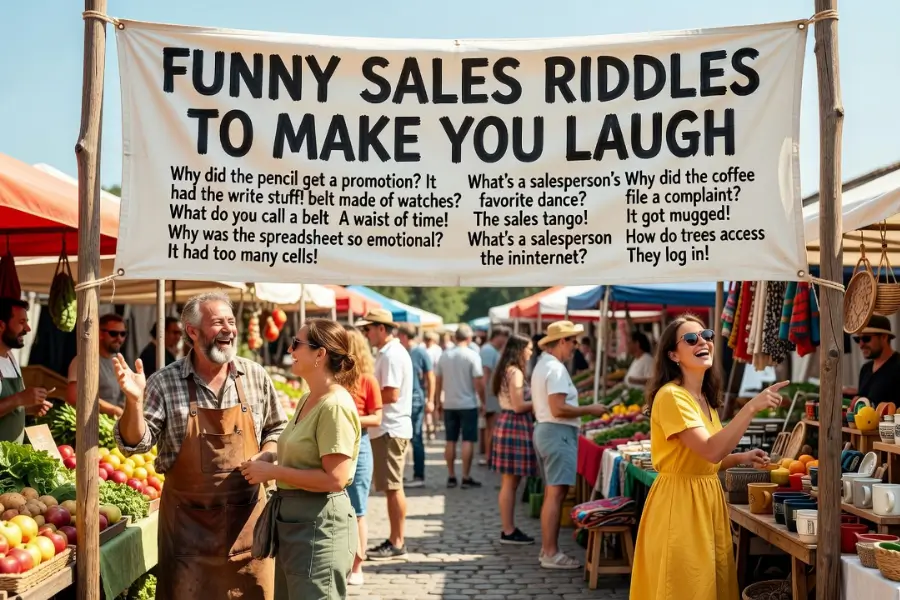
Sales Riddle #21: The Salesperson’s Superpower
What can a great salesperson turn into an opportunity without using magic?
Answer: A customer question.
Sales Riddle #22: The Empty Wallet
Why did the wallet avoid the shopping mall?
Answer: It needed a break from spending.
Sales Riddle #23: The Talking Price Tag
What would a price tag say to an expensive customer?
Answer: “Please don’t judge me by my numbers!”
Sales Riddle #24: The Lazy Salesperson
Why did the salesperson bring a ladder to work?
Answer: To reach higher sales targets.
Sales Riddle #25: The Shopping Bag
Why did the shopping bag feel important?
Answer: It carried everyone’s purchases.
Sales Riddle #26: The Discount Sign
Why was the discount sign always surrounded by people?
Answer: It knew how to attract attention.
Sales Riddle #27: The Product That Never Complains
Which product is the quietest employee in a store?
Answer: A display mannequin.
Sales Riddle #28: The Customer’s Favorite Word
Which word can make a shopper smile before buying anything?
Answer: “Sale!”
Sales Riddle #29: The Overworked Cash Register
Why did the cash register need a holiday?
Answer: It had too many transactions to process.
Sales Riddle #30: The Sales Target
Why did the target go to the gym?
Answer: It wanted to be easier to hit.
Sales Riddle #31: The Pricey Joke
Why did the expensive product tell terrible jokes?
Answer: It thought its price made it a premium comedian.
Sales Riddle #32: The Shopping Addiction
Why did the shopping cart refuse to go home?
Answer: It wanted one more round around the store.
Sales Riddle #33: The Forgetful Customer
What does a forgetful shopper look for after leaving the store?
Answer: The receipt they put somewhere safe.
Sales Riddle #34: The Sales Meeting
Why did the salesperson bring a pillow to the meeting?
Answer: The presentation promised to cover every detail.
Sales Riddle #35: The Confident Product
Why did the product stand in front of the mirror?
Answer: It wanted to improve its presentation.
Sales Riddle #36: The Cheap Joke
What is a bargain hunter’s favorite type of comedy?
Answer: A low-cost laugh.
Sales Riddle #37: The Talking Cashier
Why did the cashier become a comedian?
Answer: Every transaction gave them a new punchline.
Sales Riddle #38: The Shopping Shoes
Why did the shoes love working in retail?
Answer: They were always on sale.
Sales Riddle #39: The Salesperson’s Coffee
Why did the salesperson drink coffee before calling a customer?
Answer: To make the conversation percolate.
Sales Riddle #40: The Missing Customer
Why did the salesperson look under the desk?
Answer: They were searching for a low lead.
Tricky Sales Riddles to Challenge Your Brain
Read each question carefully. Some answers depend on logic rather than sales knowledge.
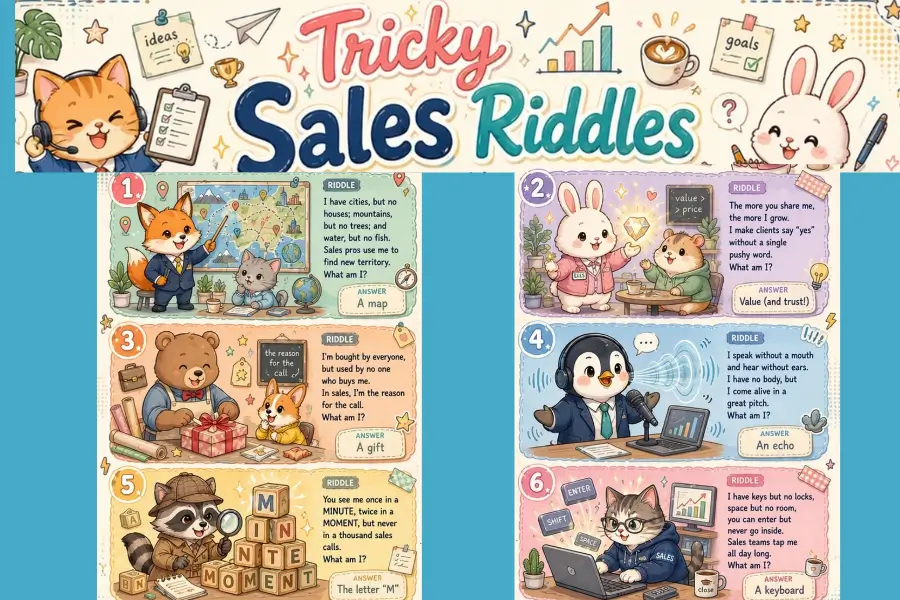
Sales Riddle #41: The Price Puzzle
A product costs $20. A customer buys two identical products at full price. How much do they pay before tax?
Answer: $40.
Explanation: Two products at $20 each cost $40.
Sales Riddle #42: The Discount Trap
A $100 product receives a 10% discount. What is the new price before tax?
Answer: $90.
Sales Riddle #43: The Two Customers
Two customers enter a shop. Each buys one item, but only one transaction takes place. How is that possible?
Answer: They make a joint purchase in a single transaction.
Sales Riddle #44: The Unsold Product
What can a salesperson sell without physically handing over a product immediately?
Answer: A service or a product ordered for later delivery.
Sales Riddle #45: The Silent Seller
What can persuade a customer to buy even when no salesperson is speaking?
Answer: An effective product display.
Sales Riddle #46: The Returning Customer
A customer visits a store every week but never buys anything. Can the store still learn something useful from the visits?
Answer: Yes. It can learn about the customer’s interests and questions, although a purchase is not guaranteed.
Sales Riddle #47: The Profit Question
A shop buys a product for $30 and sells it for $45. What is the gross profit before other expenses?
Answer: $15.
Sales Riddle #48: The Mystery Buyer
Someone pays for an item but leaves without taking it home. Is the sale necessarily incomplete?
Answer: No. The item may be scheduled for delivery or collection later.
Sales Riddle #49: The Unopened Box
A store sells a sealed box without opening it. How can the buyer know what is inside?
Answer: Through the product label, description, or packaging information.
Sales Riddle #50: The Price Difference
One shop sells a product for $50, and another sells it for $45. How much cheaper is the second shop?
Answer: $5.
Sales Riddle #51: The No-Talking Challenge
Can a salesperson communicate product information without speaking?
Answer: Yes, through signs, demonstrations, written descriptions, or videos.
Sales Riddle #52: The Missing Profit
A product sells for exactly what it costs the business to purchase. What is the gross profit?
Answer: Zero.
Sales Riddle #53: The Unusual Customer
A customer asks many questions and buys nothing. Was the salesperson necessarily unsuccessful?
Answer: No. The customer may return later, although no future purchase is guaranteed.
Sales Riddle #54: The Fast Decision
What can help a customer make a quick but informed buying decision?
Answer: Clear information about price, features, and suitability.
Sales Riddle #55: The Price That Changes
A product costs $80 in the morning and $70 later. What happened to its price?
Answer: It decreased by $10.
Sales Riddle #56: The Full Store
A shop has plenty of visitors but few sales. What might be the problem?
Answer: Visitors may not find suitable products, clear prices, or reasons to buy.
Sales Riddle #57: The Invisible Product
What can a business sell even though customers cannot hold it in their hands?
Answer: A digital service, subscription, or online course.
Sales Riddle #58: The Double Discount
A $100 product receives a 10% discount followed by another 10% discount on the reduced price. What is the final price?
Answer: $81.
Explanation: The first discount reduces the price to $90. The second reduces $90 by $9.
Sales Riddle #59: The Sales Mystery
A salesperson makes ten calls and gets two orders. How many calls did not result in an order?
Answer: Eight.
Sales Riddle #60: The Honest Answer
What should a salesperson do when they do not know the answer to a customer’s question?
Answer: Admit it, verify the information, and follow up with an accurate answer.
Sales and Marketing Riddles
These puzzles explore advertising, promotion, branding, and the process of attracting potential customers.
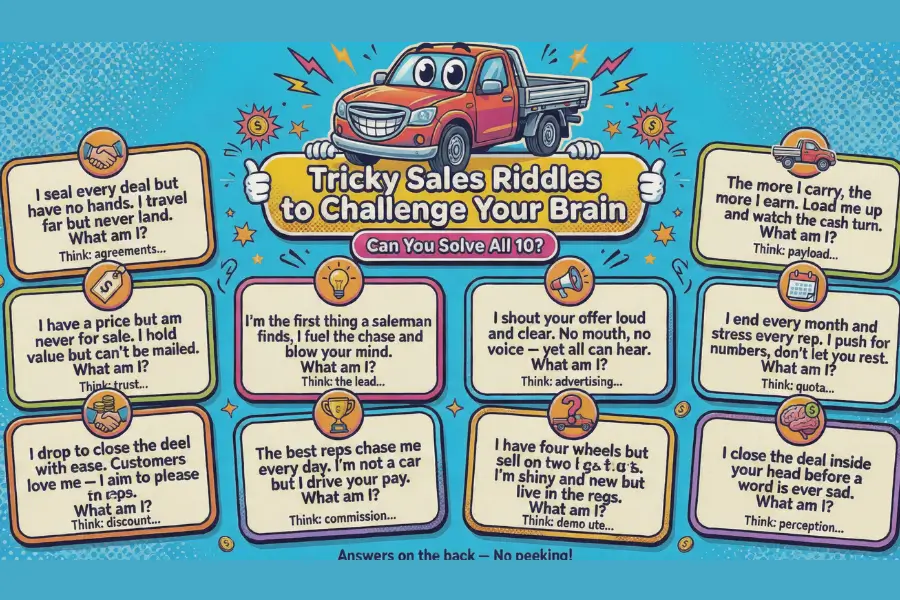
Sales Riddle #61: The Attention Getter
I appear online or in print to introduce people to a product. What am I?
Answer: An advertisement.
Sales Riddle #62: The Brand Identity
I help customers recognize a business through a distinctive visual design. What am I?
Answer: A logo.
Sales Riddle #63: The Marketing Message
I explain why a product may be useful to a particular audience. What am I?
Answer: A value proposition.
Sales Riddle #64: The Potential Buyer
I may become a customer, but I have not purchased anything yet. Who am I?
Answer: A sales lead.
Sales Riddle #65: The Online Click
A person sees an advertisement and clicks it. What has happened?
Answer: An ad click.
Sales Riddle #66: The Customer Journey
I describe the steps people take from discovering a product to buying it. What am I?
Answer: The customer journey.
Sales Riddle #67: The Marketing Message Repeated
Why might a business show the same advertisement more than once?
Answer: To build awareness and help people remember the product.
Sales Riddle #68: The Ideal Audience
Who is most likely to respond to a carefully targeted advertisement?
Answer: People whose needs and interests match the offer.
Sales Riddle #69: The Searchable Product
What helps customers find a business through relevant search queries?
Answer: Search engine optimization, or SEO.
Sales Riddle #70: The Email Invitation
I arrive in an inbox with news, offers, or helpful information from a business. What am I?
Answer: A marketing email.
Sales Riddle #71: The Brand Promise
What should a business consistently deliver so customers can trust its message?
Answer: The quality and experience it promises.
Sales Riddle #72: The Limited-Time Offer
Why might an offer have an end date?
Answer: To define the promotion period and encourage timely decisions.
Sales Riddle #73: The Social Seller
Where can businesses share product demonstrations and answer public questions?
Answer: Social media.
Sales Riddle #74: The Marketing Test
A business compares two versions of an advertisement to see which performs better. What is this called?
Answer: A/B testing.
Sales Riddle #75: The Product Story
What can help customers understand how a product fits into their lives?
Answer: A relevant product story or use case.
Sales Riddle #76: The Conversion Question
A visitor completes the action a website wanted them to take. What has happened?
Answer: A conversion.
Sales Riddle #77: The Marketing Plan
What helps a business decide whom to reach, what to say, and where to advertise?
Answer: A marketing strategy.
Sales Riddle #78: The Trust Builder
What can reassure shoppers who are unsure about a product’s quality?
Answer: Genuine customer reviews and accurate product information.
Sales Riddle #79: The Free Introduction
A business lets people try a basic version of its service before paying. What is this called?
Answer: A free trial.
Sales Riddle #80: The Memorable Message
What is a short phrase that helps people remember a brand or campaign?
Answer: A slogan or tagline.
Retail and Shopping Riddles
Explore these retail riddles about stores, inventory, shopping habits, and customer purchases.
Sales Riddle #81: The Stockroom Mystery
Where do stores keep products that are not yet on the sales floor?
Answer: The stockroom.
Sales Riddle #82: The Missing Size
A customer wants a shirt in a size the store does not have. What should the retailer check?
Answer: Available inventory at other locations or through suppliers.
Sales Riddle #83: The Shopping Shortcut
What helps shoppers compare the prices of similar products quickly?
Answer: Price labels or a product comparison chart.
Sales Riddle #84: The Empty Shelf
What does an empty product shelf often indicate?
Answer: The product may be sold out or awaiting restocking.
Sales Riddle #85: The Barcode Reader
I scan printed lines to identify a product at checkout. What am I?
Answer: A barcode scanner.
Sales Riddle #86: The Store Layout
Why might a retailer place related products close together?
Answer: To make shopping easier and help customers discover complementary items.
Sales Riddle #87: The Online Store
I allow customers to browse products and place orders without visiting a physical shop. What am I?
Answer: An e-commerce store.
Sales Riddle #88: The Delivery Promise
What tells an online shopper when an order is expected to arrive?
Answer: An estimated delivery date.
Sales Riddle #89: The Product Exchange
A customer changes one purchased item for another. What is this called?
Answer: An exchange.
Sales Riddle #90: The Loyalty Reward
What might a store offer to thank customers for repeat purchases?
Answer: Loyalty points, rewards, or member discounts.
Sales Riddle #91: The Inventory Count
Why does a retailer count the products it has in stock?
Answer: To maintain accurate inventory records and identify shortages.
Sales Riddle #92: The Shopping Season
When might a retailer promote school supplies more heavily?
Answer: Before the school year begins.
Sales Riddle #93: The Product Comparison
Two products have similar prices but different features. What should a shopper compare?
Answer: Their quality, features, durability, suitability, and total cost.
Sales Riddle #94: The Checkout Surprise
Why should a shopper review the final bill before paying?
Answer: To check prices, quantities, discounts, and applicable taxes.
Sales Riddle #95: The Return Window
What tells a shopper how long they have to return an item?
Answer: The store’s return policy.
Sales Riddle #96: The Shelf Label
What helps customers identify the price of an item without asking an employee?
Answer: A shelf price label.
Sales Riddle #97: The Product Bundle
A retailer sells a camera with a case and memory card in one package. What is this called?
Answer: A product bundle.
Sales Riddle #98: The Popular Product
What can a retailer learn when one product repeatedly sells faster than others?
Answer: It may have strong demand among that store’s customers.
Sales Riddle #99: The Seasonal Clearance
Why might a shop reduce the price of winter clothing as spring approaches?
Answer: To clear seasonal inventory and make room for new merchandise.
Sales Riddle #100: The Convenient Purchase
What allows customers to order online and collect their items at a physical store?
Answer: Buy online, pick up in store, often called BOPIS.
Customer Service Riddles
Customer service plays a major role in the buying experience. These riddles focus on listening, solving problems, and earning customer trust.
Sales Riddle #101: The Patient Listener
What should a customer service representative do before offering a solution?
Answer: Listen carefully to understand the problem.
Sales Riddle #102: The Unhappy Customer
A customer complains about a damaged product. What should the representative do first?
Answer: Acknowledge the concern and gather the necessary details.
Sales Riddle #103: The Helpful Answer
What makes an answer useful when a customer asks about a product?
Answer: It is clear, accurate, relevant, and easy to understand.
Sales Riddle #104: The Missing Order
A customer says an order never arrived. What should the business check?
Answer: The order status, tracking information, delivery records, and shipping address.
Sales Riddle #105: The Calm Conversation
What helps a representative handle an angry customer professionally?
Answer: Patience, empathy, active listening, and clear communication.
Sales Riddle #106: The Follow-Up
Why might a representative contact a customer after resolving an issue?
Answer: To confirm that the solution worked and the customer is satisfied.
Sales Riddle #107: The Product Question
A customer asks whether an item is suitable for their needs. What should the seller explain?
Answer: The product’s relevant features, limitations, and intended uses.
Sales Riddle #108: The Fair Solution
What should guide a business when deciding how to resolve a valid complaint?
Answer: Its policies, the facts, fairness, and applicable consumer protections.
Sales Riddle #109: The Long Wait
What should a business communicate when a customer must wait longer than expected?
Answer: An honest update about the delay and the next steps.
Sales Riddle #110: The Wrong Item
A customer receives the wrong product. What is a sensible next step?
Answer: Verify the order and arrange an appropriate correction under the store’s policy.
Sales Riddle #111: The Helpful Apology
When is an apology most useful in customer service?
Answer: When it acknowledges a genuine problem and accompanies meaningful action.
Sales Riddle #112: The Repeat Question
Why should customer service answers remain consistent across different representatives?
Answer: Consistency reduces confusion and helps customers receive reliable information.
Sales Riddle #113: The Difficult Request
A customer requests something the business cannot provide. What should the representative do?
Answer: Explain the limitation politely and offer realistic alternatives when available.
Sales Riddle #114: The Customer Review
What can a business learn from thoughtful customer feedback?
Answer: Which parts of its products and services may need improvement.
Sales Riddle #115: The Helpful Guide
What can a clear FAQ page help customers do?
Answer: Find answers to common questions without contacting support.
Sales Riddle #116: The Service Promise
What should a business do when it promises to call a customer back?
Answer: Follow through within the agreed time or communicate a delay.
Sales Riddle #117: The Unclear Policy
What should a store do if customers repeatedly misunderstand its return policy?
Answer: Rewrite the policy in clearer language and make it easier to find.
Sales Riddle #118: The Customer’s Time
What makes a service interaction more convenient?
Answer: A quick, accurate response that addresses the customer’s actual need.
Sales Riddle #119: The Loyal Customer
What can encourage a customer to return to the same business?
Answer: Consistent quality, fair treatment, reliable service, and suitable products.
Sales Riddle #120: The Best Resolution
What matters more than simply closing a support ticket?
Answer: Resolving the customer’s issue as effectively as possible.
Business and Profit Riddles
These business riddles combine sales vocabulary with simple financial reasoning. All amounts are illustrative and exclude tax unless stated otherwise.
Sales Riddle #121: The Gross Profit
A business buys a product for $40 and sells it for $65. What is its gross profit per unit?
Answer: $25.
Sales Riddle #122: The Revenue Question
A shop sells 10 items for $12 each. What is its total sales revenue?
Answer: $120.
Sales Riddle #123: The Commission Earned
A salesperson earns a 5% commission on $2,000 in eligible sales. How much commission do they earn?
Answer: $100.
Sales Riddle #124: The Break-Even Point
What do we call the point where total revenue equals total costs?
Answer: The break-even point.
Sales Riddle #125: The Business Expense
What is the money a business spends on rent, wages, and utilities called?
Answer: Operating expenses.
Sales Riddle #126: The Net Profit
A business earns $1,000 in revenue and has $750 in total expenses. What is its net profit?
Answer: $250.
Sales Riddle #127: The Sales Growth
Last month, a store earned $500 in revenue. This month, it earned $600. How much did revenue increase?
Answer: $100, or 20%.
Explanation: The increase is $100 divided by the original $500, multiplied by 100.
Sales Riddle #128: The Profit Margin
A business earns $20 in profit on $100 in revenue. What is its profit margin?
Answer: 20%.
Sales Riddle #129: The Bulk Order
A customer buys 50 units instead of five. What might the seller offer if the business terms allow it?
Answer: A volume discount.
Sales Riddle #130: The Cash Flow
What shows how money moves into and out of a business over time?
Answer: Cash flow.
Sales Riddle #131: The Unsold Stock
Why can too much unsold inventory be a problem?
Answer: It ties up money and may increase storage costs or the risk of obsolescence.
Sales Riddle #132: The Price Increase
A product’s price rises from $50 to $60. What is the percentage increase?
Answer: 20%.
Sales Riddle #133: The Sales Forecast
What estimates how much a business may sell in a future period?
Answer: A sales forecast.
Sales Riddle #134: The Customer Acquisition Cost
A business spends $500 on marketing and acquires 25 new customers. What is the acquisition cost per customer?
Answer: $20.
Sales Riddle #135: The Revenue Puzzle
A business sells 20 products for $15 each. It then refunds one $15 purchase. What is the resulting revenue after that refund?
Answer: $285.
Sales Riddle #136: The Costly Discount
A product costs a retailer $70. The retailer sells it for $60. What is the gross profit or loss per unit?
Answer: A $10 gross loss per unit.
Sales Riddle #137: The Sales Quota
What is the sales goal assigned to a salesperson or team for a specific period?
Answer: A sales quota.
Sales Riddle #138: The Repeat Purchase
A customer buys the same product every month. What type of buying behavior does this demonstrate?
Answer: Repeat purchasing.
Sales Riddle #139: The Business Investment
What do we call money spent to help a business generate future value?
Answer: An investment.
Sales Riddle #140: The Financial Record
What document records the products or services sold, their prices, and the amount owed?
Answer: An invoice.
Sales Team and Workplace Riddles
Use these riddles during team meetings, sales training sessions, or workplace icebreakers.
Sales Riddle #141: The Team Goal
What happens when everyone works toward the same clearly defined sales objective?
Answer: The team works toward a shared goal.
Sales Riddle #142: The Morning Meeting
Why might a sales team discuss its priorities at the start of the day?
Answer: To coordinate tasks, share updates, and identify important opportunities.
Sales Riddle #143: The New Employee
What helps a new salesperson learn the company’s products and processes?
Answer: Onboarding and sales training.
Sales Riddle #144: The Helpful Colleague
What should a team member do when a coworker struggles with a difficult customer question?
Answer: Offer support and share accurate information.
Sales Riddle #145: The Missed Target
A salesperson misses a monthly target. What is a useful next step?
Answer: Review the results, identify obstacles, and develop an improvement plan.
Sales Riddle #146: The Shared Knowledge
What can happen when experienced salespeople share successful approaches with their teammates?
Answer: The team can learn from practical experience and improve its methods.
Sales Riddle #147: The Meeting Clock
What helps a sales meeting stay productive?
Answer: A clear agenda, focused discussion, and defined next steps.
Sales Riddle #148: The Customer Handoff
Why should a salesperson give complete notes when transferring a customer to another team member?
Answer: To maintain continuity and avoid making the customer repeat information.
Sales Riddle #149: The Team Scoreboard
What does a sales dashboard help a team monitor?
Answer: Performance measures such as revenue, conversion rates, and progress toward targets.
Sales Riddle #150: The Training Exercise
Why might a manager ask employees to role-play a customer conversation?
Answer: To practice communication and prepare for realistic situations.
Sales Riddle #151: The Shared Success
A team reaches its goal through the efforts of several members. Who deserves recognition?
Answer: The team members whose contributions helped achieve the result.
Sales Riddle #152: The Helpful Feedback
What makes feedback useful to a salesperson?
Answer: Specific examples, constructive guidance, and clear suggestions for improvement.
Sales Riddle #153: The Sales Script
Why should a salesperson understand a script instead of reading it mechanically?
Answer: Understanding it allows a more natural and relevant conversation.
Sales Riddle #154: The Busy Team
What helps a team avoid forgetting important follow-ups?
Answer: A shared task list or customer relationship management system.
Sales Riddle #155: The Sales Coach
What does a sales coach help employees improve?
Answer: Their skills, confidence, decision-making, and sales performance.
Sales Riddle #156: The Missed Message
What should a salesperson do after discovering an important customer email was overlooked?
Answer: Respond promptly, acknowledge the delay when appropriate, and address the request.
Sales Riddle #157: The Team Competition
How can a manager make a sales contest healthy and productive?
Answer: Set fair rules, recognize different contributions, and encourage ethical selling.
Sales Riddle #158: The Knowledge Gap
What should a team do when it repeatedly struggles to explain one product feature?
Answer: Arrange focused training and create clear reference materials.
Sales Riddle #159: The Workday Review
Why review sales activities at the end of the day?
Answer: To identify completed tasks, outstanding follow-ups, and priorities for tomorrow.
Sales Riddle #160: The Strongest Team Skill
What helps sales teammates coordinate their work and avoid misunderstandings?
Answer: Clear communication.
Short Sales Riddles With Clever Answers
These quick sales riddles are ideal for short quizzes, social media posts, and fast-paced team games.
Sales Riddle #161: I show the cost of a product in just a few numbers. What am I?
Answer: A price label.
Sales Riddle #162: I help customers pay without handing over cash. What am I?
Answer: A card payment.
Sales Riddle #163: I arrive after an online order and tell you where it is. What am I?
Answer: A tracking update.
Sales Riddle #164: I tell a business whether customers are returning. What am I?
Answer: Repeat-purchase data.
Sales Riddle #165: I make a product easier to recognize. What am I?
Answer: Branding.
Sales Riddle #166: I record a business’s sales activities and customer details. What am I?
Answer: A CRM system.
Sales Riddle #167: I reduce the original selling price. What am I?
Answer: A discount.
Sales Riddle #168: I am the money earned from selling goods before deducting costs. What am I?
Answer: Revenue.
Sales Riddle #169: I show whether a business earns more than its costs. What am I?
Answer: Profit.
Sales Riddle #170: I help a business decide what to promote next month. What am I?
Answer: A marketing plan.
Sales Riddle #171: I measure the percentage of visitors who complete a desired action. What am I?
Answer: A conversion rate.
Also Read : 100+Mind blowing Accounting Riddles That Every Student Must Try!
Sales Riddle #172: I help a buyer compare the features of two products. What am I?
Answer: A comparison chart.
Sales Riddle #173: I give a salesperson a reason to contact a potential buyer. What am I?
Answer: A qualified sales opportunity.
Sales Riddle #174: I tell customers what they can expect from a product. What am I?
Answer: A product description.
Sales Riddle #175: I help a business keep track of products available for sale. What am I?
Answer: An inventory record.
Logic-Based Sales Riddles
The final category combines logical reasoning, arithmetic, and everyday commercial situations. Try solving each puzzle before reading its answer.
Sales Riddle #176: The Three Customers
Three customers each buy one $10 product. The store receives $30 before tax. How much revenue comes from each customer?
Answer: $10 per customer.
Sales Riddle #177: The Discount Calculation
A $200 product receives a 25% discount. What is its price before tax?
Answer: $150.
Explanation: A 25% discount on $200 is $50, leaving $150.
Sales Riddle #178: The Commission Challenge
A salesperson earns 8% commission on $5,000 in eligible sales. What is the commission?
Answer: $400.
Sales Riddle #179: The Two Salespeople
Salesperson A sells 10 items for $20 each. Salesperson B sells five items for $50 each. Who generates more revenue?
Answer: Salesperson B.
Explanation: A generates $200, while B generates $250.
Sales Riddle #180: The Missing Product
A store begins with 100 units, receives 30 more, and sells 45. How many units remain?
Answer: 85 units.
Sales Riddle #181: The Profit Percentage
A product costs $40 and sells for $50. What is the markup on cost?
Answer: 25%.
Explanation: The $10 difference divided by the $40 cost equals 25%.
Sales Riddle #182: The Customer Conversion
A website receives 500 visitors, and 25 make a purchase. What is its purchase conversion rate?
Answer: 5%.
Read This : 100+Teacher Riddles That Celebrate Amazing Educators!
Sales Riddle #183: The Daily Target
A salesperson must sell 40 products in five equal working days. How many products should they sell per day on average?
Answer: Eight products.
Sales Riddle #184: The Combined Order
A customer buys three products priced at $12, $18, and $20. What is the total before tax?
Answer: $50.
Sales Riddle #185: The Return Problem
A store sells 20 items and receives two returns. How many sales remain after those two returns, assuming each return relates to one of the original sales?
Answer: 18 net retained sales.
Sales Riddle #186: The Revenue Target
A business wants $1,000 in revenue from products priced at $25 each. How many products must it sell?
Answer: 40 products.
Sales Riddle #187: The Discount Difference
A $120 product is reduced to $90. How much money does the customer save?
Answer: $30.
Sales Riddle #188: The Weekly Sales
A salesperson sells 12 products on Monday, 15 on Tuesday, and 13 on Wednesday. How many products are sold altogether?
Answer: 40 products.
Sales Riddle #189: The Better Deal
One supplier offers 10 units for $100. Another offers eight units for $88. Which supplier has the lower price per unit?
Answer: The first supplier.
Explanation: The first costs $10 per unit, while the second costs $11 per unit.
Sales Riddle #190: The Average Order
A shop makes three orders worth $20, $30, and $40. What is the average order value?
Answer: $30.
Sales Riddle #191: The Sales Increase
A store sells 80 units one week and 100 the next. How many additional units does it sell?
Answer: 20 additional units.
Sales Riddle #192: The Profit After Expenses
A business earns $2,500 in revenue, has $1,500 in product costs, and pays $600 in other expenses. What is its profit before any additional unlisted costs or taxes?
Answer: $400.
Sales Riddle #193: The Price Comparison
A product costs $75 in one store and $68 in another. What percentage cheaper is the second price compared with the first?
Answer: Approximately 9.33%.
Explanation: The saving is $7. Divide $7 by $75 and multiply by 100.
Sales Riddle #194: The Sales Funnel
A business has 100 leads. Twenty become qualified opportunities, and five of those opportunities become customers. How many customers does it gain?
Answer: Five customers.
Sales Riddle #195: The Final Sales Challenge
A retailer buys 20 products for $15 each and sells all of them for $24 each. What is the gross profit on the entire batch before other expenses?
Answer: $180.
Explanation: The total cost is $300, and total revenue is $480. Subtracting the cost from revenue gives a gross profit of $180.
Sales Riddle Challenge: Can You Solve These Five?
Want to test your skills without seeing the answers immediately? Try these five questions before checking the answer key.
- A product costs $80 and receives a 20% discount. What is the final price before tax?
- A salesperson earns 10% commission on $1,500 in eligible sales. How much do they earn?
- A store sells 15 products for $8 each. What is its revenue?
- A business buys an item for $25 and sells it for $40. What is its gross profit?
- A website receives 200 visitors, and 10 make a purchase. What is the conversion rate?
Answer Key
- $64. The discount is $16, leaving $64.
- $150. Ten percent of $1,500 is $150.
- $120. Fifteen multiplied by $8 equals $120.
- $15. Subtract the $25 cost from the $40 selling price.
- 5%. Ten divided by 200, multiplied by 100, equals 5%.
How to Create Your Own Sales Riddles
You can create original sales riddles by turning everyday business situations into short questions with logical answers.
- Step 1: Choose a topic. Start with a familiar concept, such as a receipt, discount, salesperson, customer, or product display.
- Step 2: Identify an interesting feature. Think about what makes the subject useful, unusual, or recognizable.
- Step 3: Turn the feature into a clue. Describe the subject without naming it directly.
- Step 4: Keep the question clear. A good riddle challenges the reader without relying on confusing wording.
- Step 5: Test the answer. Ask someone else to solve it. If the answer is unclear or several answers fit equally well, revise the wording.
For example, you might describe an invoice as a document that tells a buyer what they owe without being the payment itself. This clue tests business vocabulary while remaining easy to understand.
Frequently Asked Questions
What Are Sales Riddles?
Sales riddles are puzzles about selling, shopping, pricing, marketing, and customer interactions. They use clues, wordplay, and logical reasoning to help readers solve questions about business situations. They can be used for entertainment, classroom activities, and informal sales team training.
What Are Some Funny Sales Riddles?
Funny sales riddles use amusing situations involving salespeople, shopping carts, price tags, customers, and sales targets. For example, why did the salesperson bring a ladder to work? To reach higher sales targets. These questions combine simple humor with familiar business terms.
Why Are Sales Riddles Useful for Team Building?
Sales riddles encourage colleagues to communicate, compare ideas, and work together to solve problems. They also provide a low-pressure way to begin a meeting or introduce a training topic. Their main benefit is creating engagement rather than directly guaranteeing better sales results.
Are Sales Riddles Suitable for Adults?
Yes. Adults can enjoy sales riddles involving negotiation, customer service, advertising, retail operations, and business mathematics. More challenging puzzles can be especially suitable for sales professionals, business students, managers, and entrepreneurs who enjoy logical thinking.
Can Sales Riddles Help Improve Problem-Solving Skills?
Sales riddles provide opportunities to practice interpreting clues, checking assumptions, and evaluating possible answers. Mathematical riddles can also reinforce basic calculations involving discounts, revenue, and profit. Regular practice may support these skills, although riddles alone do not replace formal training or practical experience.
What Are the Best Sales Riddles With Answers?
The best sales riddles match the reader’s experience and purpose. Beginners may enjoy questions about price tags and shopping carts, while experienced professionals may prefer challenges involving commission, conversion rates, customer objections, and profit calculations.
Key Takeaways
- Sales riddles combine business knowledge, humor, and logical thinking.
- Easy riddles are useful for beginners, while mathematical and logic-based questions provide additional challenges.
- Sales teams can use riddles for icebreakers, training activities, and friendly competitions.
- Riddles about pricing, revenue, commission, and profit can reinforce basic business concepts.
- Original, clearly written puzzles provide a more enjoyable experience than repetitive questions.
Final Thoughts
Sales riddles offer a fun way to explore the world of business while challenging your brain. From simple shopping questions to tricky profit calculations, each puzzle gives you an opportunity to think carefully and discover an answer.
You can share these riddles with friends, coworkers, classmates, or fellow business owners. Try using them in your next meeting, quiz, or team-building activity and see which questions spark the most discussion.
Which sales riddle was the trickiest for you? Share your favorite answer with others and challenge them to solve it too.
150+ Safety Riddles With Fun Ways to Learn Safety
How to Make Riddles Easy for Students: Simple Tips That Work