Are you ready to test your brain and fool your friends? Manipulative riddles are clever puzzles that make you think one way while hiding the real answer in plain sight. They use confusing clues, unexpected meanings, and tricky questions to challenge your thinking.
Some riddles look easy but have surprising answers. Others make you question what you already know. Whether you enjoy funny brain teasers, difficult mind games, or clever questions, this collection has something for everyone.
Get ready to challenge your family, friends, and even yourself! Read each question carefully before checking the answer. You might be surprised by how easily a few simple words can trick your mind.
What Are Manipulative Riddles?
Manipulative riddles are clever questions that guide your thoughts toward an unexpected answer. They use misleading clues, wordplay, hidden meanings, and false assumptions to confuse the person solving them.
These riddles are not about manipulation in harmful relationships. They are playful mind games that test your attention, logic, and creative thinking.
For example:
Riddle: What has a face and two hands but cannot smile or clap?
Answer: A clock.
The question makes you think about a human face and hands. However, the answer is an everyday object!
Easy Manipulative Riddles for Beginners
These easy manipulative riddles are perfect for beginners. They use simple words but can still fool your first guess.
1. What gets wetter the more it dries?
Answer: A towel.
2. What has a neck but no head?
Answer: A bottle.
3. What has many keys but cannot open a single door?
Answer: A piano.
4. What can you catch but cannot throw?
Answer: A cold.
5. What has one eye but cannot see?
Answer: A needle.
6. What goes up but never comes down?
Answer: Your age.
7. What has legs but cannot walk?
Answer: A table.
8. What belongs to you but other people use it more than you do?
Answer: Your name.
9. What can travel around the world while staying in one corner?
Answer: A postage stamp.
10. What has teeth but cannot eat?
Answer: A comb.
11. What breaks without being touched?
Answer: A promise.
12. What has a head and a tail but no body?
Answer: A coin.
13. What can fill a room but takes up no space?
Answer: Light.
14. What has words but never speaks?
Answer: A book.
15. What runs but has no feet?
Answer: Water.
Tricky Manipulative Riddles That Fool Your Brain
Think twice before answering these questions. Their clues may lead you in the wrong direction.
1. A man shaves several times a day, but he still has a beard. Who is he?
Answer: A barber.
2. If you pass the person in second place during a race, what position are you in?
Answer: Second place.
3. How many months have 28 days?
Answer: All 12 months.
4. A plane crashes on the border of two countries. Where do they bury the survivors?
Answer: They do not bury survivors.
5. What word becomes shorter when you add two letters to it?
Answer: Short. Add “er” to make “shorter.”
6. You have five apples and take away three. How many apples do you have?
Answer: Three, because you took them.
7. What can you hold in your left hand but never in your right hand?
Answer: Your right elbow.
8. A rooster lays an egg on a roof. Which way does it roll?
Answer: Roosters do not lay eggs.
9. What has four fingers and a thumb but is not alive?
Answer: A glove.
10. If an electric train moves north, which way does its smoke go?
Answer: It produces no smoke.
11. What question can you never answer yes to honestly?
Answer: Are you asleep?
12. A doctor gives you three pills and tells you to take one every half hour. How long will they last?
Answer: One hour. Take the first immediately, the second after 30 minutes, and the third after 60 minutes.
13. What comes once in a minute, twice in a moment, but never in a thousand years?
Answer: The letter M.
14. If you throw a red stone into the blue sea, what happens to it?
Answer: It gets wet.
15. What has a bottom at the top?
Answer: Your legs.
16. How can someone go eight days without sleeping?
Answer: They sleep at night.
17. What has cities but no houses, rivers but no water, and forests but no trees?
Answer: A map.
18. What gets bigger the more you take away from it?
Answer: A hole.
19. If two people are born at the same time but are not twins, how is it possible?
Answer: They are two members of triplets or another multiple birth.
20. What can be broken even if you never pick it up?
Answer: Silence.
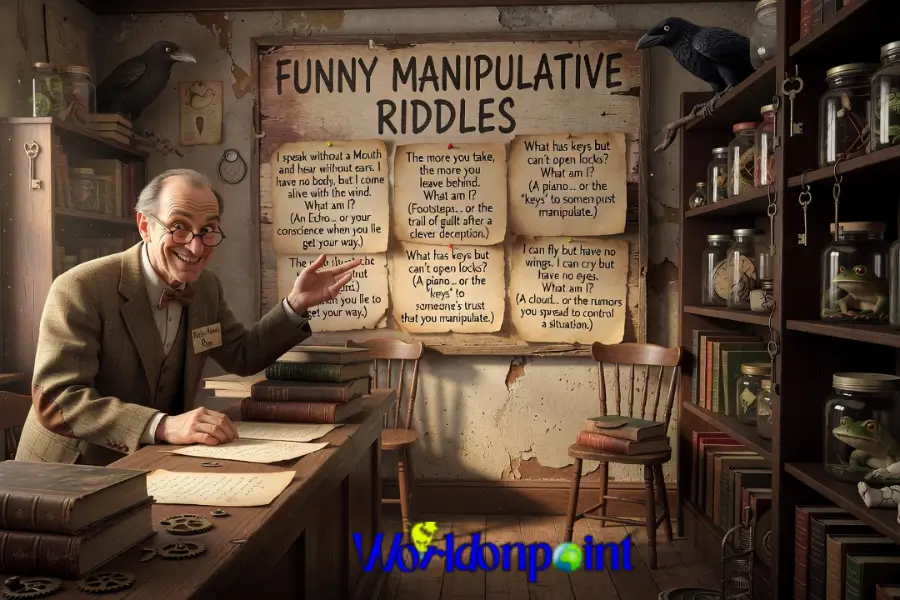
Funny Manipulative Riddles
Want to make your friends laugh while confusing them? These funny manipulative riddles mix silly ideas with clever answers.
1. Why did the computer go to the doctor?
Answer: Because it had a virus.
2. What kind of room has no doors or windows?
Answer: A mushroom.
3. Why can’t your nose be 12 inches long?
Answer: Because then it would be a foot.
4. What has four wheels and flies?
Answer: A garbage truck.
5. Why did the bicycle fall over?
Answer: Because it was two-tired.
6. What is orange and sounds like a parrot?
Answer: A carrot.
7. What do you call a sleeping bull?
Answer: A bulldozer.
8. Why did the math book look sad?
Answer: Because it had too many problems.
9. What has ears but cannot hear?
Answer: A cornfield.
10. Why did the cookie visit the hospital?
Answer: Because it felt crummy.
11. What kind of coat can only be put on when wet?
Answer: A coat of paint.
12. What has a bark but no bite?
Answer: A tree.
13. Why did the banana visit the doctor?
Answer: Because it was not peeling well.
14. What has a tongue but cannot talk?
Answer: A shoe.
15. Why did the scarecrow win an award?
Answer: Because he was outstanding in his field.
Also Read : 200+ Psychopath Riddles: Can You Solve These Dark Mysteries?
Hard Manipulative Riddles for Adults
Difficulty: Hard · 15 riddles
These challenging riddles require more than a quick guess. Use your logic and pay attention to every detail.
1. A woman has two children who were born on the same day, in the same year, but they are not twins. How?
Answer: They are part of a set of triplets or larger multiple births.
2. A man looks at a photograph and says, “Brothers and sisters, I have none, but this man’s father is my father’s son. ” Who is in the photograph?
Answer: His son.
3. You enter a dark room with a candle, a fireplace, and a lamp. You have one match. What do you light first?
Answer: The match.
4. A farmer has 17 sheep. All but nine run away. How many remain?
Answer: Nine.
5. A person walks into a restaurant and asks for a glass of water. The waiter suddenly shouts at him. The person says thank you and leaves. Why?
Answer: The person had hiccups, and the surprise stopped them.
6. What can be seen once in a year, twice in a week, and never in a day?
Answer: The letter E.
7. A man pushes his car to a hotel and suddenly knows he is bankrupt. Why?
Answer: He is playing Monopoly.
8. What is always coming but never arrives?
Answer: Tomorrow.
9. A person falls from a 20-foot ladder but is not hurt. How?
Answer: They fall from the bottom step.
10. What can you make that nobody, including yourself, can see?
Answer: Noise.
11. A father and son are in a car accident. The father dies, and the son is taken to the hospital. The surgeon says, “I cannot operate on him; he is my son.” How?
Answer: The surgeon is his mother.
12. A man is found hanging in a locked room. There is a puddle of water beneath him and no furniture nearby. How did he reach the ceiling?
Answer: He stood on a block of ice that melted.
13. What has an endless supply of letters but starts empty?
Answer: A mailbox.
14. You see a boat full of people. It has not sunk, but when you look again, you cannot see a single person. Why?
Answer: Everyone on the boat is married, so there is not a single person.
15. A clock takes five seconds to strike six. How long does it take to strike twelve at the same speed?
Answer: Eleven seconds, because there are eleven intervals between twelve strikes.
Psychological Manipulative Riddles
These psychological riddles play with your assumptions, attention, and perception. They make you question your first thought and look for another possible answer.
1. A man is standing in front of a mirror. He sees everything except his own face. Why?
Answer: He is looking at the back of his head in a second mirror.
2. You see a person crying, but they are not sad. Why?
Answer: They are crying because they are laughing.
3. A person says, “I always lie.” Is the statement true or false?
Answer: It creates a logical paradox. If the statement is true, the person is lying; if false, they do not always lie.
4. What can make you believe something without showing you any proof?
Answer: An assumption.
5. Two people see the same picture, but they describe it differently. How can both be right?
Answer: They notice different details.
6. Why might the easiest answer be the wrong one in a riddle?
Answer: Because the question may hide a misleading clue.
7. A person hears their name in an empty room. How is this possible?
Answer: They may be hearing a recording.
8. What becomes harder to find when you are desperately looking for it?
Answer: A simple answer that you are overthinking.
9. Two people look out of the same window. One sees danger, and the other sees an opportunity. Why?
Answer: They have different perspectives.
10. What can change your mind without changing the facts?
Answer: A new perspective.
11. A person knows the answer but still gives the wrong response. Why?
Answer: They may be joking or intentionally misleading someone.
12. What is something you can lose by trying too hard to control it?
Answer: Your patience.
13. Why can a familiar word suddenly look strange when you repeat it many times?
Answer: Repetition can make a familiar word temporarily seem unfamiliar.
14. What makes people see what they expect instead of what is actually there?
Answer: Their expectations and assumptions.
15. What is the biggest trick your mind can play on you?
Answer: Making you believe your first guess must be correct.
Short Manipulative Riddles
Looking for quick riddles to share in a text message? Try these short manipulative riddles. They are simple, surprising, and fun.
1. What has no life but can die?
Answer: A battery.
2. What has a ring but no finger?
Answer: A telephone.
3. What can you open but never close?
Answer: An egg.
4. What has a bed but never sleeps?
Answer: A river.
5. What has branches but no leaves?
Answer: A bank.
6. What goes through glass without breaking it?
Answer: Light.
7. What can speak every language but has no mouth?
Answer: An echo.
8. What has a spine but no bones?
Answer: A book.
9. What has a mouth but never eats?
Answer: A river.
10. What is full of holes but still holds water?
Answer: A sponge.
11. What has a heart but no blood?
Answer: An artichoke.
12. What can you hear but never touch?
Answer: A sound.
13. What has a cap but no head?
Answer: A bottle.
14. What has an end but no beginning?
Answer: A stick.
15. What gets smaller every time it takes a bath?
Answer: A bar of soap.
Read This : 100+Finger Riddles That Challenge Your Brain!
Manipulative Riddles to Trick Your Friends
Want to challenge your friends at a party or family gathering? Ask these questions and let everyone guess before revealing the answers.
1. If you have three oranges and take away two, how many do you have?
Answer: Two, because you took two.
2. A bus driver goes the wrong way down a one-way street. A police officer sees him but does nothing. Why?
Answer: The driver is walking, not driving.
3. What can you put between 7 and 8 to make a number greater than 7 but smaller than 8?
Answer: A decimal point: 7.8.
4. A man has ten fingers. How many fingers do ten men have?
Answer: 100 fingers.
5. If a rooster lays an egg on a sloping roof, which side gets the egg?
Answer: Neither. Roosters do not lay eggs.
6. How many animals did Moses take on his ark?
Answer: None. Noah built the ark.
7. What is heavier: one kilogram of feathers or one kilogram of iron?
Answer: Both weigh the same.
8. A girl falls off a ladder but does not get hurt. Why?
Answer: She falls from the bottom step.
9. What can you never eat for breakfast?
Answer: Lunch or dinner.
10. If yesterday was tomorrow, what day would today be?
Answer: The question needs a reference day to give a unique answer; it is a wording trap.
11. A man has a match, a candle, and a lantern. What does he light first?
Answer: The match.
12. What is at the end of a rainbow?
Answer: The letter W.
13. If you are in a race and pass the last person, what position are you in?
Answer: You cannot pass the last person in a normal race while remaining behind everyone else.
14. A plane is flying over the ocean. It loses one engine. What happens to the remaining engines?
Answer: They keep working if they are still functioning.
15. How can you make the number one disappear by adding something to it?
Answer: Add the letter G to make “gone” as a wordplay trick.
Manipulative Riddles Without Answers
Ready for a real challenge? These manipulative riddles come without answers. Share them with your friends and see who can solve them without asking for clues!
1. What can you see in the middle of March and April but never at the beginning or end?
2. A man enters a room with nothing in his hands but leaves with something. What did he take?
3. What has 13 hearts but no other organs?
4. What can be everywhere but cannot be seen?
5. If you remove the first letter of a word, it still sounds the same. What kind of word is it?
6. What has a thousand eyes but cannot see?
7. A person is born in one country, lives in another, and dies in a third. Where is home?
8. What can go from one person to another without moving?
9. What gets lost the moment you tell someone where it is?
10. What can be counted but never touched?
11. A man stands in the rain without an umbrella, but not a single hair on his head gets wet. Why?
12. What can be yours today and someone else’s tomorrow?
13. What has a beginning, a middle, and an end but no physical shape?
14. What can you give away and still keep?
15. What can be right in front of your eyes but remain unnoticed?
More Difficult Mind-Bending Manipulative Riddles
Difficulty: Hard · 15 riddles
These mind-bending puzzles require careful observation. Do not rush to answer because a small detail can change everything.
1. A man is looking at a woman. She is looking at a man. The man is married, but the woman is not. Are they looking at each other?
Answer: Yes. The woman could be looking at a married man.
2. There are three switches outside a closed room and one light bulb inside. You can enter the room only once. How can you find the correct switch?
Answer: Turn on the first switch for a few minutes, then turn it off. Turn on the second switch and enter. If the bulb is lit, it is the second switch. If it is off but warm, it is the first. If it is off and cold, it is the third.
3. A man has two coins that total 30 cents. One coin is not a nickel. What are the coins?
Answer: A quarter and a nickel. One coin is not a nickel; the other one is.
4. What number becomes smaller when you turn it upside down?
Answer: 9 becomes 6.
5. You have a basket with six eggs. Six people each take one egg, but one egg remains in the basket. How?
Answer: The last person takes the basket with the final egg still inside.
6. A person is found dead in a room surrounded by 53 bicycles. What happened?
Answer: The intended clue is a deck of 52 cards plus a joker, and the person was playing a card game. Without more clues, several answers are possible.
7. What is the only question that changes its answer every time you ask it?
Answer: What time is it?
8. A man travels forward without moving his feet. How?
Answer: He is sitting in a moving vehicle.
9. What can be divided among many people but never becomes smaller?
Answer: Knowledge.
10. A clock shows 3:15. What is the angle between its hour and minute hands?
Answer: 7.5 degrees.
11. What number has the same number of letters as its value?
Answer: Four.
12. A person has a birthday every year but only celebrates a birthday once every four years. How?
Answer: They were born on February 29.
13. You have two ropes. Each takes exactly one hour to burn, but they burn unevenly. How can you measure 45 minutes?
Answer: Light the first rope at both ends and the second at one end. When the first rope finishes after 30 minutes, light the other end of the second rope. It then burns out in 15 more minutes.
14. A man says he can predict the score of any football match before it starts. How?
Answer: He predicts that the score will be 0–0 before the match begins.
15. What can have a million answers but only one correct question?
Answer: A quiz.
Bonus: Extra Manipulative Riddles to Challenge Everyone
Difficulty: Mixed · 10 riddles
Here are ten more questions to complete your ultimate mind challenge.
1. What has 26 letters but only three syllables?
Answer: The alphabet.
2. A cowboy rides into town on Friday, stays for three days, and leaves on Friday. How?
Answer: His horse is named Friday.
3. What starts with P, ends with E, and has thousands of letters?
Answer: A post office.
4. How many times can you subtract 10 from 100?
Answer: Once. After that, you are subtracting 10 from 90.
5. What is always in front of you but cannot be seen?
Answer: The future.
6. What has no beginning, middle, or end?
Answer: A circle.
7. A girl has 20 dollars. She spends 10 dollars but still has 20 dollars. How?
Answer: She spends 10 dollars from someone else’s money.
8. What can be cracked, made, told, and played?
Answer: A joke.
9. What word has five letters but becomes shorter when you add two letters?
Answer: Short. Adding “er” makes it “shorter.”
10. What is something you cannot keep until you give it to someone?
Answer: Your word.
How to Solve Manipulative Riddles
Solving manipulative riddles is easier when you stop trusting your first guess. These puzzles often use simple words in unexpected ways.
Try these helpful tips:
1. Read Every Word Carefully
Do not rush through the question. A small word can change the entire meaning of a riddle.
2. Question Your First Assumption
Ask yourself whether the question actually says what you think it says. Sometimes your brain adds details that are not mentioned.
3. Look for Double Meanings
Some words have more than one meaning. For example, a bank can be a place for money or the side of a river.
4. Think Outside the Box
Do not limit your answers to common situations. Consider objects, words, numbers, and unusual possibilities.
5. Pay Attention to Small Details
A single clue may reveal the correct answer. Read the question again before making your final guess.
6. Do Not Overthink Everything
Some tricky riddles have very simple answers. Look for the easiest explanation that fits every clue.
Why Are Manipulative Riddles So Tricky?
Manipulative riddles challenge the way people understand questions. They often make you focus on one meaning while hiding another.
Here are some common techniques that make these riddles difficult.
- Misleading clues: They guide your attention toward the wrong answer.
- Wordplay: They use words with multiple meanings.
- False assumptions: They encourage you to believe something the question never actually says.
- Unexpected answers: They provide solutions that seem surprising at first.
- Logical twists: They require you to rethink the situation.
- Hidden details: They place important information inside ordinary sentences.
A good tricky riddle should still be fair. Every clue should support the answer, even if the solution is not obvious at first.
Frequently Asked Questions
What are manipulative riddles?
Manipulative riddles are tricky questions that use misleading clues, wordplay, and unexpected meanings to confuse your first guess. They challenge your logic and encourage you to think differently before choosing an answer.
What is the trickiest riddle ever?
There is no single officially recognized trickiest riddle. However, the classic question about passing the person in second place during a race is a popular example because many people quickly answer first place instead of second.
How do manipulative riddles trick your brain?
They use false assumptions, double meanings, and hidden clues. Your brain often chooses the most familiar interpretation first. The correct answer requires you to look at the question from another angle.
Are manipulative riddles good for the brain?
They provide an enjoyable way to practice logical reasoning, observation, and creative thinking. They also encourage people to question assumptions and explore different solutions.
What are some difficult manipulative riddles?
Difficult manipulative riddles often involve logic puzzles, mathematical tricks, hidden meanings, and unusual situations. The three-switch light bulb puzzle and the two-ropes time puzzle are popular examples.
Final Thoughts
Manipulative riddles are a fun way to challenge your thinking and surprise your friends. They teach you to look beyond the obvious answer and pay attention to small details.From easy questions to difficult psychological puzzles, every riddle offers a different challenge. Some will make you laugh, while others may leave you thinking for several minutes.
Try these riddles with your friends, family, and classmates. Keep track of your correct answers and see who can solve the most puzzles.Remember: Sometimes the answer is right in front of you. You just need to think differently to find it!
100+Military Riddles That Challenge Bravery, Logic and Honor!
100+Sphinx Riddles Challenge: Only the Wise Will Survive These Tests!