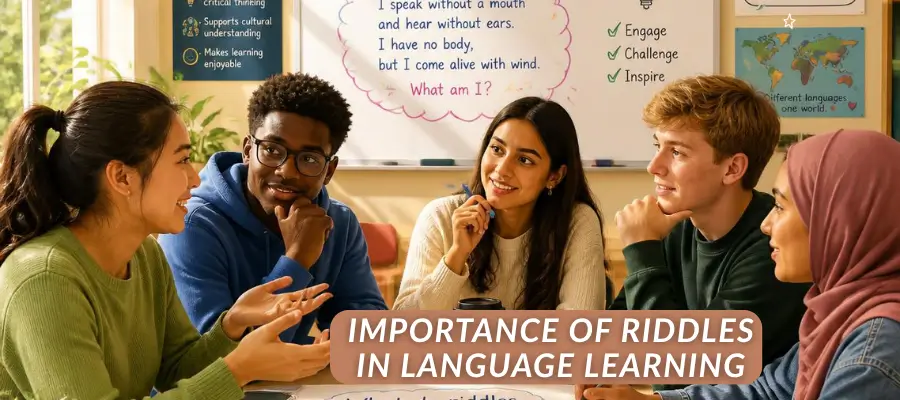
How to make riddles easy for students? A good riddle feels like a small game: a few seconds of confusion followed by that satisfying “oh, of course!” moment. For students, that moment does more than entertain. It sharpens vocabulary, trains observation, and builds problem-solving skills without ever feeling like a worksheet.
But not every riddle works for every student. A riddle that’s too clever or too wordy can leave a classroom staring blankly instead of smiling. If you’re a teacher, parent, or content creator, learning how to make riddles easy for students is the real skill, not just collecting riddles, but shaping them so students can actually solve them and feel proud doing it.
This guide walks through practical, easy-to-follow techniques for writing simple riddles for kids, along with original examples, a difficulty-by-age table, and a formula you can reuse anytime you need fresh classroom riddles.
Why Should Riddles Be Easy for Students?
Riddles for students work best when they sit right at the edge of a student’s ability challenging enough to make them think, but not so hard that they give up. When a riddle is too difficult, students disengage quickly. When it’s age-appropriate, it builds confidence instead of frustration.

Easy riddles with answers also give students a small, repeatable win. That win matters. A student who solves three riddles in a row is far more willing to try a fourth, harder one. This is why educational riddles work so well as a teaching tool; they turn thinking into a game students want to keep playing, not a task they’re forced to complete.
Simple riddles for kids also support language development. Students practice reading comprehension, context clues, and vocabulary every time they work through a clue. The easier the riddle is to understand, the more mental energy students can spend on actually solving it instead of decoding the sentence itself.
Also Read : Benefits of Riddles for Students: 10 Smart Reasons to Try Them
How to Make Riddles Easy for Students
Here are the core techniques for how to create easy riddles that students of any age can enjoy.
- Choose familiar subjects. Stick to everyday objects and ideas students already know well — school supplies, animals, food, colors, or common actions.
- Use simple vocabulary. Avoid advanced words, idioms, or terms students haven’t learned yet. Simple language keeps the focus on solving, not translating.
- Keep the clues short. One or two short sentences per clue is usually enough. Long clues bury the important detail.
- Give clear clues. Every clue should point somewhere specific. Vague description (“I am something you use”) doesn’t narrow anything down.
- Avoid confusing wordplay. Puns and double meanings are fun for older students, but they’re often the reason younger students get stuck. Save heavy wordplay for advanced riddles.
- Use one main answer. A riddle with two or three possible correct answers frustrates students because they can’t be sure they’re right, even when they are.
- Match the riddle to the student’s age. A riddle written for a five-year-old shouldn’t require the reasoning of a middle schooler, and vice versa.
- Add clues from easy to slightly harder. Structure clues so the first one is broad and the last one narrows things down. This mirrors how students naturally reason through a problem.
- Avoid unnecessary details. Every extra sentence is a chance for students to get distracted from the real clue.
- Test the riddle before using it. Read it aloud to one student or a small group first. If they solve it too fast, it might be too easy. If nobody solves it, simplify a clue.
Use Familiar Topics
The fastest way to write student-friendly riddles is to build them around things students see and use daily. Good beginner riddle topics include:
- School supplies (pencils, backpacks, books, erasers)
- Animals (cats, birds, fish, insects)
- Food (fruit, bread, milk, eggs)
- Colors and shapes
- Everyday objects (chairs, clocks, mirrors, umbrellas)
- Toys and games
Familiar topics work because students already have background knowledge to draw from. They’re not trying to imagine something abstract they’re picturing an object they’ve held or seen that same morning. This is also why riddles built around classroom items make excellent warm-up activities; the topic itself is already part of a student’s world.

Keep the Language Simple
Word choice makes a bigger difference than most people expect. Compare these two versions of the same riddle:
Difficult version: “I possess neither flesh nor bone, yet I am capable of movement across vast distances when propelled by unseen forces.”
Easier version: “I have no legs, but I can move fast when the wind pushes me. What am I?” (Answer: A kite, or a leaf)
The easier version uses shorter sentences, common words, and a direct question. Nothing about the puzzle itself changed; only the language did. When writing riddles for students, always ask: could a student two grades younger understand these words? If not, simplify.
Give Students Helpful Clues
A strong clue guides students toward the answer without spelling it out. The goal is a gentle nudge, not a giveaway.
For example, if the answer is “a calendar,” a helpful clue might be, “I have 365 pages, but you only read one each day.” This tells students something concrete (pages, a daily rhythm) without naming the object.
Weak clues tend to be too general (“I am useful”) or too specific (they basically state the answer). The sweet spot is a clue that narrows the possibilities to a small, related group of objects students should be able to make an educated guess, then confirm it with the next clue.
Match Riddles to Different Age Groups
Different age groups need different levels of vocabulary, clue complexity, and topic. Use this table as a quick reference when writing or choosing riddles for a specific grade.
| Age Group | Riddle Level | Best Topics | Example |
|---|---|---|---|
| 5–7 | Very easy, 1 clue | Animals, colors, toys | “I am red and round, and you can eat me. What am I?” (An apple) |
| 8–10 | Easy, 2 clues | School supplies, food, weather | “I have teeth but cannot bite. I help you look neat. What am I?” (A comb) |
| 11–13 | Moderate, 2–3 clues, light wordplay | Nature, numbers, simple logic | “The more you take from me, the bigger I get. What am I?” (A hole) |
| 14+ | Challenging, 3+ clues, wordplay allowed | Language, logic puzzles, abstract ideas | “I have keys but open no locks. What am I?” (A piano) |
This kind of grade-level matching is exactly why classroom riddles feel so different depending on who they’re written for a riddle that delights a first grader may bore a middle schooler, and a riddle built for teenagers may completely lose a younger child.
Easy Riddle Formula for Teachers
If you want a repeatable method for writing your own riddles, use this simple formula:
Topic + 2–3 clues + question + answer
- Pick a familiar object or idea (the topic).
- Write two or three short, true statements about it (the clues), ordered from general to specific.
- End with a simple question like “What am I?”
- Confirm there’s only one logical answer.
Example using the formula:
- Topic: Umbrella
- Clue 1: I open up when the sky gets grey.
- Clue 2: I keep you dry, but I fold up small.
- Question: What am I?
- Answer: An umbrella
This formula works for almost any topic and can be adjusted for difficulty simply by adding or removing clues.
Examples of Easy Riddles for Students
Here are ten original riddles for students, built using the formula above, with answers and short explanations.
- Riddle: I have pages, but I am not a book. I tell you the day, month, and year. What am I? Answer: A calendar Explanation: The clue about “pages” hints at something book-like, but the mention of day, month, and year narrows it to a calendar.
- Riddle: I have hands but cannot clap. I have a face but cannot smile. What am I? Answer: A clock Explanation: “Hands” and “face” describe clock parts in a playful way that students enjoy figuring out.
- Riddle: I am full of holes, but I still hold cheese. What am I? Answer: A sponge Explanation: This plays on the surprising idea that something full of holes can still be useful.
- Riddle: I get smaller every time I work. What am I? Answer: A pencil Explanation: A simple, familiar school-supply riddle that connects to something students use daily.
- Riddle: I have a bed but never sleep. I have a mouth but never eat. What am I? Answer: A river Explanation: Introduces nature vocabulary in a fun, non-literal way.
- Riddle: I can be cracked, told, or made but I am never broken like glass. What am I? Answer: A joke Explanation: A light wordplay riddle suited for slightly older students who enjoy double meanings.
- Riddle: The more you use me, the sharper I become. What am I? Answer: Your brain Explanation: A motivational riddle that ties nicely into classroom discussions about learning.
- Riddle: I am tall in the morning and short at noon. What am I? Answer: A shadow Explanation: Connects a science concept (light and shadows) to a fun mental picture.
- Riddle: I have a tail and a head, but no body. What am I? Answer: A coin Explanation: Introduces the idea of “heads and tails” in a way students can visualize.
- Riddle: I follow you all day, but I disappear at night. What am I? Answer: Your shadow Explanation: A simple, familiar concept students can picture from their own experience outside.
Common Mistakes When Creating Student Riddles
Even well-meaning riddles can fall flat. Watch for these common mistakes:
- Overly difficult vocabulary that forces students to stop and ask what a word means.
- Vague clues that could describe dozens of different objects.
- Multiple possible answers, which makes students unsure even when they’re correct.
- Excessive wordplay, especially for younger students who haven’t developed strong language skills yet.
- Clues that reveal nothing new, repeating the same idea in different words instead of adding information.
- Riddles that are too long, which cause students to lose track of the actual question.
Reviewing a riddle against this list before sharing it with students takes less than a minute and saves a lot of confused faces.
How Teachers Can Use Easy Riddles in Class
Simple riddles fit naturally into many parts of a school day:
- Morning warm-ups: Start class with one riddle to wake up students’ thinking.
- Brain breaks: Use a quick riddle between lessons to reset attention.
- Group activities: Split students into teams and let them solve riddles together.
- Vocabulary practice: Choose riddles that reinforce a specific word or concept from a lesson.
- Reading activities: Use riddles as short reading comprehension exercises.
- Team competitions: Turn a set of riddles into a friendly classroom contest.
- Exit tickets: End class with a riddle related to that day’s topic as a fun recap.
These small moments add up. A riddle a day keeps a classroom engaged and gives students something to look forward to.
How to Make an Easy Riddle More Challenging
Once students master the basics, you can gradually increase difficulty without confusing them:
- Add one more clue instead of rewriting the whole riddle.
- Introduce mild wordplay, like double meanings, once students are comfortable with straightforward riddles.
- Move from concrete objects to more abstract ideas, like emotions or time.
- Combine two simple riddles into a two-part riddle with a connected answer.
- Slightly reduce the specificity of a clue so students have to think a bit longer.
The key is gradual change. Jumping straight from a five-year-old’s riddle to a teenager’s riddle skips the steps that build real confidence.
Tips for Writing Better Riddles
Before sharing a riddle with students, run through this quick checklist:
- Is the vocabulary appropriate for the age group?
- Does each clue add new information?
- Is there only one clear, correct answer?
- Is the riddle short enough to read in one breath?
- Have I tested it on someone in the target age range?
- Does the topic come from something students already know?
Frequently Asked Questions
How do you make a simple riddle?
Pick a familiar topic, write two or three short true clues about it, then end with a simple question like “What am I?”
What makes a riddle easy for students?
Simple vocabulary, familiar topics, short clues, and one clear answer make a riddle easy to understand and solve.
How can teachers use riddles in the classroom?
Riddles work well as warm-ups, brain breaks, group activities, vocabulary practice, and exit tickets.
What are good topics for student riddles?
School supplies, animals, food, colors, and everyday objects make strong beginner riddle topics.
What age is best for riddles?
Riddles work for almost any age, but the vocabulary, clue count, and wordplay should match the student’s grade level.
How many clues should an easy riddle have?
One to three clues is usually enough for an easy riddle. More clues can be added as difficulty increases.
How do you write a riddle with an answer?
Start with the answer in mind, then write clues that describe it without stating it directly.
Can riddles help students learn?
Yes. Riddles build vocabulary, encourage careful reading, and strengthen problem-solving and observation skills.
Should riddles include wordplay?
Light wordplay works well for older students, but younger students usually do better with straightforward clues.
How do I know if a riddle is too hard?
If a small group of students in the target age range can’t solve it after a few tries, simplify a clue or shorten the riddle.
Final Thoughts
The best riddles for students share a few simple qualities: clear language, familiar topics, one solid answer, and just enough challenge to keep things interesting. Whether you’re a teacher planning a classroom warm-up, a parent looking for car-ride entertainment, or a content creator building a set of fun riddles for students, the same rules apply, keep it simple, keep it fair, and test it before you use it.
Once you understand the formula, writing your own creative riddles for students becomes easy. Try building a few using the topics and structure in this guide, and don’t be afraid to let students create their own riddles too. Some of the best classroom riddles come from the students themselves.
10 Surprising Benefits of Puzzles for Child Development
Why Are Riddles Used to Test the Intelligence of a Child? Benefits, Skills & Facts