Riddles have puzzled, entertained, and taught people for thousands of years. How to explore a world of riddles, but with so many riddles out there, finding the right one for your mood, age, or skill level can feel like searching for a needle in a haystack. That’s where categorized riddles come in.
When you explore a world of riddles categorized by type, difficulty, and topic, you skip the guesswork. Want something quick and silly for a road trip? Head to funny riddles. Need a serious challenge to test your logic? Jump into hard riddles or brain teasers. Teaching a classroom? Riddles for kids are ready and waiting.
How to explore a world of riddles?
This guide organizes the best riddles into clear, easy-to-browse categories. Along the way, you’ll find original sample riddles you can try right now, a breakdown of what each category offers, and answers to the most common questions people ask about riddles. Whether you’re a parent, teacher, trivia lover, or just someone who enjoys a good mental workout, there’s a category here for you.
Why Categorized Riddles Make Riddle-Solving Easier
Not every riddle fits every moment. A tricky riddle meant for adults might confuse a seven-year-old, while an easy riddle might bore a puzzle expert. Sorting riddles into categories solves this problem by matching the challenge to the solver.
Categorized riddles help you:
- Find riddles that match your age group or skill level
- Pick a topic you actually enjoy, like animals, food, or nature
- Choose based on purpose classroom learning, party games, or quiet brain training
- Avoid scrolling through hundreds of random riddles to find one good one
Think of riddle categories like sections in a library. You wouldn’t search the whole building for a cookbook; you’d go straight to the cooking section. Riddle categories work the same way.
Easy Riddles
Easy riddles are simple, short, and quick to solve. They usually rely on everyday objects or common sense rather than tricky wordplay. This category is perfect for beginners, young children, or anyone who wants a fast mental warm-up without much frustration.
Best for: young kids, riddle beginners, casual fun
Riddle: I have hands but cannot clap. What am I?
Answer: A clock.
Explanation: Clocks have “hands” that point to numbers, but they’re not the kind of hands that can clap together. The clue plays on the double meaning of the word “hands.”
Hard Riddles
Hard riddles demand patience and careful thinking. They often hide the answer behind misleading details or require you to look at a situation from an unusual angle. These are ideal for experienced riddle solvers who enjoy a real mental challenge.
Best for: advanced solvers, puzzle enthusiasts, competitive riddle nights
Riddle: The more you remove from me, the bigger I become. What am I?
Answer: A hole.
Explanation: This riddle works because it breaks the normal rule that removing something makes it smaller. Digging out more material actually makes a hole larger, not smaller.
Funny Riddles
Funny riddles are built around puns, silly logic, and unexpected punchlines. They’re less about deep thinking and more about getting a laugh. These work great at parties, family dinners, or classrooms that need a lighter moment.
Best for: parties, family gatherings, breaking the ice
Riddle: Why did the calendar feel nervous?
Answer: Because its days were numbered.
Explanation: This is a play on words. “Days are numbered” usually means something bad is about to happen, but calendars literally have numbered days that’s the joke.
Tricky Riddles
Tricky riddles are designed to lead your brain down the wrong path on purpose. The wording sounds like it means one thing, but the real answer is something else entirely. These riddles reward readers who pay close attention to every word.
Best for: readers who enjoy wordplay and misdirection
Riddle: A man says every word he speaks is a lie. Is he telling the truth?
Answer: It’s a paradox; the statement can’t be fully true or false.
Explanation: If his statement is true, then he’s lying, which means the statement is false. If it’s false, he’s not always lying, which means it could be true. This kind of riddle isn’t meant to have a clean answer it’s meant to make you think about logic itself.
Logic Riddles
Logic riddles ask you to reason step by step instead of relying on wordplay. They often involve sequences, comparisons, or “if this, then that” thinking. These are some of the most educational riddles because they mirror real problem-solving skills.
Best for: students, logic-game fans, brain-training routines
Riddle: Three boxes are labeled “Apples,” “Oranges,” and “Mixed,” but every label is wrong. You may pick one fruit from one box to figure out what’s really inside all three. Which box do you pick from?
Answer: Pick from the box labeled “Mixed.”
Explanation: Since every label is wrong, the “Mixed” box must contain only apples or only oranges. Whichever fruit you pull out tells you that box’s true label and from there, you can figure out the other two boxes using the process of elimination.
How Riddles Help Your Brain
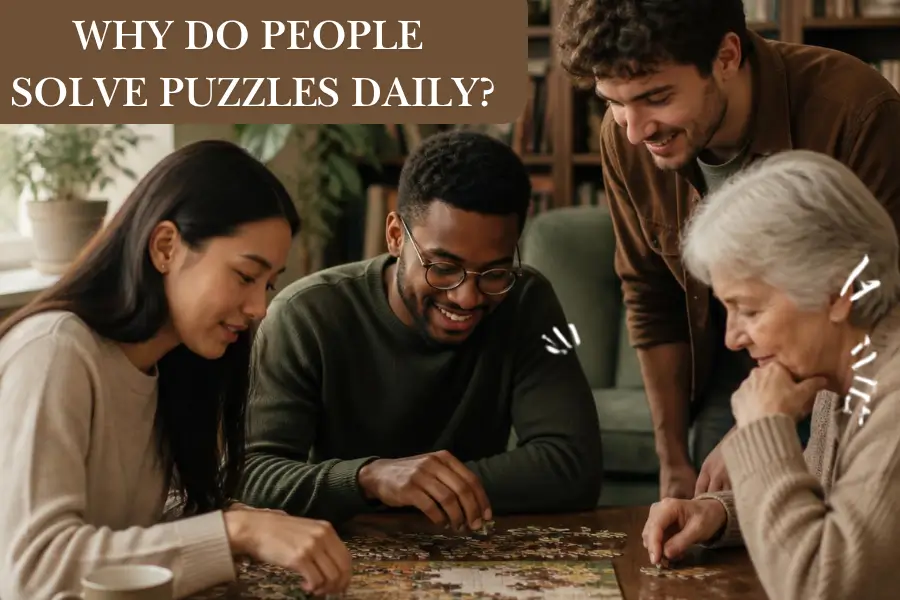
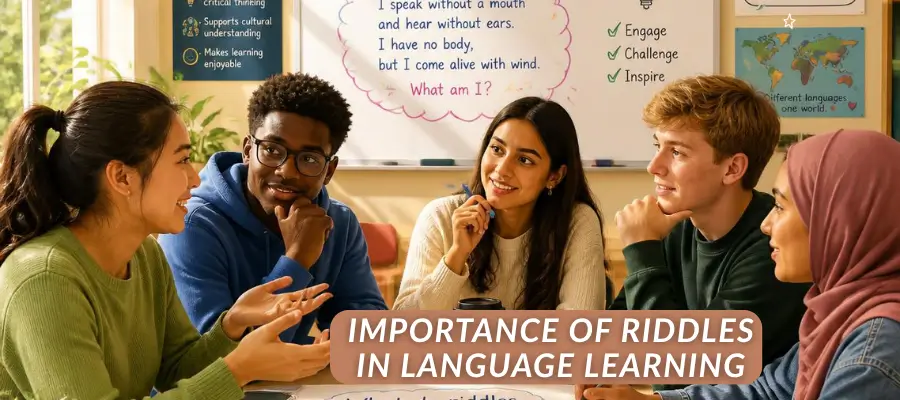
Solving riddles is a fun way to practice several mental skills at once. While riddles aren’t a guaranteed cure-all for brain health, many educators and puzzle experts point to the following benefits:
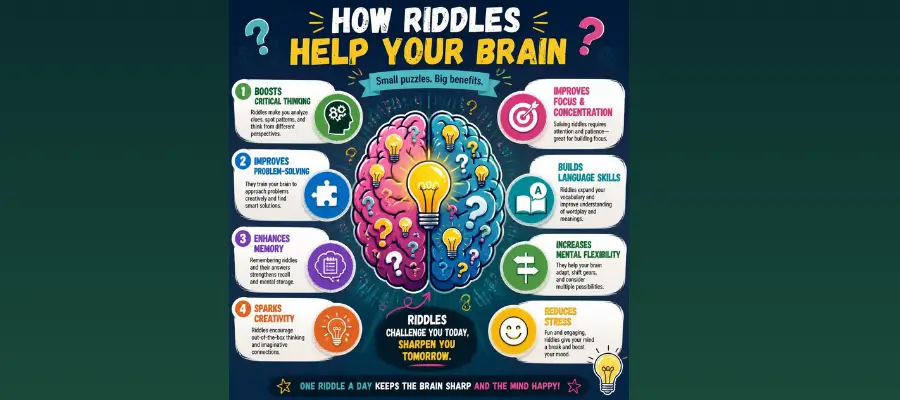
- Critical thinking — Riddles ask you to question assumptions and consider more than one possible answer.
- Vocabulary building — Word riddles and puns introduce new words and double meanings.
- Reasoning skills — Logic riddles and math riddles train step-by-step problem-solving.
- Observation — Tricky riddles reward readers who catch small details in the wording.
- Creativity — Lateral thinking and mystery riddles encourage looking at problems from new angles.
Because riddles are engaging rather than tedious, they make a natural addition to classroom lessons, family game nights, or a few minutes of daily brain training.
Riddles for Kids
Riddles for kids use familiar language, short sentences, and topics children already understand, like animals, toys, and school. They’re a great way to build vocabulary and encourage curiosity without overwhelming young minds.
Best for: children ages 5–12, classrooms, family game night
Riddle: I have a face but no eyes, hands but no fingers. What am I?
Answer: A clock.
Explanation: Kids learn that objects can have “face” and “hands” without actually being alive — a fun way to introduce them to figurative language.
Riddles for Adults
Riddles for adults often involve more complex vocabulary, layered clues, or mature humor. They’re built for readers who enjoy a slower, more thoughtful puzzle-solving experience.
Best for: grown-up game nights, trivia events, mental exercise
Riddle: I am taken from a mine and shut in a wooden case, from which I am never released, and yet I am used by almost everyone. What am I?
Answer: Pencil lead (graphite).
Explanation: Graphite is mined, then sealed inside a wooden pencil. It never physically leaves the pencil case even though people use it constantly by writing with it.
Animal Riddles
Animal riddles describe creatures through their behavior, appearance, or habitat without naming them directly. They’re popular in classrooms and nature-themed activities because they combine fun with a bit of biology.
Best for: kids, nature lovers, classroom science tie-ins
Riddle: I wear my house on my back and leave a silver trail wherever I go. What am I?
Answer: A snail.
Explanation: The “house” refers to a snail’s shell, and the “silver trail” is the mucus snails leave behind as they move.
Food Riddles
Food riddles turn everyday meals and snacks into playful puzzles. They describe an item’s shape, taste, or how it’s made, giving readers a tasty twist on classic riddle formats.
Best for: cooking clubs, kids’ lunchboxes, party games
Riddle: I start as a seed, turn into a vine, and end up mashed on your holiday table. What am I?
Answer: A potato.
Explanation: The riddle traces a potato’s life cycle planted, grown, harvested, and often served mashed during holiday meals.
Nature Riddles
Nature riddles focus on the outdoors, weather, plants, seasons, and landscapes. They encourage readers to notice details about the natural world they might normally overlook.
Best for: outdoor enthusiasts, science classrooms, camping trips
Riddle: I fall but never get hurt; I melt but never cry. What am I?
Answer: Snow.
Explanation: Snow “falls” from the sky and later “melts” as temperatures rise, but neither action causes pain or emotion the riddle personifies snow to create a playful contradiction.
Math Riddles
Math riddles combine numbers, patterns, and logic. They’re some of the most educational riddles because they sharpen calculation skills while still feeling like a game rather than homework.
Best for: students, math teachers, number lovers
Riddle: I am a two-digit number. My tens digit is three more than my ones digit, and both digits add up to 9. What number am I?
Answer: 63.
Explanation: If the ones digit is x, the tens digit is x+3. Together they equal 9, so x+3+x=9, which means x=3. That makes the ones digit 3 and the tens digit 6, giving the number 63.
Word Riddles
Word riddles rely on spelling, letters, and language tricks rather than objects or math. They’re perfect for readers who love vocabulary games and wordplay.
Best for: wordplay fans, English classes, crossword lovers
Riddle: Add a letter to the front of “each” to make a word meaning “to teach.” What word is it?
Answer: Teach (T + each).
Explanation: This riddle plays with how small letter changes create entirely new meanings — a classic technique in word riddles.
What Am I? Riddles
“What am I?” riddles describe an object, animal, or idea through clues, letting the reader piece together the answer using its qualities alone. This format is one of the most popular and flexible in the entire riddle world.
Best for: all ages, classroom warm-ups, quick brain breaks
Riddle: I have keys but no locks, space but no room. What am I?
Answer: A keyboard.
Explanation: “Keys” refers to keyboard keys, and “space” refers to the spacebar both familiar features described in an unfamiliar way.
School Riddles
School riddles focus on classroom life books, subjects, teachers, and learning tools. They’re a fun way for teachers to open a lesson or reward students with a quick brain break.
Best for: teachers, students, classroom games
Riddle: I have many pages but I’m not a book. I’m carried to school but never read out loud. What am I?
Answer: A notebook.
Explanation: Unlike a book, a notebook’s pages are meant to be written in, not read aloud, which separates it from the more obvious answer.
Holiday and Seasonal Riddles
Holiday and seasonal riddles connect to specific times of year, like winter break, summer vacation, or harvest season. They’re great additions to parties, classroom celebrations, or family traditions.
Best for: holiday parties, seasonal classroom activities, family traditions
Riddle: I appear once a year, wear an orange coat, and glow when a candle sits inside me. What am I?
Answer: A jack-o’-lantern.
Explanation: The “orange coat” refers to a pumpkin’s skin, and the glowing candle points directly to a carved Halloween pumpkin.
Short Riddles
Short riddles get straight to the point. With just one or two lines, they’re easy to remember, share, and solve on the go, making them ideal for quick entertainment.
Best for: social media, text messages, quick games
Riddle: What has a neck but no head?
Answer: A bottle.
Explanation: A bottle’s narrow top is commonly called its “neck,” even though it has no head to go with it.
Brain Teasers
Brain teasers stretch beyond traditional riddles into visual puzzles, number patterns, and situational challenges. They’re a broader category that overlaps with logic riddles but often includes non-verbal or multi-step problems.
Best for: puzzle lovers, brain-training apps, competitive thinkers
Riddle: A farmer has 17 sheep. All but 9 run away. How many sheep does the farmer have left?
Answer: 9 sheep.
Explanation: The phrase “all but 9” means 9 sheep remain. The riddle tricks readers into doing subtraction (17 minus 9) instead of reading the sentence carefully.
Difficult Mystery Riddles
Difficult mystery riddles combine storytelling with logic, often presenting a strange scenario that needs to be explained through careful questioning or deduction. These are closely related to lateral thinking puzzles and are best solved with patience.
Best for: experienced solvers, mystery fans, group puzzle nights
Riddle: A woman is found alone in a locked cabin with no windows. The only things inside are a puddle of water and a rope hanging from the ceiling. How did she die?
Answer: She stood on a block of ice, tied the rope around her neck, and the ice melted, leaving only the puddle.
Explanation: This riddle requires readers to think beyond the visible clues. The “puddle” is the missing piece of evidence of something that existed but disappeared, which is the hallmark of a good mystery riddle.

Riddle Categories at a Glance
| Category | Difficulty | Best For |
|---|---|---|
| Easy Riddles | Beginner | Kids, casual fun |
| Hard Riddles | Advanced | Experienced solvers |
| Funny Riddles | Beginner | Parties, family time |
| Tricky Riddles | Intermediate | Wordplay lovers |
| Logic Riddles | Intermediate–Advanced | Students, reasoning fans |
| Riddles for Kids | Beginner | Ages 5–12 |
| Riddles for Adults | Intermediate | Game nights, trivia |
| Animal Riddles | Beginner | Nature lovers, classrooms |
| Food Riddles | Beginner | Family fun, lunchboxes |
| Nature Riddles | Beginner–Intermediate | Outdoor fans |
| Math Riddles | Intermediate | Students, number lovers |
| Word Riddles | Intermediate | Vocabulary fans |
| What Am I? Riddles | Beginner–Intermediate | Everyone |
| School Riddles | Beginner | Classrooms |
| Holiday Riddles | Beginner | Seasonal parties |
| Short Riddles | Beginner | Quick games, social media |
| Brain Teasers | Intermediate–Advanced | Puzzle lovers |
| Mystery Riddles | Advanced | Group puzzle nights |
Frequently Asked Questions
What are categorized riddles?
Categorized riddles are riddles sorted into groups based on traits like difficulty, topic, age group, or purpose. Instead of browsing random riddles, readers can jump straight to a category like funny riddles or math riddles that matches what they’re in the mood for.
What are the most popular types of riddles?
Some of the most popular riddle types include “What am I?” riddles, funny riddles, logic riddles, and short riddles. These formats are widely shared because they’re easy to understand, quick to solve, and fun to pass along to friends and family.
What are good riddles for kids?
Good riddles for kids are short, use simple vocabulary, and focus on familiar topics like animals, food, or school. Easy riddles and animal riddles are usually the best starting point for young solvers.
What are the hardest riddles?
The hardest riddles are usually mystery riddles, advanced logic riddles, and tricky riddles that use misdirection. These often require multiple steps of reasoning or a shift in perspective to solve.
Are riddles good for your brain?
Riddles can be a fun way to practice thinking skills like reasoning, vocabulary, and observation. While they aren’t a guaranteed way to boost intelligence, regularly solving riddles is a low-pressure way to keep your mind active and engaged.
What is the difference between a riddle and a brain teaser?
A riddle is usually a short question or statement with a clever, often wordplay-based answer. “Brain teaser” is a broader term that can include riddles but also covers visual puzzles, math problems, and logic challenges that don’t rely on wordplay at all.
Where can I find fun riddles?
Fun riddles can be found in riddle books, puzzle apps, classroom worksheets, and organized riddle collections like this one, where riddles are grouped by category so you can quickly find the type you’re looking for.
How can I choose the right riddle category?
Start by thinking about your audience and goal. If you’re entertaining kids, choose easy or animal riddles. If you want a serious challenge, try hard riddles or mystery riddles. Matching the category to the moment makes riddle-solving more enjoyable for everyone involved.
Final Thoughts
How to explore a world of riddles? Riddles have stuck around for thousands of years because they turn thinking into a game. When you explore a world of riddles categorized by type and difficulty, you make it easy to find exactly the kind of challenge you’re looking for, whether that’s a quick laugh, a serious brain workout, or a fun activity for kids.
From easy riddles and funny riddles to hard riddles and difficult mystery riddles, every category offers something different. The best part is that there’s no wrong place to start.